Hankuk Carbon LNG Insulation Business vs GTT: Inventory Risk
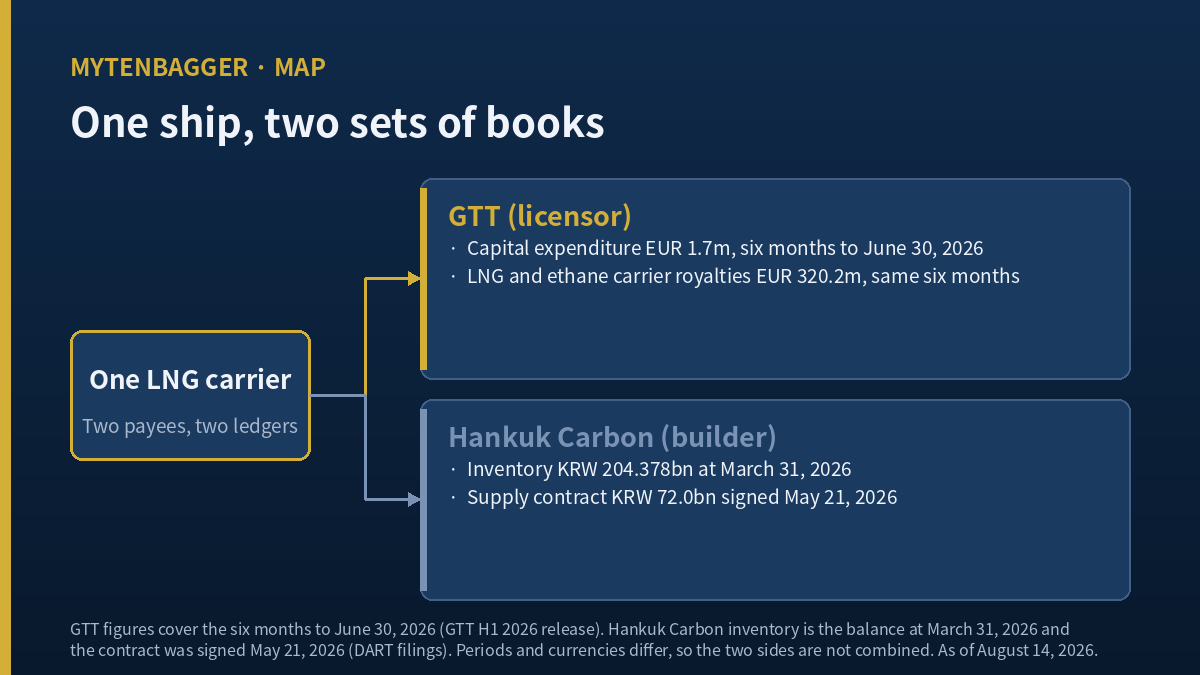
One of these two companies spent 1.7 million euros on capital expenditure in the six months to June 30, 2026. The other was sitting on 204.378 billion won of inventory on March 31, 2026. Both of them get paid for the same LNG carrier, and I spent the morning of August 14, 2026 (Fri) refusing to divide one of those numbers by the other. That refusal is most of what I have to say about Hankuk Carbon stock.
What follows is my own reading, in the order I actually did it, which turned out to be backwards.
Contents
Four numbers I did not put on the same scale
Every summary I write usually converts things into one unit so they can be compared. This table leaves all four figures in the currency and the period they were reported in, and the last column says what stops each one lining up with the row above it.
| Figure | Whose books | As of | What stops it lining up with the row above |
|---|---|---|---|
| 1.7 million euros of capital expenditure | GTT | Six months to June 30, 2026 | A half year of spending, so it is a flow |
| 204.378 billion won of inventory | Hankuk Carbon | March 31, 2026 | A closing balance on one date, and not a period of spending |
| 320.2 million euros of LNG and ethane carrier royalties | GTT | Six months to June 30, 2026 | Booked as vessels progress through construction |
| 72.0 billion won supply contract | Hankuk Carbon | Signed May 21, 2026 | A contract value, and no part of it is revenue yet |
Won figures from the company’s consolidated filings with Korea’s electronic disclosure system and from the May 21, 2026 disclosure summary. Euro figures from GTT’s own half year release of July 28, 2026. This table carries no conversions at all. Where dollar figures appear later in the piece they use 1,419.4 won per dollar, the Seoul close of August 13, 2026 (Thu), and they are approximate. Korean won is the reference currency for the Korean company throughout, and euros stay in euros.
What Hankuk Carbon stock is really being paid for
Hankuk Carbon Co., Ltd. trades on the KOSPI under 017960. The KOSPI is Korea’s main board, the largest of the country’s three equity markets, and it is a different venue from the KOSDAQ, where most small technology names list. Board is not what governs my treatment here, though. Size is: the rule I use puts anything outside Korea’s largest hundred companies on watch only, and this company is far outside that line. At the August 13, 2026 (Thu) close of 24,300 won, roughly 17.12 dollars, the 51,675,565 shares outstanding come to about 1,255.72 billion won of value, near 884.7 million dollars. Both of those are my own calculation from the share count and the closing price.
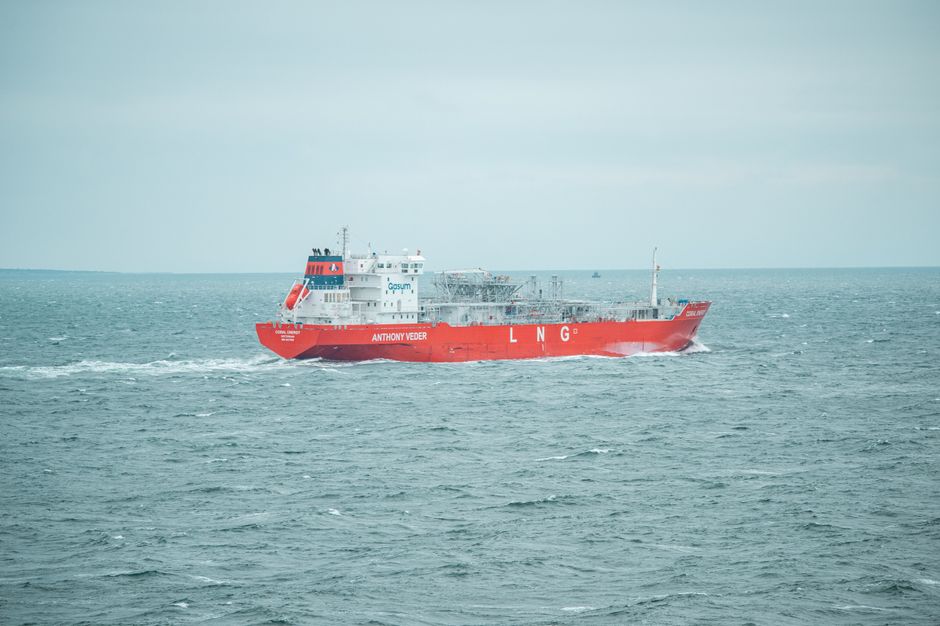
The company makes cryogenic insulation panels. When a shipyard builds an LNG carrier, the cargo has to sit at about minus 163 degrees Celsius, and the tank wall that keeps it there is a layered membrane system. Hankuk Carbon supplies the reinforced polyurethane foam panels and the Triplex barrier layers that go into that wall. It also makes carbon fiber prepreg, and heat resistant parts for Korean defense programs that Korean coverage in June 2026 described as a growing order line.
Here is the part I had never looked at properly until I sat down with the filings on August 13, 2026 (Thu). The company does not own the design of the wall it fills. The membrane specification is licensed, and the licensor is a French engineering firm, Gaztransport et Technigaz, listed in Paris as GTT. In GTT’s own words from its half year report, it “offers engineering services, technical assistance and patent licences for the construction of LNG tanks installed mainly on LNG carriers.” The yards and the panel makers build. GTT draws and collects.
The specification behind Hankuk Carbon stock was drawn in France
I want to be careful about what I am claiming. I am not saying GTT is a better company. I am saying the two of them occupy different positions in the same transaction, and that the position, and not the management, is what the margin difference mostly measures.
What each side actually reported
GTT’s 2025 financial year, published on February 19, 2026: revenue of 803.0 million euros, up 25 percent; EBITDA of 541.8 million euros for a margin of 67.5 percent; operating income of 521.3 million euros for a margin of 64.9 percent; net income of 413.6 million euros. GTT states its own net margin for that year as 51.5 percent, against 54.2 percent in 2024. The dividend was 8.94 euros a share.
Hankuk Carbon’s 2025 financial year, from the consolidated statements filed with Korea’s disclosure system in March 2026: revenue of 908.81 billion won, about 640.3 million dollars; operating profit of 130.95 billion won, about 92.3 million dollars, which is an operating margin of 14.4090 percent by my calculation; net income of 101.743 billion won, about 71.7 million dollars, a net margin of 11.1952 percent by my calculation.
So the licensor kept a bit over half of each euro it billed, and the panel maker kept about eleven won in every hundred. I have seen that gap described as a moat, and I think that word does more harm than good here. A moat implies something a competitor could in principle cross. What separates these two is closer to a job description.
The comparison I chose not to build
I could have made a table of multiples and margins with the two companies side by side. I did not, and I want that on the record as a decision, because silence would read as an oversight. GTT reports in euros, and its business carries almost no cost of goods. Hankuk Carbon reports in won, with a working capital cycle measured in months. Both close their books in December, so the years do line up; almost nothing else about the two income statements does. A tidy two column table would have implied the two rows were commensurable. They are not, and the whole point of this piece is that they sit at different stations of the same job.
Hankuk Carbon stock sits on the side that buys the panels first
This is the sentence I keep coming back to. To earn its royalty, GTT spent 1.7 million euros of capital expenditure in the first half of 2026, down 93.3 percent on the year before. Against half year revenue of 387.3 million euros, that is 0.4389 percent by my calculation. GTT’s engineers draw, the yard builds, and GTT books revenue as construction milestones pass.
To earn its share of the same ship, Hankuk Carbon has to buy chemical feedstock, make panels, and hold them. On March 31, 2026 that holding was 204.378 billion won, roughly 144.0 million dollars, or 16.2758 percent of what the market put on the whole company at the August 13, 2026 (Thu) close, on my own arithmetic. That ratio crosses two dates four and a half months apart, and I am using it for scale only. That inventory is not a sign of anything going wrong. It is what the job is.
How long the panels sit
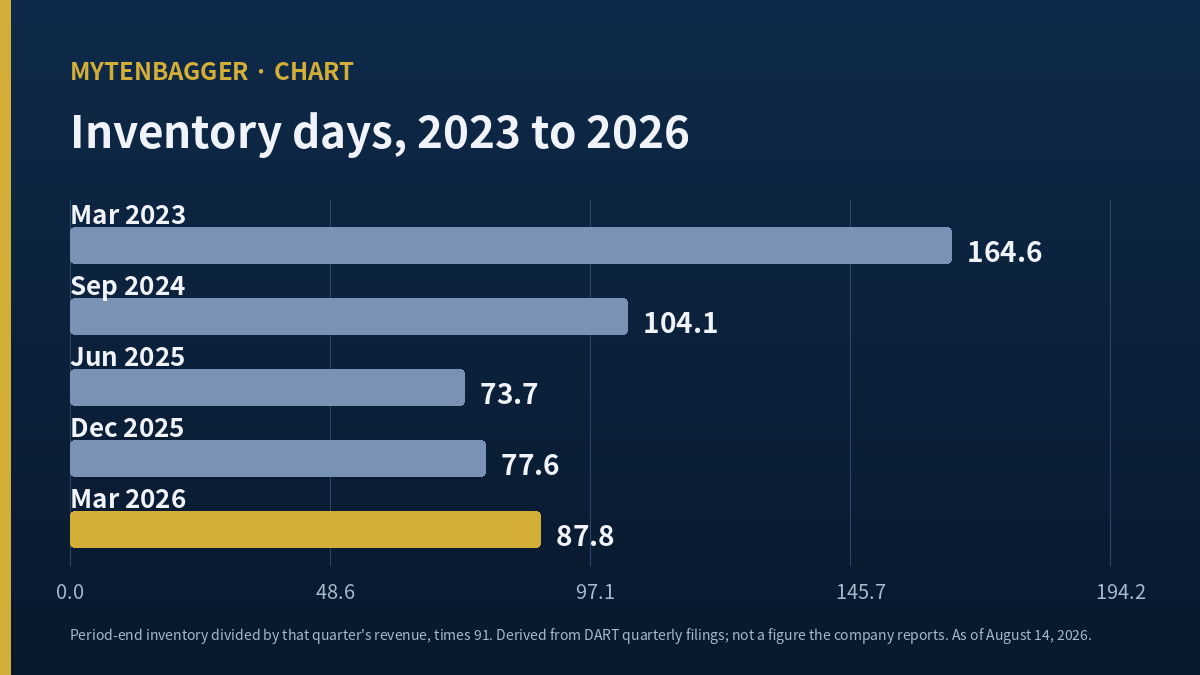
The data service I use publishes an inventory days figure, and it defines it as period end inventory divided by that single quarter’s revenue, times 91. I checked the arithmetic on the latest reading and it reproduces, so I am comfortable quoting the series.
| Quarter end | Inventory (billion won) | Days of that quarter’s revenue |
|---|---|---|
| March 31, 2023 | 186.248 | 164.6 |
| September 30, 2024 | 195.244 | 104.1 |
| June 30, 2025 | 187.215 | 73.7 |
| December 31, 2025 | 197.614 | 77.6 |
| March 31, 2026 | 204.378 | 87.8 |
Inventory balances from the consolidated quarterly filings. The days column is something I computed from the two figures beside it. The filings do not report it. Rows selected to show the range, and the full series runs from March 2022.
The long move from 164.6 days down to 73.7 is the cycle turning in the company’s favor. The move back up to 87.8 in the first quarter of 2026 is the thing I actually want explained, and the explanation is not in the numbers I have. It could be panels being staged for the deliveries the sell side expects in the second half. It could be something slower. I cannot tell, and I am not going to guess in a direction that flatters my own reading.
What GTT’s filings show about the other end of the same ship
GTT’s half year release of July 28, 2026 is worth reading even by someone who will never hold a share of it, because it is the clearest public description of the demand both companies are exposed to.
Revenue of 387.3 million euros, down 0.4 percent. EBITDA of 263.6 million euros, a margin of 68.1 percent. Operating income of 248.2 million euros, a margin of 64.1 percent against 66.1 percent a year earlier. Net income of 210.4 million euros, up 16.9 percent, which is 54.3248 percent of revenue on my own arithmetic. Royalties from LNG and ethane carriers came to 320.2 million euros, down 7.4 percent, and GTT puts that down to fewer LNG carriers under construction during the period.
The order book at June 30, 2026 stood at 1,853 million euros, split by GTT into 300 million for the second half of 2026, 655 million for 2027, 603 million for 2028 and 295 million for 2029 and beyond. Those four add to 1,853, which I checked. The unit count was 306 in the core business, being 272 LNG carriers, 22 ethane carriers, 3 floating storage and regasification units, 4 floating liquefaction units and 5 onshore tanks, plus 43 vessels using LNG as fuel. Those five core lines add to 306, which I also checked. First half order intake was 65. GTT confirmed full year guidance of 740 to 780 million euros of revenue and 490 to 530 million euros of EBITDA.
Two things in there matter for the Korean side. The first is that GTT’s own royalty line fell in the first half, which tells me the count of ships actively under construction dipped, and that dip lands on panel makers too. The second is that the order book is laid out year by year to 2029 and beyond, which is a longer visible runway than anything Hankuk Carbon publishes about itself in English.
Hankuk Carbon stock and the quarter Korean coverage called its best since 2020
The first quarter of 2026, filed with Korea’s disclosure system on May 14, 2026, reads as follows on a consolidated basis. Revenue of 211.821 billion won, about 149.2 million dollars, which is 5.6733 percent below the same quarter of 2025 on my calculation. Operating profit of 41.066 billion won, about 28.9 million dollars, which is 32.0153 percent above the year before. That is an operating margin of 19.3871 percent by my arithmetic, against 13.8524 percent a year earlier.
Korean press reporting on a DS Investment Securities note dated May 19, 2026 described that margin as the company’s best since 2020. I have not opened that report myself and am relaying the press account.
The four full years behind it, from the same filing series, in billions of won:
| Financial year | Revenue | Operating profit | Operating margin (my calculation) | Net income |
|---|---|---|---|---|
| 2022 | 369.270 | 24.798 | 6.7154% | 20.260 |
| 2023 | 594.417 | 16.465 | 2.7699% | negative 13.450 |
| 2024 | 741.740 | 45.446 | 6.1269% | 20.321 |
| 2025 | 908.810 | 130.950 | 14.4090% | 101.743 |
Consolidated, from the annual filings of March 2023, March 2024, March 2025 and March 2026. Revenue in 2023 grew 61 percent while operating profit fell, and 2023 was the loss year. Compound revenue growth over the three years from 2022 to 2025 works out at 35.0132 percent a year on my own calculation, which reproduces the figure the data service publishes.
The line under operating profit that I could not read
Net income for the first quarter of 2026 was 15.523 billion won, about 10.9 million dollars. That is 28.9728 percent lower than the 21.855 billion won of a year earlier, on my calculation, in a quarter when operating profit rose by nearly a third.
I went looking for where it went, and I did not find it cleanly. The field my data service maps to interest expense in the consolidated filing reads 52.603 billion won for the first quarter of 2026, against 8.121 billion won in the same quarter of 2025, and against 45.255 billion won for the whole of the 2025 financial year. A single quarter reading larger than the entire preceding year tells me that line is not plain interest, and most likely gathers other financial costs into one caption. I have not opened the notes that break it down.
So what I have is a gap, and I am recording it as one. Operating profit of 41.066 billion won less the 52.603 billion won would leave a loss, and the company reported a profit, so there is offsetting income I have not identified. Until I read the notes I will not name a cause, and I will not use that line as evidence for anything. It is also why I am ignoring the interest coverage figure of 0.78 that the same service publishes. I reproduced it as 41.066 divided by 52.603 for the single quarter, so I know exactly what it is made of, and what it is made of is a caption I cannot yet read.
Hankuk Carbon stock against a KOSPI rally it never joined
Over the 241 trading days from August 14, 2025 to August 11, 2026, the shares returned negative 20.29 percent. The KOSPI returned positive 96.72 percent over the identical window. That window closes two sessions before the price I am quoting, because the comparison screen and the price screen update on different stamps, and I would rather say so than quietly stretch one to meet the other. The shipbuilding sector index I use returned negative 6.60 percent over the same window, equal weighted and with this company left out of the index it is being measured against.
That is 117.01 percentage points behind the market and 13.69 points behind its own sector. The shortfall against the index splits as 103.32 points of sector effect and 13.69 points of company effect, which add back to 117.01, so 88.3 percent of it came from being in this sector at all. Ranked against the 29 constituents including itself, it came 18th, against a median of negative 16.51 percent. Beta against the market was 0.437 with a correlation of 0.339, which is another way of saying this thing has barely been moving with the index that nearly doubled.
On closing prices the peak was 52,200 won on April 22, 2026 and the low after that peak was 19,300 won on July 29, 2026, a maximum drawdown of 63.03 percent. From that peak, the August 13 close of 24,300 won is 53.4483 percent lower, and from that trough it is 25.9067 percent higher, both my own arithmetic. On intraday extremes over 250 sessions, the range was 54,100 won high and 18,530 won low, so the close sits at 44.9169 percent of the high, which is 55.0831 percent below it, and 31.1387 percent above the low. Those same three came out at 45.0, negative 55.0 and 31.4 on my data screen, because the screen runs them against 24,350 won, its own reference price from an earlier session. I recalculated all three against the close I am quoting so that everything in this piece stands on one price.
Three houses wrote a level down, a fourth did not, and all four predate the July low
Korean brokerages have been consistently positive, and the dates matter more than the levels.
| Date written | House | Level written down | Days before my reference close |
|---|---|---|---|
| May 19, 2026 | DS Investment Securities | 59,000 won, about 41.57 dollars | 86 |
| May 26, 2026 | IBK Investment Securities | 51,000 won, about 35.93 dollars | 79 |
| June 2, 2026 | Korea Investment and Securities | 53,000 won, about 37.34 dollars | 72 |
| June 4, 2026 | Daol Investment and Securities | Positive view, and no level in the summary I saw | 70 |
All four reached me through Korean press summaries and aggregation screens. I did not open a single original report, and I am flagging it here so the sourcing does not drift. Day counts are mine, measured to August 13, 2026.
Every one of those was written before the shares fell to 19,300 won on July 29, 2026 (Wed). The spread between the highest and lowest level is a factor of 1.1569 by my arithmetic, which is unusually tight, and tightness among stale figures does not amount to agreement about the price in front of me. The DS note carried 2026 operating profit of 188.0 billion won, growth of 43.5 percent as the note itself put it, at a 19.5 percent margin, and listed expected LNG carrier ordering from Exxon Mobil at 20 to 30 vessels, Woodside Energy at 10 to 12 and TotalEnergies at 17. Etoday’s account of a June 2, 2026 Korea Investment and Securities note, written by analyst Hwang Hyun-jung, reports that polymeric MDI, the key feedstock, had turned down from a high of 3,015 dollars a tonne on April 13, 2026 to 2,725 dollars on May 25, 2026, and that reinforced polyurethane foam selling prices in the first quarter ran 9.0 percent above the 2025 average. I am reporting these as things those houses wrote. I am not adopting any of them.
Hankuk Carbon stock and the 938,592 shares inside the capital line
This is the part I enjoyed most, and it started as an arithmetic problem that would not close.
Korean shares carry a stated par value, and this one is 500 won. Paid in capital on the screen is 26.3 billion won. I divided that by the 51,675,565 shares outstanding and got 508.94 won a share, which is not a par value anybody uses. Something was off by roughly 924,000 shares.
The answer is a March 2026 cancellation. The company retired 938,592 common shares. Korean disclosure coverage records the cancellation date as March 27, 2026, revised from an earlier date, and I have not read the filing itself. Under Korean practice, retiring treasury shares out of retained earnings retires the shares without reducing stated capital, so the capital line keeps the fingerprint of the share count from before. Adding the retired shares back gives 52,614,157, and 52,614,157 multiplied by 500 won is 26,307,078,500 won, which is the 26.3 billion on the screen. The arithmetic closes exactly.
That cancellation was 1.8163 percent of the shares now outstanding, or 1.7839 percent of the pre-cancellation count, both my own calculation. It is not large. What I liked is that a stale looking capital figure turned out to be a record of a corporate action instead of a rounding artifact, and I would not have found it if the arithmetic had closed the first time.
Other things I could not close
- Book value a share reads 11,536 won on my screen, and the consolidated equity of 580.592 billion won at March 31, 2026 divided by the share count gives 11,235.33 won. My first thought was non controlling interests, and that is backwards: 11,536 won multiplied by the share count comes to 596.13 billion won, which is more than the filed consolidated equity, so stripping a minority out would push the figure down and not up. The screen is standing on a base I cannot see. I use neither number.
- Return on equity reads 19.3 percent on my screen and 17.54 percent in the filing series for 2025, while 2025 net income over closing equity gives me 17.5240 percent. Three numbers under one label, which means at least two of them are standing on an average or an opening balance that nobody wrote down for me. None of them carries any weight in what follows.
- The EBITDA field reads 41.066 billion won, identical to the quarter’s operating profit down to the last digit. It is a copy of a line I already have, so there is nothing in it to use, and I discard it.
- The half year report is due to Korea’s regulator on August 14, 2026 (Fri). At the time I am writing, the newest confirmed statements are the first quarter. Second quarter figures are not in this piece because I could not verify any.
- I have not read the original text of the May 21, 2026 contract filing, only the disclosure summary and press accounts of it.
Where Hankuk Carbon stock could prove me wrong
Three of them, and the third is aimed at me.
One. The margin gap may be narrowing in the licensee’s favor and I would not see it from annual figures. Reinforced polyurethane foam prices in the first quarter ran 9.0 percent above the 2025 average, according to Etoday’s summary of that June 2, 2026 note, at the same time as the key feedstock turned down from its April 2026 high. If panel makers are holding price while input costs fall, the eleven won in a hundred is a lagging measure and the position I am describing is already moving underneath the 2025 accounts.
Two. Reading the licensor’s economics as the limit on the licensee may simply be the wrong model. Line the two up properly and my framing gets weaker, not stronger. GTT’s royalty revenue fell 7.4 percent in the first half of 2026, and Hankuk Carbon’s revenue fell 5.6733 percent in the first quarter, so on the top line the two do move together. What separates them is that the panel maker’s operating profit rose 32.0153 percent across the same three months. So the thing that came apart is price and mix, and it is not demand. A framing built on position in the chain does not explain that at all, and the honest reading may be that the ordering the sell side is waiting for is the only variable that matters here.
Three. I chose an axis that made a company outside Korea’s largest hundred interesting to write about, and that is a suspicious thing to catch myself doing. A shipbuilding materials supplier trading 53.4483 percent below its April 22, 2026 (Wed) closing peak, in a market that nearly doubled while it fell, is normally a story about a cycle and a drawdown. I turned it into a story about where in a value chain the money stops. That may be the more interesting piece and the less useful one.
My position on Hankuk Carbon stock
The barrier that matters here is the reverse of the one I usually write about. Everything that makes the licensor side of this argument legible is published in English by GTT, in full, on its own website. Almost nothing that makes the licensee side legible is. The consolidated statements, the cancellation notice and every brokerage note quoted above exist in Korean only. The single exception is the short English disclosure summary I link below, which carries the contract value and the counterparty and nothing else. So an English reader can check half of my argument to the last euro and has to take the other half on my transcription. That is an unusual way for the language barrier to fall, and it is worth saying plainly, and I would rather say it here than bury it in a footnote.
What I am doing
Hankuk Carbon sits on my watch list as of August 14, 2026 (Fri).
Two things would move it. The first is the second quarter statements, due to the regulator on August 14, 2026 (Fri), showing whether inventory days keep climbing from 87.8 or fall back toward the 73.7 of June 2025. I should be blunt about the state of that condition: days already went from 77.6 at the end of December 2025 to 87.8 at the end of March 2026, in the same quarter the operating margin jumped from 13.8524 percent to 19.3871 percent. That combination is the one I would read as panels being staged for later deliveries. One quarter of it proves nothing, and a second would start to. The second is any disclosure, from the company or from a broker, that puts a number on what one vessel’s insulation package is worth to the panel maker, whether or not the license payment sits in the same cost base. That number would let me run the arithmetic this whole piece has refused to run.
The order I read things in still bothers me. I opened GTT’s half year report before I opened the Korean filings, purely because it loaded in English and I was in a hurry, and by the time I got to the Korean statements I already had a frame that the Korean numbers had to fit into. I have caught myself doing that before with a foreign peer and I have not found a good answer for it, other than noticing it out loud, which is what this paragraph is.
So the closing act is a subtraction I am not performing. I have 1.7 million euros of half year capital spending on one side and 204.378 billion won of inventory on the other. Different currencies, different periods, one a flow and one a balance. Putting an operator between them would produce a number, and the number would be false in a way that reads as insight. I would rather end with two figures side by side and no arithmetic sign between them.
Prices and multiples reflect the August 13, 2026 (Thu) close as checked at the time of writing. My data screen’s reference price was 24,350 won from an earlier session, and every derived figure here has been recalculated against 24,300 won. Dollar conversions are approximate, at roughly 1,419.4 won per dollar on that same date, and Korean won is the reference currency for the Korean company. Euro figures are left in euros deliberately, because routing them through two conversions would compound the error. Screen data is from Kiwoom via my data service, referenced to the August 10, 2026 update stamp where noted.
on the same chain: my note on Hanwha Ocean, the yard that signed the May contract, and on HD Hyundai Heavy Industries and the Qatar LNG selloff, which is the order flow both companies here are exposed to. For a supplier whose working capital question I answered differently, see Taihan Cable, where the question was who funded the growth, and for a case where I could name what the price was paying for, Hyosung Heavy Industries.
Primary sources used here: GTT’s 2026 half year financial report and its full year 2025 results release, the first half 2026 results summary, Korea’s electronic disclosure system for the consolidated statements, the May 21, 2026 disclosure summary in English for the Hanwha Ocean contract, Newspim for the DS Investment Securities note, Etoday for the Korea Investment note and feedstock prices, and market data for GTT’s Paris listing.