
Lotte Wellfood Earnings Outlook: When Cheaper Cocoa Arrives
Contents
Lotte Wellfood Stock: Two Shipments of Cocoa That Have Not Landed
The cheapest cocoa this company will ever have bought is not in its income statement yet. Neither is the expensive cocoa it bought in July. Both are in transit, they will land in that order, and I do not know how long the gap between them is. That sentence is the whole reason I spent a night on Lotte Wellfood stock and then stayed on watch.
Lotte Wellfood (KRX: 280360) is a Korean confectionery and ice cream maker listed on the KOSPI, which is the senior board of the Korea Exchange. It makes chocolate, biscuits, ice cream and processed meat, and it reported second quarter results after the close on Friday, August 7, 2026. Consolidated operating profit came in at 64.7 billion won, up 88.5 percent from a year earlier. First half operating profit reached 100.5 billion won, up 98 percent. Overseas subsidiaries posted 29.6 billion won of operating profit, up 133 percent, and the company pointed to a new ice cream plant in Pune, India and to sales growth in Kazakhstan as the drivers (Newspim, in Korean, August 7, 2026).
Three triple digit growth figures on one screen usually pull me deeper into a company’s own material. This time I opened a commodity screen instead. A chocolate maker’s income statement is, in large part, a copy of the cocoa price. The copy just arrives several months late, and that delay is what the rest of this piece is about.
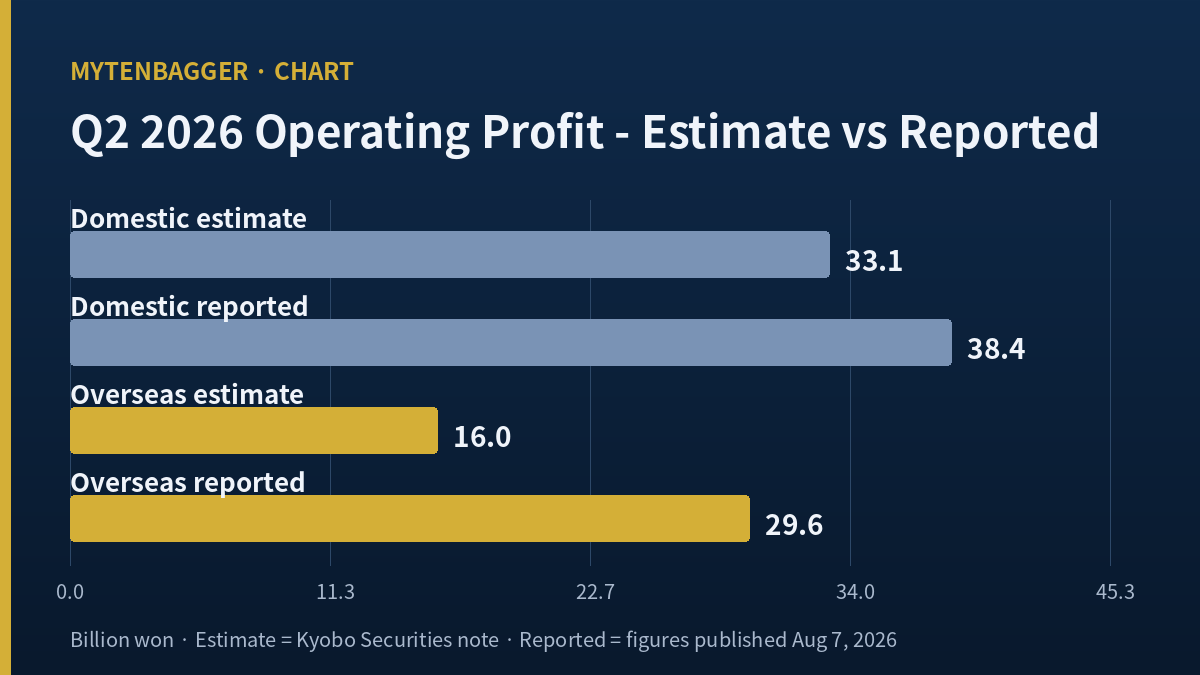
| Q2 2026 operating profit | Kyobo estimate | Reported | Gap (my calculation) |
|---|---|---|---|
| Domestic (parent only) | 33.1 bn won | 38.4 bn won | plus 5.3 bn, or 16.0 percent |
| Overseas subsidiaries | 16.0 bn won | 29.6 bn won | plus 13.6 bn, or 85.0 percent |
| Consolidated | 45.1 bn won | 64.7 bn won | plus 19.6 bn, or 43.5 percent |
What the Second Quarter Actually Showed
I separate what the company published from what I divided myself. The right hand column below is mine, not the company’s.
| Q2 2026 | Revenue | Operating profit | Margin (my calculation) |
|---|---|---|---|
| Consolidated | 1,155.7 bn won, up 8.6 percent | 64.7 bn won, up 88.5 percent | 5.60 percent |
| Domestic (parent only) | 859.8 bn won, up 11.6 percent | 38.4 bn won, up 39.1 percent | 4.47 percent |
| Overseas subsidiaries | 311.2 bn won, up 28 percent | 29.6 bn won, up 133 percent | 9.51 percent |
| First half, consolidated | 2,183.1 bn won, up 7 percent | 100.5 bn won, up 98 percent | 4.60 percent |
Revenue, operating profit and growth rates are the figures the company gave in its August 7, 2026 release, which I am summarizing from Korean coverage instead of quoting it (Jabon and InTheNews, both in Korean). Note that Korean outlets do not agree on the consolidated revenue growth rate: two printed 8.6 percent and one printed 12.5 percent. I use the majority figure, and the argument here rests on amounts and margins, so either one leaves the conclusion unchanged.
The growth rates are not what held me. The margin gap is. An overseas operating margin of 9.51 percent is 2.13 times the 4.47 percent the parent company earned, and the overseas units are only 26.93 percent of revenue. A quarter of the sales produced 45.75 percent of the profit.
One reconciliation before I move on. Parent revenue of 859.8 billion won plus overseas revenue of 311.2 billion won totals 1,171.0 billion, which overshoots consolidated revenue by 15.3 billion won, or 1.32 percent. The same addition on operating profit gives 68.0 billion against a consolidated 64.7 billion, an overshoot of 3.3 billion won or 5.10 percent. That is intercompany elimination. I did not build anything on the overshoot itself. I checked it so that I would not mix figures from two different reporting layers in the same sentence.
Where the Cocoa Price Sits, and Where It Sat
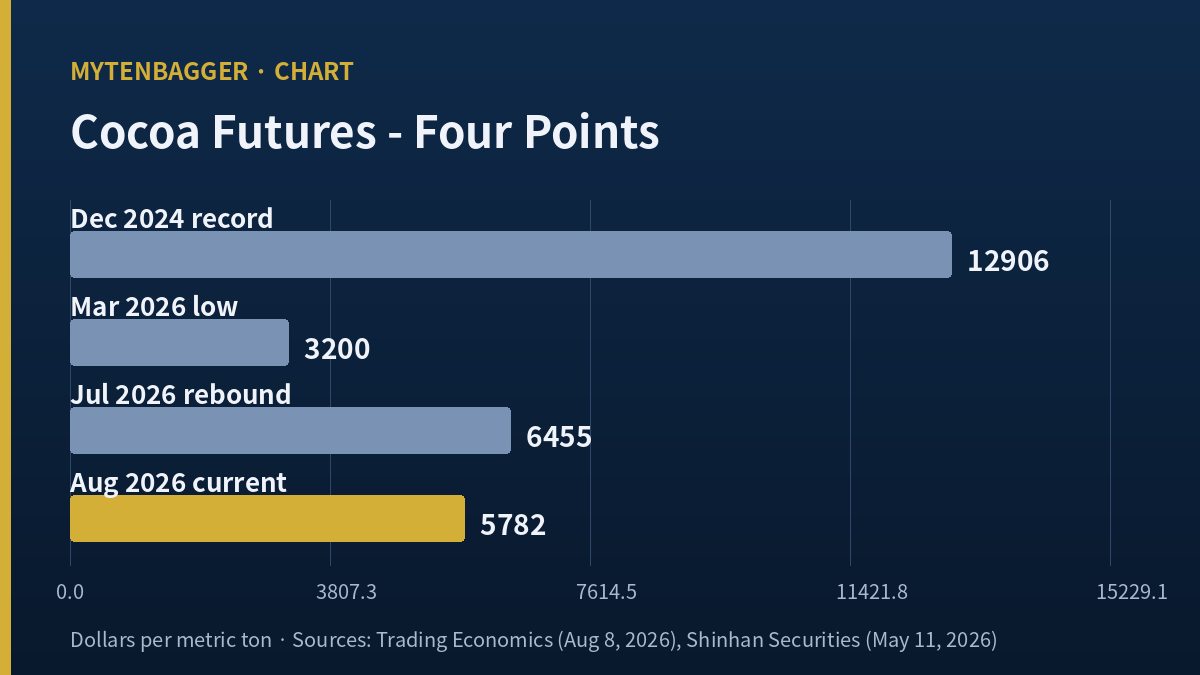
Cocoa futures peaked at 12,906 dollars per ton in December 2024. They fell hard from there. A Shinhan Securities note dated Monday, May 11, 2026 described cocoa as having dropped to around 3,200 dollars during 2026 after trading above 10,000 dollars in the first half of the prior year (Ajunews, in Korean). Korean business daily Herald Economy put the March low near 3,100 dollars in an August 2, 2026 piece.
Then it turned. Trading Economics displayed 5,782 dollars per ton as of Saturday, August 8, 2026, after an eight month high of 6,455 dollars on Thursday, July 9, 2026, with West African supply worries cited and Ghana projecting a drop of at least 16 percent for the 2026/27 season (Trading Economics). Three reference points, three different stories:
- Against the December 2024 record, cocoa is down 55.2 percent. Cheap.
- Against a year ago, it is down 34.13 percent. Also cheap.
- Against the March 2026 level of 3,200 dollars, it is up 80.7 percent (my calculation). Against the July 9 high it is down 10.4 percent, and the monthly change Trading Economics displays is 10.43 percent lower.
Now add the delay. That same Herald Economy piece noted that manufacturers were still working through beans bought months earlier at 7,000 to 8,000 dollars a ton, so the older, higher cost was still flowing into product pricing (Herald Economy, in Korean). If that holds for this company, the sequence is straightforward and slightly uncomfortable.
The cocoa sitting inside that 64.7 billion won of second quarter profit was bought expensively in 2025. The company earned a 5.60 percent consolidated margin while still eating the expensive beans. The 3,200 dollar cocoa from March has not landed. Kyobo Securities analyst Kwon Woo-jung wrote on Wednesday, July 8, 2026 that cocoa and dairy input costs were expected to turn lower on a year over year basis from the third quarter, with earnings passing through a trough (Betanews, in Korean). And the 6,455 dollar cocoa from July has not landed either.
So when I look at this company I read the next quarter off a futures screen before I read it off a filing. The good quarter on display is already spent cost. The direction the price is pointing has not reached the accounts. Hana Securities analyst Shim Eun-joo made a related point on Wednesday, July 22, 2026, describing the first half as heavily helped by base effects and flagging higher prices for secondary materials as a burden in the second half (Newspim, in Korean).
Lotte Wellfood Stock and the Estimate Nobody Got Right
The most instructive thing in this quarter is not the result. It is the distance between the result and what two brokerages had written down two weeks apart.
- Hana Securities, July 22, 2026: consolidated second quarter operating profit of 45.0 billion won. Reported 64.7. Off by 43.8 percent (my calculation).
- Kyobo Securities, July 8, 2026: 45.1 billion won. Off by 43.5 percent.
Two houses, two weeks apart, landed on 45.0 and 45.1 and both were low by about the same amount. On its own that is unremarkable. What makes it usable is that Kyobo published the split: 33.1 billion won domestic and 16.0 billion won overseas. Set that against the reported numbers and the miss localizes immediately, as the table near the top of this piece shows.
Domestic came in 16.0 percent above the estimate. For a quarterly forecast that is respectable work. Overseas came in 85.0 percent above. Adding the two segment gaps gives 18.9 billion won, of which 71.96 percent sits in the overseas line (13.6 divided by 18.9, my calculation). The consolidated gap of 19.6 billion is 0.7 billion larger than the sum of the parts, which is consolidation adjustment, and I did not assign that residual to either segment.
Read that plainly: professionals who cover this name for a living get the Korean business roughly right and miss the overseas business badly. Nearly half the company’s profit lives in the half they cannot see. I have no reason to think my own visibility into a Pune ice cream plant is better than theirs. When I looked at Studio Dragon a session earlier, I found one house whose quarterly call was fine while its valuation moved the other way. Here it is two houses missing the same segment in the same direction, which is a different kind of signal.
The Numbers Behind Lotte Wellfood Stock, and the Fields I Dropped
Everything below is on the Friday, August 7, 2026 close of 116,900 won. The vendor data I used carries the same latest trading date, which is how I confirmed the two agreed.
| Item | Value | What I checked |
|---|---|---|
| Market value | 1,076.0 bn won (about 760 mn dollars) | 116,900 times 9,204,448 shares reproduces the figure to the won |
| P/E, P/B, P/S | 15.11, 0.49, 0.26 | P/B reproduces at 0.4924, P/S at 0.2552 |
| Book value per share | 237,423 won | Total equity field is empty, so I recovered 2,185.3 bn won from book value times shares |
| Return on equity, operating margin | 3.3 percent, 2.6 percent | Prior fiscal year basis, a different period from the 5.60 percent quarter |
| Debt to equity, interest coverage | 102.19 percent, 1.61 times | 109.5 bn operating profit divided by 1.61 implies roughly 68.0 bn of interest cost |
| Dividend per share, yield, payout | 3,300 won, 2.82 percent, 42.7 percent | Total dividend of 30.4 bn won over 71.4 bn net income gives 42.5 percent, which closes |
| 250 day intraday high and low | 136,400 and 90,000 won | 85.70 percent of the high, 14.30 percent below it, 29.89 percent above the low, all three on the closing price |
What I dropped, and why. Three cash flow fields went unused. The displayed figure for earnings before interest, taxes, depreciation and amortization is 35,788, while the prior year operating profit on the same screen is 109.5 billion won. Those units do not reconcile and I had nothing to establish which scale applies, so operating cash flow and free cash flow went with it. On payout I used only the 42.7 percent headline figure, because the raw variant of 26.8 percent does not close against the total dividend path above. The three year revenue growth rate went unused as well. On share count, coverage of the buyback cancellation gives 9,204,574 shares outstanding while the data screen shows 9,204,448, a difference of 126 shares. That looks like a timing difference between sources, the market value reproduces to the won on the screen figure, and I built nothing on those 126 shares.
Price action, briefly: up 10.7 percent over one month, down 2.18 percent over three, up 0.52 percent over six and down 4.18 percent over twelve. The stock sits above its 20, 60 and 120 day averages, by 13.24 percent, 10.7 percent and 4.52 percent. That one month window contains two brokerage notes and the earnings release, and I have nothing that lets me split the move between them, so I am not assigning a cause.
Hershey: The Same Bean, the Opposite Chart
For a global comparison I picked The Hershey Company (NYSE: HSY), not because it competes with this company in any meaningful market but because it buys the same commodity. When cocoa rises, both income statements feel it.
| Item | Lotte Wellfood | Hershey |
|---|---|---|
| Market value | about 760 mn dollars | 36.64 bn dollars, or 48.2 times larger |
| Price to sales | 0.26 | 3.01, a gap of 11.81 times |
| Net margin | 1.69 percent | 12.25 percent |
| Trailing and forward P/E | 15.11, no forward figure available | 24.92 and 19.65 |
| Dividend yield and payout | 2.82 percent, 42.7 percent | 3.19 percent, 79.4 percent |
| Distance below the high | 14.30 percent, on a 250 day intraday high | 23.86 percent, on a 52 week high |
Hershey figures are the values stockanalysis.com displayed for the Friday, August 7, 2026 close: 182.35 dollars a share, 12.16 bn dollars of trailing revenue, 1.49 bn of trailing net income, earnings per share of 7.32, an annual dividend rate of 5.81 dollars and a 52 week high of 239.48 (stockanalysis.com). Net margin, price to sales and payout in that column are mine, derived from those displayed values. Hershey figures stay in dollars as published; the Korean company’s dollar equivalents use the single rate in the closing footnote.
Two companies buying the same bean, moving in opposite directions. Hershey sits 23.86 percent below its 52 week high while this one sits at 85.70 percent of its 250 day high and has gained 10.7 percent in a month. Net margins are 7.2 times apart and the price placed on each unit of revenue is 11.81 times apart. I do not read that gap as saying the Korean name is cheap. A company earning a 1.69 percent net margin should carry a low multiple of revenue; that is arithmetic, not an opportunity. What I read is narrower: the gap closes only if the margin rises first, and a large part of that margin is set by a commodity neither company controls. At Cosmax I ended up ranking three contract manufacturers by debt because margin was not telling me what I needed to know. Here margin is exactly the thing I need, and a commodity sets a large part of it.
The Chocolate Proxy Carries Only Half of This Idea
The obvious instinct is to express the same idea through a listed chocolate name, and Hershey is right there. That proxy gives you half of this idea. You get the cocoa cycle, which is the part I have been writing about. You do not get the Pune plant, the Kazakhstan expansion, or the 133 percent overseas profit growth that produced 45.75 percent of last quarter’s profit. Those two halves are the two things I would be buying, and no US listed security I know of carries the second one. That is a real constraint on this idea, not a paperwork nuisance, and I would sooner write it down than pretend the substitute is close enough.
My Position on Lotte Wellfood Stock and What Would Break It
I am only watching this one. Not because the results are bad. First half operating profit of 100.5 billion won already covers 91.8 percent of the whole prior fiscal year’s 109.5 billion (my calculation), which is a good six months by any reading. I stopped for one reason: the cheapest cost and the risen cost are both still in transit, they arrive in sequence, and the length of that interval is not something I can see.
Six ways I could be wrong. The last one is a different species from the first five. Those five are places where the evidence genuinely supports more than one reading. The sixth is a place where I simply did not find the evidence.
- The overseas business barely runs on this clock. The company put the 133 percent jump down to plant utilization in Pune and sales expansion in Kazakhstan. Profit created by volume survives a cocoa rally, and that profit is 45.75 percent of the total.
- Pinning the domestic improvement on input cost is my reading, not the company’s. The Shinhan note credited discontinued low margin products, channel rationalization, procurement efficiency and logistics improvements. If that is the larger factor, the domestic margin holds up better than I expect when cocoa returns.
- The reference point decides the story. Up 80.7 percent from the March low, down 55.2 percent from the record. I put the March comparison first. That was my choice of baseline, not the only defensible one.
- The next two quarters may be the friendly ones. If Kyobo’s third quarter turn is right, the cheapest beans this company has bought in years land in the second half, before anything from July does.
- I reduced input cost to cocoa alone. This company also buys edible oils, sugar, dairy and packaging. The higher secondary material prices Hana flagged may be about those inputs and not about beans, and I did not verify a single one of them. That single substitution is the loosest joint in this piece.
Worth stating plainly: all three brokerages I read carry buy ratings, with published valuations of 160,000 won from Shinhan on May 11, 2026 (raised 14 percent from 140,000), 175,000 won from Kyobo on July 8 and 200,000 won from Hana on July 22, against a close of 116,900. I am quoting those as facts about what the sell side published. I have not adopted any of them, and I have no basis for asserting that three houses are simultaneously wrong.
Two things would bring me back. First, a third or fourth quarter in which the parent company operating margin clears 4.47 percent decisively. That would be evidence the cheap beans actually landed, and it would also tell me how high the domestic business can actually run. Second, an overseas share of quarterly operating profit above half. At that point most of this company’s earnings sit outside the commodity clock and the frame I built here stops being the right one.
Here is the signal that I misread this. If cocoa holds near the current 5,782 dollars or climbs from here, and the parent company operating margin in the first quarter of 2027 nonetheless does not fall below the 4.47 percent of this quarter, then the claim that this income statement is a delayed copy of the cocoa price is wrong. That test does not run on a company disclosure or on a brokerage forecast. It runs on a commodity quote I can pull up any morning, which also means there is nobody to blame if it goes against me.
What I am watching from here is which of the two shipments lands first. Cheap beans first gives a few strong quarters. Expensive beans first turns the first half growth rates inside out. The company sets the earnings date. It does not set that order.
Prices and multiples reflect the August 7, 2026 close as checked at the time of writing. The cocoa quote carries an August 8, 2026 display date and is therefore one day off the equity reference date. Dollar conversions use a single rate, approximately 1,416 won per dollar, the Seoul close on August 7, 2026 (Money Today, in Korean); they are approximate and for reference, and Korean language sources are summarized in my own words, not quoted. Brokerage valuations appear as reported facts about published research and are not figures I have adopted.