What Has Hanjin KAL Stock Earned From Operations Since 2022
Contents
I Skipped Hanjin KAL Stock Twice for the Same Reason
I passed on this company twice, and both times I wrote down the same sentence. A holding company income statement does not tell you what the company is. Add up the revenue of the group’s non financial affiliates and you get USD 21.75B for fiscal 2025, per a May 29, 2026 report, while the holding company’s own consolidated revenue is USD 217.4M. That is a factor of 100.06, reconstructed. What creates the gap is Korean Air, and it never touches the revenue line, because the stake is 26.13% and equity accounting holds it below the operating result.
On my third attempt I changed the order I opened things in. I opened the ownership filings before the financial statements. The arithmetic got much simpler. A second shareholder has been buying this stock since 2022, and both what he paid and what the position was worth at the August 28, 2026 close are disclosed. I put the difference between those two figures next to what the company itself earned from operations over the same stretch.
2022 through August 28, 2026. Same window, split by who did it.
| What the company did in that window | What the second largest holder did |
|---|---|
| Consolidated operating profit of USD 72.1M in total | Accumulated 13,454,674 shares for USD 639.9M |
| 2025 alone subtracted USD 5.5M from that total | Reached a 20.153% stake (reconstructed) |
| No dividend at all for fiscal 2020 and 2021 | Position worth USD 1,287.1M (reconstructed) |
| Q2 2026 loss to controlling holders of USD 63.4M | Paper gain of USD 647.3M (reconstructed) |
The last figure on the right is 8.97 times the first figure on the left. That single multiple is the axis of this entry. My position is no position, watching.
The Hanjin KAL Stock Close I Am Working From Is August 28, 2026
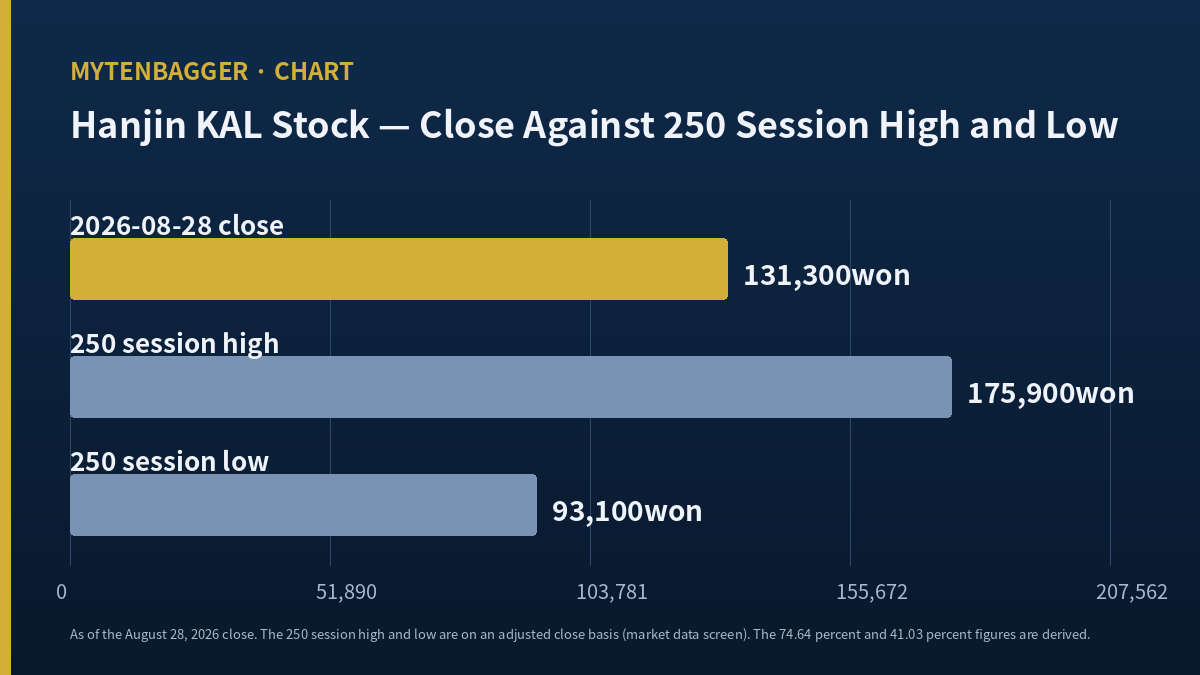
Every price in this entry comes from the Friday, August 28, 2026 close. That close was 131,300 won, or USD 95.66 at 1,372.5 won per dollar. Multiplied by 66,762,376 shares outstanding it produces a market value of 8.766 trillion won, or USD 6.387B, and that reconstruction matches the screen figure to the last digit.
The company trades on the KOSPI, the senior board of the Korea Exchange, which lists the large established industrial and financial names. The junior board is the KOSDAQ, which carries smaller growth companies. Hanjin KAL sits on the senior board and is the holding company at the top of the Hanjin group.
| Item | Value | Note |
|---|---|---|
| August 28, 2026 close | 131,300 won (USD 95.66) | base price for this entry |
| Market value | USD 6.387B | close times 66,762,376 shares |
| 250 session high and low | 175,900 and 93,100 won | adjusted close basis |
| Position against the high | 74.64 percent | 131,300 over 175,900, reconstructed |
| Move up from the low | 41.03 percent | 131,300 over 93,100, reconstructed |
I dropped the trailing return series from this entry. The screen carried 131,300 won as its reference price while the trend block in the same response was holding 126,200 won stamped Monday, August 31, 2026, on volume of 11,021 shares against 58,040 shares the prior session. That is an intraday snapshot and not a settled close. Every one of the one, three, six and twelve month returns is calculated on top of that snapshot, so none of them line up with my base price. The three high and low figures do reconcile to 131,300 won, so I kept those.
What the Company Under Hanjin KAL Stock Earned in Four Years
The consolidated statements do not contain Korean Air. What they contain are the non airline subsidiaries: KAL Hotel Network at 100 percent, Jungseok Enterprise at 60.49 percent, Topas Travel Information at 94.35 percent. Korean Air at 26.13 percent and Hanjin Transportation at 29.64 percent come in below the operating line through equity accounting. That is why revenue sits near USD 220M for a group holding company whose main asset flies aircraft.
| Fiscal year | Consolidated revenue | Consolidated operating profit | Profit to controlling holders |
|---|---|---|---|
| 2022 | USD 146.0M | USD 10.6M | USD 498.2M |
| 2023 | USD 200.9M | USD 31.2M | USD 280.6M |
| 2024 | USD 212.9M | USD 35.8M | USD 362.1M |
| 2025 | USD 217.4M | USD -5.5M | USD 112.9M |
Figures are from the consolidated statements filed with the Korean Financial Supervisory Service, converted at the single rate stated above. Four years of operating profit add to USD 72.1M, and 2025 subtracted from that total instead of adding to it. Profit to controlling holders over the same four years adds to USD 1,253.9M, which is 17.38 times the operating total. The earnings of this company do not come from operations, and that is not an accounting error. It is the structure of a Korean holding company doing exactly what it is built to do.
The first half of 2026 splits again
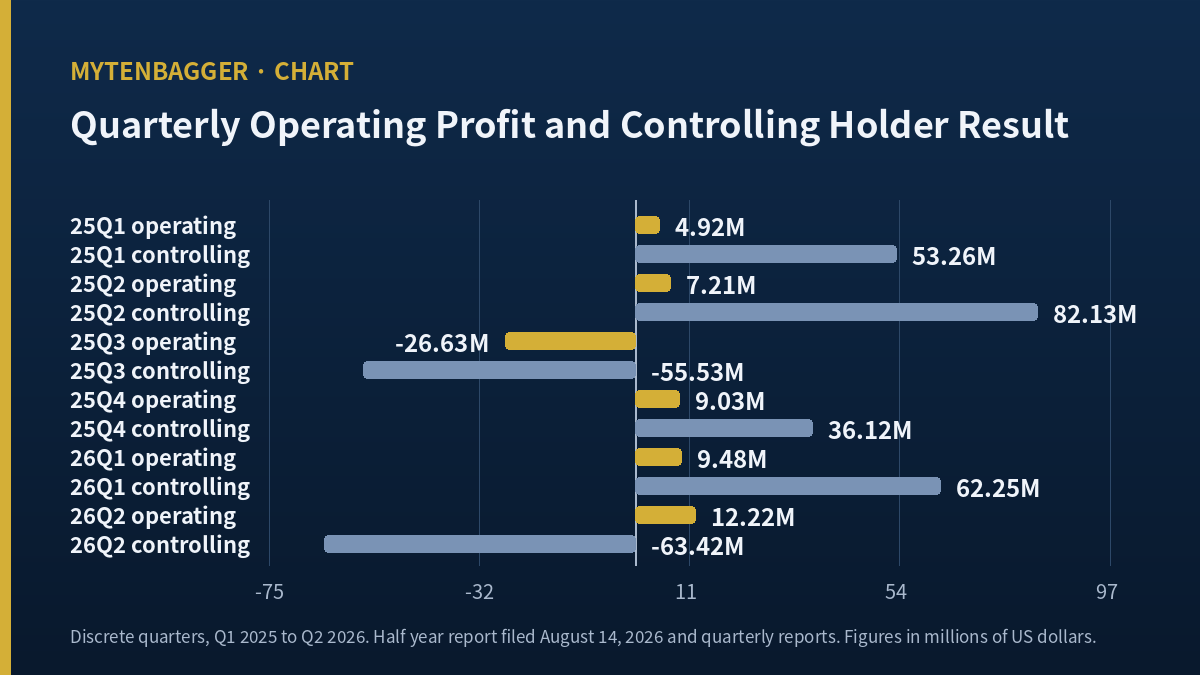
The half year report filed August 14, 2026 shows consolidated revenue of USD 102.8M and operating profit of USD 21.7M for the six months. On the operating line alone, half a year undid the full year 2025 loss. Yet the six month result attributable to controlling holders is negative USD 2.3M. Cut it to a single quarter and the split widens: Q2 2026 consolidated operating profit was USD 12.2M on a 23.48 percent operating margin, while the loss to controlling holders was USD 63.4M. USD 75.6M disappeared below an operating line that had just produced USD 12.2M.
I could not establish which account absorbed that USD 75.6M. Separating an equity method swing from a financial instrument revaluation from a tax charge requires the notes to the half year report, and the Korea Exchange filing viewer returned a 403 to me again on this attempt. I am not going to write down a cause I did not confirm, so I put this item into the fourth of my invalidation conditions below.
What the Second Largest Holder Did in the Same Four Years
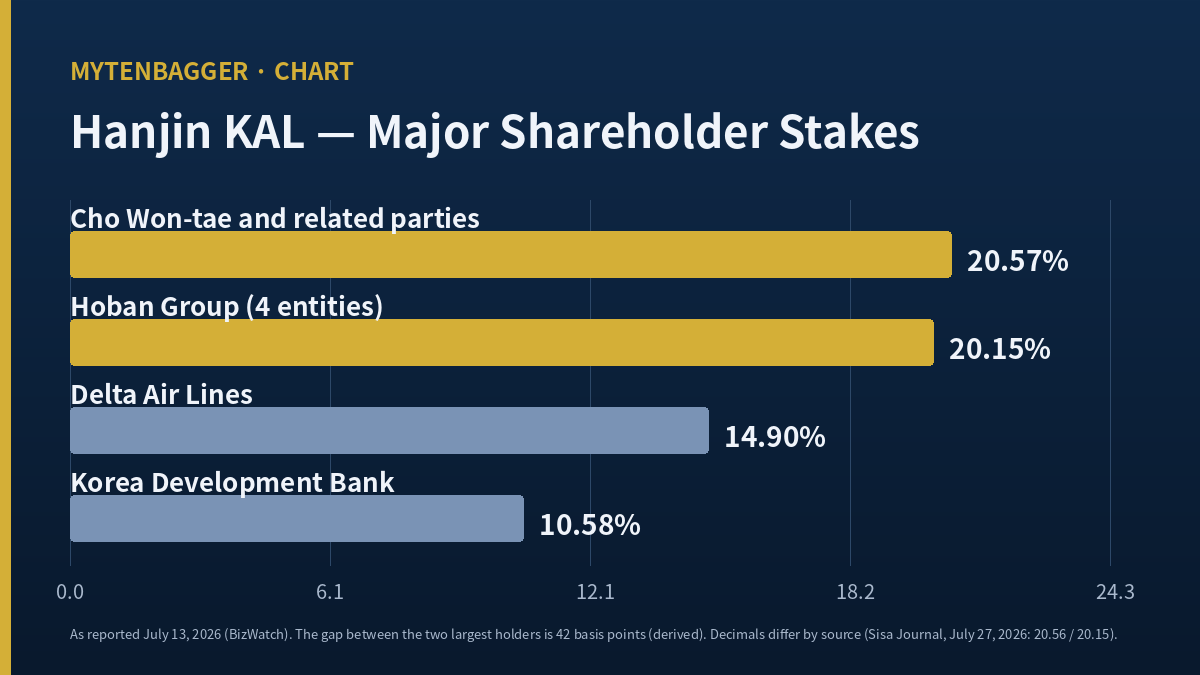
Hoban Group has bought 13,454,674 common shares since 2022 for a stated USD 639.9M, reported by Korean business press on July 14, 2026. The position is split across four entities: Hoban Construction at 11.50 percent, Hoban Hotels and Resorts at 8.34 percent, Hoban Industry at 0.17 percent and Hoban Co at 0.15 percent. Divided by 66,762,376 shares outstanding, the group holds 20.153 percent.
Two sources part company on the average entry price. The business press figure is 65,270 won a share. A July 13, 2026 report quoting analyst Bae Se-ho of iM Securities puts it at 59,793 won. I am not calling either one an error. What I can say is that dividing the stated USD 639.9M outlay by the stated share count gives 65,271 won, which is internally consistent with the two other numbers in the same article, so my arithmetic below uses that figure and this paragraph records that another exists.
Marked to the August 28, 2026 close, those 13,454,674 shares are worth USD 1,287.1M. Subtract the USD 639.9M paid and USD 647.3M of paper gain remains, a return of 101.16 percent on the USD 639.9M outlay. The same iM Securities commentary described the gain as roughly one trillion won at the July 10, 2026 close, which is USD 728.6M, and above 1.2 trillion won after subsequent price appreciation. That USD 728.6M had become USD 647.3M by the August 28 close, so the same position shed more than USD 81M in seven weeks, and I am treating that swing itself as part of the evidence.
The ownership table changes in the decimals depending on who wrote it
| Holder | Reported July 13, 2026 | Reported July 27, 2026 |
|---|---|---|
| Chairman Cho Won-tae and related parties | 20.57 percent | 20.56 percent |
| Hoban Group, four entities combined | 20.15 percent | 20.15 percent |
| Delta Air Lines | 14.90 percent | 14.90 percent |
| Korea Development Bank | 10.58 percent | 10.56 percent |
| National Pension Service | 5.44 percent | not stated |
Both articles cite the same analyst, and the state bank line still differs by 2 basis points while the chairman line differs by 1. I assume a reference date difference and I did not confirm it, so both columns stand. Either way the gap between the largest and second largest holder is 41 to 42 basis points, which on 66,762,376 shares is under 300,000 shares. In July 2026 a group affiliated foundation, Jungseok Inha Academy, sold 2,593,934 Korean Air shares plus preferred stock for roughly USD 53.6M and lifted its Hanjin KAL holding from 1.90 percent to 3.06 percent. A foundation sold the airline to buy the holding company.
The Company Wrote Its Own Number and It Was 1.3 Times Book
In a corporate value enhancement filing dated February 25, 2026, the company set out three goals for the year: hold a price to book ratio at or above 1.3 times, pay out around 50 percent of adjusted net profit, and reach 80 percent compliance with the governance core indicators. The 2025 version of the same filing asked for 1 times book, the same 50 percent payout, and 70 percent compliance, so two of the three moved up.
The price to book ratio I reconstruct from the filings is 2.621 times. Equity attributable to controlling holders at the end of Q2 2026 was USD 2,436.5M, which across 66,762,376 shares gives USD 36.49 a share, and the USD 95.66 close divided by that figure produces 2.621. The company’s own floor is being cleared by roughly a factor of two. Whether that is a success or a warning depends on how you read the word floor: as a minimum, or as the company’s own view of fair value. The filing says at or above, so the plain reading is a floor. What the tables above do not tell me is whether the business produced the overshoot.
The payout line is cleaner. Fiscal 2025 dividends per share of 360 won across 66,762,376 shares come to USD 17.5M in total, against USD 112.9M of profit attributable to controlling holders, a payout of 15.50 percent. For the promised 50 percent to hold, adjusted net profit would have to be USD 35.0M, which is 31.0 percent of the reported figure. So the definition of the adjustment decides the size of the payment, and I could not find that definition.
The dividend record is not smooth either. Disclosed dividends per share run 75 won for 2015, 125 for 2017, 300 for 2018, 255 for 2019, then nothing recorded for 2020 or 2021, then 170 for 2022, 300 for 2023, 360 for 2024 and 360 for 2025. The screen reports a three year increase streak and, one cell over, a strict consecutive increase count of zero, because 2024 and 2025 are the same 360 won. Two cells on one screen say different things about the same series.
Only one share count event landed in this window
Share count changes reset every price based figure at once, so I checked separately. A treasury cancellation was resolved on August 13, 2026 and executed on August 25, 2026, covering 4 common shares and 6,469 preferred shares with a combined book value of 54.4 million won. These came from stock the company has held since incorporation, with no fresh buying. Four common shares out of 66,762,376 changes nothing in this entry. Bonus issues, splits, rights issues and capital reductions did not turn up in any filing I could reach, and the cancellation is the only confirmed event.
Where the Screen Multiple on Hanjin KAL Stock Sits
The data screen hands over a price to earnings ratio of 57.0, a price to book of 2.64, a return on equity of 4.8 percent and an operating margin of negative 2.51 percent. Before using any of them I checked which period they stand on. The revenue, operating profit and net income cells match the full year 2025 audited figures to the last unit. They are labeled trailing and they contain an annual result.
Adding the four most recent discrete quarters by hand gives a different picture. From Q3 2025 through Q2 2026 revenue was USD 223.0M, operating profit was USD 4.1M, and the result attributable to controlling holders was negative USD 22.2M. On the four most recent quarters there is no positive earnings figure to divide the price by, so no trailing multiple exists at all. The 57.0 on the screen belongs to fiscal 2025. Neither number is wrong. They measure different periods.
The earnings per share cell is circular. The precise figure of 2,303.51 won is exactly 131,300 divided by 57.0, and the screen labels its own basis that way. A value derived from the price cannot then be used to judge the price, so I left it out.
Five Things That Argue Against My Reading
My axis is that operations are not what sets this price, so I want the case against it in one place.
One. Two credit rating agencies moved the other way. Press dated May 29, 2026 reported that Korea Ratings and NICE Investors Service both raised the outlook on Korean Air and Hanjin KAL, citing the widened commercial base and cost efficiency of the merged carrier. While I write that the price comes from a control contest, the credit side raised its view on business grounds.
Two. Judging a holding company by consolidated operating profit may be the wrong test. On a parent only basis, fiscal 2025 revenue was USD 98.4M, operating profit USD 30.4M and net profit USD 25.3M, all positive. The consolidated loss comes from the non airline subsidiaries, and there is a view that the real business of a holding company is collecting dividends and brand fees. I find this objection substantially fair.
Three. First half 2026 consolidated operating profit of USD 21.7M has already reversed the full year 2025 figure of negative USD 5.5M. My USD 72.1M comparison base grows the moment fiscal 2026 closes.
Four. The balance sheet genuinely shrank. A May 19, 2026 report describes the sale of the Grand Hyatt Incheon west tower and other assets for USD 153.0M with a book gain of USD 41.1M, and the repayment of maturing bonds that cut first quarter interest expense from USD 13.0M to USD 3.1M. The debt to equity ratio at the end of Q2 2026 was 19.50 percent.
Five. A paper gain has to be sold to exist. USD 647.3M is 20.153 percent multiplied by a closing price, and putting that block into the market gives no guarantee the price survives it. If the purpose is control, the block was never for sale and the gain will never turn into cash. Either way the figure means only what it says: marked at this close, it comes to this.
Delta Air Lines and Hanjin KAL Stock Have Opposite Problems
I picked the comparison on one rule this time: a listed company that appears on this company’s own share register. Delta Air Lines holds 14.90 percent of Hanjin KAL and is its third largest holder. It is not a peer I selected. It is a peer the ownership structure handed me.
| Item | Hanjin KAL | Delta Air Lines (DAL, NYSE) |
|---|---|---|
| August 28, 2026 close | USD 95.66 | USD 80.07 |
| Market value | USD 6.387B | USD 52.37B |
| Trailing price to earnings | not computable, four quarter loss | 13.28 |
| Forward price to earnings | no value on the screen | 9.76 |
Neither company gives me a trailing multiple I can lean on, and the reasons are opposite. Delta produces one, and it comes straight out of flying aircraft. Hanjin KAL produces a four quarter loss, so the multiple does not form. Delta figures are the published August 28, 2026 close values from stockanalysis.com, and I reconstructed them: USD 80.07 across 654.07M shares gives USD 52.37B, and USD 3.95B of trailing net income across the same share count gives USD 6.039 against a published USD 6.03, a difference of 0.15 percent on the published figure.
What I Could Not Confirm About Hanjin KAL Stock
The coverage gap comes first. The only named sell side analyst I located on this company is Bae Se-ho at iM Securities. Every other forward looking view in this entry comes from the two credit rating agencies. I did not reach two named brokerage houses, and releasing the date filter, the outlet filter and the name variants produced the same result each time. A holding company with a thin free float is a plausible explanation for thin coverage, but that explanation is mine, not a source’s.
The analyst’s comments sit at two dates. In May 2025 he called a preceding rally excessive and told readers to prepare for downside. In July 2026 he identified the state bank’s exit strategy as the decisive variable and expected it to prepare a recovery in earnest during 2027. The first of those is fifteen months old and I am not restating it in the present tense.
Four items stayed unconfirmed: which account carried the USD 63.4M Q2 loss to controlling holders, what the adjusted net profit in the payout filing adjusts for, which date the screen book value per share of 49,664 won belongs to, and how and when the Korea Development Bank’s 10.58 percent gets sold. All four can change the conclusion here, and all four close only when the Q3 report or a separate filing arrives.
My Position on Hanjin KAL Stock and What Would Break It
My position is no position, watching. I did not buy this while researching it and I have not bought it since. The reason fits in one sentence. I can name the cause of this price but I cannot date its ending. Control contests end by filing, and on the day that filing lands the condition holding this price up goes away, and I have no way to predict the day. I am not hiding an expectation either: if the merged carrier ships and the dividend and equity income flowing up from Korean Air thicken, this income statement becomes a different document, and the reported Q1 2026 parent only figure of USD 73.0M revenue including USD 62.8M of Korean Air dividends shows that channel already working. What no method of mine closed is the distance between the speed of that channel and the 2.621 times book attached to the August 28, 2026 price.
Four conditions would tell me I read this wrong. First, Q3 2026 discrete consolidated operating profit falls below USD 7.3M, breaking the run of USD 9.5M in Q1 and USD 12.2M in Q2. Second, the destination of the state bank’s 10.58 percent is confirmed by filing in either direction. Third, a disposal filing takes Hoban Group below 20.153 percent. Fourth, the Q3 report confirms a cumulative loss to controlling holders, meaning the negative USD 2.3M from the first half did not recover. The checkpoint is after November 16, 2026, because the statutory filing deadline of November 15 falls on a Sunday.
Closing on What One Decision Moves and What It Leaves Alone
Instead of a summary I am sorting the numbers in this entry into two groups. The test is one question. Does the figure change if the Korea Development Bank decides where its shares go.
Tied to that decision: the 131,300 won close, the USD 6.387B market value, the 2.621 times book, Hoban Group’s USD 647.3M paper gain, and the 8.97 multiple this entry is built on. All five rest on the assumption that the contest continues, and all five become different numbers within a day of that 10.58 percent finding a home.
Untouched by it: USD 72.1M of four year consolidated operating profit, USD 21.7M in the first half of 2026, a 19.50 percent debt to equity ratio, the 26.13 percent stake in Korean Air, and USD 17.5M of dividends paid. These five stay exactly where they are no matter what the state bank does.
The length of those two lists is why I am watching. The upper list is what makes the price, and I have no instrument for forecasting it. The lower list I can forecast, and on its own it does not produce 131,300 won. What I got from opening this company a third time is not a conclusion. It is these two lists. Next time I open it, I would like the lower one to be longer.
Sources
- Consolidated statements and the half year report filed August 14, 2026 with the Korean Financial Supervisory Service supplied revenue, operating profit, net income and equity attributable to controlling holders
- Bizwatch, on Hoban’s accumulated stake in Hanjin KAL, July 14, 2026
- Financial News, quoting iM Securities on Hoban’s additional purchase and the state bank variable, July 13, 2026
- Sisa Journal, on the Hanjin control contest and foundation purchases, July 27, 2026
- Energy Economy News, on asset sales and debt repayment at Hanjin KAL, May 19, 2026
- The Big Data, on rating outlook upgrades from two Korean agencies, May 29, 2026
- Asia Today, on the treasury share cancellation resolved August 13, 2026
- Energy Economy News, on the Hanjin group ownership chain, June 17, 2026
- stockanalysis.com, Delta Air Lines figures at the August 28, 2026 close
- Corporate value enhancement filing dated February 25, 2026 supplied the 1.3 times book floor and the payout target. Translations of Korean language sources in this entry are mine.
- Related reading: Korean Air Stock and the Merger Math Behind a 25,690 Won Line
- Related reading: SK Inc Stock and Why Selling a Prized Wafer Maker Sparked a 19% Pop
- Related reading: SK REIT Stock at 0.85 Times Owners’ Equity, One Group Pays Rent
- Related reading: Samsung C and T Stock, a 29% Drop With Stakes Worth Twice the Cap