Modetour Q2 Results: Sales Grew 7% but Operating Profit Fell
Modetour Q2 results came out on August 14 with a number that should have calmed people down: April to June revenue of KRW 42.2bn (about $31.1 million), up 7.2% on a year earlier. Industry estimates quoted in the Korean press a month before had penciled in KRW 28.0bn, a drop of nearly 30%. The company beat that by about 51%. It still lost money at the operating line, KRW 0.86bn, against a KRW 2.7bn profit in the same months of 2025.
I do not own Modetour Network (KOSDAQ: 080160). At KRW 8,300 on September 29 it is worth about KRW 156.9bn, roughly $116 million, which puts it far outside the Korean large caps I would take a position in. I keep a file on it anyway, because this quarter answered a question I had been carrying for a while: when a Korean tour operator sells more, does it earn more? For Modetour, going by the last ten quarters, the honest answer is “not reliably,” and that is the part of this print I think matters most.
Modetour Q2 results showed revenue up 7.2% and an operating loss of KRW 0.86bn. The July industry estimate had revenue at KRW 28.0bn; the real figure was KRW 42.2bn. Operating costs grew 17.6%, well ahead of sales. The company named four causes: a strong dollar, higher fuel surcharges, amortization tied to a new IT system, and a pricing policy meant to ease the load on customers. Across January to June, revenue slipped 1.3% while operating profit fell 81.4%. In four of the last six year-on-year comparisons, sales and operating profit went in opposite directions. That pattern tells me the top line is a poor guide to this company’s profit. Japan’s H.I.S. showed something similar in its May to July quarter. I read Q2 as a cost problem first and a demand problem second. I am watching and not buying. The Q3 report, due by November 16, is my first real test. If operating costs start growing slower than sales there, I will revisit.
Contents
Modetour Q2 results against the July estimate
A short word on the company for readers outside Korea. Modetour is one of the two large package-tour sellers in South Korea, next to Hana Tour, and trades on KOSDAQ, the Seoul exchange’s growth-oriented market that sits beside the main KOSPI index. Its customers are Korean travelers heading abroad, so its fortunes follow outbound travel from Korea: air fares, the won-dollar rate, and how far people are willing to fly.
In mid-July, Money Today reported an estimate for Modetour’s April to June quarter: revenue of KRW 28.0bn, down 29.5% on a year earlier, and an operating loss of KRW 3.0bn. Asia Economy repeated the same figures on August 5 and called them brokerage estimates, without naming a firm. Neither outlet named the analyst behind them, so I treat this as an unattributed consensus.
| April to June 2026 | July estimate | Reported | Reported, USD |
|---|---|---|---|
| Revenue | KRW 28.0bn | KRW 42.2bn | $31.1m |
| Change on a year earlier | -29.5% | +7.2% | +7.2% |
| Operating profit | KRW -3.0bn | KRW -0.86bn | -$0.63m |
| Operating costs (revenue minus operating profit) | KRW 31.0bn | KRW 43.1bn | $31.8m |
Estimate: Money Today (July 14) and Asia Economy (August 5), firm not named. Reported: consolidated figures from the DART interim (six-month) report, via Kiwoom; the April to June numbers are the six-month totals minus January to March. Cost rows and USD at KRW 1,356.7 per dollar are my calculations.
The estimate missed revenue by about 51% and overstated the loss. Put differently, the market expected a small, shrinking company losing a little money, and got a larger, growing company losing a little less. Operating costs came in about KRW 12.1bn above what the estimate implied. That, to me, is the whole story of the quarter in one row.
One small discrepancy I should flag. Asia Economy’s August 14 report put the revenue growth at 6.3%. My 7.2% uses the consolidated DART six-month and three-month totals. I could not work out where the gap comes from, so the table uses the filed consolidated numbers.
Modetour Q2 results in a ten-quarter table
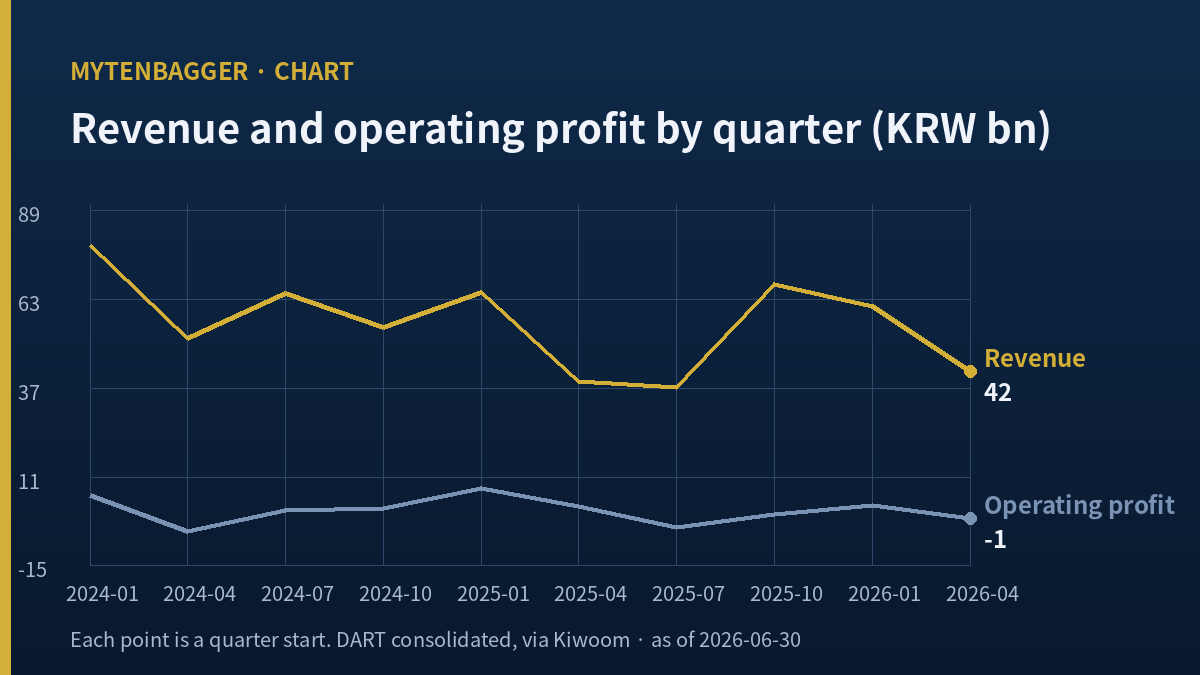
A single quarter can mislead, so I laid out every three-month period since the start of 2024. The fourth quarter of each year is not filed on its own in Korea; it is the annual total minus nine months, and I derived it that way.
| Quarter | Revenue (KRW bn) | Revenue (USD m) | Operating profit (KRW bn) | Profit per KRW 100 of sales |
|---|---|---|---|---|
| Jan-Mar 2024 | 79.3 | 58.4 | 5.74 | KRW 7.24 |
| Apr-Jun 2024 | 52.0 | 38.3 | -4.73 | KRW -9.10 |
| Jul-Sep 2024 | 65.2 | 48.1 | 1.58 | KRW 2.42 |
| Oct-Dec 2024 (derived) | 55.1 | 40.6 | 2.06 | KRW 3.74 |
| Jan-Mar 2025 | 65.6 | 48.3 | 7.90 | KRW 12.04 |
| Apr-Jun 2025 | 39.4 | 29.0 | 2.75 | KRW 6.97 |
| Jul-Sep 2025 | 37.6 | 27.7 | -3.45 | KRW -9.19 |
| Oct-Dec 2025 (derived) | 67.8 | 50.0 | 0.25 | KRW 0.37 |
| Jan-Mar 2026 | 61.3 | 45.2 | 2.83 | KRW 4.62 |
| Apr-Jun 2026 | 42.2 | 31.1 | -0.86 | KRW -2.03 |
Consolidated figures from DART quarterly, interim and annual reports, via Kiwoom. USD at KRW 1,356.7 per dollar and the last column are my calculations.
Now compare each quarter with the same months a year before. There are six such comparisons in this table, from January to March 2025 onward. In four of them, revenue and operating profit went opposite ways:
- January to March 2025: revenue down 17.3%, operating profit up KRW 2.16bn.
- April to June 2025: revenue down 24.2%, operating profit up KRW 7.47bn (from a loss to a profit).
- October to December 2025: revenue up 23%, operating profit down KRW 1.81bn.
- April to June 2026: revenue up 7.2%, operating profit down KRW 3.60bn (from a profit to a loss).
Only July to September 2025 and January to March 2026 saw both lines fall together. Four out of six is not a law of nature, but it is enough to stop me from reading revenue growth as good news for this stock. For a tour seller, revenue mixes very different things: package tours, airline tickets sold on commission, hotels, and whatever the accounting treats as gross or net. A shift in that mix can move sales without moving profit, and the reverse.
The same months at the bigger rival make the contrast clearer. Asia Economy’s August 5 report put Hana Tour’s April to June revenue at KRW 115.4bn, down 3.8%, and its operating profit at KRW 5.4bn, down 43.6%. Hana Tour sold less and earned much less: both lines fell together, which is the ordinary pattern. Modetour sold more and still went into a loss. Same country, same currency, same fuel prices, and yet the relationship between sales and profit ran the other way at the smaller company. That is why I do not think Modetour’s Q2 can be explained only by the demand slump that everyone in the sector is talking about.
I also checked January to March, because a pattern that shows up only once can be noise. In the first three months of 2026, revenue fell 6.5% and operating profit fell 64.1%, from KRW 7.90bn to KRW 2.83bn. There, both lines went down together, like Hana Tour did in April to June. So the opposite-direction pattern is not constant. It appears often enough to be a warning, and not often enough to be a rule I could trade on.
This is different from what I looked at for its larger rival. For Hana Tour, I followed operating cash going out every spring. Here I am staying with the income side on purpose. The airline side of the same months is in my piece on Jin Air, where the fuel cost is the main character.
My first read of the July estimate
When I first saw the estimate in July, I took the forecast revenue fall of nearly 30% as the big news and assumed any beat on sales would carry profit with it. That was the natural reaction, and on this company it was wrong. The revenue beat was large and the operating result still came in below zero. I had carried over an instinct from manufacturers, where more units usually means better use of fixed costs. The ten-quarter table is what talked me out of it. I now start with costs when I open this company’s numbers.
Where the Modetour Q2 results cost increase came from
Operating costs, which I define here simply as revenue minus operating profit, were KRW 36.7bn in April to June 2025 and KRW 43.1bn a year later. That is a rise of 17.6% against revenue growth of 7.2%. In won terms, costs went up by about KRW 6.4bn while sales went up by about KRW 2.8bn.
The four reasons the company gave
Asia Economy’s August 14 report carried the company’s own list. The first was the high exchange rate, since most of what a Korean tour seller pays for is priced in dollars or other foreign currencies while customers pay in won. The second was higher fuel surcharges on airline tickets. The third was amortization linked to developing its next-generation system, meaning the cost of a large IT build now passing through the income side. The fourth was a product policy to ease the burden on customers, which I take to mean that the company absorbed some price increases instead of passing them on.
The filing does not split the cost increase among these four, and I did not try to invent a split. What I can say is that two of them, currency and fuel, are outside the company’s control and can reverse. One, the pricing policy, is a choice the company can undo. And one, the system amortization, is a cost that stays for years once it starts, whatever happens to travel demand.
There is one more thing I keep in mind when reading a tour seller’s costs. A large part of what Modetour pays out goes to airlines, hotels and local operators, and those payments rise and fall with the number and length of trips sold. Staff, systems and marketing are the costs that do not move with each trip. When revenue rises 7.2% and total costs rise 17.6%, either the trip-related costs got more expensive per won of sales, or the fixed part grew, or both. The company’s four reasons point to both: currency and fuel on the trip side, the system on the fixed side. The filings I have do not let me put a number on each, and I would rather leave the question open than guess.
Six months instead of one quarter
Widening the view to January to June does not help the picture. Revenue was KRW 104.98bn in the first six months of 2025 and KRW 103.58bn in 2026, down 1.3%. Operating profit went from KRW 10.64bn to KRW 1.98bn, a drop of 81.4%. Operating costs for the six months rose 7.7%, from KRW 94.34bn to KRW 101.61bn, while revenue went slightly the other way.
That is the same message as the single quarter: costs growing at their own pace while revenue moves sideways. The company clearly sees it too. In late July it moved to an emergency management footing, with pay cuts for executives, and Dealsite reported on August 29 that full-year operating profit was expected to fall 31.4% from 2025, again without naming who expected it.
The last four quarters added together
If I add up the four most recent quarters in the table, from July to September 2025 through April to June 2026, operating profit comes to a loss of about KRW 1.23bn, by my calculation from the same DART figures. Over a full year of trading, including a winter season, the core business did not cover its own costs. The stock has also fallen about 35.6% over twelve months, according to the Kiwoom price series, so the market has clearly noticed something.
The bottom line looks better than the operating line, and I think that difference deserves a sentence. Net profit for January to June 2026 was KRW 4.35bn, about 2.2 times the operating profit of KRW 1.98bn. The gap comes from items below operating profit, which for a company that holds customer money before trips usually means interest income and similar gains. I did not rely on that gap for anything in this piece. Interest on money that customers have paid in advance depends on how much they pay in advance, and that in turn depends on the same travel demand that is under pressure. It is not a separate source of strength.
What I did not use
I did not divide revenue or profit by the number of travelers. Traveler numbers are published separately from the accounts, and the April to June revenue rose while traveler numbers fell, which tells me the two are not measuring the same thing this year. I also left out the balance sheet entirely in this piece. It has interesting movements of its own, but they would pull this note away from the question of whether sales turn into profit.
Modetour Q2 results next to a Japanese peer, H.I.S.
US readers may know the big online travel platforms, but those run on very different economics. The closer comparison is a Japanese tour and ticketing company selling to its own country’s outbound travelers: H.I.S. Co. (TSE: 9603). I chose it for one reason only: its May to July 2026 quarter overlaps most of Modetour’s April to June, and both sell overseas trips to home-market customers paying in a weak local currency.
According to Stock Analysis quarterly data, H.I.S. reported revenue of ¥86.2bn for the quarter ended July 31, 2026, up 1.4% on ¥85.0bn a year earlier, and an operating loss of ¥1.32bn against a loss of ¥0.06bn. So the Japanese company also sold slightly more and lost noticeably more.
I would not push the comparison further. The two firms have different fiscal years, different mixes and very different sizes, and I have not checked what H.I.S. itself said about the quarter. The one point I take from it is modest: Modetour’s pattern this summer was not unique to Modetour. That cuts both ways. It means the problem is partly industry-wide and may pass. It also means Modetour did not do anything special to escape it.
How I see Modetour’s July to September going
The next report must be filed by November 16 (Monday). July to September includes the summer holidays, which should be the strongest months of the year for a Korean tour seller, though in 2025 this same quarter showed a loss. These are my own rough odds.
- About 45%: a small operating profit, between zero and KRW 2bn. Revenue grows again, costs grow almost as fast, and the quarter ends up modestly positive.
- About 35%: another operating loss. Costs keep rising faster than sales, and the Q2 pattern repeats in the peak season. This would be the worst sign for me, because summer is when the business should look its best.
- About 20%: an operating profit above KRW 2bn, which would need costs to grow slower than revenue for the first time in a while.
One input has moved in the company’s favor since the quarter ended. In early August, Asia Economy described the won as trading in the KRW 1,400s per dollar, one of the pressures on travel sellers. On September 29 the Seoul close was KRW 1,356.7, according to Money Today. A stronger won makes foreign hotels and ground services cheaper in won terms, and it also makes trips more affordable for customers. The effect on Modetour’s July to September costs depends on when it paid for its summer inventory, which I cannot see from outside. It helps the October to December period more clearly than the summer.
I lean toward the first, mainly because revenue already grew in April to June and the summer months add volume on top. I hold that view loosely. None of the four cost reasons the company gave has gone away, and the system amortization will not go away at all.

What argues against my read of the Modetour Q2 results
- The revenue beat was real. A company expected to shrink by almost a third grew instead. Demand was clearly better than the people who estimate these things thought in July, and demand usually comes before profit.
- Some of the cost pressure can reverse on its own. Exchange rates and fuel prices are not permanent. If the won strengthens and fuel falls, the same revenue could carry a very different result.
- The pricing policy was a choice. If the company decided to absorb costs to keep customers, it can decide to stop, and the emergency management plan suggests it is already looking hard at costs.
- October to December has been strong for sales before. In late 2025 revenue rose about 23% on a year earlier. A good winter season could change the full-year picture.
Where I stand after the Modetour Q2 results
I am watching Modetour and not buying. My position has nothing to do with whether travel demand comes back; I think it will, at some pace. It rests on whether this company can turn more sales into more operating profit, and the last ten quarters say it often cannot. These are the things that would change my mind, starting with the one that reports first:
- The Q3 report, due by November 16, shows operating costs growing slower than revenue on a year earlier.
- The same report gives an operating profit for July to September above KRW 2bn.
- H.I.S. reports its August to October quarter back in operating profit, which would tell me the industry pressure is easing.
- Full-year 2026 operating profit comes in better than the 31.4% decline Dealsite reported as the expectation.
Until at least one of those shows up, I will keep reading Modetour’s revenue line as the least useful number it publishes. That is an odd thing to say about a tour company, but it is where the data has taken me this year.
Prices and market value use the September 29, 2026 close. USD figures are approximate, at KRW 1,356.7 per dollar, the Seoul close on the same day as reported by Money Today.