CJ Logistics Q2 Results: Parcel Volume Up, Operating Profit Down
Parcel volume at this company grew 12.1 percent in the second quarter of 2026, and operating profit for the same quarter fell 11.9 percent. I opened CJ Logistics stock at the August 12, 2026 close to find out whether one line explains that. If one line can, it has to be the price per box. Inside the figures the company has published, very little else survives as a candidate.
So I worked the price out. I did it three times and got three answers.
THE ONE FIGURE THIS ARTICLE HOLDS ON TO
USD 11.46 million
That is KRW 16.23 billion, the money that separates the widest and narrowest readings of the Q2 2026 parcel price decline. It is the 1.6477 percentage point band applied to parcel revenue of KRW 984.8 billion (USD 695.63 million), and it equals 39.67 percent of that quarter’s parcel operating profit of KRW 40.9 billion (USD 28.89 million).
My position is watching. The reference price is KRW 74,100 (USD 52.34) at the August 12, 2026 close, market capitalization KRW 1,690.37 billion (USD 1.1940 billion, derived), price to book 0.3818.
Contents
Where CJ Logistics stock trades and what a Korean listing means here
The company trades on the KOSPI under code 000120. KOSPI is the senior board of the Korea Exchange, the venue for the country’s largest listed companies; KOSDAQ is the separate junior board where smaller and technology names list. This one sits on the senior board and has done so for decades under earlier corporate identities.
US-based readers should know the access constraint before the numbers. There is no US-listed depositary receipt for this name. Neither fund gives you exposure to the specific question this article is about.
The August 12, 2026 close was KRW 74,100. The session opened at KRW 77,600, reached KRW 79,400 intraday, and closed at the low of the day. Against the prior session close of KRW 77,400 that is a 4.26 percent decline, on volume of 130,979 shares against 48,054 the session before, a multiple of 2.73. The company reported second quarter results on August 11, 2026, the day before.
Closing the market capitalization to the last won
Share count comes in two versions. The data vendor screen shows 22,811,944 shares; the company investor page shows 22,812,344, a difference of 400 shares or 0.0018 percent. I used the vendor count because the derived market capitalization reconciles exactly against the vendor display. KRW 74,100 multiplied by 22,811,944 shares is KRW 1,690,365,050,400, or KRW 1,690.37 billion, which converts to USD 1.1940 billion. The two share counts differ by KRW 29.64 million of market value, immaterial to any judgment here, but I am stating which one I used. The vendor’s own market capitalization display of KRW 1,795.30 billion reproduces as KRW 78,700 times 22,811,944 shares, which fixes that screen’s reference date at August 10, 2026.
Treasury holdings are 2,867,215 shares, 12.5687 percent of shares issued, leaving 19,945,129 shares in float. That figure cross-checks independently. Korean press reported total 2025 dividends of KRW 15.9 billion, and the declared dividend of KRW 800 per share multiplied by 19,945,129 shares is KRW 15.956 billion. Treasury shares receive no dividend, so the float count is current.
At the same close, trailing earnings multiple is 6.9863 times on earnings per share of KRW 10,606.47, price to book is 0.3818 times on book value per share of KRW 194,059, and dividend yield is 1.0796 percent. The price sits 51.88 percent below the 250-day intraday high of KRW 154,000 and 6.77 percent above the 250-day intraday low of KRW 69,400.
The quarter behind CJ Logistics stock, opened out to segments
Consolidated second quarter 2026 revenue was KRW 3,380.0 billion (USD 2.3875 billion) and operating profit KRW 101.6 billion (USD 71.77 million). Pulling the prior-year quarter from the Korean regulatory filing database gives revenue of KRW 3,048.41 billion and operating profit of KRW 115.24 billion, so revenue grew 10.8775 percent and operating profit fell 11.8392 percent. The company’s own release stated plus 10.9 and minus 11.9, which differ from my figures only below the decimal. Operating margin moved from 3.7805 percent to 3.0059 percent.
| Segment | Revenue (KRW bn) | Operating profit (KRW bn) | Segment margin | Profit year over year |
|---|---|---|---|---|
| O-NE (parcel) | 984.8 | 40.9 | 4.1531% | -10.7% |
| Contract logistics | 900.1 | 39.8 | 4.4217% | -11.4% |
| Global forwarding | 1,206.0 | 20.4 | 1.6915% | -1.4% |
| Sum of the three | 3,090.9 | 101.1 | 3.2708% | not published |
| Consolidated total | 3,380.0 | 101.6 | 3.0059% | -11.9% |
Segment figures come from the company release of August 11, 2026, translated from Korean by me. Prior-year comparisons come from the Korean regulatory filing database. Segment margins and the three-segment sum are my calculations.
The three segments sum to KRW 3,090.9 billion of revenue and KRW 101.1 billion of operating profit. Against the consolidated total that leaves KRW 289.1 billion of revenue and KRW 0.5 billion of profit unaccounted for. The company disclosed only three segments in its release and did not break out its construction division or consolidation adjustments. I could not verify where the KRW 289.1 billion originates, so it does not enter any calculation here.
One observation about the three declines. If one segment had fallen, that would be a segment story. All three fell, including the two whose stated cause was spending the company chose. Parcel profit fell on what the company called investment in service upgrades; contract logistics fell on external cost pressure and infrastructure investment; global forwarding fell on a weak freight forwarding market, which the company traced to the US-Iran conflict. Two chosen outlays taking profit down in the same quarter is the sentence I sat with longest.
Three ways to count the price line inside CJ Logistics stock
Isolate the parcel segment. Revenue grew 8.5 percent, and the company wrote that volume grew 12.1 percent. Volume growing faster than revenue means the amount collected per box fell. Working it out gives 1.085 divided by 1.121, which is 0.967886, a decline of 3.2114 percent.
A second volume figure exists for the same quarter. Korea Investment and Securities analyst Choi Go-un wrote in an August 12, 2026 note that volume grew 11 percent, adding that two consecutive quarters of double-digit growth was a first in five years. Running the same arithmetic on 11 percent gives 1.085 divided by 1.110, which is 0.977477, a decline of 2.2523 percent.
The third value is not derived. iM Securities analyst Bae Se-ho wrote in a note the same day that parcel pricing had fallen for ten consecutive quarters and declined 3.9 percent in the second quarter against the prior-year quarter. That note did not publish a won-level price, so I cannot check what the amount per box actually is.
| Counting route | Volume used | Price change | Whose figure |
|---|---|---|---|
| Parcel revenue 8.5% over company volume | 12.1% | -3.2114% | my arithmetic on two company figures |
| Parcel revenue 8.5% over brokerage volume | 11.0% | -2.2523% | my arithmetic on Korea Investment volume |
| Price stated directly in a note | not applicable | -3.9% | iM Securities, Bae Se-ho |
| Band between widest and narrowest | not applicable | 1.6477pp | my calculation |
Parcel revenue growth of 8.5 percent and volume growth of 12.1 percent come from the company release of August 11, 2026. The 11 percent volume figure and the 3.9 percent price figure come from Korean brokerage notes dated August 12, 2026, as quoted by Korean press. All divisions are mine.
What 1.6477 percentage points is worth in profit
As a percentage it looks small. As money it does not. Parcel revenue for the quarter was KRW 984.8 billion, and 1.6477 percent of that is KRW 16.23 billion, or USD 11.46 million. Parcel operating profit for the same quarter was KRW 40.9 billion, so 16.23 divided by 40.9 is 39.67 percent. Which reading of the price you accept moves close to forty percent of that segment’s quarterly profit.
Even the narrowest gap holds. The 0.9592 percentage point spread between my own two derived values, applied to the same revenue, is KRW 9.45 billion, which is 23.10 percent of the KRW 40.9 billion segment profit.
No conclusion follows from that yet. What follows is my constraint. I cannot narrow the reason this company’s profit fell to a single value. A business whose volume grows in double digits and a business whose price per box has fallen for ten straight quarters are the same business here, and even the size of that price decline comes out differently depending on whose figure feeds it. In that state I have no basis for using valuation as an argument.
The second line under CJ Logistics stock is four years of interest
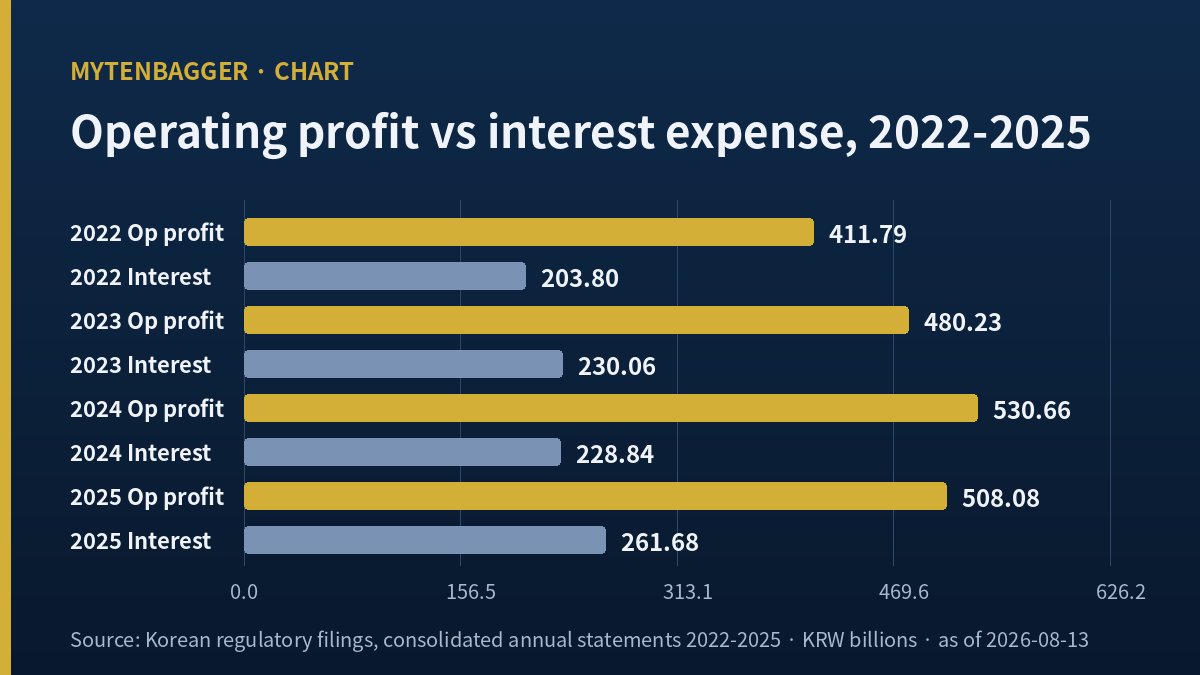
Price is a quarterly story. Widening to four years surfaces a different line. I pulled consolidated annual statements from the Korean regulatory filing database for 2022 through 2025.
| Year | Revenue (KRW bn) | Operating profit (KRW bn) | Interest expense (KRW bn) | Interest coverage |
|---|---|---|---|---|
| 2022 | 12,130.71 | 411.79 | 203.80 | 2.0205 |
| 2023 | 11,767.89 | 480.23 | 230.06 | 2.0874 |
| 2024 | 12,116.76 | 530.66 | 228.84 | 2.3189 |
| 2025 | 12,284.65 | 508.08 | 261.68 | 1.9416 |
Consolidated annual statements from the Korean regulatory filing database, filings 20230317000857, 20240320001789, 20250317000953 and 20260316001417. Interest coverage is operating profit divided by interest expense, calculated by me.
Across those four years revenue moved from KRW 12,130.71 billion to KRW 12,284.65 billion, growth of 1.269 percent. Operating profit moved from KRW 411.79 billion to KRW 508.08 billion, growth of 23.3845 percent. Interest expense moved from KRW 203.80 billion to KRW 261.68 billion, growth of 28.3986 percent. Interest grew faster than the profit it is paid out of, and coverage fell from 2.3189 times in 2024 to 1.9416 times in 2025.
The first quarter of 2026 went lower still. Operating profit of KRW 92.11 billion (USD 65.06 million) against interest expense of KRW 72.41 billion (USD 51.15 million) is coverage of 1.2721 times. The prior-year first quarter was KRW 85.37 billion against KRW 60.21 billion, coverage of 1.4178 times. Over that year operating profit grew 7.8942 percent while interest expense grew 20.2558 percent, and what remains after interest fell from KRW 25.16 billion to KRW 19.70 billion.
Capital spending explains the direction. Filed capital expenditure was KRW 193.26 billion in 2024 and KRW 573.95 billion in 2025. Korean press has reported an expected figure near KRW 634.3 billion for 2026. The 2025 outlay of KRW 573.95 billion equals 112.97 percent of that year’s operating profit of KRW 508.08 billion. The company spent more than it earned at the operating line, and the difference has to be funded.
One place where sources disagree
Borrowing figures diverge. A Korean report dated June 9, 2026 put debt in the KRW 4 trillion range with annual interest expense above KRW 150 billion. The filed 2025 consolidated interest expense is KRW 261.68 billion. The two differ by more than KRW 110 billion. The same report’s capital expenditure figures (KRW 193.3 billion for 2024, KRW 574.0 billion for 2025) and free cash flow figures (KRW 412.9 billion for 2024, KRW 328.4 billion for 2025) matched the filings to the last unit, so the interest line is the single item out of step. I could not establish which figure is parent-only and which is net of interest income. I carry both and use only the filed consolidated number in every calculation here.
How four Korean brokerages read CJ Logistics stock, sorted by what they saw
| House and analyst | Number on the page | Previous number | Results reflected |
|---|---|---|---|
| Korea Investment and Securities, Choi Go-un | KRW 125,000, buy | not stated in coverage | Q2 2026 |
| iM Securities, Bae Se-ho | KRW 110,000, buy | KRW 140,000 | Q2 2026 |
| Hana Securities, Ahn Do-hyun | KRW 120,000 | KRW 165,000 | Q1 2026 |
| LS Securities, Lee Jae-hyuk | KRW 120,000 | KRW 140,000 | Q1 2026 |
Houses, analysts and figures are taken from Korean press coverage quoting each note. I do not adopt any of these values as my own.
Sorting them by what they had seen matters more than averaging them. The first two wrote after second quarter results; the second two wrote with only the first quarter in hand. Blending four numbers with two different information sets produces one number that describes neither. iM Securities cut its 2026 and 2027 operating profit estimates by 4 percent and 5 percent, citing promotional pricing to secure volume and infrastructure spending, and published 2026 estimates of KRW 13,361.0 billion revenue and KRW 462.0 billion operating profit. That KRW 462.0 billion sits 9.0694 percent below the KRW 508.08 billion actually earned in 2025.
The first quarter belongs in the same view. Operating profit came in at KRW 92.11 billion against a market expectation of KRW 116.5 billion, so 92.11 divided by 116.5 is 0.7906, a shortfall of 20.94 percent. Two consecutive quarters of earning less than the market expected is the common background behind every number those four houses moved.
CJ Logistics stock beside a global peer in the same work
GXO Logistics (NYSE: GXO) is the cleanest listed comparison, because contract logistics is its entire business, while the Korean company runs it as one division among several. At the August 11, 2026 close GXO traded at USD 46.67 with a market capitalization of USD 5.35 billion and trailing twelve month revenue of USD 13.64 billion. Price multiplied by the 114.68 million share count gives USD 5.3521 billion, which reproduces the displayed capitalization, and USD 46.67 divided by the trailing multiple of 41.03 gives USD 1.1375, which reproduces the displayed earnings per share of USD 1.14. Revenue-based valuation there is 0.3924 times.
Running the identical calculation on the Korean company gives market capitalization of KRW 1,690.37 billion over 2025 revenue of KRW 12,284.65 billion, which is 0.1376 times. Each unit of revenue is valued at 35.07 percent of what the market pays for GXO’s. GXO carries a trailing earnings multiple of 41.03 times and a forward multiple of 14.09 times, the profile of a company whose profit is thin now and whose recovery is being paid for early. This company earns money and carries a multiple near seven. Both sell contract logistics.
I am not calling either one cheap on that comparison. Accounting regimes differ, markets differ, and GXO carries no parcel network. What the comparison establishes is narrower and still useful: a 0.38 times book multiple is not simply what this industry receives everywhere. That number is attached to the conditions of this specific company.
The case for optimism on CJ Logistics stock, carried over intact
Stopping here would leave one side of the file. I am carrying the other side across as it was written.
First, Korea Investment and Securities kept a buy view and a KRW 125,000 valuation on August 12, 2026, writing that volume grew 11 percent on new last-mile delivery growth and deeper cooperation with large platform customers, and that two consecutive quarters of double-digit growth was a first in five years. The same note expected operating margin to improve gradually from a second quarter floor. Read that way, the profit decline is a starting point for recovery.
Second, market position. Korean coverage from June 2026 put this company at 43.4 percent of domestic parcel volume against roughly 35 percent for Coupang. Lowering price to hold volume can be read as spending to defend that position, which is directionally consistent with the company attaching its own profit decline to service investment and infrastructure investment.
Third, price. A book multiple of 0.3818 times values the whole company at 38 percent of its net assets, and an earnings multiple of 6.9863 times says that seven years of current profit would cover the market capitalization. The price also sits 51.88 percent below the 250-day high of KRW 154,000.
I do not dispute any of the three. All three, though, rest on where the price per box stops falling. That the size of the fall currently reads three different ways is exactly why I am watching.
What I left out, and where my position stands
The exclusions first, because a blank is safer than a plausible wrong number. The vendor screen’s EBITDA of KRW 921.05 billion is unit-for-unit identical to the same screen’s first quarter 2026 operating profit of KRW 92.11 billion, which marks it as a copied field, so I dropped it. The Korean filing database provides no depreciation account, so I could not build EBITDA myself either. Second quarter interest expense has not been filed yet, so I calculated no second quarter coverage. I saw a reference to Daol Investment and Securities raising its number to KRW 130,000 but could not fix the note’s date, so it stays out of the table. Treasury share cancellation is unresolved, with the company saying only that shareholder return remains under review, so no capitalization adjustment was made for it.
My position is watching. Two conditions together would change my read. One is the gap between parcel revenue growth and parcel volume growth closing. In the second quarter of 2026 those were 8.5 percent and 12.1 percent, a gap of 3.6 percentage points; inside one percentage point I would read the price decline as over. The other is interest coverage returning above 2 times. The 1.2721 times of first quarter 2026 is lower than anything in the four-year series above.
The condition that kills my read is different in kind. If the three values for the price decline converge on one number and margin still fails to recover, then price was never the cause and the axis of this article was wrong from the start. In that case I count again from zero. What that test judges is not the company’s results but whether my explanation was any good.
Adjacent Korean transport names I have worked through before use different axes entirely: the earnings multiple left behind after a narrative unwound at Hyundai Glovis, freight rates against a buyback price at HMM, and merger arithmetic at Korean Air.
Price, market capitalization and multiples use the August 12, 2026 close of KRW 74,100. Annual financials come from consolidated filings in the Korean regulatory database; quarterly indicators cross-check a Korean data vendor screen refreshed August 10, 2026 against those filings. Every dollar conversion applies KRW 1,415.70 per US dollar, the Seoul foreign exchange market daytime close of August 12, 2026 as reported by Korean press.
The line I will open first next quarter
When third quarter results arrive I do not plan to start with the income statement. I will put parcel revenue growth and parcel volume growth side by side and read the distance between them first. In the second quarter of 2026 that distance was 3.6 percentage points.
If it narrows, this company has finished the stretch where it buys volume by discounting price. If it holds or widens, a ten-quarter run becomes eleven, then twelve. For a company that has spent four years between KRW 12 trillion of revenue and roughly KRW 500 billion of operating profit, the figure actually moving is neither of those two. It is the price line wedged between them.
The 2026 half-year filing will also fix first-half interest expense, which shows whether 1.2721 times was a single-quarter event. I intend to open both numbers on the same day.
Sources
- Company newsroom, Q2 2026 results release, August 11, 2026 (Korean)
- Global Economic, quoting the Korea Investment and Securities note, August 12, 2026 (Korean)
- Etoday, quoting the iM Securities note, August 12, 2026 (Korean)
- Bloter, capital spending, free cash flow and dividend policy, June 9, 2026 (Korean)
- Business Post, Q2 2026 results and company commentary, August 11, 2026 (Korean)
- Money Today, Seoul FX daytime close of KRW 1,415.70 on August 12, 2026 (Korean)
- Korean regulatory filing database, annual and quarterly reports
- stockanalysis.com, GXO Logistics metrics as of August 11, 2026