Hanon Systems Share Issues: Less Debt, Lower Earnings Per Share
A company can fix its balance sheet. It cannot un-issue a share.
That asymmetry is the whole subject of this entry. I have been going through Hanon Systems stock at its August 14, 2026 close of 3,820 won, roughly 2.69 US dollars, and what I found is a business whose profit has come most of the way back and whose per-share profit has not come back at all.
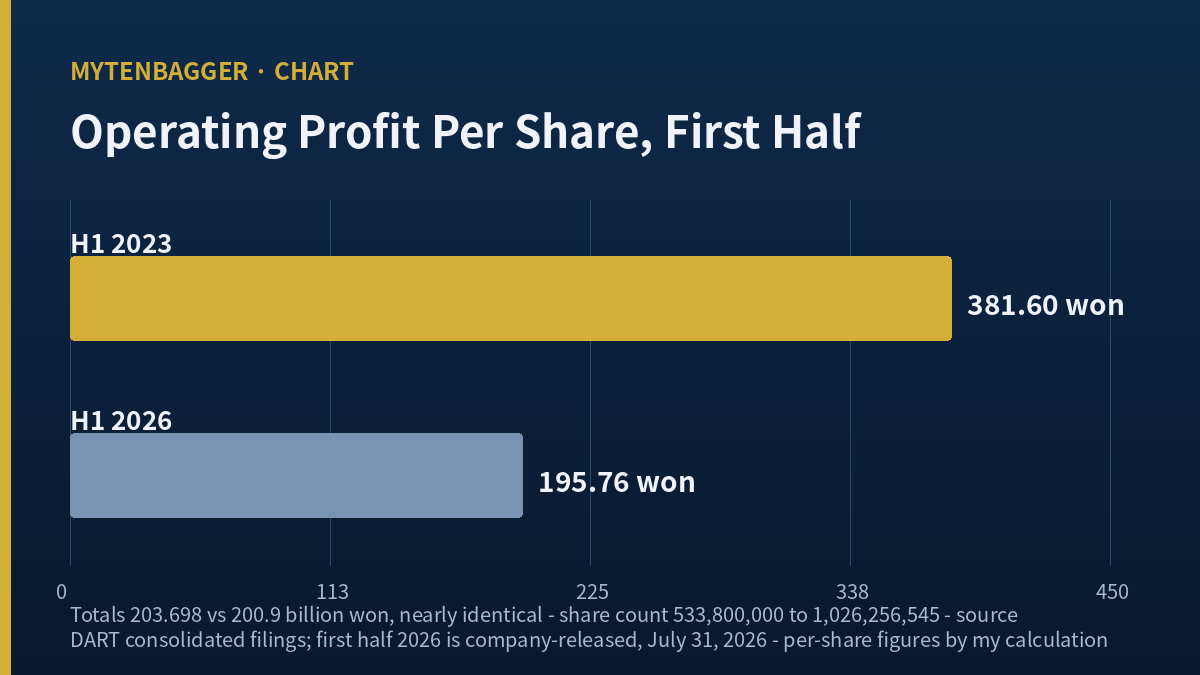
First half 2023 to first half 2026, three arrows
Operating profit → 203.698 billion won to 200.9 billion won → down 1.37 percent
Shares outstanding → 533,800,000 to 1,026,256,545 → up 92.25 percent
Operating profit per share → 381.60 won to 195.76 won → down 48.70 percent
Contents
Hanon Systems Stock at 3,820 Won and the Share Count Under It
Hanon Systems trades on the KOSPI, the senior board of the Korea Exchange, under code 018880. The KOSPI is Korea’s main-board market, the venue where Samsung Electronics and Hyundai Motor list; the smaller KOSDAQ board is a separate market and this company is not on it.
The August 14, 2026 close was 3,820 won. I am writing on Saturday, August 15, which is Liberation Day in Korea, so there is no trading and no Friday-night revision. The last business day is the base for everything below.
Market value at that price is 3.9203 trillion won, about 2.76 billion US dollars. I multiplied it out instead of copying the screen: 3,820 won times 1,026,256,545 shares equals 3,920,300,001,900 won. That matches to the last won, which tells me the market value on my screen is built on the post-issue share count.
I checked the share count a second way. Paid-in capital is 102.6 billion won, and 1,026,256,545 shares at a 100 won par value comes to 102.626 billion won. The two confirm each other, and the data screen’s stock-split flag is off, which is consistent with that multiplication.
Then I looked one cell over and the agreement broke. The screen shows earnings per share of negative 288 won. But the 2025 consolidated net loss of 197.269 billion won divided by 1,026,256,545 shares is negative 192.22 won. To produce negative 288 won, the number doing the dividing has to be about 684.96 million shares, which is where the count sat before the December 2025 issue. A weighted average landing there is normal accounting. The effect is still that the market-value cell uses the new share count and the earnings-per-share cell uses the old one.
I do not treat that as a data error. It is closer to a preview of the subject: almost every historical figure attached to this company was produced on a share count that no longer exists.
Two Share Issues, Fourteen Months Apart
Korean business press reported the arithmetic plainly in February 2026: 533.8 million shares before, 1,026.26 million after, a 92 percent increase. Two separate issues produced it.
The first came in December 2024, a third-party allocation of roughly 600 billion won, about 423 million US dollars, raised while Hankook Tire and Technology took control of the company. The second came in December 2025, a rights offering to existing holders with the unsubscribed remainder placed publicly.
The company published the second one in detail. The final issue price was 2,830 won per share for 347.5 million new shares, about 983.4 billion won in total, roughly 693 million US dollars, with the new shares scheduled to list on January 12, 2026. Hankook Tire and Technology subscribed to 100 percent of its allocation, 152,293,930 shares, which is 43.8 percent of the new stock. That is a Korean-language corporate release; the figures here are my rendering of it and no part of this is a quoted English original.
Two checks of my own. 347,500,000 times 2,830 equals 983,425,000,000 won, which agrees with the company’s stated total. And 152,293,930 divided by 347,500,000 is 43.83 percent, which agrees with the 43.8 percent the company stated.
For the December 2024 issue I could not find a share figure published by the company, so I subtracted: 1,026,256,545 minus 533,800,000 minus 347,500,000 leaves 144,956,545 shares by my calculation. Dividing the reported 600 billion won by that gives roughly 4,139 won per share, also by my calculation, but the 600 billion is itself a rounded press figure, so that unit price is approximate and I do not build anything on it. The share count is the part I use.
Where the money went
The company’s own disclosure allocates the December 2025 proceeds: 883.4 billion won to debt repayment, of which 800 billion retired a bridge loan from NH Investment and Securities and 83.4 billion a term loan; 51.2 billion won to working capital; 48.8 billion won to facilities. Just under 90 percent of the raise went to paying down borrowings.
It worked. On Korean regulatory filings, consolidated total liabilities fell from 7,621.5 billion won at the end of 2024 to 6,579.3 billion won at the end of 2025, a reduction of 1,042.2 billion won or about 734 million US dollars. Equity rose from 2,998.7 billion to 3,912.9 billion won over the same span. The debt-to-equity ratio went from 254.16 percent to 168.14 percent, and stood at 164.60 percent at the end of the first quarter of 2026.
None of that is in dispute here. What I want on the record is who paid for it. I worked through a similar structure when I separated what leverage contributes to a return metric at Cosmax, though the amounts here are larger and the dilution is much wider.
Hanon Systems Stock and a First Half That Matched 2023
On July 31, 2026 the company released second-quarter results: revenue 2,875.2 billion won, about 2.03 billion US dollars; operating profit 103.7 billion won, about 73 million dollars; net profit 86.1 billion won, swinging from a 15.1 billion won loss a year earlier. Korean coverage of the release put the operating profit increase at 61.2 percent year over year.
I checked that against the regulatory filings. Second-quarter 2025 standalone-quarter operating profit was 64.301 billion won. 103.7 divided by 64.301 is 1.6127, so 61.27 percent, which agrees with the company figure to the first decimal. Revenue agrees too: 2,875.2 billion against 2,858.196 billion is up 0.59 percent, and the company said 0.6 percent.
First-half totals: revenue 5,623.5 billion won, about 3.96 billion US dollars; operating profit 200.9 billion won; net profit 153.5 billion won. The company’s second-quarter release also gives a first-half cost-of-goods ratio of 89.3 percent and an electrified-vehicle revenue share of 31 percent.
| Period | Revenue | Operating profit | Margin | Net profit |
|---|---|---|---|---|
| FY2023 | 9,559.3 | 277.3 | 2.90% | 58.9 |
| FY2024 | 9,998.7 | 95.5 | 0.96% | −358.6 |
| FY2025 | 10,883.7 | 270.4 | 2.48% | −197.3 |
| Q1 2026 | 2,748.2 | 97.2 | 3.54% | 67.5 |
| Q2 2026 | 2,875.2 | 103.7 | 3.61% | 86.1 |
| H1 2026 | 5,623.5 | 200.9 | 3.57% | 153.5 |
| H1 2023 | 4,769.5 | 203.7 | 4.27% | 155.8 |
The bottom two rows are why I started writing. First-half 2026 operating profit of 200.9 billion won is 98.63 percent of the 203.698 billion won earned in the first half of 2023. Net profit is 98.49 percent of its 2023 counterpart. Three years on, the company earns essentially what it earned.
Revenue over the same span went from 4,769.5 billion to 5,623.5 billion won, up 17.91 percent, so the company sells considerably more to earn the same amount. Operating margin fell from 4.27 percent to 3.57 percent. Read on its own, that is an ordinary story about a supplier under cost pressure that made up ground with volume.
Dividing Hanon Systems Stock Profit by a Bigger Number
The ordinary story stops here. Run the same two half-years through the share count and the sign flips.
First half 2023: 203.698 billion won over 533,800,000 shares is 381.60 won per share, by my calculation, about 0.269 US dollars.
First half 2026: 200.9 billion won over 1,026,256,545 shares is 195.76 won per share, by my calculation, about 0.138 dollars.
195.76 over 381.60 is 0.5130. A decline of 48.70 percent.
Net profit behaves the same way: 291.96 won per share in the first half of 2023, 149.57 won in the first half of 2026, down 48.77 percent. The two results sit 0.07 percentage points apart.
They land together because the arithmetic forces it. Total profit fell between 1 and 1.5 percent while the share count rose 92.25 percent, and 0.9863 divided by 1.9225 is 0.5130. The figures agree with each other, and the agreement also shows where the 48.7 percent came from. It came from the share count, and very little of it from the business.
Change the base year and the answer reverses
Something I have to put on the record. Choosing the first half of 2023 as the comparison was my decision, and a different choice produces the opposite conclusion.
First-half 2025 operating profit was 85.375 billion won. The share count then was 678,756,545, by my calculation, being after the December 2024 issue and before the December 2025 one. That is 125.78 won per share. Against it, the first-half 2026 figure of 195.76 won is up 55.64 percent.
So “per-share profit halved” and “per-share profit rose by half” are both true statements about the same company over the same six months. Only the starting point differs. I picked 2023 because 2024 and 2025 carried net losses of 358.6 billion won for the full year and 37.7 billion won for the first half respectively, which makes them poor stand-ins for normal operations. That is a judgment, and I am labeling it as one.
The issue price and the current price
Anyone who took up the December 2025 rights paid 2,830 won, about 1.99 US dollars. The August 14, 2026 close of 3,820 won is 34.98 percent above that. Subscribers are ahead.
Someone who held before either issue is in a different position: the slice of company profit attached to each of their shares shrank by the amount calculated above. The same event reached two sets of holders differently, and I do not think the two facts cancel. They coexist.
Eight Days and Two Estimates for Hanon Systems Stock
Before the quarter was published, two Korean brokerages moved in opposite directions on the same three months. I did not arrange this contrast; the dates and the levels are simply on the record.
Hyundai Motor Securities analyst Jang Moon-soo, on July 15, 2026, modeled second-quarter operating profit at 109.0 billion won, kept a marketperform rating, and moved the level he had written down from 4,200 won to 3,900 won. He expected the quarter to come in 0.4 percent under consensus.
Yuanta Securities analyst Kim Yong-min, eight days later on July 23, 2026, modeled the same quarter at 139.0 billion won, kept a buy rating, and moved the same 4,200 won starting level up to 4,300 won. He expected the quarter to beat a 112.0 billion won consensus by 24 percent.
Two houses, one common starting level, eight days, opposite direction. The two quarterly estimates stood 27.52 percent apart.
The company reported 103.7 billion won on July 31, 2026.
| Source | Date | Figure | Versus 103.7 actual |
|---|---|---|---|
| Hyundai Motor Securities, Jang Moon-soo | July 15, 2026 | 109.0 | +5.11% |
| Market consensus, as cited by Yuanta | as of July 23, 2026 | 112.0 | +8.00% |
| Yuanta Securities, Kim Yong-min | July 23, 2026 | 139.0 | +34.04% |
| Company release | July 31, 2026 | 103.7 | — |
All three figures sat above the reported number, and the lowest of them was the closest. The estimate that called for a 24 percent beat missed high by 34.04 percent.
I am not writing this to score anyone. I am writing it because a quarterly result that splits two professional estimates by 27.52 percent over eight days is telling me something about the business: cost inputs, currency, and customer volumes move this profit line enough that a good analyst working with a full model can be a third off. That volatility is a property of the company, and I want it in my notes before I ever consider owning it.
Five Houses and What They Marked for Hanon Systems Stock
In early May 2026, after the first quarter was published, a cluster of Korean brokerage summaries carried levels in their headlines. I did not read the underlying research; what follows is the level printed in each summary, and I want that limitation stated before the list.
- Kiwoom Securities marked 6,500 won on May 4, 2026, raised, with the note citing an April 30 price of 4,230 won
- Kyobo Securities marked 6,100 won on May 4, 2026
- Eugene Investment marked 5,250 won on May 4, 2026
- Korea Investment and Securities marked 5,200 won on May 4, 2026
- BNK Investment Securities marked 5,000 won on May 7, 2026
The two July marks discussed above were 3,900 won and 4,300 won. Because the May group and the July pair are from different dates, lining them up as a single range and measuring its width would be a mistake. Keeping the dates attached, the direction still reads: early May clustered between 5,000 and 6,500 won, mid-to-late July between 3,900 and 4,300.
A February 4, 2026 Korean article carried a 3,000 won level with a neutral stance, and I could not establish from that piece which house issued it, so I am leaving the figure without an owner. What that same article contributed to my thinking is a sentence, which I am paraphrasing out of Korean instead of presenting as an English quotation: profitability gains driven by cost cuts have uncertain durability, and because the share count rose through the equity issues, the recovery in earnings per share is correspondingly limited. That is the argument I ended up making with my own arithmetic.
The same article listed earnings per share of 96 won for 2023, negative 311 won for 2024, and negative 234 won for 2025. Those are the article’s figures, and as established above, each year divides by a different share count. I did not compare them to each other.
Hanon Systems Stock Against Modine, Which Left Its Share Count Alone
I did not choose it because the product lines overlap neatly. I chose it because it is a thermal-management manufacturer that left its share count essentially untouched over the same stretch. My argument turns on the share count, so I need a company where that count held still and I can watch what else moved.
In its fiscal 2026 results, for the year ended March 31, 2026, Modine reported net sales of 3,181.1 million dollars, up 23 percent from 2,583.5 million; operating income of 342.4 million; net earnings of 123.3 million, which included a 116.1 million dollar non-cash pension termination charge; and diluted earnings per share of 2.26 dollars on 53.8 million weighted-average diluted shares.
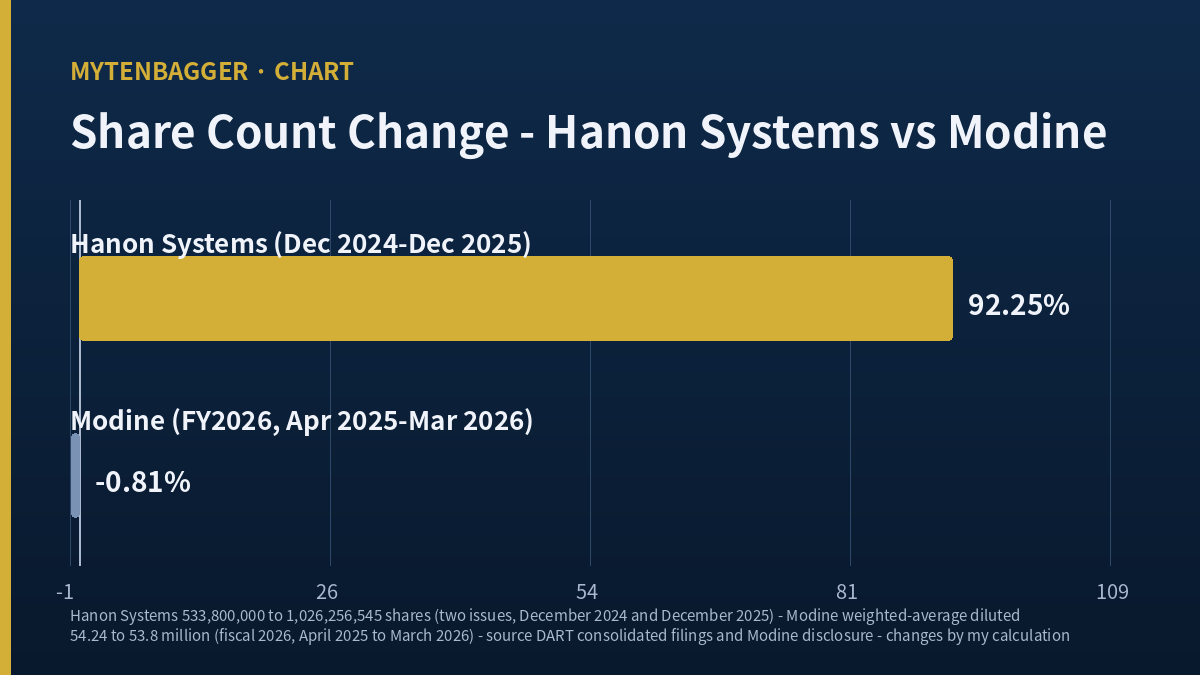
The prior year showed 3.42 dollars of diluted earnings per share on 185.5 million dollars of net earnings, implying about 54.24 million shares by my calculation. Modine’s share count therefore moved 0.81 percent lower over the year, by my calculation. Effectively flat.
Its earnings per share, meanwhile, fell from 3.42 to 2.26 dollars, down 33.92 percent by my calculation. When the share count holds still and the per-share figure drops, the drop is coming from earnings, and Modine’s release names the cause, the pension charge, right in the text.
Hanon Systems is the mirror image. Its half-year earnings are within a percent and a half of where they were three years ago, and the per-share figure is down by half. The cause is on the other side of the division.
That is where I stop. I am not putting the two companies’ margins or multiples in one table. The fiscal years end in different months, with Modine’s 2026 year covering April 2025 through March 2026 against a December year-end here; Modine has grown a substantial data-center cooling business, so the revenue mix has diverged; and above all I have not read either company’s accounting notes to establish what does and does not sit inside each operating profit line. A table that puts differently-defined figures side by side gives a reader false precision.
What I use is one item: the change in share count, negative 0.81 percent against positive 92.25 percent. That item means the same thing at both companies.
What I Left Out
A comparison year took most of my working time on this entry. I set up against the first half of 2024, dropped it, went to the first half of 2025, dropped that too. Somewhere in there I noticed that what I was actually doing was hunting for the year that made my conclusion look sharpest. So I changed approach and wrote the rejected year into the article itself; the section above on changing the base year is what came out of that. If I do not write down that kind of doubling back, the next time I do it I will not recognize it.
Fields I dropped from the screen
From my data screen (Kiwoom feed, refreshed August 14, 2026 at 17:11 Korean time, derived fields August 15 at 00:30), the following did not make it into the argument.
- EBITDA of 97,180 million won. Identical to the first-quarter 2026 operating profit of 97,180 million won, to the last unit. No depreciation has been added, so it is not usable as EBITDA.
- Interest coverage of 0.86. That is 97.18 divided by 113.049 billion won, a single quarter’s figure. Worse, the interest expense series does not reconcile annually: cumulative third-quarter 2025 interest of 342.5 billion won exceeds the 337.9 billion won reported for the full year. I could not settle the account definition, so I did not even use it directionally.
- Price-to-earnings of zero. Trailing earnings per share is negative, so the ratio has no value.
- Book value per share of 3,671 won. Multiplied by 1,026,256,545 shares that is 3,767.4 billion won, against consolidated equity of 4,115.9 billion won at the end of the first quarter. The 348.5 billion won gap may be non-controlling interests or a different basis; I could not confirm which, so I quote price-to-book of 1.04 as displayed and derive nothing from it.
- Free float of 1,026,263,000 shares. Essentially the entire listing, despite a large controlling holder. The field is not reflecting a float concept.
- Dividend fields. Dividend per share zero and yield zero, while a payout-ratio field in the raw feed still carries 47.5.
- Forward earnings per share, forward price-to-earnings, and peer multiple. All three empty.
One field that did check out
The three-year revenue growth field reads 8.05, and this time it reproduces. The cube root of 10,883.7 divided by 8,627.7, minus one, is 8.05 percent, which confirms fiscal 2022 revenue of 8,627.7 billion won as the starting point. I have been excluding this field on other names for a long run of entries; here it is correct, so it does not go on the excluded list.
Price position depends on which window you use
Over a one-year window ending August 14, 2026, covering 244 trading days, the closing high was 5,730 won on May 11, 2026 and the closing low was 3,160 won on July 29, 2026. Against those, the August 14 close of 3,820 won is 33.33 percent below the high and 20.89 percent above the low.
A different cell on the same screen uses a 250-trading-day adjusted-close window and puts the high at 5,940 won, which makes the drawdown 35.69 percent. The 2.36 percentage point gap comes from the window length and nothing that happened at the company. I used the one-year window in the body so the price position is computed from the same window as the close printed in my tables.
Benchmark decomposition, checked and set aside
Over the same year the stock returned 30.06 percent against 116.33 percent for the KOSPI and 2.03 percent for an equal-weighted auto-parts sector index excluding the stock itself. It lost badly to the market and beat its sector, with the sector effect accounting for most of the shortfall. That is the same pattern I used in recent entries, and running the same pattern again as an argument turns analysis into repetition. So it is recorded here and kept out of the case.
Nineteen Ways Hanon Systems Stock Could Prove Me Wrong
- Half a year is a short measuring period for judging cost improvement at an auto supplier, and my whole comparison is built on half-years.
- This company’s profit swings with customer volumes and currency. Two estimates eight days apart differing by 27.52 percent is itself the evidence.
- The controlling holder taking up 43.8 percent of the new stock can be read as a stability signal. I treated it only as dilution.
- My non-controlling interest estimate of 348.5 billion won is inferred from the gap between book value per share and total equity. I did not read it from a filing.
- The share count implied by the screen’s negative 288 won earnings figure is about 684.96 million by my calculation, but I could not establish exactly which weighted-average period that represents.
- Modine has grown a data-center cooling business, so its mix already differs from a pure vehicle supplier.
- Modine’s fiscal year ends in March, so the comparison periods do not align exactly.
- The 3,000 won level in the February article has no owner I could identify.
- The May group and the July pair carry different dates. Reading anything more than direction from them would be wrong.
- Margin falling from 4.27 percent to 3.57 percent has nothing to do with the share count. That is an operating story, and my framing could obscure it.
- If the company earns more with the capital it raised, the per-share figure recovers. My calculation is a still frame that contains no such recovery.
- The 31 percent electrified-vehicle revenue share is a company figure, and its contribution to profit is not disclosed.
- The 89.3 percent first-half cost ratio is a company figure, and I could not obtain the equivalent for the first half of 2023.
- I did not read the accounting notes on what enters and leaves the operating profit line. There is no guarantee the 2023 and 2026 compositions match.
- I did not verify the listing date of the December 2024 issue, and my 678,756,545 share count for the first half of 2025 rests on that assumption.
- The 144,956,545 new shares from the December 2024 issue is a subtraction of mine. No filing I saw printed it.
- Second-quarter figures are company-released and the half-year regulatory filing is not out. The statutory deadline is August 15, 2026, which falls on a holiday and may move to Monday, August 17.
- Without the equity issue, interest expense would have taken more of the profit. I have not quantified what the dilution bought.
- I chose the base year. Measured from the first half of 2025, per-share operating profit is up 55.64 percent. This is the strongest objection on the list.
Where I Stand
At 3.9203 trillion won of market value it sits outside the top hundred Korean listings, where watching is my default, and nothing in this arithmetic was strong enough to move me off that default.
Watching is not the same as being negative. The cost improvement is visible in the figures. Second-quarter operating profit of 103.7 billion won is 6.71 percent above the first quarter’s 97.18 billion and 61.27 percent above the same quarter last year. The direction is up.
Two things would get my attention. First, whether second-half operating profit clears the first half’s 200.9 billion won; if it does, the full year passes the level of three years ago for the first time, and there is a reason to run the per-share arithmetic again. Second, whether the share count moves again. A further raise or a cancellation would mean my 48.70 percent has to be rebuilt from scratch instead of adjusted.
My discard condition sits elsewhere. If second-half operating profit comes in below the first half’s 200.9 billion won, this entry’s subject is void: the problem would be the operating business and not the share count, and an argument built on the share count would be pointed at the wrong thing. In that case I throw the comparison away instead of revising it.
The comparison sits on the wrong side of the page
What is unusual here is the direction of the liquidity problem. Modine, the company I brought in only as a check on my own arithmetic, is the one that is widely followed and easily traded. The company this entry is actually about is neither. For once the nearest listed exposure to this product category sits on the comparison side of the page.
For related entries in the same corner of the market, I have written on record profit at Hyundai Mobis trading below book value, on a Nexen Tire multiple I decided not to use, and on why I favored Kia over Hyundai Motor, which is the customer end of this same supply chain.
The number that settles this is not one my spreadsheet can produce. It is one the company will choose: whether it goes back to the market for capital again. Until that choice is made, everything above is arithmetic on a share count that happens to be sitting still.
Prices and multiples reflect the August 14, 2026 close as checked at the time of writing, so live quotes will differ. Fiscal 2023 through fiscal 2025 and the first quarter of 2026 come from Korean regulatory filings, while the second quarter of 2026 and the half-year totals are company-released figures dated July 31, 2026, and I have not confirmed that the two sources define every line identically. Dollar figures are approximate, converted at roughly 1,419.4 won per dollar, the Seoul close of August 13, 2026, one business day before the price date. Korean won is the reference currency throughout, and all per-share figures are my own calculation.