Hankook Tire Earnings: Group Profit Below Owner Profit in 2025
I went looking at Hankook Tire stock for the usual reasons and stopped on a line I almost never read. For fiscal 2025 the company reported group net income of KRW 971,594 million and net income attributable to owners of the parent of KRW 1,089,466 million. The whole is smaller than the part. I subtracted the two and got KRW -117,872 million, which is what the minority shareholders of the consolidated group were assigned for the year.
That is roughly 117.9 billion won, or about 85 million US dollars at the rate I use throughout this piece. It is not an accounting impossibility. It is what happens when a subsidiary loses money and someone else owns a large slice of it. What made me sit with it is that this company had never done it before, and that a named analyst had written almost exactly the same number four months earlier for a completely different reason.
The one line this piece is built on. Fiscal 2025 group net income KRW 971,594 million, minus net income attributable to owners KRW 1,089,466 million, equals KRW -117,872 million. Source: consolidated statements in the fiscal 2025 annual filing. The subtraction is mine.
Contents
What Hankook Tire Stock Looks Like Before I Open the Filings
Hankook Tire and Technology trades on the KOSPI under 161390. The KOSPI is the senior board of the Korea Exchange, the larger and generally more liquid of Korea’s two listed markets, and 161390 sits in its auto parts group.
The close on August 25, 2026 was 66,900 won. Multiplied by 123,874,439 shares outstanding that gives 8,287,199,969,100 won, or about 8.29 trillion won, which matches the market capitalization field on my data screen at the hundred-million-won level. In US dollars that is roughly 5.995 billion. Trailing PER 7.61, PBR 0.68, EPS 8,795 won, BPS 98,085 won, ROE 9.4, debt-to-equity 84.72 percent, foreign ownership 39.58 percent.
Against a 250-day high of 78,400 won and a low of 37,650 won on an adjusted-close basis, the August 25 price sits at 85.33 percent of the high, 14.67 percent below it, and 77.69 percent above the low. All three are my own calculations from the close in this piece. The twelve-month return is plus 50.34 percent and the one-month return is minus 5.11 percent.
None of that told me anything I could use, because the denominator under the PER changed shape in 2025 and I had not yet worked out how.
Two Lines That Do Not Agree About Whose Year It Was
Here is the four-year sequence for the two profit lines, in hundreds of millions of won, from the consolidated annual filings.
| Fiscal year | Group net income | Owners share | Minority line |
|---|---|---|---|
| 2022 | 7,057.74 | 6,902.48 | +155.26 |
| 2023 | 7,287.92 | 7,202.17 | +85.75 |
| 2024 | 11,310.97 | 11,146.28 | +164.69 |
| 2025 | 9,715.94 | 10,894.66 | -1,178.72 |
Units are hundreds of millions of won, converted from the filings’ million-won values by dividing by 100. The minority column is group net income less the owners’ figure, computed by me.
Three years at plus one to two hundred, then one year at minus eleven hundred. I want to be careful about the word I use for that. The minority line going negative does not mean money moved from one pocket to another. It means the consolidated group’s loss-making piece is owned in part by people who are not the parent, and the arithmetic assigns their share to them.
The subsidiary that changed the shape
Hankook Tire took control of Hanon Systems, a Korean thermal management supplier listed as 018880. The board approved a 50.5 percent acquisition in May 2024 at a planned total near 1.73 trillion won. Execution came in two pieces: a 600 billion won third-party share issue that settled in December 2024 and lifted the stake to 36.6 percent, then the purchase of 122,774,000 existing shares from Hahn and Company that closed on January 3, 2025 and took the stake to 54.77 percent. That closing date is when consolidation begins.
Hanon Systems posted a net loss in both 2024 and 2025, with reported EPS of minus 311 won and minus 234 won respectively, and Korean trade coverage tied the 2025 fourth-quarter loss of about 196 billion won to roughly 200 billion won of asset impairment connected to electric-vehicle program cuts at two US automakers. I wrote about that subsidiary on its own terms in a piece on how its per-share profit halved. This piece is the same event seen from the parent’s income statement.
Hankook Tire Stock and an Incremental Margin of 0.67 Percent
Before I got to the profit split I did a simpler thing, and it is the calculation I would keep if I could keep only one from this session.
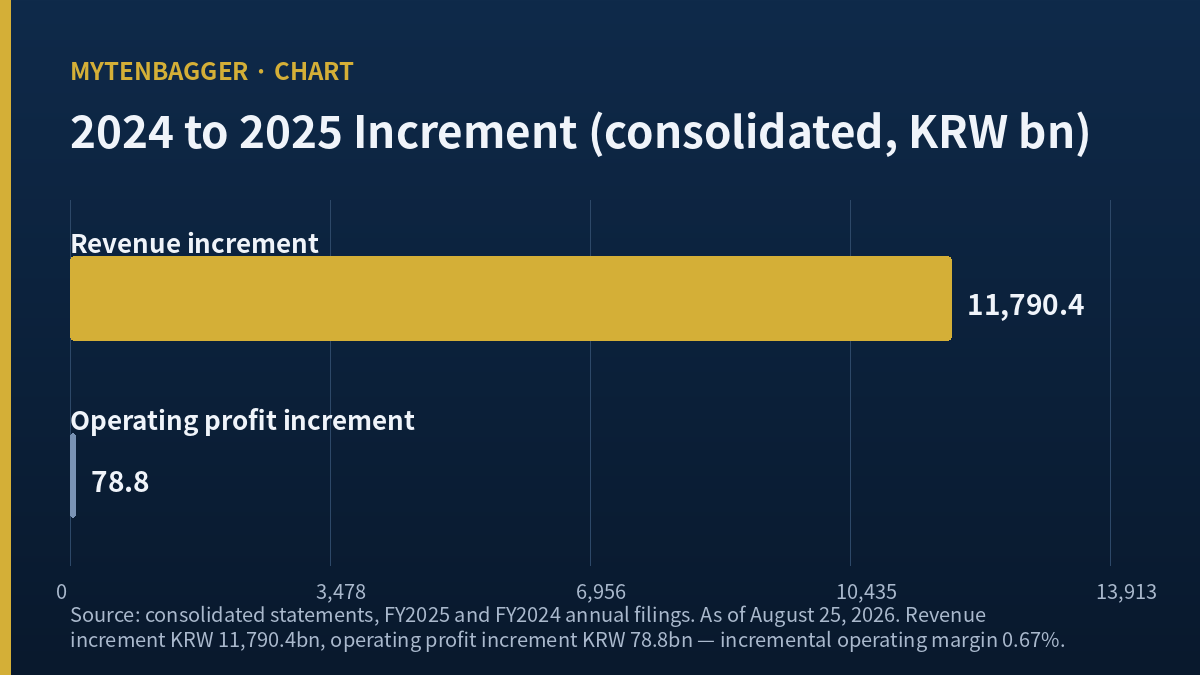
Consolidated revenue went from KRW 9,411,947 million in 2024 to KRW 21,202,299 million in 2025. That is a 125.27 percent increase, a multiple of 2.2527, and an absolute increase of KRW 11,790,352 million. Operating profit over the same two years went from KRW 1,762,260 million to KRW 1,841,075 million, an increase of 4.47 percent and KRW 78,815 million.
Dividing the second increase by the first gives 0.6685 percent. Every hundred won of newly consolidated revenue brought about sixty-seven jeon of additional operating profit. The pre-existing business had been running an 18.72 percent operating margin, so the incremental slice came in at roughly one twenty-eighth of that, 18.72 divided by 0.6685 being 28.0. Group operating margin fell from 18.72 percent to 8.68 percent.
What that ratio cannot tell me
Two things contaminate it and I did the division knowing so. First, the 78,815 million won of incremental operating profit is not purely the acquisition’s contribution. It also carries whatever the legacy tire business gained or lost that year, and 2025 was a year in which US tariffs and raw material costs pressed on Korean tire makers. Korean coverage put this company’s tariff-related hit at about 65.7 billion won as of the third quarter of 2025. If the base business had not been squeezed, the numerator would be larger and the ratio would move.
Second, whether the consolidated year captured twelve months of the subsidiary or something slightly less changes the denominator. So I treat 0.6685 percent as a statement about order of magnitude, not precision. Near seven-tenths of one percent, not near one percent. That is as far as I will take it.
A Sell-Side Note Wrote the Same Negative Number Before I Did
After I had the -117,872 million figure I went looking for anyone who had published it. Samsung Securities, in an April 8, 2026 note by Im Eun-young and Kim Hyun-ji, carries minority net income for 2025 at minus 118.0 billion won and estimates 2026 at minus 166.0 billion won. The original tables are in billions of won and I have converted.
My subtraction gives 117.872 billion. Their figure is 118.0 billion. The relative gap is 0.11 percent, which is a rounding difference. Two paths, one number, and I trust the number more for having arrived at it twice.
The same number read the opposite way
Where the note and I part company is on what causes it. The note traces the negative minority line to purchase price allocation, the amortization of intangible assets recognized when the acquisition was booked. Under that reading, the subsidiary’s reported loss is partly an accounting consequence of how the parent bought it, and the split assigns a share of that amortization to minority holders by ownership percentage. Nobody transferred value. A ledger allocated a charge.
That is a materially gentler story than the one I started with, and I think it is probably the better story. It is also the story that makes the number persist, because the note puts 2026 at minus 166.0 billion, which is 1.41 times the 2025 actual. Amortization does not stop just because a reporting period closes.
The same note is blunt about the deal itself, describing Hanon Systems as an acquisition whose business synergy was unclear and saying investor disappointment was reflected in the price. So the most sympathetic available explanation for my central number comes attached to an unsympathetic view of the transaction that produced it.
The amount I could not pin down
I tried to find the purchase price allocation charge itself and failed. One Korean report cites about 57.4 billion won for a single quarter of 2025; another cites 288 billion won in a third-quarter context without saying whether that is cumulative. I could not reconcile the two, so neither figure appears in my reasoning above. I am relying on a named analyst’s characterization without the underlying amount, and that is a real weakness.
Hankook Tire Stock Carries an Interest Line That Tripled
The money for the deal shows up lower in the statement. The interest expense line went from KRW 144,167 million in 2024 to KRW 539,134 million in 2025, a multiple of 3.74. Debt to equity moved from 41.58 percent to 87.63 percent, touched 102.17 percent at the third quarter of 2025, and came back to 84.72 percent by the second quarter of 2026.
Dividing operating profit by that interest line gives 4.82 in 2022, 6.68 in 2023, 12.22 in 2024, and 3.42 in 2025. The first half of 2026 gives 3.18 against 1.80 in the first half of 2025. The worst of it has passed and 2024 is still a long way off.
One caution about the denominator. My data tool documents that this field uses a pure interest expense account where the filer provides one and substitutes total finance costs, including derivative and foreign exchange losses, where it does not. I did not establish which applies here. If it is the broader account, every multiple in the paragraph above means something slightly different.
The parent put money back in and got diluted for it
There was a fourth payment after the three that bought control. Hanon Systems completed a roughly 983.4 billion won rights offering that settled at the end of December 2025, with about 883.4 billion of the proceeds allocated to debt repayment. Hankook Tire took up its full entitlement, reported at about 430 billion won at the final subscription price of 2,830 won, and its holding was expected to dilute from 54.77 percent to 51.07 percent. New shares listed on January 12, 2026.
So the parent paid to reduce the subsidiary’s borrowings and ended up owning 3.70 percentage points less of it. I read the 15.00 percent drop in the consolidated interest line in the first half of 2026 as partly the result of that offering. Reducing interest cost about 430 billion won is a fair way to describe the trade.
Korean rating agencies have kept the corporate bond rating at AA with a stable outlook throughout, unchanged since 2019 according to the company’s own investor relations disclosure. I did not find the 2026 annual review outcome.
The first half of 2026 runs the other way
I would be building a one-sided piece if I left this out. Consolidated revenue for the first half of 2026 was KRW 10,996,422 million against KRW 10,333,326 million a year earlier, up 6.42 percent. Operating profit was KRW 1,066,050 million against KRW 708,284 million, up 50.51 percent. The owners line was KRW 625,257 million against KRW 501,764 million, up 24.61 percent. The interest line fell 15.00 percent. All four changes are mine, computed from the half-year filings.
The company’s own second-quarter release, on August 11, 2026, gave consolidated revenue of about 5.68 trillion won, up 5.8 percent, and operating profit of about 559 billion won, up 58.1 percent. Recomputing from the filed quarterly figures I get 5.83 percent and 58.09 percent, which agree with the company to one decimal place, so I ran every division in this piece off the filed series.
Segment detail from that release is worth one more subtraction. Tire revenue of about 2,807.3 billion won plus thermal management revenue of about 2,875.2 billion won equals 5,682.5 billion, matching consolidated revenue exactly at that rounding. But tire operating profit of about 483.2 billion plus thermal management operating profit of about 103.7 billion equals 586.9 billion, against consolidated operating profit of 559.0 billion. About 27.9 billion won goes missing between the segments and the group. Revenue adds up and profit does not. I could not find the note that explains it, so I record it and do not lean on it.
The two segment margins in that quarter were 17.2 percent for tires and 3.6 percent for thermal management. Those two businesses now share one income statement.
Seven Tire Companies Closed December 31 and Only Three Bought Anything
Every large listed tire maker I checked runs a December fiscal year, so for once the comparison does not need a timing caveat. What differs across the rows is direction. I added a column for the most recent large completed transaction in 2024 and 2025, and it separates this company from most of its peers.
| Company | FY end | Revenue (m, reported) | Net income (m, reported) | Last large deal |
|---|---|---|---|---|
| Michelin (EPA: ML) | 2025-12-31 | EUR 25,992 | EUR 1,665 | Sold (bias tires and tracks) |
| Bridgestone (TYO: 5108) | 2025-12-31 | JPY 4,429,452 | JPY 327,264 | None identified |
| Continental (ETR: CON) | 2025-12-31 | EUR 19,676 | EUR -165 | Separated (AUMOVIO spin-off) |
| Goodyear (NASDAQ: GT) | 2025-12-31 | USD 18,280 | USD -1,721 | Sold (Dunlop brand, OTR unit) |
| Hankook Tire (KRX: 161390) | 2025-12-31 | KRW 21,202,299 | KRW 971,594 group KRW 1,089,466 owners |
Bought (Hanon Systems) |
| Pirelli (BIT: PIRC) | 2025-12-31 | EUR 7,063 | EUR 498 | None identified |
| Sumitomo Rubber (TYO: 5110) | 2025-12-31 | JPY 1,207,061 | JPY 50,379 | Bought (Dunlop brand) |
| Yokohama Rubber (TYO: 5101) | 2025-12-31 | JPY 1,234,959 | JPY 105,398 | Bought (Goodyear OTR unit) |
Peer revenue and net income from stockanalysis.com company pages, retrieved August 26, 2026, in each company’s reporting currency and in millions. I have not converted anything, so the revenue column does not support comparison across rows. The Hankook row carries both profit lines because the distinction between them is what this piece is about; for the other seven I did not establish which basis the vendor used.
Counting the deal column directly: three rows completed a large disposal or separation, three completed a large purchase, and for two I could not identify one. Michelin closed the divestment of its bias tires and tracks business for compact construction equipment on September 1, 2025. Continental completed the AUMOVIO spin-off on September 18, 2025, leaving a tire-centered company. Goodyear announced the sale of the Dunlop brand on January 7, 2025 and closed the sale of its off-the-road unit to Yokohama on February 4, 2025.
Two of the three buyers, Sumitomo and Yokohama, bought tire assets from Goodyear. Only one of the eight bought a business that makes something other than tires, and its consolidated operating margin fell by more than ten percentage points in the year the purchase consolidated. That is the comparison I keep coming back to.
a smaller Korean tire maker in August 2026
Where Hankook Tire Stock Could Prove Me Wrong
I am watching, and the reason I am only watching is that I could not separate an operating fact from an accounting one. Four ways this piece fails, hardest first.
One. The negative minority line is most plausibly purchase price allocation amortization split by ownership, which is what the note I rely on says. If that is right, my language about a loss being carried by minority holders describes a ledger entry as though it were an economic event, and the correction is mine to make.
Two. I never established the amortization amount. Two Korean figures for it do not reconcile and I could not tell which was cumulative. The whole allocation reading therefore rests on one analyst’s characterization with no underlying number behind it.
Three. My peer table shows two profit lines for one row and one line for the other seven, and I do not know which basis those seven use. A stricter version of this piece would have refused to publish a table it could not put on a single basis.
Four. Framing the piece on fiscal 2025 was a choice, and the six months since already run the other direction: operating profit up 50.51 percent, the interest line down 15.00 percent, both segments improving. A reader who says I picked the worst available window has a point I cannot fully answer.
What would change my reading
One test, stated in advance. If cumulative group net income exceeds the cumulative owners line for the first three quarters of 2026, then 2025 was a first-year artifact and I will say so. If it does not, the structure is fixed for now and the Samsung Securities estimate of minus 166.0 billion is the better map. The statutory filing deadline for the third quarter is November 15, 2026, so the disclosure lands after that date.
What this one taught me
A subtraction I had never performed. In every acquisition I have looked at, I checked the price paid and then I checked how much bigger revenue became. I have never once put the increase in operating profit over the increase in revenue and looked at the quotient, and I have never compared a group profit line to an owners’ profit line to see whether they had the same sign. Two subtractions and one division. It took me about ten minutes and it reordered everything I thought I knew about this balance sheet. The company did not teach me a view. It taught me an order of operations.
Prices and multiples reflect the August 25, 2026 close as I checked it while writing; this piece may appear later, so live quotes can differ. Korean won is the reference currency here, and the single US dollar conversion uses roughly 1,382.4 won per dollar, the Seoul market close of August 24, 2026, so the currency reference sits one day earlier than the price reference. Financial figures come from the company’s consolidated regulatory filings, converted from million-won values. Percentages, multiples and ratios are my own calculations from those filings unless credited to a named source. Additional sourcing: Korean press coverage of the second-quarter release, the group’s own Korean-language results announcement, Korean deal press on the acquisition settlement, Korean capital-markets press on the cumulative investment, and Korean reporting on tariff costs across the domestic tire makers. Where a Korean source is quoted the wording is my paraphrase in English, not a translation of a published quotation.
- KT Corp Q2 Earnings: Five Ways to Score One Korean Telco Quarter
- Kyobo Securities Earnings: Brokerage Gains, Derivative Losses
- Korean Flex Circuit Maker BH Co: Profit Barely Covers Interest
- DN Automotive Debt From the 2022 DN Solutions Acquisition