Daewoong Pharmaceutical Current Ratio Falls Below 100%
- Below one. Current assets divided by current liabilities came to 88.5033% on June 30, 2026, against 124.3759% six months earlier.
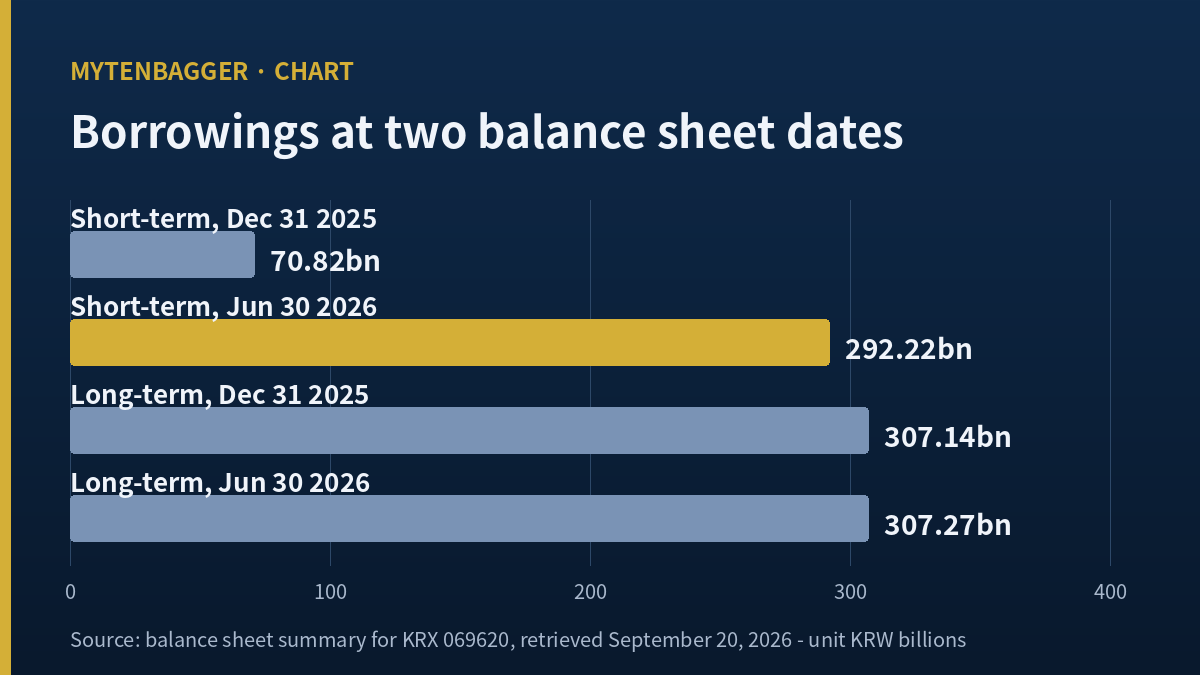
- Four times over. Short-term borrowings went from KRW 70.82 billion to KRW 292.22 billion in those same six months, a factor of 4.1262.
- Barely moved. Long-term borrowings sat at KRW 307.14 billion and then KRW 307.27 billion. Almost the entire increase in debt landed on the short end.
A current ratio is a comparison of two columns on the same page, and for this company it crossed under 1.0 between one balance sheet date and the next.
The two dates are December 31, 2025 and June 30, 2026. In that window current assets rose from KRW 732.35 billion to KRW 760.73 billion, and current liabilities rose from KRW 588.82 billion to KRW 859.55 billion. That is what I have been reading about Daewoong Pharmaceutical stock this weekend. It was not the income statement, which had a strong quarter. What I read instead was the funding line underneath it. The share price I am using is the September 18, 2026 close of KRW 109,200, and I hold none of this and have no order in. My default for anything outside the top 100 by value on this market is to watch, and this piece records why I am still watching.
Contents
What moved under Daewoong Pharmaceutical stock in six months
Here are the four lines I pulled, all at the group level, all from the balance sheet summary for the periods ending December 31, 2025 and June 30, 2026. Amounts are in Korean won, with a dollar figure beside each for scale.
| Line | Dec 31, 2025 | Jun 30, 2026 | Change |
|---|---|---|---|
| Current assets | KRW 732.35bn | KRW 760.73bn | +3.8752% |
| Current liabilities | KRW 588.82bn | KRW 859.55bn | +45.9800% |
| Short-term borrowings | KRW 70.82bn | KRW 292.22bn | 4.1262x |
| Long-term borrowings | KRW 307.14bn | KRW 307.27bn | +0.0423% |
Source: annual balance sheet summary for KRX 069620, retrieved September 20, 2026. Percentage changes and the 4.1262 factor are my own arithmetic. USD figures in this piece use roughly KRW 1,383.3 per dollar, the Seoul close on September 18, 2026, and are approximate.
Current liabilities grew almost twelve times faster than current assets did. That single asymmetry is the whole of the ratio move, and KRW 221.40 billion of the KRW 270.73 billion increase in current liabilities is the short-term borrowing line by itself, which is about USD 160 million.
The plant did not absorb it
My first guess was construction. Property, plant and equipment went from KRW 825.30 billion to KRW 916.80 billion over the same six months, an increase of KRW 91.50 billion, or USD 66 million at the rate above. So the new short-term money is about 2.4197 times the increase in fixed assets over the same period.
Intangibles moved too, up to KRW 392.96 billion, and cash went the other way, down from KRW 168.94 billion to KRW 154.74 billion. I cannot close the circle from a summary balance sheet alone. What I can say is that the plant line does not account for the borrowing line, and I stopped there instead of guessing at the remainder.
A ratio under one is not automatically an alarm
I want to be careful here, because 88.5033% reads worse than it may be. A company with heavy revolving working capital can run under 1.0 indefinitely if the short-term lines roll. Total liabilities against total equity stood at 112.9763% on June 30, 2026, against 108.2395% six months earlier, which is a much gentler move than the current ratio implies on its own.
What changes my reading is the direction of the shift, and its size matters less to me. Long-term borrowings were flat to four decimal places worth of movement while short-term borrowings quadrupled. A company funding a long asset with a short liability is making a bet on refinancing conditions, and that bet is invisible in the income statement.
One more caveat on the ratio itself, and it is the one I would raise first if someone showed me this analysis. A current ratio counts drawn liabilities but not undrawn credit. A company with committed facilities it has not used looks worse on this measure than one with no facilities at all and the same cash. I have no visibility into committed but undrawn lines here, and that single unknown could move my reading of the 88.5033% more than anything else in this piece.
The same applies in reverse to the numerator. A receivable is a current asset on the day it is booked whether it is collected in thirty days or ninety. Two companies with identical ratios can sit a month apart in real liquidity, and the division will not say which is which.
A longer frame on the same page
Going back further, at the end of 2022 the same ratio was 116.1009%. So this is not a company that has always run tight and has simply kept running tight. It ran above 1.0 for years, moved higher through 2025, and then dropped under in half a year.
Over that longer window property, plant and equipment went from KRW 432.70 billion to KRW 916.80 billion, a factor of 2.1188, while total assets went up by a factor of 1.6232. The company has been building, and the building has been paid for somehow. For most of that stretch the payment did not show up on the short-term line. Now it does.
Inside the numerator, the mix changed more than the total
The top of the ratio barely moved, and that flatness hides something. Trade receivables went from KRW 166.72 billion to KRW 205.18 billion over the same six months, a rise of 23.0685%. Cash went the other way, from KRW 168.94 billion to KRW 154.74 billion, down 8.4054%. Inventories were close to flat, KRW 310.87 billion to KRW 316.26 billion.
So current assets rose 3.8752% in total while the most liquid component inside them shrank and the least liquid of the three grew fastest. A ratio is one division and it cannot show that. If I had only read the 88.5033% I would have missed that the numerator is now slightly heavier in items that convert to cash on someone else’s schedule.
I am not calling that a deterioration. Receivables rising alongside a quarter of strong export shipments is the ordinary look of a growing business, and I have no ageing schedule to say otherwise. But it does mean the drop in the ratio is not purely a liabilities story, which is how I had it framed when I started writing.
Equity grew, and liabilities grew faster
Total equity went from KRW 1,134.65 billion to KRW 1,191.48 billion, up 5.0086%. Total liabilities went from KRW 1,228.14 billion to KRW 1,346.09 billion, up 9.6039%. The company is retaining earnings and it is also adding obligations, and over this particular half year the second grew at roughly twice the rate of the first.
Non-controlling interests fell slightly, from KRW 128.56 billion to KRW 127.54 billion, so essentially all of the equity increase accrued to the parent. That matters for the claim arithmetic later in this piece: the book value a judgment would reach is mostly the controlling shareholders’ book value, and it is not a mixed figure.
| Balance sheet date | Current assets | Current liabilities | Ratio |
|---|---|---|---|
| Dec 31, 2022 | KRW 548.96bn | KRW 472.83bn | 116.1009% |
| Dec 31, 2025 | KRW 732.35bn | KRW 588.82bn | 124.3759% |
| Jun 30, 2026 | KRW 760.73bn | KRW 859.55bn | 88.5033% |
Source: the same balance sheet summary by period, retrieved September 20, 2026. Ratios are mine.
Reading the three rows together changes the emphasis again. Between the end of 2022 and the end of 2025 both columns grew, and the numerator grew faster, so the ratio improved by 8.2750 points across three years. Then in half a year it gave back more than four times that improvement. Whatever happened, it happened quickly and it happened on one side of the fraction.
That speed is the part I keep returning to. A slow slide across several reporting periods would read as a business steadily consuming its own liquidity. A step this sharp in two consecutive statements reads more like a single decision, or a single event, and decisions and events tend to have documents attached to them. I do not have the document. The third quarter report is where it would show up, if it exists.
There is also a question of what I should have expected. Going in, I assumed a pharmaceutical company in the middle of a capacity build would carry its construction funding long instead of short, because the asset has a twenty-year life and the loan would normally be matched to it. Finding the opposite is what made me write this at all. It may still be entirely routine, and the most likely routine explanation is the reclassification I listed above. But routine explanations are things I should verify instead of assuming, and I have not verified this one.
I have read two other Korean pharmaceutical names on the same kind of question this quarter. One was a company whose headline licensing numbers sat above a subsidiary going the other way, and another was a firm whose largest product is one it does not own. Both taught me the same lesson this one is teaching: the line a company leads with is rarely the line that decides the next twelve months. A third piece, on a contract manufacturer I admire but would not pay up for, is where I first wrote down that a good business and a good entry are separate questions.
A claim lodged against Daewoong Pharmaceutical stock sits beside the equity line
On September 2, 2026 the company disclosed that the plaintiff in a long-running dispute over a botulinum toxin strain had changed its claim to KRW 500.10 billion, about USD 362 million. The appeal is before the Seoul High Court. A first-instance ruling in February 2023 went partly against the company.
Set that against total equity of KRW 1,191.48 billion on June 30, 2026, and the claim comes to 41.9730% of it. I want to be exact about what that percentage is and is not. It is a plaintiff’s demand divided by a book figure. It is neither a provision nor a judgment, and it carries no probability with it. The company has said publicly that the revision is a one-sided claim and that it sees no material effect on its financial position. I am recording that statement as a statement.
The reason I put the claim next to equity instead of next to anything else is that equity is the line a judgment would eventually reach, and equity is also the line I just watched grow more slowly than liabilities.
There is a second reason, and it is about timing and not size. A dispute that has run since 2017 has been sitting beside every balance sheet this company has published, including the ones where the ratio looked comfortable. What changed in 2026 is not that the dispute appeared. It is that the claim was restated upward in the same year the short-term funding line quadrupled. Those two facts have no causal link that I can demonstrate, and I am not asserting one. I am noting that they now sit on the same page of my notes, and that neither of them was on that page a year ago.
The peer I set beside it sells the same vials under another name
Global peer comparison is usually where I reach for a large western pharmaceutical group and line up multiples. I did something else this time. The company I am setting beside this one is Evolus, Inc. (NASDAQ: EOLS), and the reason is narrow and specific: Evolus commercializes Jeuveau, and Jeuveau is manufactured by this Korean company. It is the same product wearing a different name in a different market.
I have taken no figure of any kind from Evolus into this piece. No revenue, no multiple, no margin, and no direction either. What the existence of a separately listed distributor did was change how I read my own number. When I wrote that one product line is carrying the growth, I had been picturing a single company capturing that growth end to end. It does not. Part of the economics of the same vials sits inside a different listed entity on a different exchange under a different contract, and I have not read that contract.
That is the whole use I made of the peer. It did not give me a comparison. It told me that my own percentage is measuring something narrower than I had assumed when I wrote it.
Three ways the next two quarters can go for Daewoong Pharmaceutical stock
I put rough weights on these because writing a number forces me to be honest about which one I actually expect. They are my own judgment and there is no model behind them.
The short lines roll and nobody notices (38%). Short-term borrowings get refinanced or termed out, the current ratio drifts back toward 1.0 through the second half, and this piece turns out to have been about a temporary funding arrangement during a construction cycle. Inside this branch I give about 14 points to the case where some of the short debt is explicitly converted to long.
The ratio stays under and the cost starts showing (39%). The short lines keep rolling but at a price, and finance costs appear in the income statement in a way they did not before. This is the branch I would want to see in the third quarter report, because it is the one that turns a balance sheet observation into an earnings observation.
Something else is inside the borrowing (23%). The increase is tied to an item I cannot see from a summary, an acquisition, a guarantee called, a working capital swing at a subsidiary. Inside this branch I give about 9 points to the case where the third quarter filing makes me withdraw the framing of this piece entirely.
None of the three turns on the share price. That is deliberate. I did not build any of this out of the quote.
Where I argue against myself on Daewoong Pharmaceutical stock
- A current ratio under 1.0 is normal in several industries and says nothing on its own about solvency.
- I used a summary balance sheet and never opened the notes. The composition of current liabilities is invisible to me.
- Six months is two data points. A ratio that crossed once can cross back.
- The company had a strong second quarter on the income statement, and nothing here contradicts that.
- Debt to equity moved only 4.7368 points over the same window, which is a mild reading of the same balance sheet.
- The KRW 91.50 billion increase in property, plant and equipment may lag the cash that paid for it by more than one reporting period.
- I do not know the interest terms on either borrowing line.
- Cash fell by KRW 14.20 billion. That is small enough that reading intent into it would be overreach.
- The plaintiff’s claim is a demand, and demands are set high in appeals.
- The first-instance ruling in February 2023 was partial and is under appeal. Treating it as settled would be wrong in either direction.
- Putting the claim against equity is my framing choice. Against total assets it looks smaller, against annual profit it looks larger.
- A third manufacturing site has been under construction in Hwaseong, which is a plausible reason for a heavy investment period. I did not print the reported cost of it, because the source I found stated the amount in won and in dollars at figures that do not convert into each other.
- Capacity expansion reported at that site would raise annual output substantially, which argues the investment is planned instead of distressed.
- I have not checked whether any of the short-term borrowings are simply the current portion of longer debt reclassified.
- If they are, the entire framing of this piece is a labeling artifact and nothing else.
- Two named Korean brokerages published forward estimates for this company earlier in 2026, and neither flagged liquidity as their central issue.
- Neither of those reports did I read in full. I worked from summaries.
- Intangibles at KRW 392.96 billion are a third of equity, and I did not examine what they consist of.
- The dollar figures here are approximations at one day’s rate and should not be treated as precise.
- Where I nearly went wrong. The first noun in my notes was the word current. I spent a while writing a paragraph that slid between the accounting sense of the word, meaning due within twelve months, and the everyday sense, meaning now. The two are not the same, and a sentence that uses one and means the other reads as a warning when it is only a classification. The working rule I am keeping: when a ratio’s name is also an ordinary English word, write out what the name means in the statement before using it in a sentence about the present.
- Watching is not a conclusion. It is the absence of one, and I would rather say so than dress it up.
- This piece is built on two balance sheet dates and one disclosure. That is a thin base for anything stronger than watching.
What would break this reading of Daewoong Pharmaceutical stock
- The third quarter current ratio returns above 100% without new equity being raised.
- Short-term borrowings fall back under KRW 150 billion while long-term borrowings rise by a matching amount, which would mean the shift was a reclassification.
- Property, plant and equipment rises by more than the KRW 221.40 billion of new short-term money, which would put the plant back at the center of the explanation.
- Finance costs in the third quarter statement rise by a visible margin over the first half run rate.
- The appellate court rules, in either direction, before the third quarter filing.
- Total equity falls instead of rising in the third quarter, which would compress the ratio I used for the claim.
The first four are answered by one document, the third quarter report, whose statutory filing deadline is November 16, 2026.
The line I am most sure of, and the one I am least sure of
Most sure: short-term borrowings rose 4.1262 times in six months while long-term borrowings did not move. Both numbers come off the same summary, and the only thing I did was divide. A year from now that sentence will still be true.
Least sure: that this is a funding signal and not a bookkeeping one. I can construct a perfectly boring explanation in which a chunk of long debt simply reached its final year and moved columns, and I cannot rule it out from where I am standing.
The sentence I hesitated over longest was the one about the plant. I wanted to write that the borrowing went somewhere other than the plant, which is a stronger claim than my evidence supports. What I can support is that the plant increase is smaller than the borrowing increase over the same six months. Those are different sentences, and the gap between them is where I would have misled myself and anyone reading.
Prices and balance sheet figures reflect the September 18, 2026 close and the June 30, 2026 statement. USD conversions are approximate, at roughly KRW 1,383.3 per dollar on the same close.
Sources: Seoul Economic Daily on the revised damages claim · Korea Biomedical Review on the 2023 first-instance ruling · KED Global on the third toxin plant in Hwaseong · Annual income statement aggregation for KRX 069620 · The September 2, 2026 litigation disclosure · Evolus on who manufactures Jeuveau · The balance sheet summary by period
Related reading
- Dongkook Pharmaceutical Debt Ratio Rose Again in First Half
- SK Bioscience Operating Loss: One German Plant Did the Work