Leeno Industrial Stock: Why I’m Starting to Buy the Pullback
Leeno Industrial stock (KOSDAQ: 058470) has fallen from a 52-week high near ₩129,000 (~$85) to about ₩82,000 (~$54) — down roughly 36%, squarely mid-range. Earlier in this Korean semiconductor moat series, Tokai Carbon Korea was near its highs, so I waited for a dip rather than adding. Leeno is the opposite setup. On a ~45% operating margin and the recurring revenue of a wear-out consumable, I’m starting to accumulate here. But the valuation is still rich and recent flows are weak — I’ll write that warning down too.
Across this series I’ve made a point of naming the kind of moat each time. HPSP had a qualification moat in high-pressure annealing; Park Systems, a technology moat in metrology; Tokai Carbon Korea, a qualification moat reconfirmed in court. Leeno Industrial has the least glamorous moat of the four. It isn’t a single patent or an exotic material nobody else can make. Leeno’s moat is the factory itself.
I’ll be honest: I underrated this one for years. “A company that makes a pin and a socket — how much of a moat can that be?” It makes the tiny metal pin that touches a chip during testing and springs back. And yet, off that “unremarkable” pin and socket, it has earned operating margins above 40% — the kind most large chipmakers never see. When Leeno did a 5-for-1 stock split earlier this year, the per-share price dropped and the name became far more accessible to a retail investor like me, and only then did I look at it properly. Late again — so this time I’m nailing the reasons and the counter-case down in the same journal.
Contents
The moat behind Leeno Industrial stock is a factory, not a patent
“It has a moat” explains nothing. You have to name the kind. Leeno’s splits into three.
One: a cost moat — the root of everything. Leeno performs roughly 90% of the entire process chain in-house, from design and machining to injection molding (per Hyundai Motor Securities analyst Kwak Min-jung). The micro-springs inside the pins, the molded socket bodies — most of it is made under one roof. Competitors buy pieces here and there and assemble; Leeno builds start to finish. That vertical integration lands three rabbits at once: cost, quality, and lead time. A latecomer can copy “a similar pin,” but copying 40 years of an integrated production chain is a different task — the asset isn’t one part, it’s the whole line, and you’d have to replicate all of it. That’s why I read Leeno’s 40%-handle operating margin not as a line item but as evidence the moat is alive.
The proof that this integration is a real moat shows up in an odd place. Leeno takes the same micro-machining know-how outside semiconductors, making probe parts for ultrasound diagnostic equipment — close to 10% of revenue. When the precision that shapes a test pin carries over into medical devices, it tells you the company isn’t really selling “a pin”; it’s selling a micro-manufacturing capability others can’t easily match. A rival can copy one pin, but standing up the whole process asset takes decades again. That is what “the factory is the moat” means. It also shows in the numbers on the ground: Leeno’s own supplier profile claims roughly a 70% share of the ultra-precision wafer-test pin market and pins as fine as 0.075mm — a niche it effectively defines.
That niche is also climbing the value chain toward exactly the packaging shift the thesis rests on. Per Leeno’s product line, it now ships RF sockets rated to 40GHz, fine-pitch probe heads carrying more than 30,000 pins for wafer-level test, and WLCSP probe cards for wafer-level packaging — plus sockets tuned for the high pin counts of AI chips. A pin maker that can hold signal integrity at 40GHz and 30,000-pin density isn’t a commodity supplier being squeezed; it’s being pulled up-market by the same advanced-packaging complexity that lifts its prices. That is the difference between a part that gets cheaper every year and one that gets more valuable.
Two: a switching-cost / custom moat. Test sockets aren’t off-the-shelf. They’re designed to each customer’s specific chip. That’s why Leeno leans on a multi-variety, short-lead-time system as its edge — every time a customer launches a new chip, Leeno designs the matching socket fast, and the customer, once qualified, doesn’t casually switch. A bad socket compromises the trust of an entire test line. “Fast, custom, and already validated,” compounded over years, is lock-in. When a customer rolls a new chip generation, staying with the partner whose hand is already in beats re-matching with a stranger. Layer the recurring consumable reorders on top, and the customer who’s in rarely leaves.
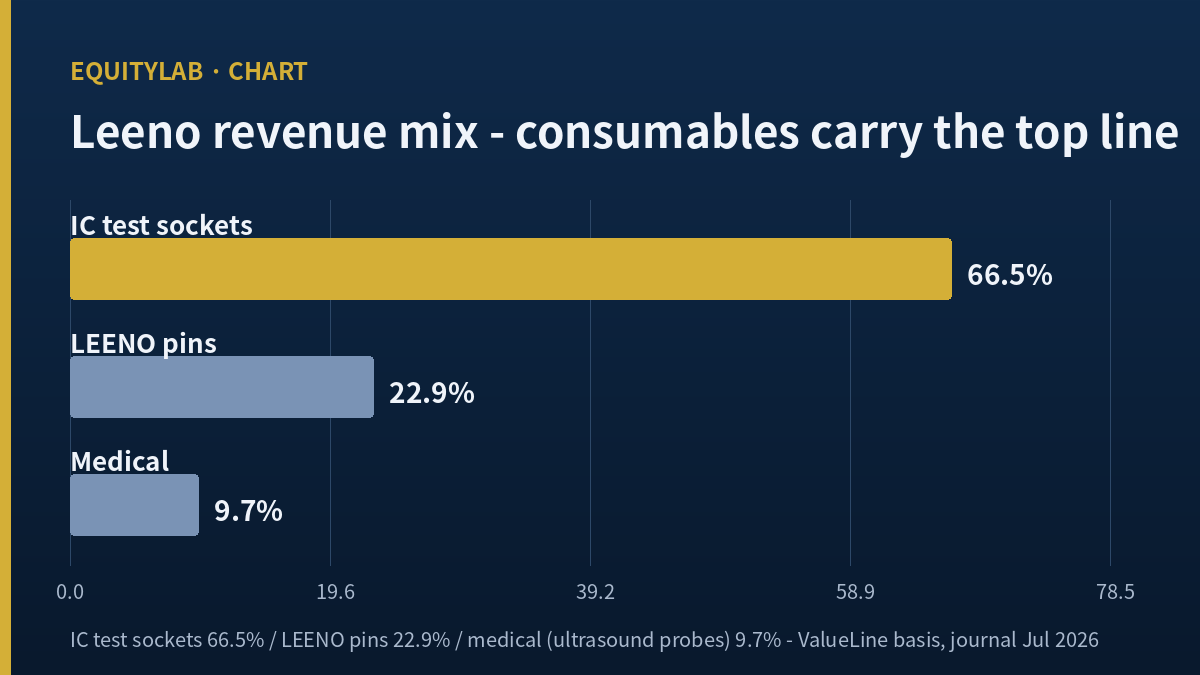
Three: recurring consumable demand. LEENO pins and sockets wear with every test. It isn’t a one-and-done sale — the customer keeps swapping them out while it churns chips. Even if tool orders pause, replacement demand keeps coming off the lines already running. Sell the razor once, keep selling blades. By mix, IC test sockets are about 66.5% of revenue (mostly exported), LEENO pins 22.9%, and medical 9.7%, so recurring consumables carry most of the top line.
Here’s why the consumable point matters more than it looks. Testing is a mandatory step on every chip made, and the pin and socket wear a little each time — so Leeno’s revenue keys off the customer’s production volume, not its capex. When a semiconductor equipment name swings hard on the order cycle, a consumable name keeps billing as long as lines are running. That difference is what builds the earnings floor.
Why Leeno Industrial stock out-earns its global test peers
Here’s where I read it differently from the crowd. The market lumps Leeno in as “a chip-test cyclical” — up when semis are hot, down when they’re cold. Half right. But the more interesting fact is the margin, and it’s clearest against the global test names a US investor would reach for first.
Take FormFactor (NASDAQ: FORM), the probe-card leader, which management now frames as sitting at the intersection of high-performance computing and advanced packaging — its cards test chips before they’re assembled into complex packages, and it’s targeting a revenue double by 2030 on AI test intensity. Take Cohu (NASDAQ: COHU), the handler-and-contactor name: recent coverage put its Q1 2026 gross margin near a healthy 46%, yet its operating margin was negative. Now set Leeno’s ~45% operating margin beside that. A US test-equipment peer runs a ~46% gross margin into a negative operating line; Leeno converts a comparable gross line into a mid-40s operating margin. That single gap captures why I’m here: FormFactor and Cohu build the test equipment, while Leeno makes the vertically integrated consumable that the equipment burns through — and a consumable built end-to-end under one roof simply keeps far more of every dollar than a machine builder does.
The structural driver is real and shared across all of them. Korea’s DS Securities (analyst Lee Su-rim, January 6) flagged that a major North American customer’s advanced packaging is shifting from InFO to a WMCM (wafer-level multi-chip module) structure. Pack more dies more tightly and the number of test points rises, pushing a socket’s pin count and signal density up together — which means higher socket ASPs and more replacement demand at once. FormFactor’s own materials make the same point from the probe side: advanced packaging raises the bar for wafer test, and stacking more dies raises the financial cost of every defect. Independent market work sizes it too: one research house sees the semiconductor test socket market approaching $1.9B by 2026 as AI pin-counts climb toward 20,000. Put plainly: the more complex the chip, the more Leeno’s socket costs and the more often it sells. Where the market flattens this into one word — “cyclical” — I see a structural ASP tailwind.
For a US reader the instinct is to play this theme through FormFactor or Cohu directly — both ride the same AI-test wave, and FormFactor is scaling HBM3e and HBM4 probe cards into multi-year memory contracts. But that instinct buys you the equipment layer’s economics, not Leeno’s. Leeno sits one layer down, selling the consumable that every one of those test cells burns through, at a margin the equipment names don’t reach. When I compare the three, I’m not saying Leeno is “better” than FormFactor or Cohu — they’re different businesses solving different parts of the same problem. I’m saying the consumable layer, run as a vertically integrated Korean small-cap, is the part of this value chain I’d rather own at these margins.

Reading Leeno Industrial stock: I start with the 40% margin
I don’t judge every semiconductor-parts name by the same gauge. For a consumable maker like Leeno, operating margin is the first instrument, because margin is both pricing power and the strength of the moat. On top of that come capacity headroom and forward volume, then valuation, and flows last. Here’s that read.
Operating margin. On a standalone basis, 2024 revenue was ₩278.1b (~$184M) with operating profit of ₩124.2b (~$82M) — about a 44.6% operating margin. Net income of ₩113.3b puts the net margin above 40% as well. Against a Korean manufacturing average in the single digits, that is a company holding its own price. It’s the inverse of a scale equipment builder that runs single-digit-to-teens margins even in a boom — and, as the peer comparison showed, ahead of global test names on the operating line. Same “chip-cycle beneficiary,” very different margin structure.
Turn and expansion. Through the first three quarters of 2025, standalone revenue rose 47.8% year over year and operating profit 56.7% (per FnGuide) as AI and advanced-packaging demand began landing in the numbers. DS Securities models 2026 revenue of ₩429.5b (+19%), operating profit of ₩200.5b (+20%), and a 47% operating margin, with a new plant lifting long-term capacity toward ₩900b a year. When a high-margin company adds capacity, the incremental volume drops through to profit — 2025 nine-month net income was up 49.9%, and with a net margin over 40%, new revenue converts to earnings unusually efficiently.
Valuation — this is where the call splits. The 5-for-1 split (par value ₩500 to ₩100, trading resumed April 25) raised the share count from 15.24M to 76.21M and lowered the per-share price. The stock is around ₩82,000 (~$54) as of early July, a market cap near ₩6.35T (~$4.2B). With a 52-week range of ₩39,050–₩129,000, it sits mid-range, down 36% from the high. Korean sell-side is split: the ₩77,000 target DS Securities set in January is a level the market has already passed after the run to ₩129,000 and back, while the analyst consensus average sits higher at ₩117,500 (10 buy ratings). Sell-side targets are market information I cite, not numbers I adopt as my own. But the fact that those targets are this far apart tells me the valuation debate is live right now. For the underlying business detail — the two reporting segments and the shareholder structure — I’ve been cross-checking Leeno’s company profile against the Korean filings; both frame the same picture of a probe-and-socket core with a small medical wing. The split itself changes none of that — it multiplied the shares by five and cut the price to match, nothing more. What it did change is who can hold the stock: at roughly $54 a share instead of the pre-split equivalent, a name that used to sit above most retail thresholds is now easy to buy in size, which is exactly why I’m looking at it now rather than a year ago.
Is Leeno Industrial stock a spot to start buying?
I weighed the case for against the case for caution, side by side.
The case for. First, the position: mid-range, not the top. With Tokai Carbon Korea I wrote that I don’t add after a near-double; Leeno is the mirror image, down more than a third from its high. Second, the ~45% operating margin and the capacity expansion together give large earnings leverage on any top-line growth. Third, recurring consumable revenue holds the floor while advanced-packaging ASPs push the ceiling. Fourth, the margin defense I showed earlier — even in a single-digit-growth year (2024) the operating margin cleared 44% — gives my downside math a real backstop. Those four overlap here, so I start accumulating in tranches rather than all at once. There’s a fifth, smaller point too: the medical wing gives a non-semiconductor leg — ultrasound-probe parts made on the same micro-machining line — that runs on a different demand cycle. It won’t move the stock on its own, but it’s optionality I’m handed for free, and one more sign the asset is a capability rather than a single product.
The case for caution. As of late May, ValueLine’s model tagged the stock as in an “overvalued zone,” marked its supply/demand signal as weak, and flipped its three-month trend to bearish. I don’t wave that away. Test-socket leaders always carry a premium multiple, and premiums unwind fast when results miss consensus. This company has also seen earnings pressed in past smartphone down-cycles — a consumable floor is firm, but not fully cycle-proof. One more: the 5-for-1 split, by making the shares easier for retail to buy, also raised short-term volatility. More liquidity is good for access, but it means more chop to sit through. And I hold the growth read itself with some humility: the 2026 estimates lean on a single North American customer’s packaging transition landing on schedule, so if that shift slips a couple of quarters, the ASP story arrives later than the multiple already assumes — and a premium name that has to wait tends to correct first and ask questions later.
Overlaying the two, my conclusion is this. I treat today’s level as a spot to start accumulating, not to load. The mid-range position and the consumable/structural-demand substance give me reasons to buy; the rich valuation and the weak flows say “slowly, in pieces.” So I don’t rush — I build the position in tranches.
What would pull me back to the sidelines
Writing only the reasons to buy, with no breaking condition, isn’t a journal — it’s cheerleading. So I fix the conditions that break my thesis in advance.
First, if the operating margin settles below 40% on trend — not one cost-heavy quarter, but a structural slide. That breaks the premise that the company sets its own price. The cost moat is cooling.
Second, if the advanced-packaging ASP story fails to show up in the results, and a rival — a silicone-rubber-socket name (like ISC), Korea’s TSE, or a Taiwan player such as WinWay — is confirmed taking real high-spec socket volume. A custom-and-consumable moat rests on “fast, validated response”; if a competitor pries that seat open, the premium wobbles.
Third, if the newly added capacity meets a front-end slowdown and sits empty. A high-margin company’s expansion is earnings leverage in a boom, but turns into fixed-cost drag when the cycle rolls over.
If one of the three wobbles, I stop accumulating and move to watch. If two overlap, I trim what I’ve already built. It isn’t a mechanical price line — it’s a check on whether the moat is still alive. The second one worries me most: margin and cycle heal with time, but hand a competitor a customer’s trust on a custom socket once, and that seat rarely comes back. Much of this shows up at the August 18 print — whether the margin holds and whether advanced-packaging volume actually prices through — so I treat that date as the checkpoint that sets my accumulation pace.
What I’m doing here
No neat wrap-up. My position, stated plainly: Leeno owns the least flashy moat in this series and, at the same time, the one hardest to lift wholesale — not a patent, but four decades of an integrated line that is the moat. Down 36% off the high, a ~45% operating margin, revenue that recurs as parts wear out, and an advanced-packaging tailwind pushing prices up — that’s the case, and it’s why I’ve begun buying. In tranches, not in one clip, because the multiple is full and the tape is soft. The results, not my impatience, set the pace from here.
This post is the fourth entry in my semiconductor supply-chain moat series – earlier entries cover HPSP, Park Systems, and TCK.
→ Next in the moat series: EO Technics Stock Fell 45% While Estimates Rose: Why I Buy