Why Hotel Shilla Lagged the KOSPI as Its Operating Profit Rose
The KOSPI more than doubled in the year to August 14, 2026 (Friday). Hotel Shilla stock fell over the same twelve months. Both sentences are true, and together they explain almost nothing, which is why I spent an evening pulling them apart instead of quoting them.
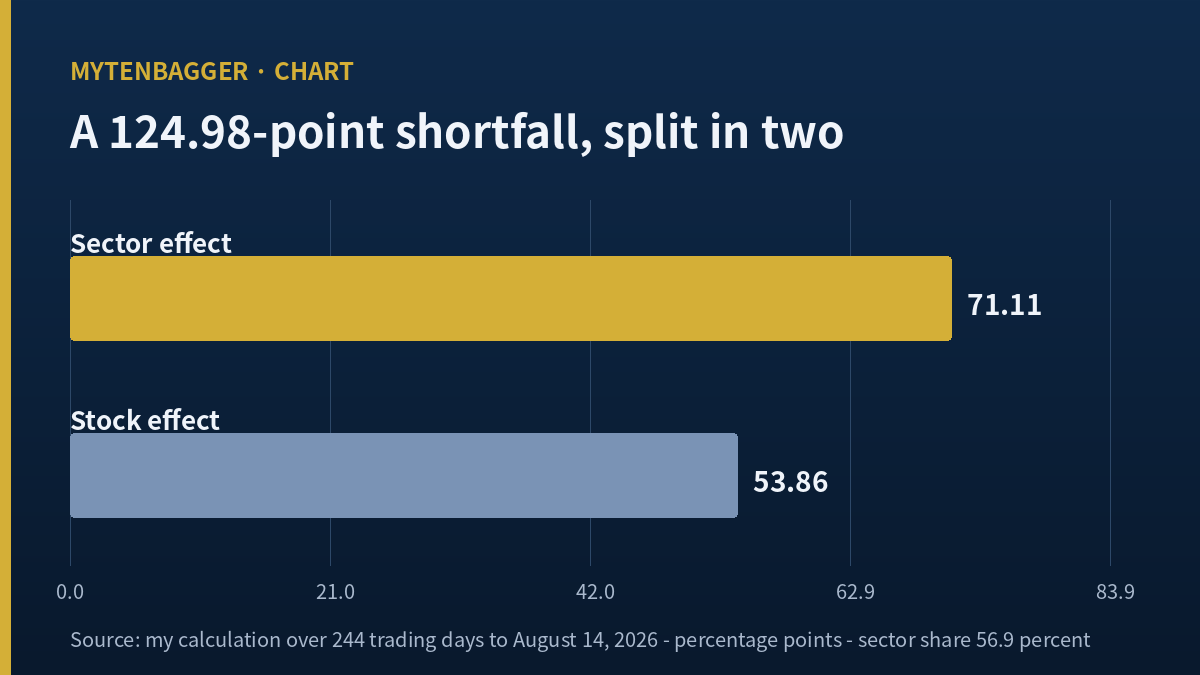
The pulling apart is arithmetic, and the arithmetic is the first thing I want on the page. Over the 244 trading days from August 14, 2025 to August 14, 2026, the stock returned −8.65 percent and the index returned +116.33 percent. The distance between those two is 124.98 percentage points. That distance divides cleanly into two pieces, and the larger piece is the one that has nothing to do with this company.
One shortfall, two components (244 trading days to August 14, 2026)
stock −8.65% minus index +116.33% = −124.98 points
= (sector − index) −71.11 + (stock − sector) −53.86
The sector piece is 71.11 ÷ 124.98 = 56.9 percent of the total (my calculation). Sector here is the equal-weighted Korean department-store-and-general-retail group with this stock removed from its own comparison group, which returned +45.21 percent. Weighting it by market value instead gives +40.76 percent, so the verdict holds either way.
Contents
The price behind every Hotel Shilla stock figure below
I am writing in the small hours of Monday, August 17, 2026, in Seoul. August 15 fell on a Saturday and was also Liberation Day in Korea, and August 16 was a Sunday, so the last session with a print was Friday, August 14. Every price here is that day’s close: ₩45,400, roughly $32.01 at ₩1,418.3 to the dollar.
What the KOSPI is, and why its year matters here
The KOSPI is the main board of the Korea Exchange, the larger of the two Korean equity venues; the KOSDAQ is the smaller, growth-tilted board. Hotel Shilla trades on the KOSPI under the code 008770. The index had an extraordinary twelve months, peaking at 9,114.55 on June 22, 2026 (Monday), falling to 5,593.56 by July 30 (Thursday), and closing at 6,977.94 on August 14. Even after that drawdown the index was up 116.33 percent across the window I am using. An American reader looking at a single Korean name this year is looking at it against a benchmark that ran very hot, and the gap I am about to dissect is partly a statement about that benchmark.
I multiplied the shares out before trusting the screen
The vendor screen lists 39,248,899 shares outstanding and a market value of ₩1,781.9bn. Multiplying gives ₩45,400 × 39,248,899 = ₩1,781,900,014,600, which is ₩1,781.9bn to the won, or about $1.256bn. That single multiplication tells me which session the vendor priced from, and I run it before I use any multiple from the same screen.
On the drawdown, I use closing prices only. The highest close in the 244-day window was ₩69,400 on April 28, 2026 (Tuesday), and the lowest close after that peak was ₩41,250 on August 3, 2026 (Monday). The August 14 close sits 34.58 percent below the peak and 10.06 percent above the trough, with a peak-to-trough decline of 40.56 percent. The same screen also carries a 250-day high of ₩70,300 and low of ₩39,700; checking the raw daily bars, both come from intraday prints, ₩70,300 on April 29 (Wednesday, which closed lower at ₩67,700) and ₩39,700 on March 9 (Monday, which closed at ₩40,400). Measured on the intraday series the decline from the high becomes 35.42 percent, which is 0.84 points wider. I use the closing series and say so.
Splitting the Hotel Shilla stock shortfall, and where the split stops working
Of the 124.98-point gap, 71.11 points come from the sector trailing the index and 53.86 points come from the stock trailing the sector. Neither piece flatters the company. The group it sits in did badly against a roaring index, and the company then did badly against that group.
The rank makes the second half concrete. Among the twelve names that traded the full window in this sector, Hotel Shilla placed tenth. The median member returned +27.34 percent. Two members did worse. This ranking is independent of how the sector index is weighted, which is exactly why I lean on it when the weighted verdicts could have disagreed. Here they did not disagree, so the rank confirms instead of arbitrating.
One check I ran that the split would have failed without
A sector comparison collapses when the company being measured dominates the group it is measured against. On this screen the heaviest member of the sector carries 21.2 percent of the group’s value, and the tool reports that the heaviest member is not this company. I have thrown out a sector comparison before for exactly the opposite finding, in a Korean advertising name that made up 58 percent of the index it appeared to beat. At 21.2 percent held by someone else, the split above survives that objection.
The 2025 charge that bought the 2026 profit
Now the company itself. In the third quarter of 2025 Hotel Shilla posted consolidated operating profit of +₩11.44bn and a net loss of −₩149.16bn. Something in the order of ₩160.6bn vanished below the operating line in a single quarter, and that quarter set the whole year: the 2025 full-year net loss was ₩172.85bn, of which 86.3 percent sat in that one cell.
Two Korean outlets, two figures, one event
I did not open the filing footnote. What I have is Korean press. Bloter, writing on February 4, 2026 (Wednesday), reported a right-of-use asset termination loss of roughly ₩230.2bn (about $162.3m) taken in the third quarter of 2025, arising from the early surrender of the company’s Incheon Airport duty-free concession. Newsis, on June 11, 2026 (Thursday), reported that the penalty for that surrender exceeded ₩190.0bn (about $134.0m) and went through non-operating expense in one go. The ₩230.2bn figure is an accounting outcome and the ₩190.0bn figure is closer to cash, and whether one contains the other I could not settle. The half-year filing notes would settle it; I did not read them.
The arithmetic at least closes. Operating profit of ₩11.44bn less a ₩230.2bn charge lands near −₩218.8bn pre-tax, and a tax credit somewhere around ₩70bn brings that to the −₩149.2bn actually reported. One line accounts for nearly the whole loss.
The concession itself is worth stating plainly. The company won the Terminal 1 DF1 zone for ten years, 2023 through 2033, bidding ₩8,987 per departing passenger. That translated into rent of roughly ₩30bn a month. It walked away after about two years, paid the penalty, and on May 20, 2026 (Wednesday) sued Incheon International Airport Corporation for ₩106.5bn (about $75.1m), arguing the penalty was excessive. Sell-side work from Shinhan Securities analyst Cho Sang-hoon dated August 3, 2026 (Monday) puts the annual rent saved by the surrender at about ₩330bn, roughly $232.7m.
Revenue fell and Hotel Shilla stock’s operating profit multiplied in the same quarter
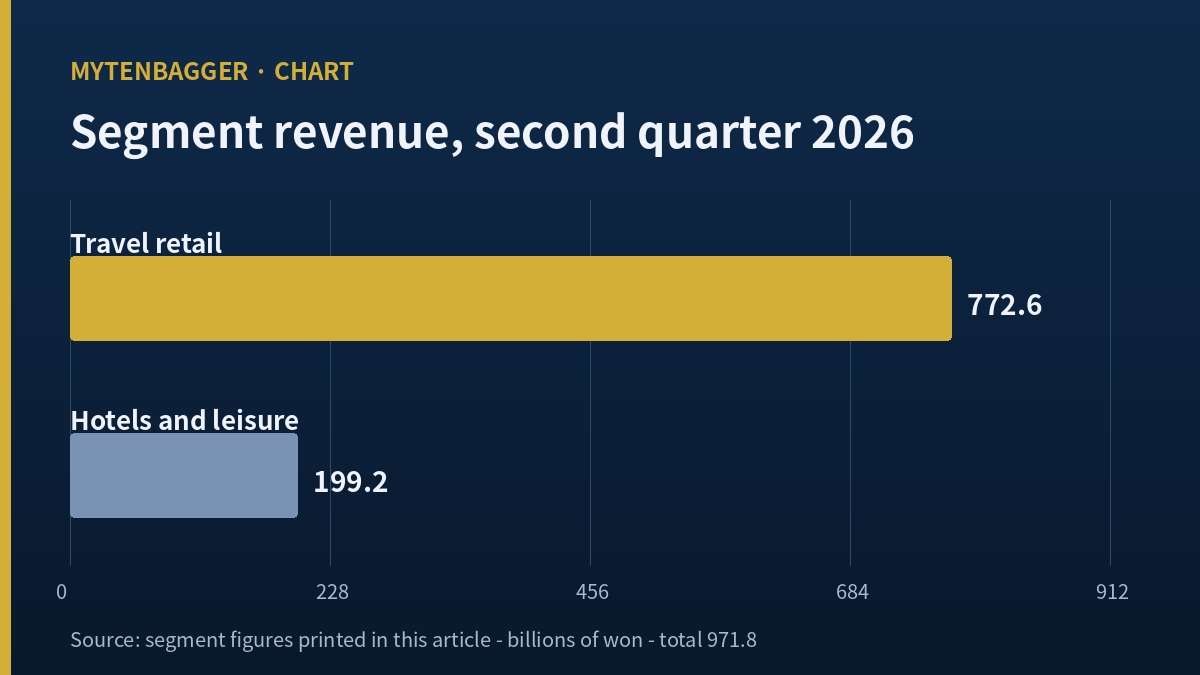
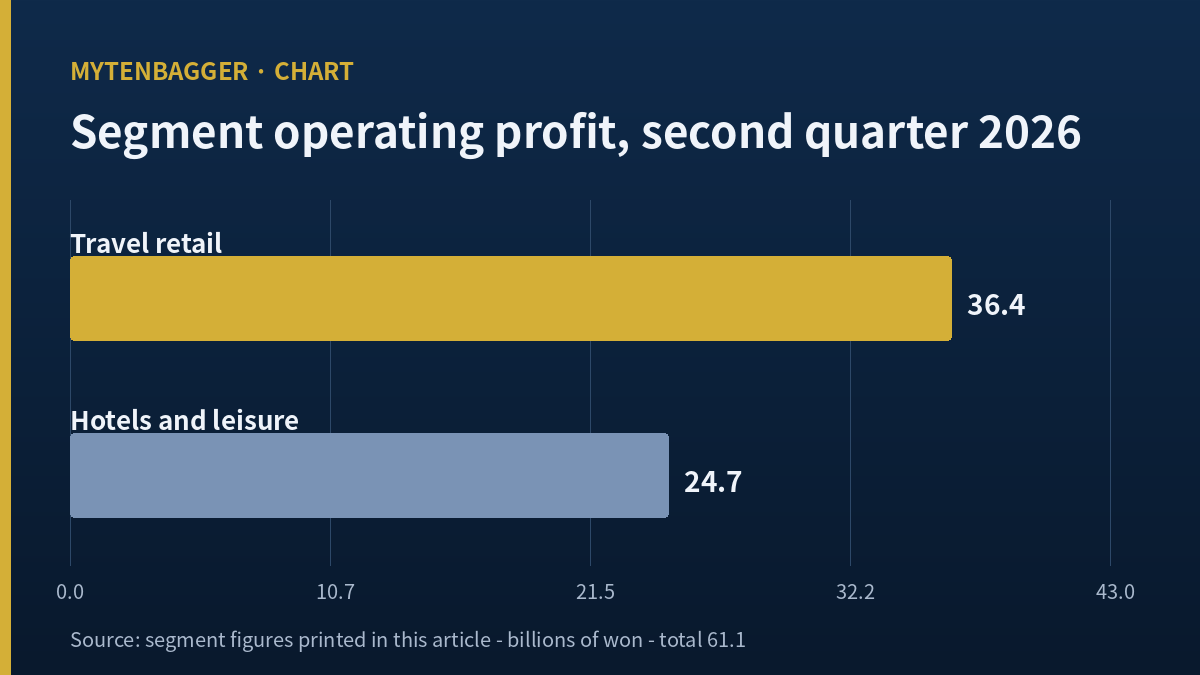
Second-quarter 2026 consolidated revenue was ₩971.8bn (about $685.2m), down 5.2 percent from a year earlier. Operating profit was ₩61.1bn (about $43.1m), up 606.0 percent. The company sold less and earned far more, which locates the improvement in costs.
The two segments add to the total
| Q2 2026 | Revenue | YoY | Operating profit | YoY |
|---|---|---|---|---|
| Travel retail (duty free) | ₩772.6bn | −9.1% | ₩36.4bn | to profit |
| Hotels & leisure | ₩199.2bn | +13.6% | ₩24.7bn | +23.5% |
| Total | ₩971.8bn | −5.2% | ₩61.1bn | +606.0% |
772.6 plus 199.2 gives 971.8, and 36.4 plus 24.7 gives 61.1. The segments close to the reported totals to the last digit. So the profit swing sits in duty free, whose revenue shrank 9.1 percent, with airport-channel revenue reported down 17.4 percent. That airport channel is the DF1 zone, which stopped trading on April 30, 2026 (Thursday).
Across the first half, operating profit was ₩81.6bn (about $57.5m) on revenue of ₩2,025.3bn, up 1.4 percent, with net profit of ₩27.5bn returning to positive. I rebuilt that half from its parts: ₩20.42bn of audited first-quarter operating profit plus ₩61.1bn of second-quarter preliminary gives ₩81.52bn, about ₩0.085bn short of the company’s ₩81.6bn, a 0.104 percent difference that comes from rounding the second quarter to the nearest ten billion won. For context, the whole of 2025 produced operating profit of ₩13.51bn, so one half year is 6.03 times a full prior year (my calculation), and 2024 was a full-year operating loss of ₩5.19bn.
Against ₩230.2bn spent, ₩81.6bn recovered in six months is 35.4 percent (my calculation). That ratio is mine; neither the company nor any analyst I read has published it. It also overstates the recovery, because the second quarter alone put ₩24.7bn of profit through hotels, where revenue grew 13.6 percent and rent had no part in it. How much of the remainder is rent relief I cannot say, because the company has not disclosed the saving separately.
Why doubling the half year is the wrong move on Hotel Shilla stock
Four consecutive loss-making fourth quarters
| Operating profit, ₩bn | Q1 | Q2 | Q3 | Q4 | Year |
|---|---|---|---|---|---|
| 2022 | 15.14 | 43.21 | 26.65 | −6.66 | 78.35 |
| 2023 | 34.53 | 67.23 | 7.74 | −18.26 | 91.23 |
| 2024 | 12.12 | 27.63 | −16.99 | −27.95 | −5.19 |
| 2025 | −2.47 | 8.66 | 11.44 | −4.12 | 13.51 |
| 2026 | 20.42 | 61.1 (prelim.) | not yet | not yet | not yet |
Each completed row reproduces its own year; two of them land 0.01 apart because every quarter here is rounded to the nearest ten million won. Fourth quarters are computed as the full year less nine-month cumulative, since the Korean filing regime does not publish them separately.
The fourth quarter has been an operating loss in every one of the last four years, averaging −₩14.25bn (my calculation). Any model that annualises the first half by doubling it ignores that pattern.
Shinhan’s Cho marked 2026 operating profit at ₩191.6bn and 2027 at ₩224.4bn. Subtracting the ₩81.6bn already reported leaves ₩110.0bn for the second half. Holding the fourth quarter at its four-year average of −₩14.25bn puts ₩124.2bn on the third quarter alone (my calculation), which is 10.9 times the ₩11.44bn the same quarter produced in 2025. I did not find support for that multiple anywhere in my reading, which is a statement about my reading as much as about the estimate.
Peers I stood Hotel Shilla stock beside for the same six months
How I chose which operators to stand beside it
To tell whether this profit came from what the company stopped doing or from something the whole trade got back, I wanted operators that closed the identical January-to-June period on a December year-end and published two lines I could divide myself. Everything below is an operating margin I recomputed from a revenue line and a profit line, and none of it is a valuation multiple.
Four operators, first half of 2026
| H1 2026 | Revenue | Operating profit | Margin |
|---|---|---|---|
| Hotel Shilla (KRX 008770, group) | ₩2,025.3bn | ₩81.6bn | 4.03% |
| Shinsegae DF (Korea, duty free) | ₩1,132.4bn | ₩43.9bn | 3.88% |
| Lotte Duty Free (Korea) | ₩1,696.5bn | ₩64.1bn | 3.78% |
| Avolta AG (SIX: AVOL, Switzerland) | CHF 6,569m | CHF 409m (CORE EBIT) | 6.23% |
| CTG Duty Free (SSE 601888, China) | CNY 27,591.72m | CNY 3,740m | 13.6% |
Two things fall out. The Korean trio cluster between 3.8 and 4.0 percent, so the margin Hotel Shilla just produced is close to what its two domestic competitors produced over the same months. And the two foreign operators sit above the Korean cluster, Avolta at roughly one and a half times and the Chinese operator at more than three times. The recovery reads as ordinary inside Korea and thin outside it, and I would rather hold both of those sentences than pick an adjective.
What I hedged, and what I dropped
The Chinese figure needs a warning attached. Its revenue and net profit come from a preliminary results announcement dated July 14, 2026 (Tuesday); the audited interim report is due on August 21, 2026 (Friday). Worse, the operating profit line behind that 13.6 percent rests on a single trade publication, and I could not corroborate it. Treat it as directional. The Avolta figures are the company’s own release of July 30, 2026 (Thursday), and its CORE EBIT is a management-defined measure that is not identical to a Korean statutory operating profit line, which is a real limit on the comparison and not a footnote.
One competitor number needs no hedge and cuts against this company. Lotte Duty Free grew first-half revenue 30.0 percent while Hotel Shilla’s duty-free revenue shrank. On my rough stacking of the Korean travel retail halves, Lotte’s ₩1,696.5bn also came in ahead of Hotel Shilla’s duty-free half, which would be the first time in a long while. I say rough because the first-quarter segment split I used for Hotel Shilla came through Korean trade press and not from the company’s own segment table.
What the sell-side marked Hotel Shilla stock at
Seven named houses and one consensus screen, in date order. Every figure below is what someone else published, and none of them is mine.
| Dated | House / analyst | Marked at | vs Aug 14 close |
|---|---|---|---|
| Apr 27, 2026 (Mon) | DB Financial Investment, Heo Je-na | ₩90,000 (from ₩65,000) | 1.98× |
| Apr 27, 2026 (Mon) | IBK Securities, Nam Sung-hyun | ₩81,000 (from ₩64,000) | 1.78× |
| Jun 18, 2026 (Thu) | Hyundai Motor Securities, Kim Hyun-seok | ₩70,000 (from ₩59,000) | 1.54× |
| Jul 1, 2026 (Wed) | Heungkuk Securities, Park Jong-ryeol | ₩65,000 (from ₩80,000) | 1.43× |
| Jul 4, 2026 (Sat) | Korea Investment & Securities, Kim Myung-joo | ₩85,000 (from ₩100,000) | 1.87× |
| Aug 3, 2026 (Mon) | Shinhan Securities, Cho Sang-hoon | ₩65,000 (from ₩72,000) | 1.43× |
| Aug 3, 2026 (Mon) | Daishin Securities, Yoo Jung-hyun | ₩90,000 | 1.98× |
| Aug 14, 2026 (Fri) | Consensus screen, 13 contributors | ₩69,846 | 1.54× |
Late April moved up together and July and August moved down together. Heungkuk cut 18.8 percent, Korea Investment 15.0 percent, Shinhan 9.7 percent. Those cuts straddle a quarter in which operating profit multiplied by six.
The ₩69,846 consensus is described on its own screen as a three-month rolling average, and that three-month window runs straight across the July 31, 2026 (Friday) results release, mixing work done before and after. I left it out of my reasoning and am recording why. Daishin’s ₩90,000 also carries less weight for me: I could not establish what it replaced or when it was last revised, and I kept the row only because removing it would leave August represented by Shinhan alone.
Screen values I left alone on the vendor page
Price to net assets
The screen shows net assets per share of ₩30,267 and a price-to-net-assets multiple of 1.5, and ₩45,400 ÷ ₩30,267 = 1.4999, so the multiple reproduces internally. The input does not. ₩30,267 × 39,248,899 shares gives ₩1,187.9bn, while the audited first-quarter 2026 equity belonging to the parent’s shareholders was ₩1,114.7bn, a 6.58 percent difference. Excluding the 2,135,000 treasury shares brings the implied figure to ₩30,033, still 0.78 percent away. I could not establish which equity total was divided by which share count, so the multiple stays out. The same screen’s total-equity field was empty.
Earnings per share
The screen shows −₩4,321 per share, flagged as a rounded integer. The 2025 loss belonging to the parent’s shareholders divided by shares outstanding gives −₩4,404; the trailing four quarters divided by shares excluding treasury gives −₩4,329. The second lands within 0.2 percent and still does not match. The price-to-earnings cell reads zero because the trailing year is a loss. Both cells stay untouched.
Two different one-year returns
The price-trend panel shows a twelve-month change of −0.87 percent while the benchmark tool shows −8.65 percent for one year, a spread of 7.78 points. Digging into the raw daily series, −0.87 percent reproduces only from the August 1, 2025 close of ₩45,800, and −8.65 percent reproduces from the August 14, 2025 close of ₩49,700. The shares rose 8.5 percent across those thirteen days, and that move is the entire discrepancy. I use the figure whose window is stated.
Three more, briefly. The three-year revenue decline of 6.15 percent a year does reproduce from ₩4,068.3bn over ₩4,922.0bn, but 2022 was a pandemic-recovery year and the starting point would be doing the arguing, so it is out. The free-cash-flow yield of 2.42 percent turns out to be one quarter of free cash flow over the current market value, and the annual version would be 2.81 percent. The interest-cover figure and the EBITDA cell both simply repeat the latest quarter’s operating profit, so neither says anything new. Inventory stands at ₩519.9bn on 44.9 days, and unlike a Korean apparel name whose market value had fallen below its own inventory, this company is valued at 3.4 times its stock in trade, so that angle does not open.
Twenty places I could be wrong
Already published, so these are facts and not objections (six)
- Duty-free revenue is shrinking. Second-quarter travel retail fell 9.1 percent.
- Lotte Duty Free grew first-half revenue 30.0 percent to ₩1,696.5bn with operating profit up 193.5 percent to ₩64.1bn.
- Shinsegae DF returned to profit on revenue down only 3.0 percent, a smaller decline than this company’s duty-free arm.
- Spend per head is falling. First-half foreign spend per buyer at Korean duty-free stores was ₩751,900, down 3.2 percent, while buyer numbers rose 29.4 percent.
- Credit outlooks disagree. Two Korean agencies carry AA− with a negative outlook and one carries AA− stable.
- Retained earnings fell from ₩209.3bn at the end of 2024 to ₩1.1bn at the end of 2025, ending a dividend record that ran from 2000 through 2023.
Reached only by my own arithmetic (four)
- The 35.4 percent recovery ratio is mine. Substituting the ₩190.0bn penalty for the ₩230.2bn charge lifts it to 42.9 percent.
- The ₩124.2bn implied third quarter combines someone else’s full-year estimate with my four-year fourth-quarter average. Either input failing breaks it.
- That four-year average rests on four observations. A profitable fourth quarter in 2026 removes the seasonality argument entirely.
- I recomputed the 606.0 percent second-quarter move as 605.5 percent from a ₩8.66bn prior-year quarter, and I did not confirm the company used the same prior-year base.
Given to me by tools or sources I could not fully trust (five)
- Net assets per share disagrees with the audited equity by 6.58 percent, which is why the multiple is absent.
- Earnings per share does not reproduce from any period-and-share-count pairing I tried.
- The 250-day high and low are intraday prints while the field description says closing basis.
- The Chinese peer’s operating profit rests on one trade publication and its half-year figures are preliminary until August 21.
- Avolta’s CORE EBIT is a management-defined measure and is not the same construct as a Korean statutory operating profit.
Never resolved (five)
- Whether ₩230.2bn and ₩190.0bn overlap. The half-year notes would say; I did not open them.
- The half-year report was filed on August 14, 2026 (Friday), and what I confirmed was the filing itself and nothing inside it.
- How much of the ₩81.6bn is rent relief. The company has not split it out.
- Whether the ₩132.8bn exchangeable bond issued in July 2024 saw early redemption claims, which became possible from July 5, 2026. The exchange price of ₩62,200 sits well above the August 14 close of ₩45,400, so exchange looks unattractive, but a cash claim would change the balance sheet picture.
- How the ₩106.5bn claim against the airport operator will land, in which year, and on which line.
Where I stand on Hotel Shilla stock, and what would prove me wrong
At ₩1,781.9bn, roughly $1.256bn, it is not a small company in Korea, and my reason for only watching has nothing to do with its size.
What I am watching is not the speed of the recovery but which year and which line it came from. Profit that comes from stopping something arrives once. The rent that disappeared makes 2026 look dramatic against 2025, and by 2027 the comparison base will already have absorbed it. Meanwhile duty-free revenue is still contracting and spend per head is still falling. I have not yet seen the quarter where profit grows because the company sold more.
What breaks my reading. If the third quarter of 2026 shows travel retail revenue turning positive against the prior year and that segment’s operating profit above ₩40bn in the same quarter, then reading this recovery purely as the arithmetic of stopping was wrong. The ₩40bn line sits 9.89 percent above the ₩36.4bn the segment produced in the second quarter (my calculation). I ask for both conditions because one is a change of sign and the other is a level, and shrinking revenue with expanding profit is precisely how this company has operated so far. Profit has to arrive some other way for my reading to fall.
There is a second test, and it is about my own method. If the same 244-day window, rerun after the 2026 full-year close, shows the stock-versus-sector shortfall shrinking below half of the current 53.86 points while the sector still trails the index, then splitting the gap was a way of excusing the stock, and I should have read the 53.86 on its own from the start.
One figure in this piece is not mine to keep current. The Chinese operator’s half-year revenue and profit are preliminary numbers from a July announcement, and they become audited ones on August 21, 2026 (Friday). If they move, the margin table above moves with them, and so does the sentence about the recovery reading thin outside Korea. I am leaving that date here in plain sight so that anyone reading afterwards knows which row to check before trusting the rest.
Prices and multiples reflect the August 14, 2026 (Friday) close as checked at the time of writing. Financials are consolidated filings with the Korean regulator; second-quarter 2026 figures are the company’s preliminary release. Dollar amounts are approximate, at about ₩1,418.3 to the dollar on the same Friday, which was the Seoul market’s 3:30 p.m. close. Won is the currency that governs throughout.
Sources —
Korean regulatory filings, Hotel Shilla ·
Hankyung, Q2 2026 results ·
ZDNet Korea, segment breakdown ·
Bloter, termination charge ·
Newsis, airport lawsuit ·
Newsis, Lotte Duty Free first half ·
Avolta AG, H1 2026 release ·
TR Business, CTG Duty Free first half ·
MarketScreener, CTG interim ·
Shinsegae Group newsroom, H1 2026 ·
Kukmin Ilbo, Incheon rent per passenger ·
Edaily Marketin, 2024 land revaluation ·
Korea DutyFree News, first-half industry data ·
Newsway, Heungkuk Securities ·
Asiae, Korea Investment & Securities
- Pan Ocean Tanker Orders Ahead of a 2028 Delivery Wave
- KG Mobility Operating Margin Stayed Under 1% for Four Years
- Dongkuk Steel Outlook: What the Steel Plate Duty Was Really Worth