Korean Caterpillar Dealer Hyein: Valuation on Two Share Counts
On the Friday, August 14, 2026 close, Hyein stock cleared every one of the seven checks I keep on my screen. Revenue scale, operating margin, earnings per share, return on equity, price to earnings, price to book, and positive operating profit. Seven out of seven, and the screen printed a hundred. I had never opened this company before that day, and the first thing I did with the perfect score was divide two of the seven by each other.
The price-to-earnings ratio was 8.65 times and the price-to-book ratio was 0.74 times. For one company on one date, the second divided by the first should give you that company’s return on equity. That relationship holds by construction, because price and share count cancel out. I ran it and got 8.5549 percent. The 2025 standalone filing, dividing net profit by total equity directly, gives 11.1542 percent. The gap is close to two and a half percentage points.
So one of them had to be wrong. That was the question I carried into this entry, and the answer turned out to be that neither was.
Why a company that cleared all seven checks stayed on my watchlist
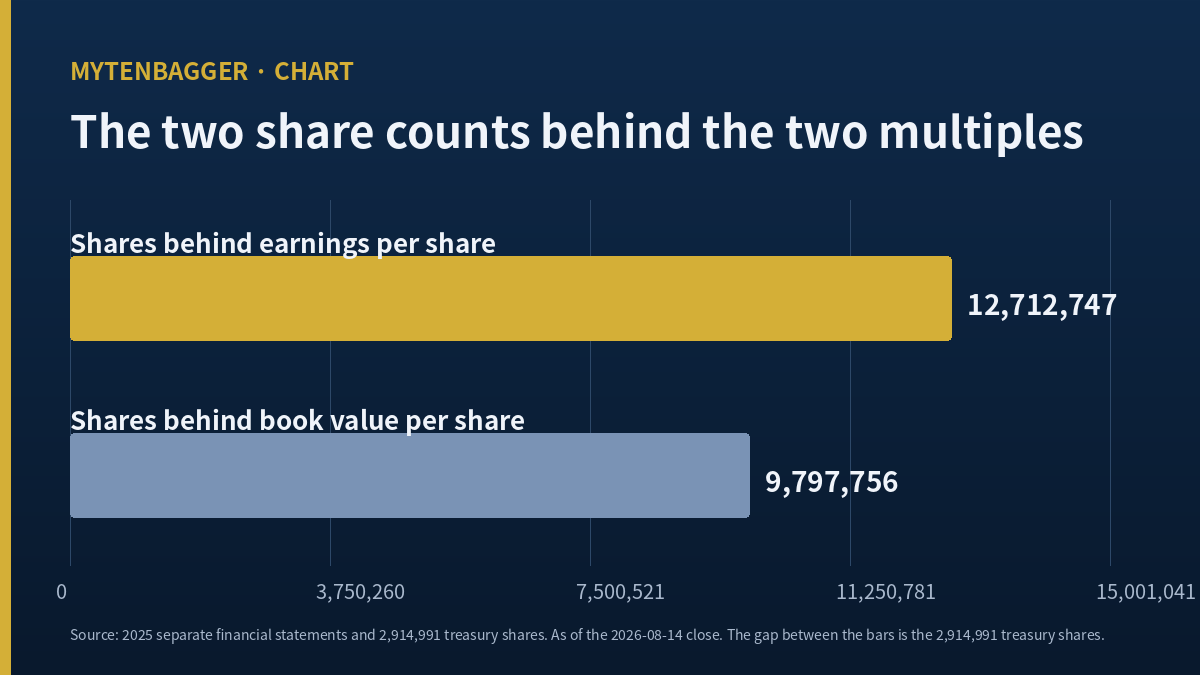
First, the two multiples behind the perfect score were built on two different share counts. Earnings per share used all 12,712,747 shares issued. Book value per share used the 9,797,756 that remain once 2,914,991 treasury shares come out.
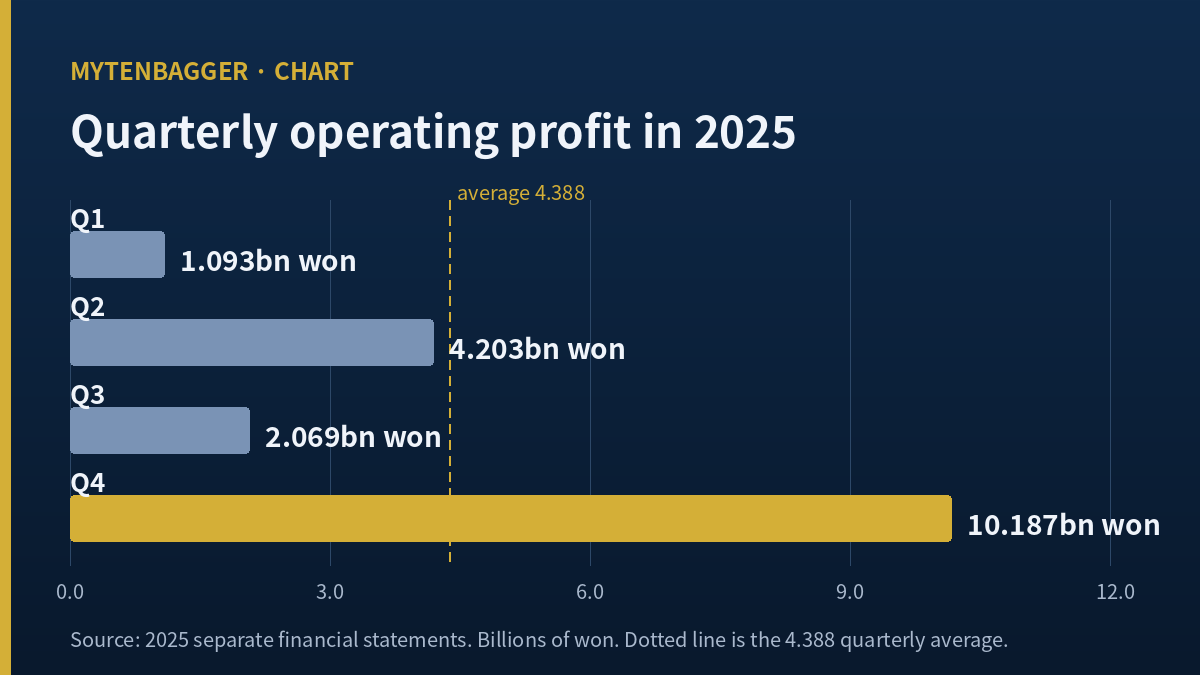
Second, of the 14.236 billion won ($10.0374 million) of 2025 net profit that the score rests on, 7.456 billion won ($5.2570 million), or 52.3743 percent, arrived in the fourth quarter alone.
Third, the most recent quarter I can verify is the first quarter of 2026, where revenue of 40.365 billion won ($28.4601 million) was 39.5236 percent below the 66.745 billion won ($47.0599 million) of a year earlier, and operating profit of 1.301 billion won came to 0.6594 times the 1.973 billion won of interest expense booked in the same quarter.
Contents
What the seven-point screen on Hyein stock actually cleared
Hyein Corp trades on the KOSPI, the senior board of the Korea Exchange, under the code 003010. The KOSPI is Korea’s main market, distinct from the KOSDAQ, which lists smaller and more growth-oriented names. Hyein was founded in 1960 and imports and sells Caterpillar equipment in Korea. The company’s own January 19, 2026 press release describes sixty-five years as Caterpillar’s official dealer in engines and power generation. It sells construction machinery and parts as merchandise, engines as product, and books service income on top.
That distinction carries most of this entry. Hyein does not manufacture. It buys finished equipment and resells it, which means inventory financing, delivery timing, and the exchange rate all sit between the end market and the income statement in ways they would not for a maker.
The seven cleared readings, on 2025 standalone figures: revenue of 241.713 billion won ($170.4245 million), operating margin of 7.28 percent, earnings per share of 1,120 won, return on equity of 11.5 percent, 8.65 times earnings, 0.74 times book, and operating profit of 17.552 billion won ($12.3754 million). The thresholds are revenue above 100 billion won, margin above 5 percent, positive earnings per share, return on equity above 10 percent, an earnings multiple between zero and 15, a book multiple between zero and 1.5, and positive operating profit.
One note on Korean filings before the numbers start. Quarterly flow items in Korean disclosure are cumulative from the start of the fiscal year, so a single quarter is a subtraction, and the fourth quarter is derived by taking three quarters of cumulative figures out of the annual. Every quarterly figure in this entry is the single-quarter value after that arithmetic. The fiscal year runs January to December, the same as in the United States.
One company, two share counts
The earnings figure
Net profit for 2025 on a standalone basis was 14.236 billion won. Shares issued come to 12,712,747. The company’s own investor page carries that figure, the WiseReport company screen carries it, and so does the body of the 2023 half-year filing. Dividing gives 1,119.82 won, which prints as the 1,120 won on the screen.
I set one thing aside here. The indicator database I normally pull from reports 12,714,138 shares, which is 1,391 more. Market capitalization rounds to the same 123.2 billion won either way, so the screen never shows the difference. I took the count the company publishes about itself and left the vendor figure out.
The book value figure
Total equity at the end of 2025 was 127.629 billion won ($89.9873 million). Across all 12,712,747 shares that is 10,039.45 won per share. The screen prints 13,026 won, close to three thousand won higher.
Working backwards from 127.629 billion won at 13,026 won per share gives 9,797,756 shares. Take that away from 12,712,747 and 2,914,991 remains. Korean disclosure explains exactly where that comes from. The company let a one-year buyback trust signed on April 10, 2025 expire on April 9, 2026, moved the 950,567 shares acquired under it into direct corporate custody, and disclosed treasury holdings of 2,914,991 shares afterward. That is 22.9297 percent of shares issued, and the same filing said no cancellation had been decided.
Closing the identity
So one number on the screen removes treasury shares and the other keeps them, and they sit side by side without saying so.
| Share count used | Earnings per share | Book value per share | Price to earnings | Price to book |
|---|---|---|---|---|
| All 12,712,747 issued | 1,119.82 won | 10,039.45 won | 8.6532x | 0.9652x |
| 9,797,756 after treasury | 1,452.99 won | 13,026.35 won | 6.6690x | 0.7439x |
| The pairing on the screen | 1,120 won | 13,026 won | 8.65x | 0.74x |
| Filed inputs behind both | profit 14.236bn won | equity 127.629bn won | close 9,690 won | filed return on equity 11.15% |
Align the share count and the identity closes. On the treasury-excluded line, 0.7439 divided by 6.6690 is 11.1542 percent. On the all-shares line, 0.9652 divided by 8.6532 is also 11.1542 percent. Dividing 2025 net profit of 14.236 billion won by equity of 127.629 billion won gives 11.1542 percent. Three routes to four decimal places.
Only the pairing printed on the screen came out at 8.5549 percent, and it did so because the top of one ratio and the top of the other were built over populations of shares that do not match.
I built this check last month on a different name, using two multiples to judge a third figure. The entry after that one had all three routes disagree, and I ended up printing every value side by side because I could not pick. This company shows me why that happened. The check only judges anything when both multiples stand on the same share count. When it fails, the first thing to suspect is not which figure is wrong but whether the two ratios were divided by the same number of shares. I would take that one line as the whole return on this entry.
I also left out a second vendor screen showing 11,080 won of book value and 0.87 times book. Neither the issued count nor the treasury-excluded count reproduces it, so I could not establish which population it used. A figure I cannot reproduce is worth less to me than a blank.
Treasury stock and what it does to Hyein stock
The 22.9297 percent in treasury is not only an accounting curiosity here. It is most of the reason this security moves the way it did in August.
The controlling shareholder group, the founding family, holds 2,506,954 shares, or 19.72 percent. Employee and welfare funds hold 359,355. Add treasury and the three together lock up 45.4764 percent of the company. What is left to trade is 6,931,447 shares, and that number reconciles exactly: 12,712,747 less 2,914,991 less 2,506,954 less 359,355. At the August 14 close that free float is worth 67.166 billion won, or $47.3565 million.
This is the access caveat I would want before touching it from outside Korea. But size of position is not the constraint I would think about first. The constraint is that a stock with under fifty million dollars of tradeable value and two limit-up sessions between August 3 and August 14 is one where the shape of the tape says as much as the shape of the business.
Half of the 2025 profit landed in a single quarter
The 8.65 times earnings looks inexpensive because there is 14.236 billion won of profit under it. I checked whether that profit accumulated evenly.
| 2025 single quarter | Revenue | Operating profit | Net profit | Operating cash flow |
|---|---|---|---|---|
| First | 66.745bn won | 1.093bn won | 0.323bn won | minus 21.256bn won |
| Second | 65.829bn won | 4.203bn won | 5.974bn won | 21.515bn won |
| Third | 56.542bn won | 2.069bn won | 0.483bn won | 20.183bn won |
| Fourth | 52.597bn won | 10.187bn won | 7.456bn won | 25.662bn won |
Fourth-quarter operating profit of 10.187 billion won ($7.1825 million) is 58.0390 percent of the annual 17.552 billion won. Fourth-quarter net profit of 7.456 billion won is 52.3743 percent of the annual 14.236 billion won. Revenue went the other way across those same four quarters, from 66.745 billion won down to 52.597 billion won.
For an importer this is not automatically a warning. Delivery acceptance drives when a machine becomes revenue, and a fourth-quarter concentration is ordinary in this trade. What I want to hold onto is narrower. When I read 8.65 times earnings I read it as a multiple on twelve months, and more than half the weight underneath it was placed in three.
Three Caterpillar dealers pointing three different ways
The useful comparison for this company is not the manufacturer whose machines it sells. It is other listed dealers, because a dealer earns on distribution and service, carries the inventory, and lives on the end market in front of it. I picked three that are listed and disclose in English, which is my eighteenth basis for choosing a peer and the first time I have compared dealers to a dealer instead of reaching for the maker.
Finning International, listed in Toronto and the largest Caterpillar dealer in the world, reported second-quarter 2026 revenue of 3,130 million Canadian dollars, up 20 percent, with basic earnings per share of 1.22 Canadian dollars and an equipment backlog of 3.8 billion Canadian dollars, up 22 percent from the end of 2025. Toromont Industries, the Caterpillar dealer for much of eastern Canada, reported second-quarter revenue of 1,597.7 million Canadian dollars, up 16 percent, operating income up 41 percent, basic earnings per share of 1.53 Canadian dollars, and backlog of 2.9 billion Canadian dollars against 1.4 billion a year before. Titan Machinery, listed on Nasdaq and a dealer for agricultural and construction lines, showed trailing revenue of $2.36 billion with revenue growth of minus 11.7 percent, trailing earnings per share of minus $2.35, and a market value of $411.52 million on a $18.11 share price.
Two arithmetic checks on the Titan figures, since those are the ones I lean on hardest: $18.11 times 22.72 million shares gives $411.4 million against the $411.52 million market value shown, and minus $2.35 times 22.72 million gives minus $53.4 million against trailing net income of minus $53.59 million. The Titan quote is as of the August 17, 2026 close, one session after my Korean price date of August 14, and I am flagging that mismatch instead of pretending the dates line up.
I am deliberately not building a multiple table across these four. The two Canadian dealers report in Canadian dollars on a mining and energy end market, Titan sits on North American agriculture, and Hyein sits on Korean construction and marine engines. What survives the differences is direction, and the direction is the point. Two of these dealers are growing revenue in the high teens or better with backlogs expanding. One is shrinking, and Hyein is shrinking harder: down 2.86 percent for full-year 2025 and down 39.5236 percent in the first quarter of 2026. Being a Caterpillar dealer has not been one trade this year.
Why I am only watching Hyein stock
The move did not start with a company figure
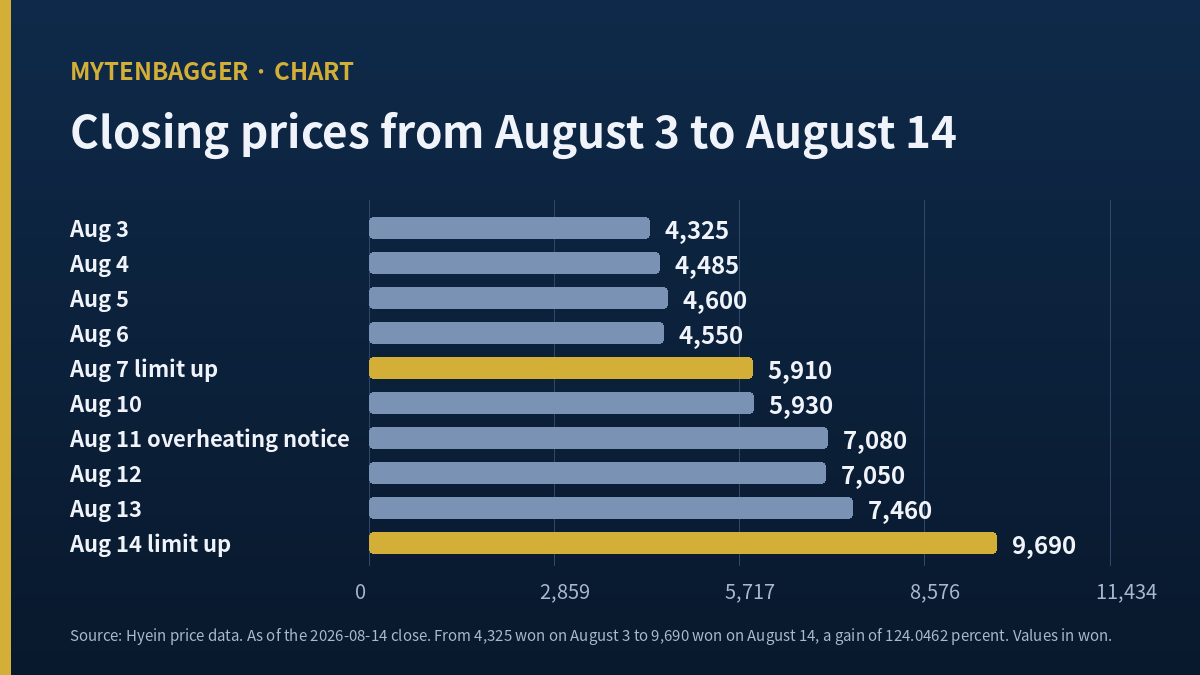
The close was 4,325 won on August 3, 2026 and 9,690 won on August 14, a rise of 124.0462 percent. There were two limit-up sessions in between, on August 7 and August 14, gaining 29.8901 percent and 29.8928 percent. The August 14 close is also the 250-session high and sits 86.9213 percent above the 20-day moving average of 5,184 won.
The article that ran on the morning of the first limit-up gave the reason as expectations around expanding artificial-intelligence data centers, on the logic that a Caterpillar dealer supplies standby generating sets. The company itself had said in January that it supplied standby generators to Samsung Electronics and Kakao data centers, without disclosing amounts or dates.
Then on August 11, after a 19.39 percent session, the Korea Exchange issued a formal query asking the company to disclose any material undisclosed development. The company answered that it had none in progress or determined. Another limit-up followed on August 14. The company confirmed through an official channel that there was no order or result to point at, and the price rose again anyway.
The exchange flagged overheating and the price added 63 percent after that
On August 11 the Korea Exchange placed Hyein on advance notice for short-term overheating designation. Measured against the trailing 40-session average, a close above 130 percent, turnover above 600 percent, and volatility above 150 percent together trigger three sessions of periodic single-price auctions instead of continuous trading. The close on August 10, the session before the notice, was 5,930 won. The close on August 14 was 9,690 won, which is 63.4064 percent higher. Whether the notice converted into an actual designation is something I could not confirm, and advance notice and designation are separate steps, so I am not asserting it did.
A number I published myself in July sits against this
On July 26, 2026 I published an entry on Korea’s data center power bottleneck and put a 1.9 percent grid-impact approval rate for the capital region into it, against 89.7 percent outside it. Standby generators ship when buildings get built. If capital-region data center construction is stuck at the approval stage, and new grid capacity runs three to five years, the demand that moved this price in August lands later than the price did. I have not found anything since that says the bottleneck cleared.
The near end market is worse than flat. The Construction and Economy Research Institute of Korea reported June 2026 construction orders of 18.7 trillion won, down 21.7 percent year over year, with private housing orders of 3.4 trillion won, down 52.8 percent. That is the demand base under a construction-equipment importer. Korea’s own compact-equipment maker said much the same on its February call, describing a delayed domestic recovery. I wrote about that company in an earlier entry on Doosan Bobcat, where the question was how much of a reported beat came from a one-time item.
And the latest quarter I can see covered its interest 0.66 times
The latest quarter I can verify is the first of 2026. Standalone revenue was 40.365 billion won ($28.4601 million), operating profit 1.301 billion won ($0.9173 million), and net profit 0.415 billion won. Revenue fell 39.5236 percent from 66.745 billion won a year earlier while operating profit rose 19.0302 percent from 1.093 billion won.
Interest expense in the same quarter was 1.973 billion won ($1.3911 million). Operating profit covered 0.6594 times of it. Operating cash flow was minus 6.756 billion won ($4.7634 million outflow).
Operating cash flow at this company flips sign year to year: positive 6.547 billion won in 2022, negative 1.814 billion in 2023, negative 21.274 billion in 2024, positive 46.104 billion won ($32.5065 million) in 2025. Buying machines and holding them until delivery puts that timing straight through the cash statement, so a negative quarter here is not by itself a signal. The point is narrower. There is no cash-flow line on the seven-point screen at all. The screen reads the income statement.
Margin moved the wrong way while volume moved the right way. Korean press working from the half-year filing put gross margin at 14.2 percent for the first half of 2025 against 18.2 percent for full-year 2024, a fall of 4.0 percentage points, while revenue over the same half rose 33.62 percent to 132.574 billion won ($93.4739 million). Selling more and keeping less of it is the combination I would want explained before the multiple means anything.
No one publishes an estimate on Hyein stock
The consensus panel on the WiseReport company page says, in Korean, that no opinion has been offered within the past three months. The 2026 and 2027 estimate tables are present as empty structure. I could not surface a named brokerage report under any search I tried. I am recording that as a coverage gap in the text and not working around it.
Two figures that looked like published valuations turned out not to be. One was a four-year-old opinion from a television analyst reposted on a personal site, the other an automatically generated summary page. Counting either would have made coverage look like it exists.
A coverage gap says two things at once. There is no estimate to miss or beat, so results land without a prior number attached. And through a move of 124 percent, no professional put a figure on the other side of that price. I weigh the second more.
Where I stand on Hyein stock and what would prove me wrong
What I could not confirm
The 2026 half-year report was legally due on August 15, 2026. August 15 through 17 were holidays in Korea, and as of my writing date of August 18 I could not locate that filing through disclosure search, news search, or results aggregators. Everything I found stopped at the first quarter of 2026. The prior year’s equivalent was filed on August 14, 2025. This may simply be an indexing lag. What I can state is that the most recent verifiable results for a stock that doubled between August 3 and August 14 cover a quarter that ended five months ago.
Four more items I checked and left out. Whether the overheating notice became an actual designation, and over which sessions. Current segment revenue weights, since the segment table I hold in original form is from the 2023 half-year filing, where merchandise was 53.8 percent, product 36.5 percent, and service 7.4 percent. The size and timing of the Samsung Electronics and Kakao generator supply, which the company confirmed happened but did not quantify. And the second vendor’s book value figure discussed above.
One more, on price. My basis throughout is the August 14, 2026 close of 9,690 won, or $6.83. I did not put an intraday quote into this entry, and I expect the screen a reader sees will differ from 9,690 won by a meaningful amount. Every multiple above is calculated on that close.
Market capitalization is 123.187 billion won, or $86.8554 million, which puts this company far outside the largest hundred listings in Korea. The dividend was 200 won ($0.141) per share for fiscal 2025, a 2.0640 percent yield at the August 14 close, with a payout of 17.86 percent measured against earnings per share on the full issued count.
Two things would bring me back. The 2026 half-year filing showing second-quarter operating profit above the same quarter’s interest expense, and that improvement being explainable by gross margin recovering instead of by delivery timing bunching up. I want both, in the same filing. A buyback that was announced but not yet canceled is the same kind of open question, and I counted it in my Hyundai Department Store entry.
Here is what would show this entry to be wrong. If first-half 2026 revenue in that filing comes in above the 132.574 billion won of first-half 2025, then I read a single quarter of delayed deliveries as a direction, and my third reason above collapses. The other two hold either way. The share-count observation is arithmetic, and the concentration of 2025 profit in one quarter is already filed.
Sources
Financial series are from disclosure-based standalone statements, loaded August 4, 2026. Price and multiples are the August 14, 2026 close screen at WiseReport. Share count and company history come from the Hyein investor page and its January 19, 2026 release, both in Korean and paraphrased here instead of quoted. The first limit-up was reported by Aju Business Daily on August 7, 2026, the exchange query and the second limit-up by Etoday on August 14, 2026, and the overheating notice by CBC News on August 11, 2026. Margin and half-year revenue are a Korean press compilation from The Fair, September 26, 2025. The treasury trust expiry and the 2,914,991 share figure were reported by Datatooza on April 9, 2026, citing the company disclosure of that date. Construction orders are from the Construction and Economy Research Institute of Korea, August 2026 monthly. Peer figures are from Finning’s August 5, 2026 release, Toromont’s July 28, 2026 release, and Titan Machinery statistics as of the August 17, 2026 close. Won amounts are converted at 1,418.3 won per dollar, the Seoul daytime session close on August 14, 2026 as reported by Newsis.
- LX International Dividend Reveals 2.79 Million Treasury Shares
- Kumho Tire Stock Costs the Same as Goodyear: Valuation Compared