Megastudy Edu Earnings Forecast: Two Estimates Nobody Revised
Digital Daesung, a smaller Korean test-prep company listed on the same exchange, reported first-half revenue up 16.0 percent and operating profit up 65.6 percent on August 3, 2026 (Monday). Two weeks later, the company I am writing about here reported the same six months with operating profit down 7.58 percent.
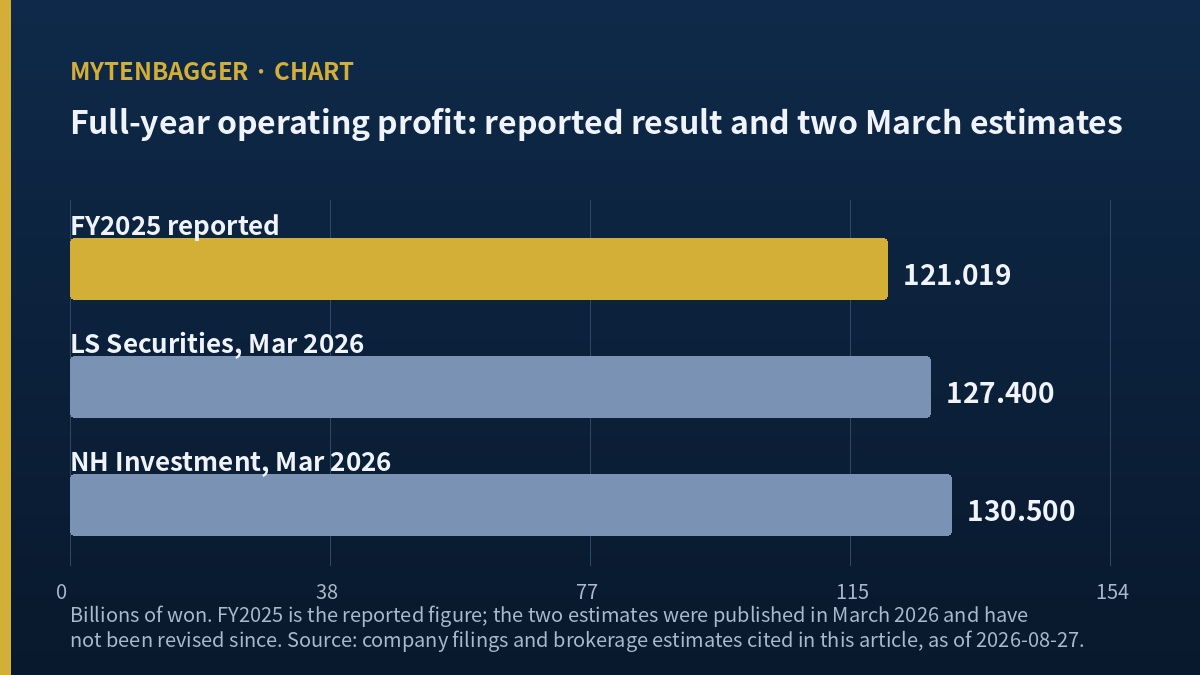
That contrast is not the reason I opened the file. I opened it because of what happened next, or more precisely because of what did not happen. Two brokerages cover Megastudy Edu stock. Both published a 2026 full-year operating profit estimate in March 2026. Both estimates implied growth. As of my check on August 27, 2026 (Thursday), I could not find a revised number from either one, and the consensus earnings figure sitting on the company information screen still carries the March assumption inside it.
Megastudy Edu Co. (KOSDAQ: 215200) is a Korean private education company. It sells recorded and live online lecture passes to high school students and repeat test-takers, and it runs physical cram schools, including boarding academies for students retaking the national college entrance exam. KOSDAQ is the junior board of the Korea Exchange, roughly analogous in role to Nasdaq relative to the NYSE, and it is where most Korean small and mid-cap growth names list. The stock closed at 35,700 won on August 27, 2026 (Thursday), which puts the market value at 370.0 billion won, or roughly 267 million US dollars.
Contents
Megastudy Edu stock and the two numbers that have not moved
The estimates I can source come from a comparison piece published on March 24, 2026 (Tuesday) by the Korean outlet Daily Invest, which set three houses side by side (Daily Invest, in Korean). LS Securities put FY2026 operating profit at 127.4 billion won. NH Investment and Securities put it at 130.5 billion won. Against the FY2025 outcome of 121.019 billion won, that works out to growth of 5.27 percent and 7.83 percent respectively, both of which I calculated back from the published figures.
One row in that same article does not survive checking, and I am flagging it because I nearly used it. A third house, Yuanta, was listed with FY2026 revenue of 884.9 billion won and operating profit of 121.0 billion won. Those are the FY2025 actuals to the decimal. I treated that row as a reporting error and left it out.
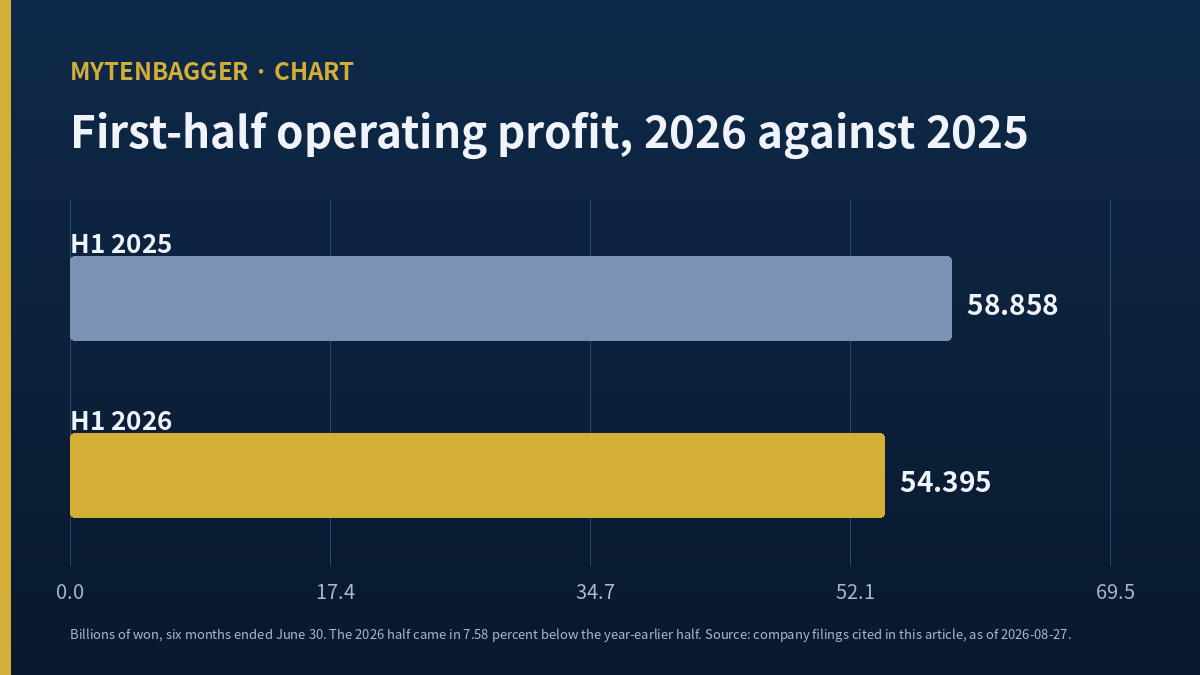
The half-year arrived on August 14, 2026 (Friday). Operating profit for the six months was 54.395 billion won, against 58.858 billion won a year earlier. Revenue was up 0.59 percent over the same span. So the top line held and the profit line did not.
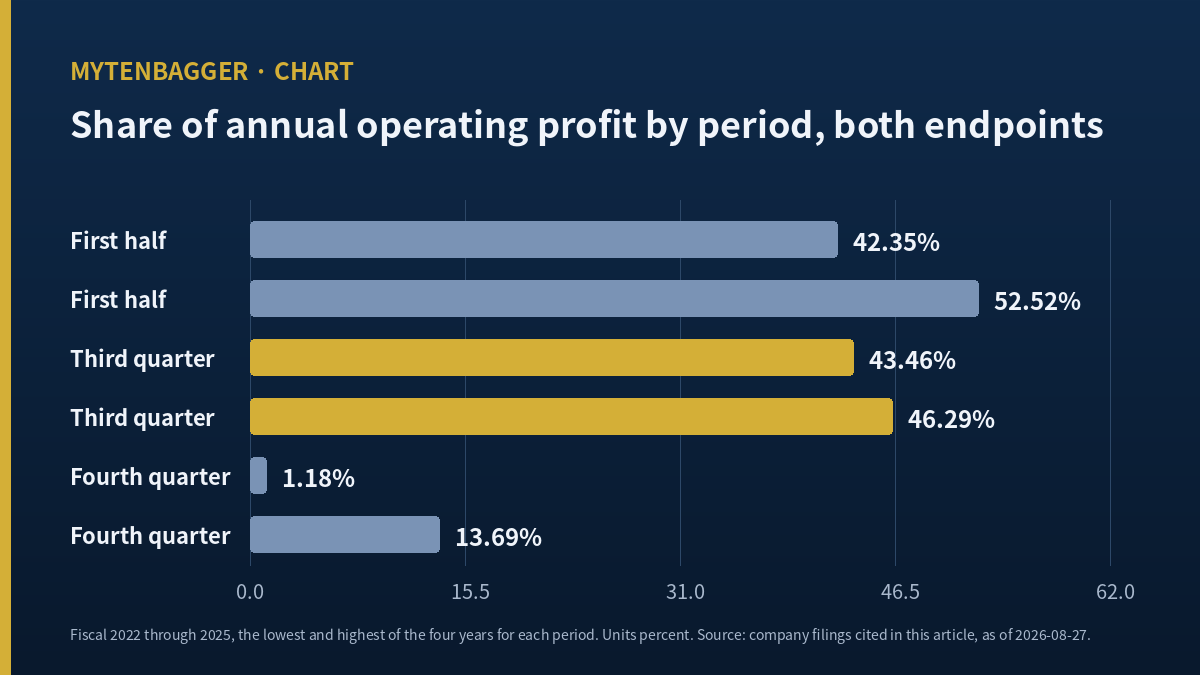
Here is the part I want to be careful about. A first half that lands at 54.395 billion won represents 42.70 percent of the LS full-year estimate and 41.68 percent of the NH estimate, both figures calculated back by me. That sounds like a shortfall. It is not necessarily one, and the reason is the subject of the next section: at this company the first half has historically accounted for anywhere between 42.35 percent and 52.52 percent of the full year. A first half at 42 percent of the annual number is inside that range, not outside it.
What I can say without stretching is narrower and, I think, more useful. Two forward numbers exist for this company. Both were written before the interim results. Neither has been restated in anything I could reach, and the report-listing service on the Korean company information site I use has been discontinued, so I cannot even browse the publication history to check.
Why one quarter decides the year at this company
Korean education is unusual in that the demand cycle is set by a single national event. The College Scholastic Ability Test, known in Korea as the Suneung, is held on one Thursday in November. The 2027 admissions cycle exam falls on November 19, 2026 (Thursday). Everything this company sells, from an online lecture pass to a place in a boarding academy, is priced against that date.
That does something specific to the income statement. I took the four completed fiscal years from 2022 through 2025 and calculated what share of each year’s operating profit landed in each part of the year.
| Fiscal year | First half share | Third quarter share | Fourth quarter share |
|---|---|---|---|
| 2022 | 50.38% | 43.46% | 6.16% |
| 2023 | 52.52% | 46.29% | 1.18% |
| 2024 | 42.35% | 43.96% | 13.69% |
| 2025 | 48.64% | 43.95% | 7.42% |
| Spread, four years | 10.17 points | 2.83 points | 12.50 points |
Source: consolidated statements filed with Korea’s Financial Supervisory Service electronic disclosure system, retrieved through a financial history tool with an as-of date of August 20, 2026. Korean quarterly filings report flow items cumulatively, so single-quarter figures are the discrete values. The fourth quarter is not filed separately in Korea and is computed as the annual figure minus the nine-month cumulative, which makes the fourth-quarter column the weakest one in this table. All shares are my own division of the filed numbers. The three shares sum to 100.00 percent in each of the four years.
The third quarter, which covers July through September, delivered between 43.46 percent and 46.29 percent of the full-year operating profit in every one of those four years. The distance between the two ends of that range is 2.83 points. The fourth quarter, the three months immediately after, ranged from 1.18 percent to 13.69 percent, a gap of 12.50 points. Dividing the second gap by the first gives 4.4130, which I round to 4.41 times.
The mechanism is not mysterious. When the exam ends in the third week of November, revenue from repeat-student programs and from final-year high school students stops at once. How quickly the next cohort of repeat students enrolls, and how quickly rising seniors start buying, varies from year to year, and all of that variance lands in the fourth quarter. Year-end costs and impairments land there too. In the fourth quarter of 2024 the company posted a net loss of 33.1 billion won; the background is the 53.8 billion won impairment recognized during that year after its planned acquisition of a rival was blocked by Korea’s competition regulator in March 2024, leaving prepayment-type assets written down (Money Today, in Korean, citing an LS Securities note).
So the picture for someone reading a half-year print in late August is this. The part of this company’s year that has varied least has not been reported yet, and it will not be until the third-quarter filing, which is due November 15, 2026. That date is a Sunday, so the filing realistically arrives on or after November 16, 2026 (Monday).
What Megastudy Edu stock’s half-year actually said
| First half, consolidated | 2026 | 2025 | Change |
|---|---|---|---|
| Revenue | 441.273bn won | 438.663bn won | +0.59% |
| Operating profit | 54.395bn won | 58.858bn won | −7.58% |
| Net profit to owners | 43.456bn won | 44.361bn won | −2.04% |
| Second quarter revenue | 204.743bn won | 200.993bn won | +1.87% |
| Second quarter operating profit | 28.412bn won | 32.658bn won | −13.00% |
Source: consolidated interim statements, filed August 14, 2026 (Friday). Percentage changes are all my own calculation from the two figures shown. Second-quarter figures are the discrete values, derived by removing the first quarter from the cumulative half-year.
The high school division carried the decline
First-half revenue from the high school division was 279.4 billion won, down 0.07 percent from 279.6 billion won, and 63.31 percent of total revenue (IB Tomato, in Korean). Divisional operating profit fell from 38.5 billion won to 32.5 billion won (Newstomato, in Korean). The Korean report gives that decline as 15.5 percent; recalculating from the two figures it prints gives 15.58 percent, a rounding difference. In absolute terms the division lost 6.0 billion won of profit, which is more than the 4.463 billion won the whole company lost. Other divisions covered part of it.
Two prices moving opposite ways
The same Korean reporting splits the pricing. Average revenue per high school online course rose from about 102,000 won to about 119,000 won, an increase of roughly 17 percent. Average revenue per high school offline enrollment fell from about 465,000 won to about 303,000 won, a decline of roughly 35 percent. The company has been adding physical capacity, and lower-priced single-subject offline courses have taken a larger place in the mix. Revenue holds; margin thins.
The lease line
New right-of-use asset additions in the first half were 64.0 billion won against 26.6 billion won a year earlier, which the Korean report describes as 2.4 times. Long-term lease liabilities went from 41.2 billion won to 78.2 billion won. The report states that increase as 89 percent; dividing the two printed figures gives 89.81 percent. Lease interest expense for the half was about 1.8 billion won. In July 2026 the company opened a new offline brand aimed at top-tier students in Seoul’s Daechi-dong district (Finance Today, in Korean). An online business is buying floor space, and floor space is contracted for years. I have watched the same ordering elsewhere, where the money went out well before the return came back.
Megastudy Edu stock carries a multiple built before August
On the company information screen I checked on August 28, 2026 (Friday), two houses contribute estimates, the consensus opinion reads 4.00 on a five-point scale, and the consensus earnings per share for fiscal 2026 is 8,866 won. The screen’s own reported figure for fiscal 2025 earnings per share is 7,903 won. The consensus number is therefore 12.19 percent above the reported one, which is another way of saying the growth assumption is sitting inside the multiple.
The reported earnings per share is itself worth a minute. Multiply 7,903 won by the 10,364,146 shares outstanding and you get 81.908 billion won, while net profit to owners for fiscal 2025 was 85.268 billion won. Divide the other way and 85.268 billion won over 7,903 won implies 10,789,321 shares, which is 425,175 more than the current count. The company canceled 405,671 treasury shares on October 28, 2025, so the reported figure looks like a weighted average that still contains pre-cancellation shares. I could not confirm that. So I recalculated the multiple on the share count I can verify: 85.268 billion won over 10,364,146 shares gives 8,227 won per share and a multiple of 4.34 times at the closing price, against the 4.52 times on the screen.
The book value figure behaves the same way. The screen shows 47,982 won per share, which multiplied out gives 497.292 billion won. That is not the 506.730 billion won of owners’ equity at the end of the second quarter of 2026; it is within 0.05 percent of the 497.065 billion won at the end of 2025. The equity input on that screen is a year-end value, not an interim one.
None of this makes the stock expensive or cheap. It makes the two most quoted valuation numbers for this company harder to use than they look, because one of them rests on a share count I cannot reproduce and the other rests on a profit assumption written in March. I ran into the same class of problem at Emart, where one ratio had two defensible answers depending on which inputs you accepted.
Megastudy Edu stock against twelve listed education companies
Korean private education has no clean global comparison, so I built the group in three blocks: American education operators, US-listed Chinese tutoring companies, and Japanese juku operators, which are the closest business analogue since they also run physical academies alongside content.
| Company | Listing | Latest FY end | Revenue | Net income | Net margin |
|---|---|---|---|---|---|
| Grand Canyon Education | Nasdaq LOPE | 2025-12-31 | 1,106m USD | 216.17m | 19.55% |
| Stride | NYSE LRN | 2026-06-30 | 2,518.081m USD | 338.192m | 13.43% |
| Chegg | NYSE CHGG | 2025-12-31 | 376.91m USD | −103.42m | −27.44% |
| Coursera | NYSE COUR | 2025-12-31 | 757.5m USD | −51.0m | −6.73% |
| New Oriental Education | NYSE EDU | 2026-05-31 | 5,661m USD | 475.17m | 8.39% |
| TAL Education | NYSE TAL | 2026-02-28 | 3,009m USD | 530.75m | 17.64% |
| Gaotu Techedu | NYSE GOTU | 2025-12-31 | 6,147m CNY | −323.31m | −5.26% |
| Nagase Brothers | Tokyo 9733 | 2026-03-31 | 64,183m JPY | 3,983m | 6.21% |
| Riso Kyoiku | Tokyo 4714 | 2026-02-28 | 34,240m JPY | 1,615m | 4.72% |
| Step | Tokyo 9795 | 2025-09-30 | 15,847m JPY | 2,690m | 16.97% |
| Meiko Network Japan | Tokyo 4668 | 2025-08-31 | 24,827m JPY | 1,727m | 6.96% |
| Waseda Academy | Tokyo 4718 | 2026-03-31 | 37,658m JPY | 2,487m | 6.60% |
| Megastudy Edu | KOSDAQ 215200 | 2025-12-31 | 884,945m KRW | 85,268m | 9.64% |
Twelve peer rows: four American operators, three US-listed Chinese companies, five Japanese juku operators. The thirteenth row is the subject company, shown separately. Figures are as presented by a single vendor, stockanalysis.com, and I did not manage a second-source check on most rows; the one I did verify exactly was Stride, whose company release matches the vendor to the dollar. The net margin column is my own division of the revenue and net income shown, not the vendor’s displayed margin, and three rows differ from the vendor’s figure in the second decimal. Currencies are native and unconverted. Fiscal year ends span four different months, so these are not the same twelve months of trading conditions.
The five Japanese operators are the block I keep coming back to, because they sell the same thing into a country with the same demographic problem: physical classroom hours plus content, to a shrinking cohort of teenagers. Their net margins for their latest completed year run from 4.72 percent to 16.97 percent. Megastudy Edu’s 9.64 percent, calculated on profit attributable to owners, sits inside that band. That is an observation about where the number falls, not a claim about which business is better run.
Three companies that left the list
Building that table taught me something I did not expect, so I am keeping it in the piece as its own block instead of burying it in a footnote. Three of the education companies a US reader would most plausibly reach for are no longer investable.
| Company | Former listing | What happened |
|---|---|---|
| Benesse Holdings | Tokyo 9783 | Taken private by BPEA EQT with the founding family; delisted May 17, 2024 |
| 2U | Nasdaq TWOU | Chapter 11 filed July 25, 2024; emerged as a private company |
| Instructure Holdings | NYSE INST | Taken private by KKR and Dragoneer in a 4.8 billion dollar transaction |
Sources: MarketScreener on Benesse, The Washington Post on 2U, and Private Equity Wire on Instructure.
There is a fourth trap I walked into and want to record. Adtalem Global Education, which many screens still list as ATGE, renamed itself Covista on February 5, 2026, with the ticker changing to CVSA on February 24, 2026. It is still listed and still operating; only the name and symbol changed. I left it out of the table for a different reason, that its degree-granting business is not comparable to a test-prep operator, but a piece written in August 2026 that prints ATGE is printing a symbol that no longer trades.
What I could see about who holds Megastudy Edu stock
This section is usually the shortest and the least satisfying, and this time I want to be explicit about the size of what I could actually see rather than only about what I found.
On index funds, here is the part I can quantify. The holdings view I could open showed the top 25. That means I verified absence across 32.05 percent of the fund. The Franklin FTSE South Korea ETF held 162 positions as of August 14, 2026 in the vendor mirror I could reach, and again I could see 25, so my check covers 15.43 percent of it. Neither percentage is enough to say a company is not in a fund. What I can say is that a company of roughly 267 million US dollars in market value is well below the size band a 78-name large and mid-cap index normally reaches, and that the broader-reaching Franklin fund is the more plausible of the two.
One more thing worth recording, because it recurs: the fund’s own page and the vendor mirror disagree about the same fund. The issuer says 78 holdings as of August 26, 2026; the mirror says 86 as of August 20, 2026. Different counts, different dates, same product.

What would break this read on Megastudy Edu stock
My position first. I am watching. At 370.0 billion won of market value this is a size where watching is my default, and nothing below is a signal. It is a list of the conditions under which what I wrote above stops being true.
Inheriting an aggregator screen
The consensus earnings figure of 8,866 won and the two-house count both came off one company information screen. I did not open either underlying report; both are behind access I could not clear. I do not know how that screen averages two contributors, how often it refreshes, or which vintage of each estimate it holds. When I wrote that nothing has been revised, the thing I actually observed was that one aggregator still displays a March-consistent number. Those are different claims, and if the screen simply updates slowly, my central observation is about the vendor and not about the analysts.
The seasonal pattern is four observations deep
The third-quarter share held inside 2.83 points across fiscal 2022 through 2025. That is four data points, and 2026 is the year this company is materially changing its cost structure by adding leased floor space. Physical academies recognize revenue on a different rhythm from online passes. The stable band I leaned on could break in exactly the year I am leaning on it.
What the third-quarter filing settles
When the third-quarter report arrives on or after November 16, 2026 (Monday), three things resolve. Whether the third quarter lands inside its historical band. Whether the high school division’s margin turns. Whether right-of-use assets and lease liabilities keep climbing, because if they do, the fourth quarter carries a heavier cost base into the weakest and least predictable part of this company’s year.
What I could not confirm about Megastudy Edu stock
Ordered by how much each one bothers me.
One. I could not open either brokerage report. Everything I wrote about the two estimates comes from a Korean news comparison of them and from an aggregator screen. Saying an estimate has not been revised, when the thing I checked was a secondary display of it, is a weaker statement than it sounds.
Two. I could not find any 2026 buyback or cancellation filing. The company re-published a corporate value enhancement plan on March 11, 2026 (Wednesday) committing to a shareholder return ratio above 60 percent, half-yearly buyback review, and cancellation of everything repurchased (Digital Today, in Korean). 2026 is the final year of that three-year program. A policy statement is not an execution, so I put no cancellation into any calculation here.
Three. Share count and earnings per share disagree across sources. One screen shows 10,364,146 shares, another 10,365,216, a difference of 1,070. The reported earnings per share of 7,903 won reconciles to neither, and a third aggregator prints fiscal 2025 earnings per share as 8,072 won. I standardized on the share count and disclosed it.
Four. Korean outlets give first-half high school division revenue as either 279.4 billion won or 283.4 billion won, a 4.0 billion won gap I could not resolve. I used the figure that reconciles with the 63.31 percent share printed in the same article.
Five. I have no verified figures on the physical academy business: no student headcount, no campus count, no divisional revenue. Searches returned the company’s own enrollment pages. So I sized the offline expansion only through the lease lines, which is an indirect measure.
Six. The 33.1 billion won fourth-quarter 2024 net loss is something I could tie to an annual impairment of 53.8 billion won, but no report I found states how much of that impairment was booked in the fourth quarter specifically. That is why the text above attributes it at the annual level.
I made a related mistake once at Studio Dragon, At Harim I dealt with a company nobody covers at all
Prices and multiples reflect the August 27, 2026 (Thursday) close as checked at the time of writing. The Korean won is the reference currency throughout; the single US dollar conversion is approximate, at about 1,386.30 won per dollar, the Seoul market close of August 26, 2026 (Wednesday) as reported by Business Korea, which is one day earlier than the price date. Financial figures are consolidated and filed with Korea’s electronic disclosure system; every ratio and percentage change I derived myself is marked as such in the text.