Shinsegae Stock Fell 47 Percent While Its Estimates Went Up
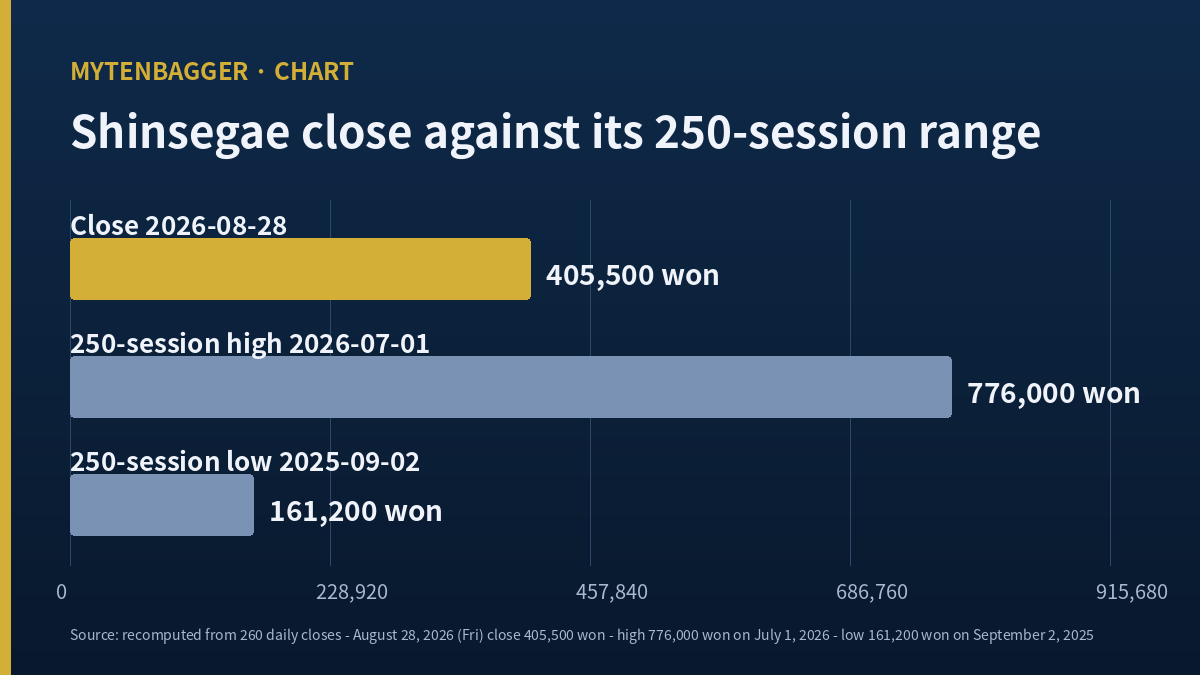
On August 11, 2026 (Tue), Shinsegae reported the largest first-half operating profit in its history: 365.0 billion won, up 75.7 percent year on year, on gross turnover of 6.36 trillion won. On August 12 and 13, six Korean brokerages cut their valuations on the shares. Shinsegae stock closed at 405,500 won on August 28, 2026 (Fri), which is 47.74 percent below its highest close of the past 250 trading sessions.
I spent a while assuming the second fact had to contradict the first, and that I would find an earnings problem buried under the headline. I did not find one. What I found is that at least one of those six houses raised its 2026 operating profit estimate in the same note that moved its valuation down.
Shinsegae Inc. trades on the KOSPI, the senior board of the Korea Exchange, under the code 004170. It is the holding and operating company behind Shinsegae Department Store, the duty-free arm Shinsegae DF, and Shinsegae Centralcity. It is a separate listed company from Emart, which runs the group’s discount stores.
| What moved | Direction | Where I read it |
|---|---|---|
| Q2 2026 operating profit | Up 121.9% YoY | Company release, Aug 11 |
| One house’s 2026 profit estimate | Up, to 829.2bn won | Heungkuk note, Aug 13 |
| The same house’s valuation | Down | Same note |
| Shinhan’s EV/EBITDA multiple | 7x to 6x | Shinhan note, Aug 12 |
| The KOSPI index in July | Down 22.19% | Index closes, my calculation |
Contents
The date I priced Shinsegae stock from
I am writing before the Korean market opens on Monday, August 31, 2026, so the last close available to me is Friday, August 28. Saturday the 29th and Sunday the 30th are not trading days. Every price and multiple below sits on that Friday close of 405,500 won unless I say otherwise.
At that price the market capitalization is 3.83 trillion won, or roughly 2.8 billion US dollars at about 1,377 won per dollar. The Korean won is the reference currency throughout this piece and the dollar figures are approximate conversions for readers who price things that way. Foreign investors held 29.5 percent of the shares and margin balances stood at 0.38 percent of the float on the same date, according to the Kiwoom-sourced indicator screen I use.
What the six houses actually changed about Shinsegae stock
The estimate went one way and the valuation went the other
Six houses moved on August 12 and 13, 2026: Kiwoom Securities (Park Sang-jun), Korea Investment and Securities (Kim Myoung-ju), Shinhan Investment (Cho Sang-hoon), Hanwha Investment and Securities (Lee Jin-hyup), DB Financial Investment, and Heungkuk Securities (Park Jong-ryeol). All six lowered their valuations. All six kept a buy rating. Korean press counted eleven separate downward valuation notes on this company across the month of August, per Hankyung on August 26, 2026.
I am not going to quote the valuation figures, because the figures are not the interesting part. Here is what is. Heungkuk’s Park Jong-ryeol put 2026 operating profit at 829.2 billion won on revenue of 13.2 trillion won, a rise of 73.04 percent over the 479.2 billion won the company actually earned in 2025 (my calculation), and moved the valuation downward in the same note. The multiples he applied were 7.7 times forward earnings and 0.8 times book. Shinhan’s Cho Sang-hoon said plainly that he had taken his EV/EBITDA multiple from 7 times to 6 times, with 2026 operating profit at 806.6 billion won. Kiwoom’s Park Sang-jun trimmed his third-quarter operating profit estimate by 8 percent, to 179.5 billion won, which is the only downward earnings revision I found in the group.
So five of the six either held or raised the profit line while every one of them lowered what they would pay for it. That is a repricing of the multiple, and it is the market that sets a multiple, while the retailer sets the earnings.
Where the multiple went
The KOSPI closed June 2026 at 8,476.48 and closed July at 6,595.45, a fall of 22.19 percent for the month by my calculation. On July 28 the index dropped 10.84 percent in a session to 6,023.66, per Herald Business. Circuit breakers fired on July 28 and again on July 29, the first back-to-back halts in the index’s history; Money Today put the two-day loss at 16.17 percent, and chaining the two daily moves gives 16.18 percent. The index then rose 17.91 percent on July 31 in a single session, which is why the month’s headline number is 22.19 percent and not the larger figure some coverage carried mid-crash. On August 28 the index closed at 6,788.88.
Korean department store revenue tracks this more directly than most retail does. Seoul Economic Daily reported on July 28, 2026 that Shinsegae’s June fashion category grew 9.1 percent, its slowest month of 2026, against a January-to-May average of 12.4 percent. That is 3.3 percentage points of deceleration in the category that carries the most operating leverage.
The half-year the market marked Shinsegae stock down
Segment results for the June quarter
Second-quarter gross turnover was 3.14 trillion won, up 8.5 percent year on year; consolidated revenue was 1.78 trillion won, up 5.1 percent; operating profit was 167.1 billion won, up 121.9 percent, as reported by Etoday on August 11, 2026. Department stores contributed 108.8 billion won of operating profit on 2.02 trillion won of turnover. Shinsegae Centralcity contributed 14.9 billion won. Shinsegae Live Shopping contributed 5.2 billion won, down 15.4 percent, the only segment whose profit fell.
Segment turnover is stated on a gross basis while consolidated revenue is net, so I have not added the segment lines together. Korean groups that report this way are common enough that I ran into the same two-basis problem on a trading house earlier this month.
Duty free turned profitable on a shrinking top line
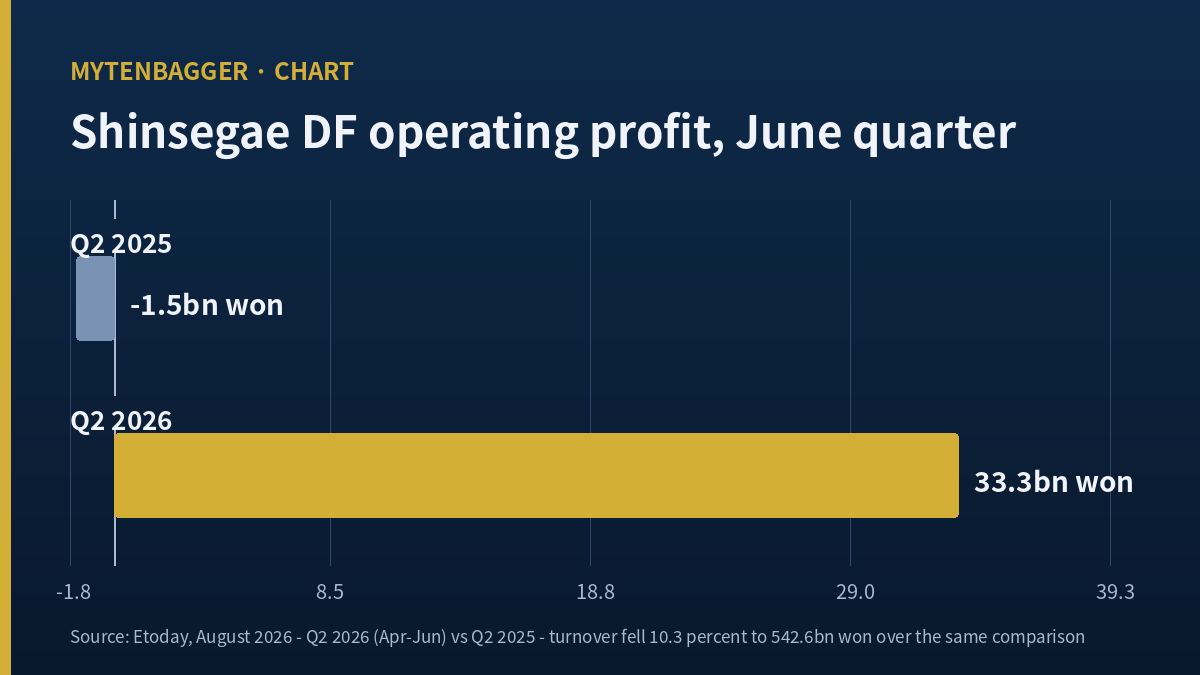
Shinsegae DF posted 33.3 billion won of operating profit against a 1.5 billion won loss a year earlier. Turnover fell 10.3 percent to 542.6 billion won over the same comparison. The profit did not come from selling more.
Shinsegae exited the DF1 and DF2 concessions at Incheon International Airport on April 27, 2026. The original contract ran to June 2033, and the exit followed four consecutive loss-making quarters, per Financial News on November 19, 2025. Kiwoom’s Park Sang-jun estimated the reduction in airport-related losses at roughly 16 billion won in his August 12, 2026 note. A duty-free operator that stops paying an airport concession fee books a better margin without selling an additional unit, and that is most of what happened here. For contrast, the other Korean operator I have written up kept paying its concession instead of walking: Hotel Shilla’s gap to its index came apart along a different seam.
Who is actually walking into Shinsegae stores
Foreign customer revenue at Shinsegae’s department stores reached 580 billion won in the first half of 2026, up 120 percent year on year, per Etoday on July 13, 2026. The same report noted that Chinese nationals fell from 77 percent of Shinsegae’s foreign customer mix in 2019 to 48 percent in the first half of 2026.
The policy behind that growth is not the company’s. Korea began admitting Chinese group tourists without visas on September 29, 2025, and the justice ministry has extended the arrangement through December 31, 2026, according to Travel Times on June 29, 2026. The same source gives the count: 104,369 people entered under the visa waiver between September 29, 2025 and June 21, 2026, against 512,998 who entered on group electronic visas over the identical window. The waiver route accounts for 16.91 percent of the two, by my calculation. The headline policy carried a much smaller share of the traffic than its name suggests.
Korean airlines were pulled by the same inbound recovery, and I looked at one of them from a completely different angle, through its order book rather than its passenger mix.
Korea has four duty-free operators and one of them grew
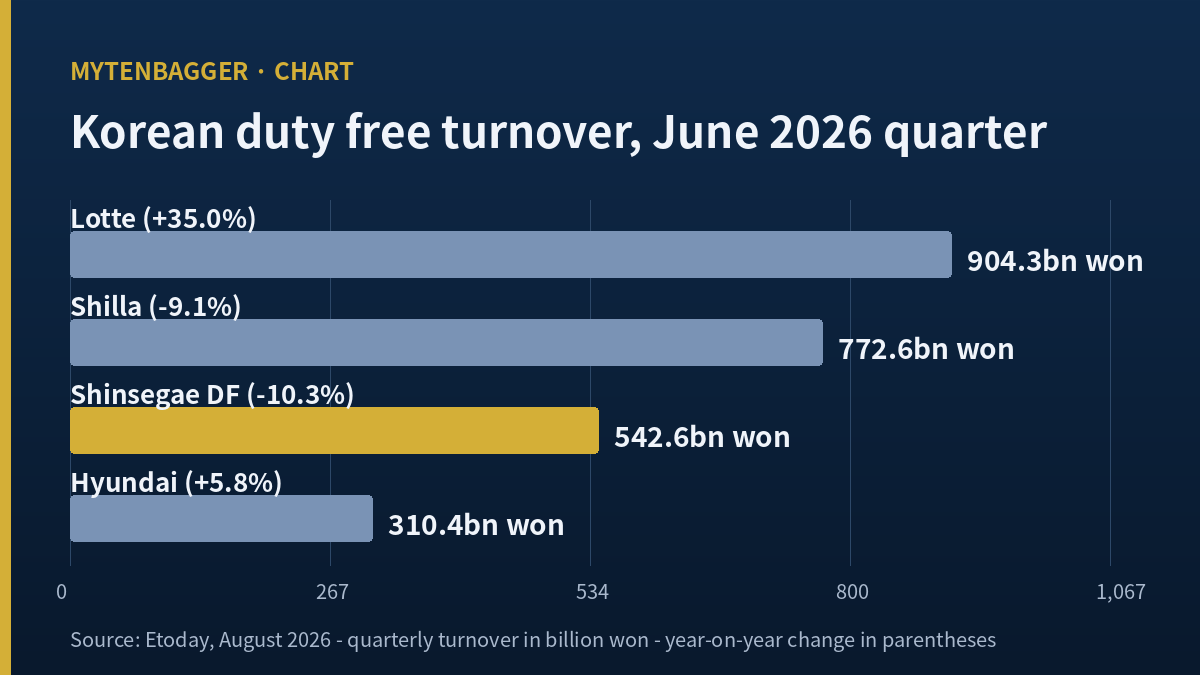
Korean duty free is a concentrated market with four licensed operators, and the June 2026 quarter separated them cleanly. Lotte Duty Free turned over 904.3 billion won, up 35 percent year on year, with 31.9 billion won of operating profit. Shilla turned over 772.6 billion won, down 9.1 percent, with 36.4 billion won. Shinsegae DF turned over 542.6 billion won, down 10.3 percent, with 33.3 billion won. Hyundai turned over 310.4 billion won, up 5.8 percent, with 6.2 billion won. The figures come from Etoday on August 18, 2026.
Add the four and the quarter comes to 2.53 trillion won, which puts Shinsegae DF at 21.45 percent of the four-operator total by my calculation. That is a share of these four and not of the whole Korean duty-free market, which also includes smaller downtown and city licences I have no quarterly data for.
What stands out is that only Lotte grew. Shilla and Shinsegae both shrank, and both are the two operators who handed back Incheon airport concessions during the same period. Turnover moved to whoever kept paying for the airport footprint, and profit improved for whoever stopped. Those are two different scoreboards, and an investor has to decide which one describes the next three years before deciding whether the margin turn at Shinsegae DF is durable.
A corporate split lands on December 1
On August 27, 2026 (Thu) the board approved a spin-off of SSG.com, the group’s online arm, into two companies. The surviving entity keeps the grocery business and sits under Emart. A newly created company, provisionally called Shinsegae Mall, takes fashion, beauty and department store merchandise and sits under Shinsegae. An extraordinary shareholder meeting is set for late October and the new entity is scheduled to be established on December 1, 2026 (Tue), per Bloter.
The direction of travel matters more than the mechanics. The Shinsegae group formally separated its two family branches during 2025, with department stores on one side and discount retail on the other, and this split cleans up the one large asset the two branches still shared. Korean fair trade rules set a cross-holding threshold at under 10 percent for a formal family separation to be recognised, and the shareholding here has been well above that, so further steps would be needed after December. I am filing this under structure. It is not a driver of the next few quarters. It changes what a Shinsegae shareholder owns; it does not obviously change what a Shinsegae department store sells.
For a US reader the practical read is narrower still. Korean groups reorganise ownership this way routinely, and the segment tables I quoted above are drawn on the current structure. Comparisons made across December 1 will need the segment definitions checked before the numbers are lined up.
The multiple band Shinsegae stock sits inside
Before placing Shinsegae anywhere, I wanted to know how wide the band is. So I measured the band first and looked at position second. These are the four listed department store operators with data current enough for me to use, all from stockanalysis.com, priced off the August 28, 2026 close and refreshed between August 16 and August 30.
| Company | P/E | P/B | ROE |
|---|---|---|---|
| Macy’s (NYSE: M) | 9.05 | 1.20 | 14.36% |
| Dillard’s (NYSE: DDS) | 14.27 | 4.64 | 33.75% |
| Kohl’s (NYSE: KSS) | 7.51 | 0.47 | 6.67% |
| Marks and Spencer (LSE: MKS) | 31.18 | 2.46 | 7.80% |
| Shinsegae (KRX: 004170) | 21.04 | 0.47 | 3.30% |
The band across those four spans 4.15 times on earnings (7.51 to 31.18) and 9.87 times on book (0.47 to 4.64), both by my calculation. A sector with that much spread does not have one correct multiple, which is the background condition for six analysts changing theirs in the same week. Shinsegae sits at the bottom edge of the book band, level with Kohl’s to the second decimal, and inside the earnings band. Its return on equity is below all four.
The five I could not use
J. Front Retailing, Takashimaya, Isetan Mitsukoshi, Avolta and China Tourism Group Duty Free all carry data as of dates between June 3 and July 27, 2026 on the same source. That is six to twelve weeks stale against a market that fell 22.19 percent in July and recovered part of it in August, so I left them out instead of setting a post-crash Korean price against pre-crash Japanese and Chinese ones. Two more comparables no longer exist: Nordstrom was taken private in May 2025, and Hudson’s Bay closed its remaining stores in June 2025.
The practical consequence is that every peer I could use is American or British. I do not have a current Asian department store comparison, and the Asian names are the ones whose customer mix most resembles this company’s. The two Korean operators are excluded on a different ground: their fiscal presentation and segment mix differ enough from a pure department store that a three-column table would mislead. I have written one of them up on its own terms, from the payout side of its accounts.
Getting at Shinsegae stock from a US account
There is no American depositary receipt for this company that I could verify, so the share itself is reachable only through a broker with direct KRX access. Neither vehicle gives a US investor a way to express a view on Korean department store multiples specifically, which is the exact thing this piece is about.
A revision note is the document type I have historically read backwards. When I see a valuation cut I look first for the deteriorated line in the model, and for years that instinct has been roughly right. It was wrong here, and it was wrong in a way I could have caught in one minute by reading the estimate table before the headline. I read the headline first anyway. Treating a price change as evidence about the company is hard to unlearn precisely because it usually works.
Where I stand on Shinsegae stock and what would break this note
I do not own the shares and I have no order working. My default for a company outside the top hundred by Korean market capitalization is to watch, and I am watching. What I take away is narrower than a view on the price: when a Korean retailer’s valuation moves in the same week as its earnings report, I now check which of the two the analyst actually revised before I decide what the move told me.
What would break this note is a decision taken outside the company by a third party. Shinsegae DF’s return to profit rests on no longer paying the Incheon airport concession. If Incheon International Airport Corporation writes the next concession tender in terms that make re-entry attractive, or writes it in terms that penalise the operators who walked away, the duty-free margin I described stops behaving the way I described it. Korean reporting has already flagged that both operators who exited face credibility deductions in re-bidding. That tender is designed by an airport authority. Neither the company nor I get a vote, and no quarterly report will show it coming.
Four things that cut against this reading
- One raised estimate is not six. I verified Heungkuk’s raise and Shinhan’s multiple change directly from press coverage of those notes. For the other four houses I have the direction of the valuation change and not the underlying estimate table. My sentence about five of six holding or raising rests on the absence of a reported cut, which is weaker evidence than a reported hold.
- Kiwoom did cut an earnings number. The third-quarter operating profit estimate came down 8 percent, and the reason given was slower fashion sales after a June gadget promotion. That is a company-level operating fact about the second half, and it sits inside my window.
- The multiple may be right. A retailer whose foreign revenue growth depends on a visa policy with a stated end date, and whose duty-free profit depends on a concession it has already left, is arguably a business that deserves a lower multiple than it carried in June. Nothing in this note argues the market was wrong to reprice it.
- The peer table is Anglo-American by default. I excluded the Japanese and Chinese comparables on data freshness, which means my band of 4.15 times on earnings was measured on four retailers operating in consumer markets quite unlike Korea’s. A fresher Asian set could produce a different band and a different position within it.
Numbers I checked and left out of this Shinsegae stock note
No Korean outlet published a net income figure for the first or second quarter of 2026, and the company’s own releases carried gross turnover and operating profit only. A data aggregator has quarterly net income, but a single aggregator source is not enough weight for a number this central, so I worked with operating profit throughout.
The indicator screen shows a 10.31 percent free cash flow yield and 2.61 times interest cover. Both take a first-half 2026 cumulative numerator against a spot market capitalization or a half-year cost base, so the periods do not line up and I left them out.
Two pages on the same data provider give this company a forward earnings multiple of 9.32 and 8.86. I could not establish which vintage each page uses, so I quoted neither and used the individual house notes instead.
Prices and multiples reflect the August 28, 2026 close as checked at the time of writing. The Korean won is the reference currency here and dollar figures are approximate, at roughly 1,377 won per dollar on that date. Figures marked as my calculation were derived by me from the sources cited and do not appear in those sources in that form. Segment turnover is stated gross and consolidated revenue net, and the two are not additive.