Lotte Rental Stock Made Me Count the Same Used Car Twice
Lotte Rental stock closed at 47,350 won on Monday, August 31, 2026, which is about USD 34.60. Before I opened a single valuation screen I pulled the divisional profit table apart, and the first thing I found was two numbers moving in opposite directions on the same object. The two auto rental divisions added 13.514 billion won of operating profit in the June 2026 quarter. The used car resale division gave back 7.06 billion won in the same three months. The object being priced on both sides is a used car.
One variable, two signs inside one company. June 2026 quarter, as reported.
| Side that wants cars cheap | Side that wants cars expensive |
|---|---|
| Long term auto rental operating profit 45.3 billion won Positive. Up 25.6% year on year. |
Used car resale operating profit 26.4 billion won Negative. Down from 33.46 billion won a year earlier. |
| Short term auto rental operating profit 9.9 billion won Positive. Up 76.2% year on year. |
Used car resale revenue 217.1 billion won 28.35% of the 765.8 billion won consolidated top line, but 31.21% of group operating profit. |
| Used cars as a share of new long term fleet placements 20.6% Positive. Up from 14.1% in the June 2024 quarter. |
Resale price of the cars coming off contract Negative. Korean trade press cites a July 2026 decline in the national used car average. |
| My stance is watching, no position. The two columns sit on opposite sides of one variable, and I cannot yet decide which direction of used car prices is good for this company. | |
Contents
What Lotte Rental Stock Is, and Where It Trades
Lotte Rental is Korea’s largest car rental company. Its shares trade on the KOSPI, the main board of the Korea Exchange, which is the senior of Korea’s two domestic markets. The other one, KOSDAQ, carries smaller and earlier stage companies. A KOSPI listing tells you the company clears the exchange’s larger size and governance thresholds, and it says nothing at all about the business being safe.
For a reader outside Korea the practical position is this. There is no American depositary receipt for this company. I did not verify whether either fund currently holds this specific name, and I am not going to assume it. At about USD 1.256 billion of market value the company sits at the small end of what broad Korea funds usually carry.
The August 31 marks
| Item | Value | How I checked it |
|---|---|---|
| Close | 47,350 won (USD 34.60) | Daily bar and indicator screen agreed |
| Market value | 1.7192 trillion won (USD 1.256bn) | 36,308,342 shares, reconciled to zero difference |
| 250 session high | 48,750 won | Adjusted close basis. The August 31 close is 97.13% of it |
| 250 session low | 26,650 won | 77.67% above that low |
| Twelve month return | plus 60.51% | Three month plus 51.52%, one month plus 26.1% |
| Price to book, recomputed | 1.088x | Owner equity of 1.5802 trillion won at June 30 |
I checked the reference price three ways before I put any percentage change into this piece. The indicator screen’s current price, the trend summary’s latest price, and the August 31 row of the daily series all read 47,350 won. When those three disagree the change figures have been computed on an intraday snapshot and I leave them out. This time they agreed.
The Lotte Rental Stock Number That Made Me Stop Reading the Group Line
The company reported its June quarter on August 5, 2026, and the divisional figures below come from that release as carried by the Korean outlet EBN. The percentage changes are the company’s. The prior year amounts are mine, worked backward from those percentages, and I mark them as derived every time they appear.
| Division | Revenue | Operating profit | Change in profit | Margin |
|---|---|---|---|---|
| Long term auto rental | 421.5bn won | 45.3bn won | plus 25.6% | 10.75% |
| Short term auto rental | 52.5bn won | 9.9bn won | plus 76.2% | 18.86% |
| Used car resale | 217.1bn won | 26.4bn won | minus 21.1% | 12.16% |
| T car retail platform | 30.9bn won | not disclosed | revenue plus 108.8% | not computable |
| Consolidated group | 765.8bn won | 84.6bn won | plus 9.6% | 11.05% |
The table does not close, and I want that visible before anything else. The three disclosed divisional profits sum to 81.6 billion won against a consolidated 84.6 billion won, leaving 3.0 billion won unaccounted. Revenue behaves the same way. The four disclosed lines sum to 722.0 billion won against 765.8 billion won consolidated, leaving 43.8 billion won. General rental and other unallocated activity presumably sits there. I am not going to write a guess as though it were a fact.
Turning the percentages back into money
The company gave changes, not prior year amounts, so I divided. Every figure in this list is derived.
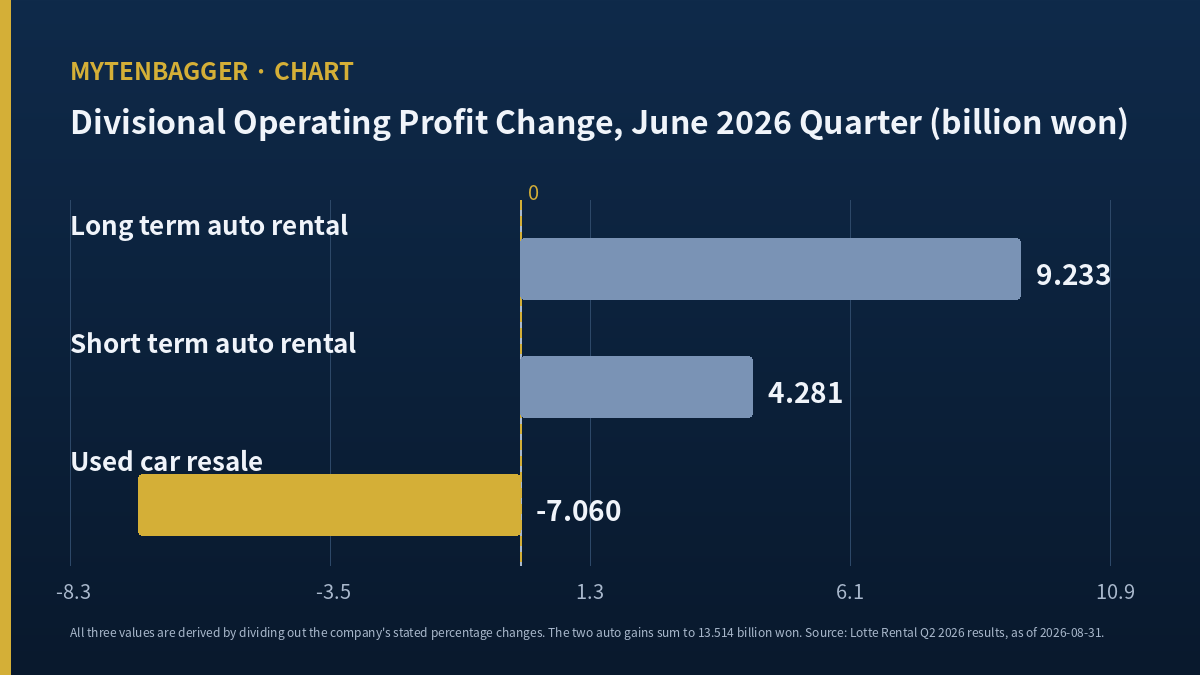
- Long term auto rental a year earlier: 45.3 divided by 1.256 equals 36.067 billion won, so this quarter added 9.233 billion won.
- Short term auto rental a year earlier: 9.9 divided by 1.762 equals 5.619 billion won, so this quarter added 4.281 billion won.
- Used car resale a year earlier: 26.4 divided by 0.789 equals 33.46 billion won, so this quarter gave back 7.06 billion won.
The two auto divisions gained 13.514 billion won between them. The resale division gave back 7.06 billion won, which is 52.24% of that 13.514 billion won gain. More than half of what the rental side earned in improvement was returned by another division of the same company.
I tested the method before I trusted it. Group operating profit of 84.6 billion won divided by 1.096 gives 77.19 billion won, and the June 2025 standalone quarter computed from the regulatory filing is 77.211 billion won. Those two are 0.03% apart, so working backward from the company’s stated percentages behaves in this particular case.
Where Lotte Rental Stock Wins on Cost and Loses on Revenue
The business cycle is short to describe. Buy a car, rent it out, sell it when the contract ends. Vehicle prices therefore enter the income statement twice, once as an input cost and once as revenue.
The cost side
Among the reasons the company gave for a 25.6% rise in long term rental profit was the share of used vehicles among new fleet placements. That share was 20.6% in the June 2026 quarter against 14.1% in the June 2024 quarter. The company placed 23,607 vehicles in the quarter, up 11.6%, and net fleet additions were 5,095 vehicles, up 59.1%.
Buying a used car instead of a new one to put on a long term contract lowers the cost of each unit placed. The monthly rate collected will be lower too, but the depreciation load falls and the capital comes back sooner. When used car prices fall, this side of the company gets better.
The revenue side
In the same quarter the resale division booked 217.1 billion won of revenue, down 2.9%, and 26.4 billion won of operating profit, down 21.1% from a derived 33.46 billion won. Profit fell more than seven times as fast as revenue. My reading is that the spread between sale price and carrying value narrowed on each car sold.
This division is not a rounding item. It is 28.35% of consolidated revenue and 31.21% of group operating profit, so it carries more of the profit than of the sales, and among the three divisions whose profit the company disclosed it was the only one that fell.
Korean trade press points the same way. A July 24, 2026 report citing a survey by the used car marketplace Encar and the newspaper Herald Business said the national used car average fell 1.09% from the prior month, with domestic models down 1.05% and imports down 1.14%. I am putting a Korean source into English here, not quoting an English original. It is weaker evidence than a filing, so I use it for direction only.
Why that combination stops me
An input price usually pushes a company one way. Here a falling used car price improves the buying side and damages the selling side at the same time. If the two effects were equal they would cancel, and the reported result is whatever the difference happens to be. This quarter the buying side was slightly larger, and the 9.6% rise in group operating profit is that difference.
What I cannot do is say which direction of the variable is good for the company next quarter. Getting the direction right without being able to set the sign is not a usable input for me, and that is the first reason I am watching this one instead of owning it.
Six Ways I Could Be Reading Lotte Rental Stock Wrong
- Divisional profit is split the way management splits it. Move shared costs between divisions and both 45.3 and 26.4 billion won change. I did not obtain the allocation policy.
- Blaming the resale decline on price is my interpretation, not the company’s. Fewer cars sold or a different age mix would produce the same shape.
- The cost benefit arrives on a lag. A car bought cheaply in the June 2026 quarter only reaches the resale division once its contract ends, and I could not confirm how many years that lag runs, so treating the two sides as offsetting within one quarter overstates the mechanism.
- My used car price source is weak. The 1.09% figure comes from press coverage of a marketplace survey, not from a filing or a statistical agency.
- A larger variable is unresolved. A 56.17% control block has no buyer, and once that is settled the divisional story goes to the back of the line for a while.
- The sell side reads the same fact the other way. Analyst Park Kang-ho at Daishin Securities raised his valuation on August 11, 2026 from 46,000 won to 53,000 won and cited the rising used car mix as evidence of improving profitability. He treats it as one signal. I treat it as two signals pointing opposite ways.
Lotte Rental Stock Against a Peer With the Same Share Count
I picked Avis Budget Group, listed on Nasdaq under CAR, for a reason that has nothing to do with size or geography. It has almost the same number of shares outstanding as this Korean company, which makes the two per-share prices directly comparable in a way that peers rarely are.
| Measure | Avis Budget Group | Lotte Rental |
|---|---|---|
| Shares outstanding | 35.33 million | 36,308,342 |
| Price on August 31, 2026 | USD 147.49 | USD 34.60 |
| Market value | USD 5.21bn | USD 1.256bn |
| Revenue, trailing twelve months | USD 11.71bn | USD 2.178bn |
| Net income, trailing twelve months | minus USD 636.00 million | positive |
| Trailing earnings multiple | not available, EPS is minus USD 17.94 | not used here, see below |
The share counts are 2.77% apart and the per-share prices are 4.26 times apart. Avis carries 5.38 times the revenue on a market value 4.15 times as large, and it lost money over the last twelve months while the Korean company did not. I reconciled the American figures before using them. Multiplying USD 147.49 by 35.33 million shares gives USD 5.211 billion against a stated USD 5.21 billion, a drift of 0.02%, and dividing the trailing loss by the share count gives minus USD 18.00 against a stated minus USD 17.94.
Neither company can be valued on a trailing earnings multiple right now, and the reasons are different. Avis has no positive trailing earnings to divide into. Lotte Rental has positive earnings, and my data screen shows a trailing multiple of 13.47 times, but that number is built by dividing the price by an earnings figure which was itself derived from the same multiple. It is circular, so I left it out. I recomputed price to book directly instead. Owner equity of 1.5802 trillion won at June 30 over 36,308,342 shares gives book value of 43,522 won a share, and the close divides into that at 1.088 times.
Lotte Rental Stock on a Fleet Balance Sheet
First half of 2026
The half year filing lodged with Korea’s Financial Supervisory Service on August 14, 2026 shows consolidated revenue of 1.49669 trillion won, operating profit of 168.264 billion won, and owner net income of 50.784 billion won. The comparable prior year figures are 1.43440 trillion won, 144.202 billion won, and 59.958 billion won. Revenue rose 4.34% and operating profit rose 16.69%, and owner net income fell 15.30%.
The balance sheet is heavy in the way a fleet business is. At June 30 assets were 8.03567 trillion won, liabilities 6.46813 trillion won, and equity 1.56754 trillion won, which is a debt to equity ratio of 412.63%. Against the end of 2023, assets grew by 1.31756 trillion won and liabilities grew by 1.11531 trillion won, with equity contributing 202.259 billion won. Borrowing funded 84.65% of the asset growth. Buying more cars means borrowing more money, and that ratio says so plainly.
The part I could not close
Operating profit rose 16.69% while owner net income fell 15.30%, so something below the operating line grew. Interest expense for the half was 85.910 billion won against 82.332 billion won a year earlier, an increase of 3.578 billion won. The gap between operating profit and owner net income widened from 84.244 billion won to 117.480 billion won, an increase of 33.236 billion won. Interest explains 10.77% of that widening. The remaining 29.658 billion won sits in accounts I could not identify, because the route to the note disclosures was blocked when I tried it. I would rather leave that open than fill it with something plausible.
A Control Block With No Buyer
In August 2024 Affinity Equity Partners bought 100% of SK Rent-a-Car for 820 billion won. In March 2025 the same firm agreed to buy 56.17% of Lotte Rental, or 20,396,594 shares, from Hotel Lotte and Busan Lotte Hotel for 1.5730 trillion won, with a further 212.0 billion won to go in through a share issue. On January 26, 2026 the Korea Fair Trade Commission prohibited the combination. Korean coverage put the two companies’ combined 2024 year end shares at 38.3% of long term rental, 29.3% of inland short term rental, and 21.3% of short term rental on Jeju island. Analyst Shin Yun-chul at Kiwoom Securities noted the next day that this was the ninth outright prohibition in the agency’s history. The appeal window closed unused on March 30, 2026, and by late May the purchase agreement had been terminated. Hotel Lotte and Busan Lotte Hotel hold the block again and a fresh sale process is under way.
Two per-share prices sit inside that history and they are far apart. The control block was priced at 1.5730 trillion won over 20,396,594 shares, which is 77,121 won a share. The new shares were priced at 212.0 billion won over 7,263,406 shares, which is 29,187 won, so the control price is 2.64 times the price of the new shares. Both of those are my arithmetic and neither is a disclosed per-share figure. The share count came out of a difference between two sources: Kiwoom described the stake as 63.5% and 27.66 million shares while other outlets described it as 56.17%. Those are not contradictory, they measure different moments. Subtracting 20,396,594 from 27,660,000 leaves 7,263,406 new shares, and adding those to 36,308,342 existing shares puts the post-issue stake at 63.48%, which matches what Kiwoom wrote. Neither figure is an error.
The close of 47,350 won is 61.40% of the 77,121 won that was once offered for control. I will not use that as an argument that the shares are cheap. Control blocks carry a premium, that premium gets reset by whoever the next buyer is, and one obvious buyer has already been removed by the competition authority.
Share count and payout
Because the share issue never happened, the count is unchanged at 36,308,342. No bonus issue, split, reduction, or entitlement event falls inside this window, so every per-share figure in this piece sits on one scale. The dividend has been 1,200 won a share for three straight years through 2025. Multiplied out that is 43.570 billion won, which is 34.14% of 2025 owner net income of 127.605 billion won, and it yields 2.53% on the August 31 close.
It is worth marking how recently the price range moved. A November 4, 2025 roundup by the Korean outlet Dealsite recorded a close of 29,300 won that day, with published valuations of 36,000 won at Hyundai Motor Securities, 49,000 won at SK Securities, 42,000 won at Shinhan Investment, and 34,000 won at Hana Securities. Three of those four sit below the August 31, 2026 close of 47,350 won. The same piece noted the stock was down 4.7% for that year to date while the KOSPI was up 59%. Those are ten month old figures and not current views, and I cite them only because quoting stale work on this name produces an article pointing the opposite way.
On the forward view I have two named houses. Daishin Securities on August 11, 2026 modeled 2026 revenue of 3.0786 trillion won and operating profit of 352.9 billion won at an 11.5% margin, with 2027 at 3.2554 trillion won and 378.0 billion won, and set its valuation at 53,000 won. Eugene Investment analyst Lee Jae-il kept a buy rating and a 46,000 won valuation on May 11, 2026 after the March quarter. Both of those numbers belong to those houses. I have not adopted either one and I put no valuation of my own anywhere in this piece.
My Stance on Lotte Rental Stock and What Would Break It
Watching, no position. Market value of 1.7192 trillion won puts this outside Korea’s hundred largest listed companies, and I do not take trading positions at that end of the board. Separately from the size rule, my reason for watching here is the sign problem above. One variable changes sign twice inside the company and I cannot set the direction of the net. Meanwhile the shares sit at 97.13% of their 250 session high of 48,750 won.
Conditions that would tell me I read this wrong, written down now:
- The Q3 2026 report shows used car resale profit falling year on year for a second consecutive quarter while group operating profit still rises. That would mean the auto side is improving on its own and my offset framing was wrong.
- The used car share of new long term placements falls below 20.6% and the long term margin holds at 10.75% anyway. That would mean cheap input cars were not the engine.
- The 56.17% block gets a confirmed buyer in a filing. On that day this divisional argument goes to the back of the line and I start again.
- Quarterly group operating profit drops below 80 billion won. That is both sides deteriorating together instead of offsetting.
The checkpoint is November 15, 2026, the statutory filing deadline for the third quarter report.
Two Groups of Numbers, Kept Apart
Instead of a closing summary I am separating this article’s numbers into two piles, because they are not equally reliable and a reader should be able to redo the weaker pile.
Reported by the company, the filing, or the press. Divisional revenue of 421.5, 52.5, 217.1, and 30.9 billion won. Divisional profit changes of plus 25.6%, plus 76.2%, minus 21.1%, and revenue plus 108.8%. Consolidated 765.8 and 84.6 billion won. Used car mix of 20.6% and 14.1%. Placements of 23,607 and net additions of 5,095. The three half year lines. Debt to equity of 412.63%. Stakes of 56.17% and 63.5%. Consideration of 1.5730 trillion won and 212.0 billion won. The 47,350 won close.
Made by me, with the arithmetic shown. Prior year divisional profit of 36.067 (45.3 over 1.256), 5.619 (9.9 over 1.762), and 33.46 billion won (26.4 over 0.789). Gains of 9.233 and 4.281 billion won and a give-back of 7.06 billion won. A combined gain of 13.514 billion won and a give-back ratio of 52.24% (7.06 over 13.514). Control price of 77,121 won a share (1.5730 trillion over 20,396,594). New shares of 7,263,406 (27,660,000 less 20,396,594) at 29,187 won each (212.0 billion over 7,263,406). The 61.40% relationship between the close and the control price. Book value of 43,522 won and price to book of 1.088. Dividend total of 43.570 billion won and payout of 34.14%. Borrowed funding of 84.65% of asset growth.
The second pile is weaker than the first. The division is sound but the divisors are rounded percentages the company published, so the results move by whatever the rounding hides. I built my stance on the first pile only. When the third quarter report lands I intend to take divisional profit straight from the filing and move the second pile into the first.
Two earlier entries of mine sit close to this one: the Nexen Tire entry where I refused a multiple and the Coway entry on Korea’s other large rental model.
Sources
- EBN on the June 2026 quarter divisional results, August 5, 2026 (Korean)
- Hankyung on the Fair Trade Commission prohibition, January 26, 2026 (Korean)
- Hankyung on the abandoned appeal and restructured filing, April 1, 2026 (Korean)
- Bloter on the terminated agreement and renewed sale process, May 28, 2026 (Korean)
- Kiwoom Securities comment by Shin Yun-chul, January 27, 2026 (Korean)
- Press9 on the Daishin Securities note by Park Kang-ho, August 11, 2026 (Korean)
- Newspim on the Eugene Investment note by Lee Jae-il, May 11, 2026 (Korean)
- Stockanalysis.com quote page for Avis Budget Group
- Dealsite roundup of sell side valuations, November 4, 2025 (Korean)
- Korean coverage of the Encar and Herald Business used car survey for July 2026
- Money Today on the August 31, 2026 won close (Korean)
Notes. Price, market value, moving averages, and the 250 session range are Kiwoom data as of the Monday August 31, 2026 close, and the indicator screen agreed with the daily series. Financial figures are consolidated and come from Korea’s electronic disclosure system, with the first half of 2026 filed on August 14, 2026. Divisional figures were released by the company on August 5, 2026 and reached me through Korean press coverage. Prior year divisional amounts and the changes derived from them are my own arithmetic and are labeled as derived wherever they appear. Dollar conversions use 1,368.6 won per dollar, the Seoul foreign exchange market daytime session close on August 31, 2026, and are approximate. Enterprise value, EBITDA, free cash flow, three year revenue growth, and interest coverage fields did not reconcile to source data and were left out.