Robotis Stock: A US Ban Lifted It, Chinese Buyers Built It
On July 29, 2026 the US Federal Communications Commission blocked new imports of foreign-made humanoid robots. Five weeks later, on Friday September 4, 2026, Robotis stock closed at KRW 304,500, up 22.54% from the previous session by my calculation, and the Korean brokerage note circulating that morning gave two reasons at once. One was the American ban. The other was that this company’s shipments into China had tripled. I spent the afternoon trying to hold both of those in my head, and I am writing this because I could not.
| Where I stand | No position, no order. This is a watch note. |
| What it makes | Actuators for robot joints. 97.99% of first-half 2026 revenue. |
| The catalyst | A US import ban on Chinese humanoid robots, announced July 29, 2026. |
| The complication | Its China revenue went from about KRW 500 million to KRW 1.5 billion in one quarter, selling into Chinese humanoid builders. |
| The accounting problem | A first-quarter charge for treasury shares handed to staff flipped the trailing operating margin negative. |
| What I could not settle | Whether the ban is a net gain or a net loss for this specific supplier. |
Contents
Why Robotis stock rose on a ban aimed at its buyers
A quarterly loss line is what first pulled me into this company, and I want to admit up front that I nearly used it badly. When I saw a KRW 11.8 billion operating loss on KRW 11.8 billion of first-quarter revenue, my instinct was to write the sentence that comparison invites. I had the draft. Then I checked what produced the loss, found it was one non-cash item, and threw the sentence out. What follows is the version I could defend.
Robotis (KOSDAQ: 108490) is not a robot company in the way most people mean it. KOSDAQ is the smaller of South Korea’s two exchanges, the venue where technology names list before they graduate to the main KOSPI board, and this company sits there with a market value of KRW 4.47 trillion, roughly USD 3.31 billion, on my calculation from the September 4, 2026 close. It sells the parts that move a robot’s joints. In the first half of 2026, actuators were 97.99% of revenue at KRW 26.67 billion, and its own autonomous mobile robots were 2.01% at KRW 548 million, per the company’s disclosure as carried by Korean business daily Edaily on August 14, 2026.
Who owns it, and where the balance sheet came from
The register is unusual for a KOSDAQ small cap. Founder Kim Byung-soo and two related parties hold 23.80%, LG Electronics holds 6.56%, and Samsung Asset Management holds 6.29%, with foreign ownership at 4.79%, all from the WiseReport company screen dated September 4, 2026. Having a large domestic electronics manufacturer on the register as a minority holder is worth noting, though I have no acquisition date or cost for that stake and so I have kept it out of my reasoning.
The balance sheet was rebuilt in 2025 for a reason that has nothing to do with trading. Total equity went from KRW 96.0 billion at the end of 2024 to KRW 314.1 billion at the end of 2025, while net income for that year was KRW 5.3 billion. Most of the difference came from a rights issue: on August 28, 2025 the company approved a shareholder-allocation offering with a public tranche for unsubscribed shares, and the September filing set 1,349,528 new shares at a first-stage price of KRW 106,800, an expected KRW 144.1 billion, with a record date of September 30, 2025, per Bloter on September 26, 2025. I could not reconcile the final issue price to the equity increase down to the last won, so I have kept the capital-structure story out of my argument and left it here as context. Total liabilities are KRW 10.97 billion against equity of KRW 361.1 billion as of June 30, 2026, a debt ratio of 3.04%. Whatever risks this company carries, leverage is not among them. That is a different starting point from the Korean robotics names whose order books I have looked at before, including SFA Engineering and its robotics backlog.
What the FCC actually did on July 29, 2026
The scope of the order
The commission blocked new imports of foreign-made humanoid robots, four-legged robots, and power inverters used in renewable energy systems and data centers. Existing equipment authorizations were left alone; the restriction bites on new versions coming in. Chairman Brendan Carr framed it as securing American critical supply chains, and the agency cited cybersecurity and supply-chain exposure from offshore production. China, which by press accounts holds roughly 85% of the global humanoid robot market, called it protectionism through the foreign ministry spokesperson Mao Ning and promised countermeasures. That reporting is from PBS News on July 29, 2026, with parallel coverage at Forbes and NPR.
Why Korean parts suppliers were the trade
The reasoning that reached Korean screens was straightforward. If Chinese humanoid platforms cannot enter the United States, Western robot builders will need joints from somewhere, and the somewhere that is neither American nor Chinese is Japan and Korea. KB Securities analyst Kim Sun-bong put it in terms of survival, arguing that component capacity would separate the robot companies that live from the ones that do not, and naming Korean core-parts makers with aggressive expansion plans as the beneficiaries. I am taking that framing from Korean press coverage; I have not read the underlying note.
Where the revenue behind Robotis stock actually came from
The China numbers in the same note
Here is the part that stopped me. In the same September 4, 2026 commentary, the same analyst said this company’s China revenue had averaged about KRW 500 million over the past two years and reached KRW 1.5 billion in the second quarter of 2026. He attributed it to order growth from small and mid-sized Chinese firms, and he sized that customer base: shipments by small and mid-sized Chinese humanoid builders went from 600 units in the first half of 2025 to 2,600 units in the first half of 2026, a rise of 333.3% by my calculation. The Korean report is Gukje News, September 4, 2026.
How big that is against the whole company
KRW 1.5 billion against second-quarter revenue of KRW 15.37 billion is 9.76% by my calculation. That is meaningful growth off a small base and it is nowhere near the whole story of the quarter, so I want to be careful about the weight I put on it. The headline growth was broader: second-quarter revenue rose 95.15% year on year on my recomputation from the half-year filing, and first-half revenue rose 50.35% to KRW 27.21 billion. Second-quarter operating profit was KRW 1.981 billion; the company reported that as a 722.9% year-on-year increase and my own recomputation from the discrete quarterly figures gives 725.42%, a gap of about 2.5 percentage points that appears to come from rounding in the prior-year base. I am leaving the company’s figure as published and recording my own beside it.
The market’s reaction on September 4, 2026 was concentrated in a single session. Volume was 1,433,047 shares against a twenty-session average of 284,061 shares over August 7 to September 4, 2026, which is 5.04 times normal on my count from daily bars. The stock opened at KRW 267,000, touched KRW 315,000 intraday, and closed at KRW 304,500. Korean wire coverage that morning quoted a 19% to 20% gain while the session was still running, so the intraday percentages in that reporting and my closing figure of 22.54% are measuring different moments.
The tension I could not resolve
Two stories pointing opposite ways
One story says the American ban is good for this company, because it clears Chinese platforms out of the largest robotics market and pushes Western buyers toward Korean joints. The other story, in the same paragraph of the same note, says the fastest-growing slice of this company’s order book belongs to Chinese humanoid builders. Those two things can both be true today. They cannot both stay true if the ban does what it is designed to do. Chinese platforms shut out of the United States will build fewer units, and fewer units means fewer joints, and this company sells joints.
What I would need to settle it
I would need a customer split I do not have: what share of orders comes from Chinese platforms whose end market is American, versus Chinese platforms selling domestically or into Europe and Asia. The company does not disclose that, and no analyst commentary I found breaks it out. So I am recording the tension and leaving it open. I would rather log an unresolved question than manufacture a resolution the disclosure cannot support.
There is a second thing I could not settle, and it is about the price series itself. The indicator screen I use reports a 250-session high of KRW 464,000 and a low of KRW 84,136 and labels those as adjusted closing prices. When I recalculated the same window from daily bars, both turned out to be intraday extremes. On closing prices the range is KRW 405,000 on June 2, 2026 down to KRW 87,900 on September 1, 2025. The derived figures move with the choice: the screen shows the stock 34.4% below its high, while the closing-price version puts it 24.81% below, a difference of roughly nine and a half percentage points. I have used closing prices throughout and I am flagging the discrepancy so nobody reconciles my numbers against that screen and concludes one of us made an error.
Robotis stock and an operating margin that changed sign
The charge that made the loss
In the first quarter of 2026 the company booked an operating loss of KRW 11.843 billion. The company’s explanation, as carried by Edaily on May 15, 2026, is that KRW 11.781 billion of treasury shares was handed to employees as performance compensation and ran through selling and administrative expenses. That is 99.47% of the operating loss by my calculation. Strip it out and the quarter is roughly break-even at the operating line.
Why cash went the other way
Operating cash flow in that same quarter was positive KRW 2.752 billion, from the quarterly filing. Against an operating loss of KRW 11.843 billion, the two lines sit KRW 14.595 billion apart on my arithmetic. Shares already held in treasury left the company; cash did not.
The part that changes how I read the margin
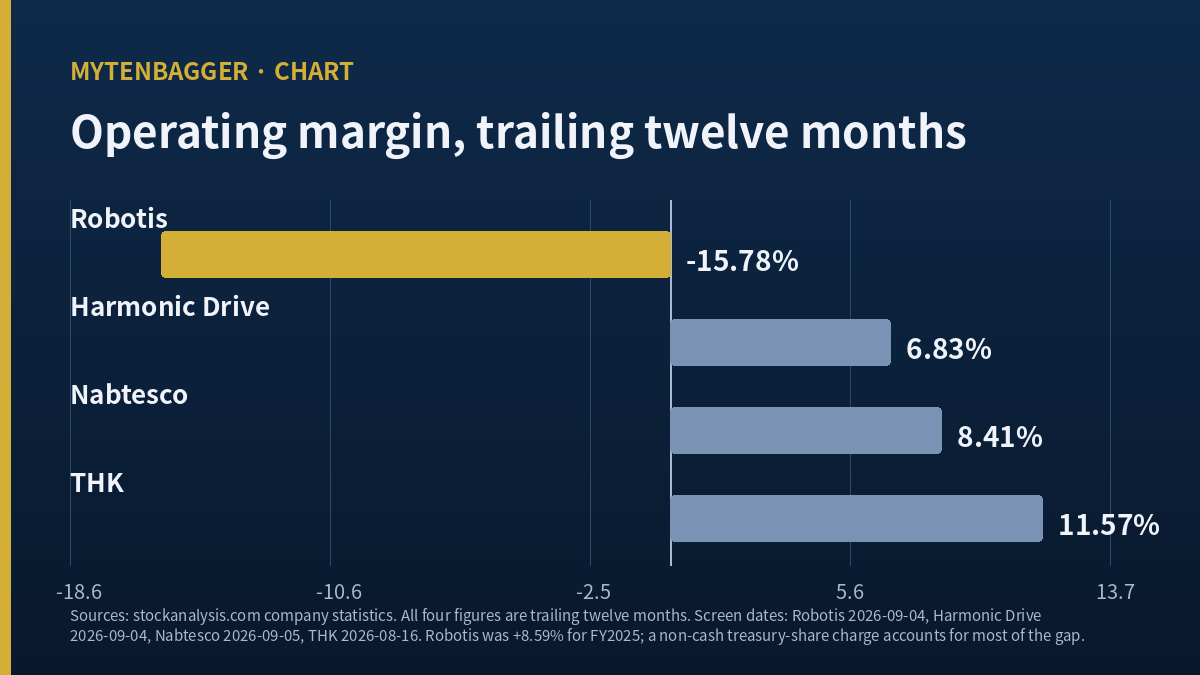
A charge measured in shares is a charge measured at the share price. The same number of shares handed over at a higher price becomes a bigger expense on the income statement. Over the trailing four quarters, revenue was KRW 48.06 billion and operating profit was negative KRW 7.58 billion on my sum of the discrete quarters, a margin of negative 15.78%. For the 2025 fiscal year alone the margin was positive 8.59%. One non-cash item is most of the distance between those two figures. I have therefore stopped treating this company’s quarterly operating margin as a reading of how well the parts business is doing, and I look at revenue and operating cash flow instead. I reached a similar conclusion about a Korean robot assembler for entirely different reasons, which I set out in an earlier note on Doosan Robotics.
Who else makes the joints
How I picked this comparison set
My rule for this table: listed companies whose main business is the motion hardware inside a robot arm, where one screen shows revenue and operating margin together, with the screen date exposed as a column because the four dates are not the same. I have deliberately left price multiples out. The peers’ margins are trailing-twelve-month figures from a screening service and this company’s fiscal-year figure is annual, so a valuation comparison would need a base alignment I have not done. Revenue is shown in each company’s home currency; I am not converting, because a table of ratios and native amounts does not need a second exchange rate in a piece that already fixes one.
| Company | What it sells | Revenue | Operating margin | Screen date |
|---|---|---|---|---|
| Robotis (KOSDAQ: 108490) | Smart actuators, robot joints | KRW 48.06bn (TTM) | -15.78% (TTM) +8.59% (FY2025) |
2026-09-04 |
| Harmonic Drive Systems (TYO: 6324) | Strain wave gears, servo actuators | JPY 62.74bn (TTM) | 6.83% | 2026-09-04 |
| Nabtesco (TYO: 6268) | Precision reduction gears | JPY 309.70bn (TTM) | 8.41% | 2026-09-05 |
| THK (TYO: 6481) | Linear motion guides, ball screws | JPY 277.37bn (TTM) | 11.57% | 2026-08-16 |
What the table tells me and what it does not
Peer figures come from stockanalysis.com company statistics pages. Three things stand out. First, on the 2025 fiscal-year figure this company’s 8.59% operating margin sits inside the Japanese band, above Harmonic Drive and just above Nabtesco, below THK. On margin it looks like an ordinary motion-components business. Second, the Nabtesco screen date is one day after my price date and the THK screen is nineteen days older, so these are four snapshots taken at four moments and I am not pretending otherwise. Third, the scale gap between this company and the two large Japanese names is obvious from the revenue column, and I am deliberately leaving it unquantified. Turning it into a single multiple would need two more exchange rates than this piece carries, and I would rather leave a gap unmeasured than measure it on a basis I have not disclosed.
What Korean sell-side has published on Robotis stock, and where I could be wrong
Two named analysts and a consensus
Hana Securities analyst Park Chan-sol wrote on April 23, 2026 that both revenue and operating profit would more than double year on year in 2026, on an estimate that actuator customer orders rise from 400,000 units in 2025 to more than one million in 2026. The same note sized Chinese humanoid production targets above 100,000 units for 2026, implying at least 2.3 million new actuators of demand. That is via Newspim, April 23, 2026. On the WiseReport company screen dated September 4, 2026, seven contributing houses average out to KRW 392,286, which is 28.83% above the September 4 close on my arithmetic, with a consensus rating of 4.00. I read neither underlying report; both are secondary sourcing, and the seven-house average is a screen figure whose contributors and update dates I could not verify.
Seven conditions that would break this note
One. If the treasury-share award turns out to repeat every year, my description of it as a one-quarter distortion is wrong and it becomes a structural cost of running this company.
Two. If the audited notes show the compensation charge measured on a basis other than the market value at handover, the mechanism I built this note on is misdescribed.
Three. If Chinese humanoid shipments keep compounding after the American ban, my tension does not exist and the two stories were compatible all along.
Four. If Western robot builders have already qualified Japanese suppliers for their joint modules, the substitution this stock is pricing has no room to happen.
Five. If the KRW 1.5 billion of second-quarter China revenue was a single order pulled forward, the 333.3% shipment growth says nothing about this company’s run rate.
Six. If Hana Securities has cut its doubling estimate since the half-year numbers landed, I am quoting a stale forecast; I could not confirm whether the April view has been refreshed.
Seven. If the capital raised in the 2025 rights issue is being spent on capacity that arrives after the order surge has passed, the KRW 11.74 billion of first-half capital expenditure buys a plant into a slower market.
One more item belongs here even though it is not a condition. Research and development ran to KRW 9.419 billion in the first quarter of 2026, which is 79.55% of that quarter’s revenue on my arithmetic. Korean coverage of the same filing printed 79.54%, a second-decimal difference. That ratio is a separate line from the share-based charge and I have not combined the two anywhere in this note. It does say something about what this business is: a company spending four-fifths of a quarter’s revenue on engineering is being valued on products that have not shipped yet, and the company has said a new actuator line and a humanoid platform are both due in the second half of 2026.
Robotis stock: what a US-based reader should know, and where I stop
The two things that would move me, and the problem with both
My first marker is the third-quarter report. Its statutory deadline is November 15, 2026, which falls on a Sunday, so the filing lands on Monday November 16, 2026 or later. If no comparable share award appears and operating profit still deteriorates against the first-half trend, then the cost story I have written here was the wrong explanation and the parts business itself is the problem.
My second marker is Chinese humanoid shipment volume. If it falls after the American ban while this company’s actuator revenue keeps climbing, then the tension I described does not hold, the customer mix has already turned over, and I have to rebuild the estimate from a different base.
There is a third thing I watch that is not a marker so much as a discipline. The 2025 fiscal year was this company’s first operating profit after three consecutive loss years, at KRW 3.35 billion on revenue of KRW 38.94 billion, against operating losses of KRW 2.16 billion in 2022, KRW 5.30 billion in 2023, and KRW 2.97 billion in 2024. One profitable year does not establish that the business scales, and the market value it now carries is more than a thousand times that year’s operating profit. I want a second and a third profitable year measured on a clean cost base before I treat the 2025 turn as the start of anything.
Both markers share a defect I want on the record. Neither arrives with a headline attached. Quarterly-report footnotes are read by almost nobody on the day they publish, and Chinese unit shipments are not a series that lands in my inbox. The realistic sequence is that somebody else notices my breaking condition first, the price moves, and I go looking for the cause afterward. A condition that gets discovered by the market before it gets discovered by me is a weak condition. I am writing it down anyway, because when I open this note again the least I want is to recognize the name of the thing I missed.
Prices and multiples reflect the September 4, 2026 close as checked at the time of writing. Korean won is the reference currency throughout, and the one USD conversion above is approximate, at roughly KRW 1,350 per dollar on that same date. Financial figures come from the company’s DART filings (FY2025 receipt 20260708000478, H1 2026 receipt 20260814003380); price and ratio data come from a Kiwoom-sourced indicator database with a financial cut-off of August 20, 2026, and from the WiseReport company screen dated September 4, 2026. Peer figures are from stockanalysis.com on the dates shown in the table. Some numbers are my own recomputations from filed quarterly data and are marked as such.