Hanmi Pharmaceutical Stock: The China Unit Lost 96.6%
Contents
Hanmi Pharmaceutical stock: the line I read before the licensing headline
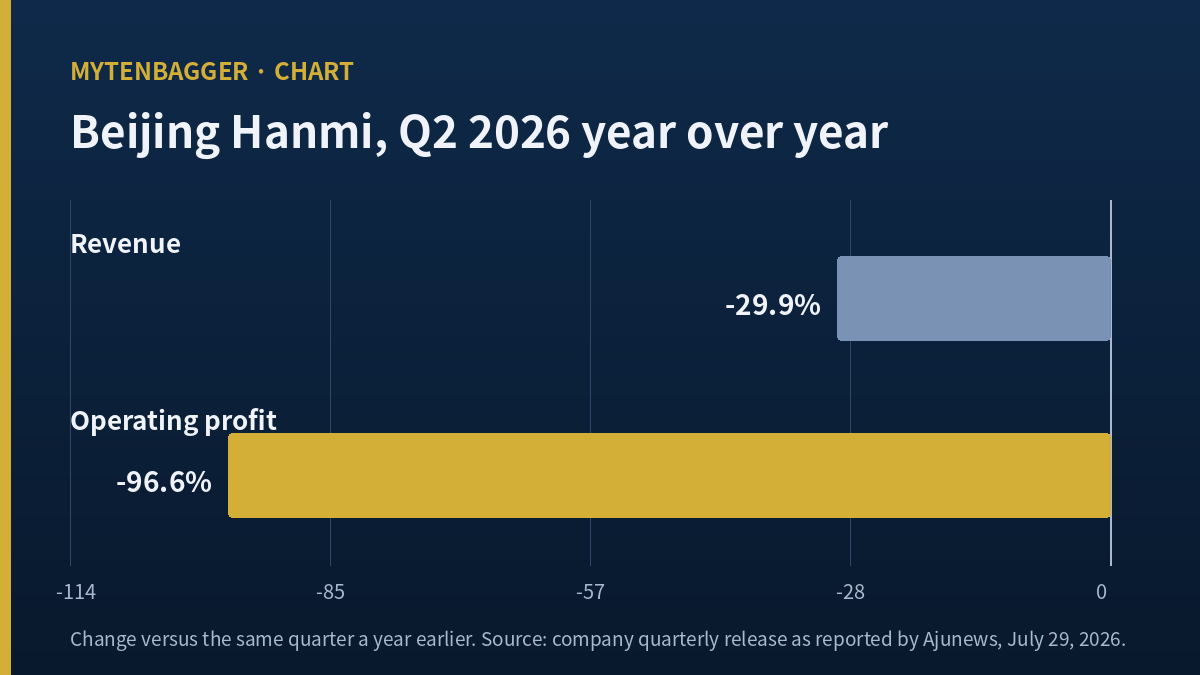
Hanmi Pharmaceutical (KOSPI: 128940) signed two out-licensing agreements this summer with a combined headline value of USD 3.56 billion. That is the number every write-up leads with. I opened the same quarterly release and went to a different line first: Beijing Hanmi, the Chinese subsidiary, posted second-quarter revenue of KRW 60.7 billion (about USD 45 million) and operating profit of KRW 0.6 billion (about USD 0.4 million). Revenue fell 29.9% year over year. Operating profit fell 96.6%.
I do not own this stock and I have no order in. What follows is how I weighed one line against the other, at the September 4, 2026 (Friday) close of KRW 473,500, or about USD 350.6 per share.
- What I am watching: the unit that sells medicine every day, not the unit that signs contracts.
- What I found: three Chinese drugmakers took the same combination of shrinking domestic pricing and Western out-licensing, and two of the three are down roughly a third over twelve months.
- What I could not settle: whether Beijing Hanmi’s quarter is one bad print or the shape of the next several years.
- Where I stand: no position, watching, with three written conditions that would tell me I read this wrong.
A note on KOSPI and on the currency here
KOSPI is the senior board of the Korea Exchange in Seoul, the venue where the country’s larger listed companies trade; KOSDAQ is the smaller-cap board alongside it. The Korean won is the reference currency throughout this piece. Dollar figures are approximate, converted at roughly KRW 1,350.4 per dollar, the Seoul market close on September 4, 2026 (Friday). Where a Korean source published its own won conversion of a dollar contract value, I quote that source’s figure and say so instead of redoing the arithmetic.
What Beijing Hanmi did in the second quarter
The numbers
Korean coverage of the July 29, 2026 (Wednesday) session put Beijing Hanmi’s second-quarter revenue at KRW 60.7 billion, down 29.9%, and operating profit at KRW 0.6 billion, down 96.6% (Ajunews, July 29, 2026). The consolidated group, over the same three months, reported revenue of KRW 467.2 billion (up 29.3%) and operating profit of KRW 131.1 billion (up 116.9%).
So the group looked excellent and one of its operating businesses nearly stopped producing profit. The KRW 0.6 billion is 0.458% of consolidated operating profit by my arithmetic, before any adjustment for ownership percentage or intercompany eliminations, so treat that as a rough sense of scale and not a segment disclosure.
Why it shrank
Mirae Asset Securities analyst Kim Seung-min, in Korean-language commentary carried the same day, tied the decline to China’s volume-based procurement program compressing sales of core products, to fixed costs that did not fall with revenue, and to continuing drug-price cuts that push profitability recovery out in time. He cut his valuation on the stock from KRW 700,000 to KRW 640,000.
Volume-based procurement, usually shortened to VBP in English coverage, is the Chinese national tendering system that awards large purchase volumes to whichever suppliers bid low enough. For a foreign-affiliated manufacturer selling established products in China, winning means volume at a much lower price and losing means the volume goes elsewhere. I did not read the tender documents and I cannot tell you which of Beijing Hanmi’s products sit inside which procurement round. That gap is real and I mark it here.
Hanmi Pharmaceutical stock and the day the market disagreed with the earnings
The second-quarter figures circulated in Korean press on July 28, 2026 (Tuesday) (Kormedi). The next session, July 29, the shares closed at KRW 322,000 against KRW 374,500, a fall of 14.02% by my calculation on closing prices. Intraday the decline reached 17.22%. The following session, July 30 (Thursday), the close of KRW 311,500 was the lowest of 2026 across 166 sessions from January 2 (Friday) through September 4 (Friday).
Four weeks later the same market moved the other way. On August 24, 2026 (Monday), after the Genentech agreement was disclosed, the stock closed at KRW 540,000 against KRW 415,500, a gain of 29.96%. Korea’s single-session limit is 30%, so that was very close to everything the market was permitted to add in a day. The next session it gave back 7.22% to KRW 501,000.
How I read the pair
I do not treat either move as the market being wrong. I treat the pair as information about what this market prices. The July print carried cash that had already arrived. The August disclosure carried a contract whose money had not moved yet. The second got the larger reaction. If I want to hold this company for its everyday commercial business, that pricing behavior works against me, because the everyday business is the part that just shrank.
Three Chinese drugmakers walked this road first
How I picked the comparison
My screen for this table was narrow on purpose: a listed pharmaceutical company with its own commercial revenue exposed to Chinese drug pricing, which also out-licensed a program to a Western large-cap partner in 2025 or 2026. That gives three names. I am deliberately not putting a price multiple column in this table, and I am not converting the revenue figures into a single currency, because a same-currency comparison would need an FX rate I have not sourced for each pair. Each revenue figure below is in the currency its own screen displays.
| Company | Revenue (TTM, as displayed) | Operating margin (TTM) | 52-week price change | Screen date |
| Hanmi Pharmaceutical (KOSPI 128940) | KRW 1,655.5bn | 19.52% | +67.31% | Sep 4, 2026 |
| Jiangsu Hengrui (SHA 600276) | CNY 31.32bn | 23.98% | -36.07% | Sep 5, 2026 |
| Innovent Biologics (HKG 1801) | HKD 18.13bn | 6.97% | -4.30% | Sep 5, 2026 |
| Sino Biopharmaceutical (HKG 1177) | HKD 38.91bn | 28.17% | -35.86% | Sep 5, 2026 |
Peer rows from stockanalysis.com statistics screens, each page stamped “Last updated: Sep 5, 2026,” data credited on-page to S&P Global Market Intelligence. The two Hong Kong lines are presented in HKD on that source even though both companies report in RMB. The Hanmi row is my own arithmetic from Korean regulatory filings: trailing four quarters to June 2026, revenue KRW 1,655.5 billion and operating profit KRW 323.1 billion, giving a 19.52% margin. Its price change is the twelve-month figure from the Korean data screen, whose anchor date is August 22, 2025.
The licensing deals those three signed
Hengrui licensed a COPD program to GSK in July 2025, with USD 500 million paid up front and success-based milestones running to roughly USD 12 billion across a broader option package. Innovent licensed a twelve-program oncology portfolio to Pfizer in May 2026 for USD 650 million up front against up to USD 10.5 billion in total value. Sino Biopharmaceutical licensed rovadicitinib to Sanofi in March 2026 for USD 135 million up front against up to USD 1.53 billion.
Hanmi Pharmaceutical stock against those three
Here is what the table tells me and what it does not. All four companies carry the same shape: real commercial revenue exposed to Chinese pricing policy, plus a Western partner holding a program that could pay for years. Three of the four have been repriced downward over the past twelve months, two of them by more than a third. Hanmi is the exception in the price column, up 67.31%, and it is also the one whose licensing announcements landed most recently.
What the table cannot tell me is whether Hanmi is early or different. If the Chinese names are what a market looks like eighteen months after the out-licensing headline stops being new, then the price column is the part of this table I should be reading hardest. If Korea’s exposure to Chinese procurement is smaller in proportion, and Hanmi’s domestic Korean prescription business carries more of the load, the comparison flatters the risk. I did not resolve that, and I will not pretend the four rows settle it.
One thing I will not do is convert these revenue lines into a single currency and rank them by size. The moment I do that, the ranking depends on an exchange rate I did not source with its own as-of date, and a size ordering built on an invented rate reads as fact while being an assumption.
What the company spends to keep the pipeline coming
The licensing income in this story is downstream of a research budget, so I looked at the budget. Hanmi spent KRW 125.5 billion on research and development in the first half of 2026, which the reporting put at 14.6% of revenue and up 18.2% from the same period a year earlier. The same tally listed Yuhan at KRW 122.2 billion (10.5% of revenue), Daewoong at KRW 115.7 billion (15.7%), Chong Kun Dang at KRW 113.5 billion (12.3%), and GC Biopharma at KRW 85.9 billion (10.0%) (Ajunews, August 23, 2026). Dividing the reported spend by half-year revenue of KRW 860.2 billion gives me 14.59%, which agrees with the published figure to one decimal place.
Only one of those five Korean companies commits a larger share of revenue to research, and that intensity is the mechanism behind both agreements this piece describes. It also means the cost side does not fall away if the deals stop coming. A company running a 14.6% research load without licensing income looks materially different from one running it with the income, and the difference lands in operating profit.
What comes back to holders
On March 16, 2026, Hanmi Science, Hanmi Pharmaceutical, and JVM jointly disclosed a value-up plan. Hanmi Pharmaceutical’s share of the roughly KRW 76.6 billion of cancellations was 85,316 shares, which the companies described as 0.67% of the count, to be confirmed by board resolution after the March 31, 2026 (Tuesday) annual meeting. Seventy percent of held treasury stock goes to cancellation and thirty percent to employee compensation, and the group set a total shareholder return floor of 20% for this company through 2030 (Kpanews, March 16, 2026). The declared dividend is KRW 2,000 per share, a 0.42% yield at the September 4 close and a 15.11% payout against reported earnings per share by my calculation. The floor is a target, and the current payout is not near it.
What the two licensing deals actually put on the table
Eli Lilly, June 1, 2026 (Monday)
Sonepeglutide, for short bowel syndrome. Headline value USD 1.26 billion, confirmed up-front payment USD 75 million, staged milestones to a maximum of USD 1.185 billion, plus royalties after launch (Newsway, June 1, 2026). Korean press framed it as the company’s first large out-licensing agreement in five years.
Genentech, August 24, 2026 (Monday)
HM17321, an obesity program aimed at preserving muscle mass while reducing fat. Headline value up to USD 2.3 billion, up-front payment USD 190 million, with Genentech’s parent Roche as the ultimate counterparty (Hankyung, August 24, 2026). Roche’s Boris Zaïtra described the appeal as selectively reducing fat mass while improving muscle mass and function.
What the company already collected
Of the USD 3.56 billion of combined headline value, USD 265 million is confirmed up-front money. Everything above that depends on trials, approvals, and sales going as planned. Seoul Economic Daily totaled the two agreements at KRW 5.0865 trillion of headline value against KRW 375.8 billion of combined up-front payments, using its own conversion rates for each deal (Seoul Economic Daily, August 30, 2026).
The Lilly payment showed up in the numbers immediately. The company attributed its second-quarter strength in part to recognizing that contract payment, which Korean coverage converted at roughly KRW 112.8 billion. Whether that full amount landed in a single quarter or was spread, I could not confirm from the disclosures I read.
Where I could be wrong about Hanmi Pharmaceutical stock
Reasons the China line matters less than I think
- Beijing Hanmi contributed KRW 0.6 billion of operating profit in the quarter. A business that small cannot damage the group arithmetic much even if it goes to zero.
- Korea Investment & Securities analyst Wi Hye-ju published on August 25, 2026 (Tuesday) looking for full-year 2026 revenue of KRW 2 trillion and operating profit of KRW 578.1 billion, which would be a record, driven by up-front inflows and high-margin core product sales (Herald Business, August 25, 2026).
- Epeglenatide, an obesity candidate this company licensed to Sanofi in 2015 and took back in 2020, has finished a domestic Phase 3 in 448 patients and its Korean marketing application was filed on December 17, 2025. Domestic approval would add revenue with no relationship to China.
Reasons the market is not reading it the way I am
- Eighteen contributing houses on the Korean consensus screen sit at a mean of KRW 660,556 with an average rating of 3.94, which is 39.50% above the September 4 close by my calculation.
- The sector price-to-earnings figure on that same screen is 144.32 times, against 35.78 for this company, so within its own sector this is not an expensive line.
- Group debt to equity fell from 108.73% in the first quarter of 2022 to 46.86% at the end of June 2026. The balance sheet improved through years with no large licensing income at all.
Things I simply could not settle
- Samsung Securities analyst Suh Keun-hee moved the rating from buy to hold on August 25, 2026 (Tuesday), citing limited near-term upside after the 30% single-session move. Two houses moved in opposite directions on the same day on the same news, and I cannot tell you which reading of the deal is better founded.
- I could not determine which Beijing Hanmi products fall under which Chinese procurement round, or when the current pricing pressure is scheduled to ease.
- The financial database I cross-checked against carries an as-of date of August 20, 2026, seventeen days before I wrote this. Any correcting disclosure in that window is not reflected here.
Two earlier pieces of mine sit next to this one. Yuhan Corporation, where 96% of a record quarter’s operating profit came from one license line, asked whether that kind of profit repeats. Chong Kun Dang, whose top seller is a product it does not own, asked what happens to margin when the growth comes from someone else’s molecule. Neither of those questions is the one I am asking here, and I did not carry their arithmetic across.
Numbers on the screen I did not use in this piece
The Korean data screen reports a 250-session high of KRW 647,000 and low of KRW 288,000, labeled as adjusted closing basis. When I rebuilt the same window from daily bars, both turned out to be intraday extremes. On closing prices the high is KRW 626,000 on February 11, 2026 (Wednesday) and the low is KRW 290,500 on September 9, 2025. The high and low dates both shift between the two bases. The drawdown from high reads 26.8% on the screen and 24.36% on closing prices by my calculation, so every drawdown in this piece uses the closing basis.
The same screen’s period returns anchor on trading-day offsets, not on calendar months. Working back from the September 4 close, the one-month, three-month, six-month, and twelve-month anchors land exactly 21, 63, 126, and 252 sessions earlier. That puts the twelve-month anchor outside the 250-session high-low window, so I kept those two figures in separate sentences.
I also set aside the float share count, which is the issued share count rounded to the nearest thousand, and a share count on the Korean broker screen that differs from the database by nine shares with no effect on market capitalization. Ownership, for reference and unused in my argument: Hanmi Science and six related parties hold 49.99%, the National Pension Service 9.87%, foreign investors 13.69%, and treasury shares 0.86%.
My marker on Hanmi Pharmaceutical stock
No position, no order, watching. At KRW 473,500 the market is paying for a pipeline and for two partners, and I have not found a way to price either that I trust more than the eighteen houses already doing it. What I can price is a commercial business, and the commercial business in China just contracted almost to nothing while the one in Korea carried the quarter.
Three conditions would tell me I read this wrong.
First, if Beijing Hanmi’s quarterly operating profit returns to the tens of billions of won by the fourth quarter of 2026, the July decline was a single bad print and I built an argument on a data point.
Second, if epeglenatide is approved in Korea and starts booking domestic revenue, this company’s growth stops depending on either China or contract signatures, and my framing goes stale.
Third, if Hengrui, Innovent, and Sino Biopharmaceutical all rerate upward over the next twelve months while their procurement exposure is unchanged, then the peer table I built was measuring something other than what I thought.
All three conditions share a property, and it is the uncomfortable one. Each is something I would notice. None of them says what I would do about it. I have watched a condition come true and then done nothing, more than once, because noticing felt like acting. So one more line: if any of the three lands, I reopen this piece and correct the sentences that were wrong, by hand. A condition I never go back and check was decoration.
Prices and multiples reflect the September 4, 2026 (Friday) close as checked at the time of writing. Dollar conversions are approximate, at roughly KRW 1,350.4 per dollar on that date, and won conversions of contract values are quoted from the sources that made them. The Korean won is the reference currency throughout. Financial statement figures come from Korean regulatory filings; the financial database cross-check carries an as-of date of August 20, 2026.