
Jin Air Stock: Three of Four Analysts Wrote 7,000 Won
Three dates are doing most of the work in this note. August 21, 2026, when the boards of three Korean budget airlines signed a merger agreement. December 2026, when shareholders vote on it. And March 17, 2027, when the combined carrier is meant to start flying under one certificate. I looked at Jin Air stock at 6,150 won on the September 9, 2026 close and saw that the price is being asked to hold all three of those dates at once, plus a fuel bill nobody at the company controls.
Jin Air trades on the KOSPI, the senior board of the Korea Exchange, under the code 272450. It is the budget carrier of the Hanjin group, the same group that owns Korean Air. Market value at that close was about USD 238.8 million.
One more piece of context for the price itself. Over the trailing year this equity traded as high as 8,600 won and as low as 4,710 won, a range in which the high is 1.8259 times the low, by my calculation. The September 9, 2026 close of 6,150 won sits at 71.51 percent of that high and 1.3057 times that low, again by my calculation. So the price has already come off substantially and has already bounced substantially, and neither of those facts tells me anything about the next twelve months on its own.
| Aug 21, 2026 | Merger agreement signed. Exchange ratios published. Share count after completion: not yet disclosed. |
| Dec 2026 | Extraordinary shareholder meeting. Exact date: not yet announced. Appraisal terms: not yet published. |
| Mar 17, 2027 | Combined carrier begins. Post-merger balance sheet: not yet modelled by any broker I can find. |
Contents
Three dates sit under Jin Air stock right now
The merger is the part most foreign readers will not have seen. On Friday, August 21, 2026, Jin Air, Air Busan and Air Seoul signed an agreement to combine into a single carrier, with completion set for March 17, 2027 and a shareholder vote in December (The Korea Herald, August 21, 2026). Wire coverage the same day put the same three facts on the record (UPI, August 21, 2026).
Two of those three airlines already sit inside the same group, so this is a tidying-up transaction more than a competitive one. It follows the Korean Air and Asiana combination set for December 17, 2026, which I wrote about separately when I ran the appraisal arithmetic on Korean Air.
What matters to me as a holder or non-holder is narrower. On March 17, 2027 the equity that trades today stops being the same security in one specific respect, and I go into that further down. The point I want to plant here is that every per-share figure quoted anywhere in this piece has a stated expiry, and that expiry is a date I can look up.
What the first half actually shows
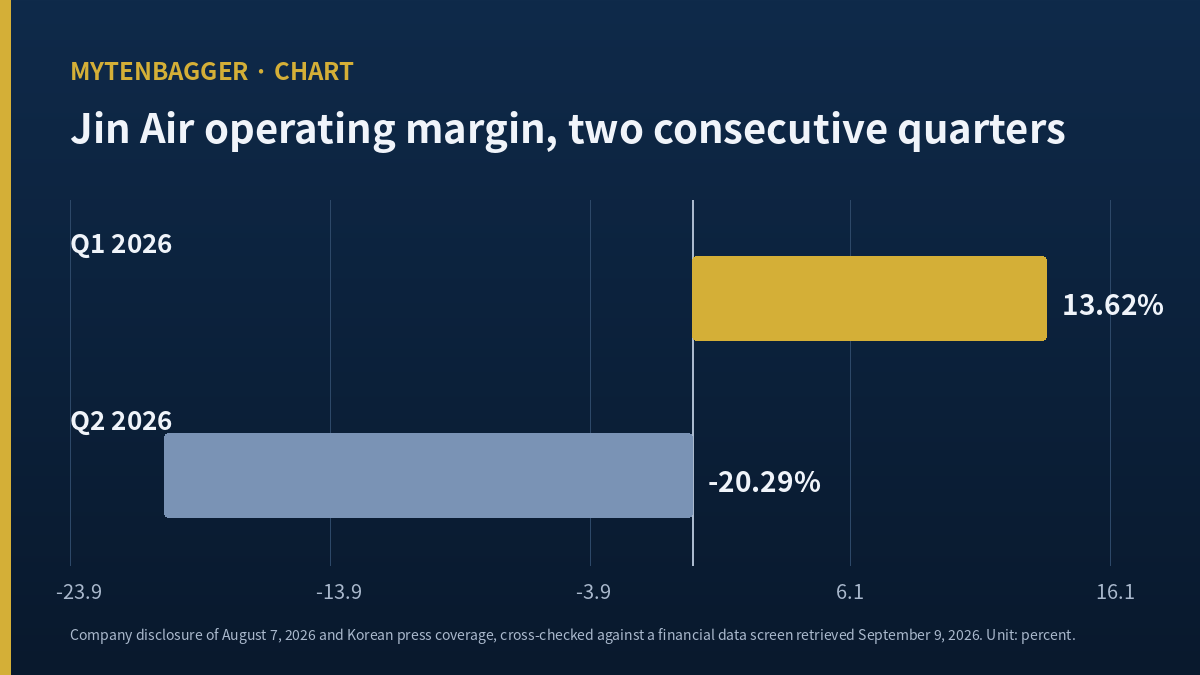
I will keep this section short because I covered the arithmetic in detail on the Korean side of this journal. The compressed version: the June 2026 quarter carried an operating margin of minus 20.29 percent against a March 2026 quarter that ran at plus 13.62 percent. Two consecutive quarters, roughly 34 percentage points apart.
Revenue was not the problem. Korean press reporting on the August 7, 2026 results put half-year revenue at a company record while the half-year operating line went negative (Etoday, August 7, 2026, in Korean). Management pointed at fuel as the cause of the swing.
Here is the part I keep returning to. Across the four full years on the screen, this airline’s operating margin reads minus 11.34, plus 14.26, plus 11.16, minus 1.39. It has been in both places. Return on equity over the same four years reads minus 47.46, plus 112.52, plus 51.15, minus 4.28. A 112 percent return on equity is not a sign of a wonderful business. It is a sign of a very small equity base, which is the subject of the next section.
The balance sheet under Jin Air stock moved faster than the income statement
Figures below are in billions of Korean won, taken from the consolidated screen at WiseReport on September 9, 2026.
| Period | Assets | Liabilities | Equity | Debt to equity |
|---|---|---|---|---|
| FY2022 | 757.8 | 662.9 | 94.9 | 698.19% |
| FY2023 | 952.3 | 809.3 | 143.0 | 566.02% |
| FY2024 | 1,227.1 | 995.9 | 231.3 | 430.65% |
| Mar 2026 | 1,383.0 | 1,137.0 | 246.0 | 462.26% |
| Jun 2026 | 1,311.9 | 1,133.6 | 178.3 | 635.72% |
Equity fell from 246.0 to 178.3 billion won in a single quarter while liabilities barely moved. That is a 27.5 percent reduction in the equity line in three months, by my calculation, and it is why the leverage ratio jumps 173 percentage points between the last two rows.
It also quietly changes the one multiple the screen still displays. Price to book shows as 1.41 against a book value per share of 4,355 won, which is the December 2025 figure. Divide the June 2026 equity by the 52,200,000 shares outstanding and book value per share is about 3,415.7 won, by my calculation, which puts the same price at roughly 1.80 times book. I am not claiming the screen is wrong. I am noting that the two numbers describe different days, and only one of them has a 2026 date on it.
The strongest disagreement with what I just wrote comes from the equity line itself: a carrier that leases most of its fleet will always show a thin equity base and a high leverage ratio, and comparing that ratio to an industrial company would be meaningless. I accept that. What I do not accept is comparing it to itself three months earlier and calling the move unimportant.
The four estimates and the three identical numbers
Four brokerages carried an opinion within the three-month window the consensus screen counts on September 9, 2026: Hana, Mirae Asset, NH Investment and Samsung. Their published valuations were 7,000 won, 7,000 won, 10,000 won and 7,000 won. The mean of the four is 7,750 won, about 26 percent above the September 9, 2026 close.
Three of the four wrote the same number. That is the detail I stopped on. When three independent houses land on an identical round figure, the figure is usually not the output of three independent models. It is more likely a shared convention about what a distressed short-haul carrier is worth per share until conditions change.
The second detail is that the same four model a loss. Consensus earnings per share for 2026 on that screen is minus 603 won. You cannot build a price-to-earnings multiple on a negative number, so whatever those four valuations rest on, it is not this year’s profit. Book value, mid-cycle earnings and merger synergy are all plausible, and none of them is stated on the screen I can see.
Only one of the four has a name attached in coverage I could reach. Hana’s Ahn Do-hyun kept a buy rating in a May 19, 2026 note titled, in translation, “the one who can endure wins,” arguing that short-haul carriers struggle to pass fuel costs into fares and that weak conditions would run at least through the third quarter (Newspim, May 19, 2026, in Korean). I did not read the underlying report. I am working from Korean secondary coverage and I would sooner say so plainly.
There is a timing point buried in that May note as well. It was published on May 19, 2026, about six weeks before the June quarter closed. The house that expected weakness through the third quarter was therefore describing a period still in progress and one that had not begun at all. When the August results landed, they did not contradict that view; they confirmed it. I want to be fair about this, because it is easy to read a loss-making quarter as an analyst failure when the analyst had already described it in advance. The disagreement between the valuation and the earnings estimate is real, but it is not a disagreement born of surprise.
What I still cannot see is the bridge. A house can hold a buy rating through a loss year on the grounds that the loss is cyclical and the balance sheet survives it. That is a defensible position and it may well be the right one here. It is simply not a position I can audit from the outside using the figures on a consensus screen, and I do not put money behind reasoning I cannot reconstruct.
Why Jin Air stock has no earnings multiple this year
Trailing earnings per share for 2025 was negative, so the trailing multiple is blank. Forward earnings per share is minus 603 won, so the forward multiple is blank as well. Dividend per share has been zero for four straight years, so there is no yield to fall back on either.
That leaves book value as the only live ratio, and I have just explained why the book value on display is nine months old. This is the honest position: for the current year, this equity has no earnings-based valuation anchor at all, and the one asset-based anchor it has is stale.
I find that clarifying. It is discouraging only if I wanted a shortcut. It tells me exactly what I am buying if I buy: an option on the fuel curve and on a merger integration, priced against a book value I would have to rebuild myself each quarter.
A fuel bill the whole industry is carrying
Before blaming management I checked whether the rest of the world was suffering the same thing. It was.
The International Air Transport Association cut its 2026 industry net profit forecast to USD 23.0 billion from USD 41 billion and lifted its jet fuel price assumption sharply for the year. The industry fuel bill goes to USD 350 billion from USD 252 billion, and fuel rises to 31.4 percent of operating costs from 25.4 percent (IATA, June 7, 2026).
The regional detail is the part that reframes the Korean numbers for me. IATA models Asia-Pacific carriers earning USD 6.6 billion in net profit on a 2.1 percent net margin, which works out to USD 3.40 per passenger carried. Three dollars and forty cents of margin per passenger is the industry backdrop against which one mid-sized Korean carrier posted a loss-making June quarter.
Two more figures from the same release matter for how I read demand. IATA models 5.1 billion passengers flown in 2026, up 2.4 percent on 2025, with Asia-Pacific revenue passenger kilometers growing 5.1 percent. Demand, in other words, is holding up across the industry this year. That aligns exactly with what the Korean numbers showed: a record half-year revenue line sitting above a negative operating line. Passengers are flying. The cost of flying them moved faster than the fare.
It is worth pausing on the profit revision too. Cutting an industry forecast to USD 23.0 billion from USD 41 billion is a reduction of roughly 44 percent in a single update, by my calculation, and it happened in June, before the June quarter that produced this airline’s loss had even closed. The sequence matters: the industry body saw the fuel move and marked the whole sector down before individual carriers reported. Anyone reading the August results as new information had not been reading IATA in June.
So the fuel story checks out globally, and that cuts both ways for me. It means the loss is not evidence of a uniquely badly run airline. It also means I cannot expect management skill to fix it, because the input causing it is set in a market that has nothing to do with Seoul.
Three fleets, one certificate
Peer tables for airlines usually compare multiples. I cannot do that here, because two of the three companies below will cease to exist as separate issuers in March 2027 and one of them is unlisted. So I built the table on the one column I can source cleanly: aircraft.
| Carrier | Aircraft before merger | Exchange ratio into the surviving entity |
|---|---|---|
| Jin Air (KOSPI: 272450) | 32 | surviving entity |
| Air Busan (KOSPI listed) | 21 | 0.29 |
| Air Seoul (unlisted) | 6 | 0.75 |
Fleet counts from Korean sector reporting on August 20, 2026; exchange ratios rounded to two decimals as published in English-language coverage on August 21, 2026. Ratios are the number of surviving-entity shares issued per share of the absorbed company.
Two sources disagree by exactly one aircraft. Korean sector reporting counted 32, 21 and 6, which sums to 59. English coverage of the signing described the combined carrier as operating 58 aircraft. I have left both figures in instead of quietly picking the one I prefer, because a single-unit gap between a sum and a stated total usually means the two counts were taken on different dates or with different treatment of aircraft in maintenance.
For scale against the global peer set, the combined carrier lands around the size of a mid-tier European or Southeast Asian budget operator, well short of the fleets at Ryanair or Southwest, which operate in the hundreds of aircraft. Korean sector reporting also flagged 14 additional aircraft arriving, comprising ten A321neo, one A321ceo and three Boeing 737-900. That is roughly a quarter of the combined fleet again, and it arrives into whatever fuel price exists at the time.
My position on Jin Air stock and what would break it
I own none of it and I have no order working. That is a watch. I did not pass on it.
What keeps it on my list is the 2023 and 2024 record, when this operator earned real money two years running with a smaller fleet than it will have in 2027. If fuel normalizes while the enlarged fleet is flying, the same operating leverage that produced a minus 20.29 percent margin in one quarter runs in the other direction. I expect that to happen eventually. I do not know whether it happens before or after the share count changes.
What keeps me out is that the security I would be buying today is not the security I would own in March 2027, and the terms of that conversion have been published while the resulting share count has not. Buying now means accepting a per-share divisor I cannot yet write down. I have made that mistake before and I would like to not make it again.
Two things would settle it.
First: whether the September 2026 quarter turns positive. The four consensus estimates only hold together if the second half earns money, and the September quarter is peak season for Korean leisure travel. A loss there would tell me the trouble is in the cost base and has nothing to do with the season. The statutory filing deadline for that quarter is November 16, 2026.
Second: whether the December vote passes the agreement unchanged. Either answer is useful. Passed as drafted, and the March 2027 share count becomes something I can compute. Amended or delayed, and today’s per-share figures stay valid longer than I assumed.
I should also say what writing those two conditions down does to me. Once I commit them to a list, I check the list and stop looking anywhere else. The regional politics around Busan as an operating base, the delivery timing on those 14 aircraft, the terms offered to dissenting shareholders: none of that is on my list, and none of it is unimportant. When I update this note I intend to start outside the list.

What I could not verify
I could not establish the share count of the unlisted absorbed carrier, the total number of new shares to be issued, the appraisal price and exercise window for dissenting holders, the exact December meeting date, or the composition of the financing outflows on the cash flow statement. The first three are what I will chase first.
Related reading: the order book at Jeju Air
Prices and multiples reflect the September 9, 2026 close as checked at the time of writing. Financial statement figures are consolidated, taken from a Korean vendor screen on that date, and quarterly figures were used only where the screen and Korean press reporting of the company’s disclosure agreed. Items marked as my calculation are values I derived myself; everything else was copied from the source named beside it. USD conversions are approximate, at roughly 1,344.45 won per dollar as of the September 8, 2026 close, the most recent session published at the time of writing. Korean won is the reference currency throughout.