Enex Stock: A Buycott Hit the Ceiling, But Still Below the Line
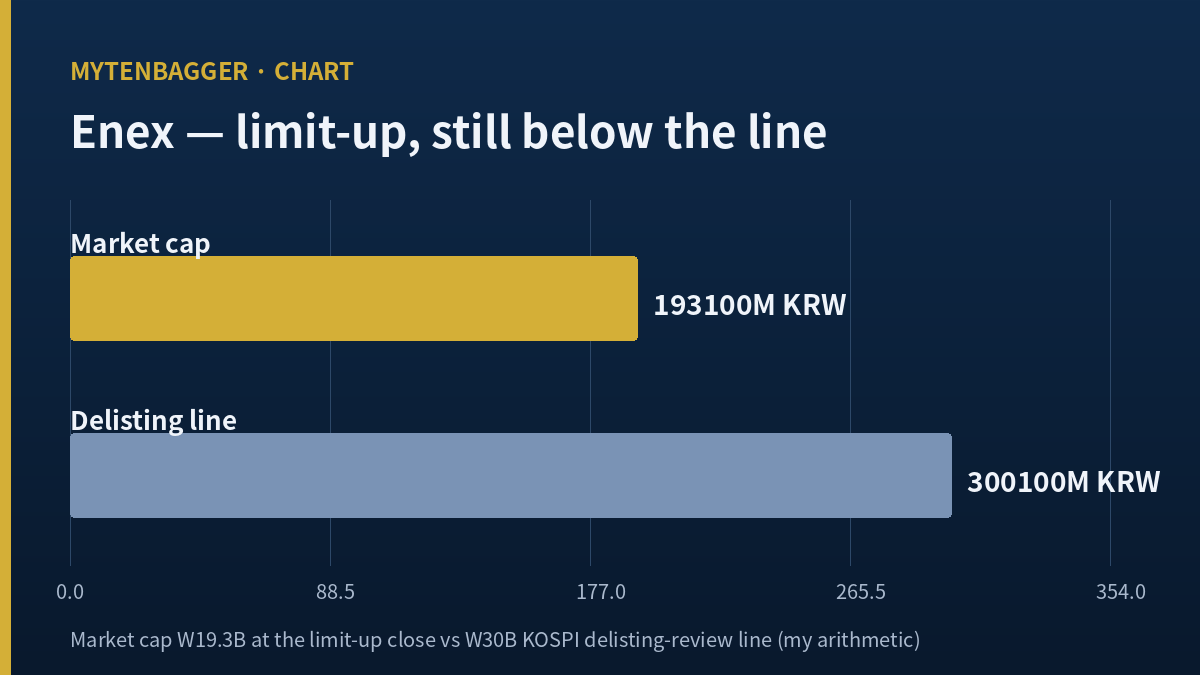
The short version — Enex stock hit its daily limit-up on July 14, closing at ₩1,631 (about $1.18), per Korean press. After crab-stick maker Hansung Enterprise and pen maker Monami, this is the third place Korea’s retail “buycott” has jumped. But this name differs from the first two in one decisive way: even after a ceiling day, its market cap is still about ₩19.3 billion (about $14M) — below the KOSPI delisting-review floor of ₩30 billion. I cheer Enex, a 50-year furniture maker that has quietly donated beds and desks to children. I’d buy Enex furniture too. But I didn’t buy the stock. This time the company hasn’t even been rescued yet, so I’ll set the gap between cheering and buying down even more plainly.
Contents
Enex stock hit the ceiling and is still below the line
Let me rebuild the facts myself first. Enex (KRX: 011090) is a furniture and interiors company listed on the KOSPI — Korea’s main board, the rough equivalent of the NYSE, not the smaller, tech-leaning KOSDAQ (closer to the Nasdaq). It has made kitchen cabinets, beds, and storage furniture for some 50 years. The stock had bled lower for a long time; the trailing-year low on my screen was ₩401 (about $0.29), and the stock is down about half over twelve months. Off that floor it has roughly quadrupled, touching the daily limit at ₩1,631 on July 14.
Here’s the crux of this piece. Even after a limit-up, Enex’s market cap is about ₩19.3 billion. About 11.8 million shares × ₩1,631 ≈ ₩19.3bn — I reverse-checked it, and the number holds. And the KOSPI delisting-review market-cap floor rose to ₩30 billion this month. In other words, Enex spent one hot ceiling day and is still below the line. Where Hansung and Monami cleared that bar on their buycotts, Enex has not. That difference is the first reason I watch this one especially carefully.
The buyers resemble the first two: foreign ownership in the 1% range, individuals’ cheer money doing the lifting. But the temperature is different. On a one-month view Enex is up only in the low teens, versus the 90%-plus that Hansung and Monami ran in a month. The flame under Enex is comparatively weak and late. I don’t wave that away. By the third name, the fad itself is starting to lose its opening blast.
Why Enex stock drifted to the delisting edge
Why did delisting come up at all? The root is the same as the first two pieces. Per Korean press (The Korea Times, KED Global), the Korea Exchange raised the KOSPI listing-maintenance market-cap floor to ₩30 billion this month — higher again next year — and long-dormant small national brands were pushed under the review line all at once. Enex was one of them. The bar rose toward the company; the company didn’t collapse overnight.
This isn’t a rule aimed at Enex alone. The same reform is sweeping the market: Korean coverage described well over a hundred KOSDAQ names failing the tightened market-cap bar, with the exchange framing 2026 as a year of clearing insolvent and penny stocks and expecting around 50 delistings this year. Against that sweep, a loss-making furniture maker below the KOSPI floor was an ordinary candidate for removal — which is why a buycott that lifts it for a day, but not above the line, reads as a reprieve rather than a rescue.
But the core business deserves a cold read. On my screen, Enex’s revenue last year was ₩215 billion (about $156M), down about 18% year on year. Operating profit was ₩0.5 billion (about $0.4M) — barely positive, and down nearly 90% from the prior year. Take it down to the bottom line and it flips to a net loss of ₩1.4 billion (about $1M). The debt-to-equity ratio is above 200%. This is, in short, a thin-margin furniture maker holding on just short of the red. If Hansung was thinly profitable and Monami four years in the red, Enex sits somewhere between — a razor-thin operating profit that interest and costs chew into until it lands as a net loss.
The furniture board itself is unforgiving. Korea’s furniture and interiors market swings hard with property transactions and moving demand, and a multi-year transaction freeze has pressed the whole sector. On top of that, furniture is a business ruled by scale and logistics. When large brands and global players lead on cost and distribution, a mid-sized manufacturer’s margin thins. Fifty years of history and a national-brand aura are precious, but the aura doesn’t guarantee a profit. Enex’s income statement is saying exactly that right now.
Dig into the demand root and it goes like this: furniture sells when people move into a new home or redo an interior. When property transactions freeze, that demand is postponed wholesale. Enex’s 18% revenue drop last year is less about the company doing something wrong and more about the outside weather — a transaction cliff. Flip that around: this company’s recovery won’t come from its own effort alone; it’s tied to a property cycle it can’t control. When I weigh a name like this, I separate the variables a company controls from the ones it doesn’t — and Enex’s recovery leans unusually hard on the uncontrollable kind.
For a global frame, furniture is a scale-and-logistics game almost everywhere. The players that endure — an IKEA on flat-pack scale, a Nitori on vertical integration in Japan — win on cost, sourcing, and distribution reach, not on national sentiment. A mid-sized domestic maker like Enex competes in the gaps those giants leave, on thin margins that a soft property cycle squeezes further. I won’t drag in a peer’s PER I can’t verify; keeping unverified multiples out of the body is a rule I hold. On structure alone: patriotic demand can nudge a shopping choice, but it doesn’t rewrite the cost curve of the furniture business.
I cheer Enex furniture — so why only watch Enex stock?
Let me be clear: I don’t think this cheer is silly at all. Enex became a buycott target after word spread that it had donated student furniture, beds, and storage to children’s shelters and welfare institutions (Newspim). That giving wasn’t a one-off marketing stunt; it was quiet, sustained social contribution. Desks and beds that went into children’s rooms — of course you want to cheer that. I’m in that line myself: next time I replace furniture, Enex goes on my shortlist, and for a company like this I’m glad to do it.
Enex’s giving wasn’t only furniture, either. Per Newspim, it extended to support for vulnerable households, employee volunteering, and sponsoring a traditional-music expo last year. Not a loudly advertised campaign, but quiet work bundled and noticed late. I hope a company like this doesn’t vanish from the market — and that hope is exactly what puts Enex on my shortlist. The sincerity of the cheer is real; the only question is which scale you put it on.
The stock is another matter. First, this company is posting a net loss right now — a razor-thin operating profit, a net loss below it, and debt at over 200% of equity. A cheer wave lifted the price for a day, but it can’t rewrite the income statement or the balance sheet. Second, that cheer hasn’t even cleared the rule. A ₩19.3bn cap has to climb roughly 55% more to reach the ₩30bn review floor; Hansung and Monami’s cheers cleared the line, Enex’s one ceiling day didn’t reach it. Third, the nature of the valuation. With earnings this thin, the PER means little; the PBR, on my screen, is 0.47x — far under book. A stock that traded at half its asset value got carried up by cheer, and a price lifted by profit holds on differently than a price lifted by sentiment.
The third buycott — where does the fad go?
Here’s the view specific to this piece. I don’t read Enex only as a single stock; I read it as the third stop of a buycott fad — and I think the sequence carries a signal.
Put the three side by side and the drift sharpens. Hansung had revenue of ₩318.4 billion and operating profit of ₩5.8 billion — thin, but profitable. Monami had revenue of ₩131 billion and an operating loss of ₩5.9 billion — four years in the red. Enex has revenue of ₩215 billion and operating profit of ₩0.5 billion but a ₩1.4 billion net loss — balanced on the knife’s edge between black and red. By market cap, Hansung cleared the floor comfortably near ₩70bn, Monami just cleared it in the ₩50bn range, and Enex at ₩19bn hasn’t cleared it at all. As the cheer moves from name to name, the fitness of the company it lands on — and the cushion the cheer buys — thin out together.
And a fourth name has arrived: lingerie brand Vivien also hit the limit, per Korean press (Sidae). The fad is spreading across “national brands with a story.” I don’t read that as only good news. The wider a theme gets, the blurrier the line between the first sincere cheer and the late momentum-chasing that piles on behind it.
The market has posted its own warning. Herald flatly called this a “Korean GameStop” — the 2021 US episode where individuals banded together and pushed valuations regardless of earnings. As GameStop showed, a price lifted by sentiment falls back as fast as the sentiment fades. I don’t think that comparison is overblown. Cheering is beautiful, but cheering is not earnings. So the further down the fad a name sits, the more I hold the excitement down.
What I especially guard against at the third stop is “the late hand.” The first name drew mostly sincere hearts moved by a good deed; by the third, “it’ll pop again” chase-buying gets mixed in. A sincere cheer feels little regret if the price falls; chase-buying sells first the moment sentiment cools. When that supply hits thin liquidity, a drop can come as fast as the limit-up did. I try to separate the purity of a cheer from the impatience of a chase, and I think the latter’s share grows with each successive name. That’s another reason I don’t open an account at this spot.
If I project the fad forward, the likeliest ending isn’t a villain but entropy. Each successive name draws a smaller pop and rests on a weaker balance sheet, until one of them fails to clear the line and the story quietly loses its magic. That is not a reason to sneer at the people cheering — most of them mean it — but it is a reason to be the observer, not the last buyer. The kindest thing I can do with a story like this is refuse to turn it into a trade I’d later regret.
And the “still below the line” fact isn’t a footnote — it changes the whole test. Hansung and Monami cleared the floor, so their question is now “can earnings hold what the cheer won.” Enex hasn’t cleared it, so its question sits one step earlier and harder: can the cheer even get it there, and can anything keep it there once the crowd moves on to the fourth name? A stock that needs another 55% just to reach the review line, on a business posting a net loss, is asking sentiment to do the work earnings won’t. I’ve watched how that ends when sentiment is the only fuel — the tank runs dry, and the price settles back near where the fundamentals actually sit. That is why, of the three, Enex is the one where I’d want to see the company clear the bar by itself before I’d even reopen the file.
What I’m waiting for on Enex stock
I’ve filed this as a watch item, not a trade. The cap is a micro-cap nowhere near the large-cap tier I take positions in, and it’s a name still below the delisting floor, so I hold no buy-or-own stance. As an observer, I write down a few reference points.
First, does the cap clear ₩30 billion on its own and hold it? Right now that’s a line a full ceiling day didn’t reach. Even if the cheer carries it over briefly, a delisting review looks at maintenance over a window, not one day. I watch whether Enex stays above the line for months, not days.
Second, does the net loss turn to profit? This company’s real problem isn’t the cap — it’s the thinned earnings. I watch whether Q3 (reported mid-November) and Q4 show operating profit recovering, the net loss narrowing, and the debt ratio falling. The fork is whether that near-90% operating-profit drop was a one-off or a structural slide: if temporary, recovery is quick; if structural, no cheer can stop it. And revenue only re-grows if property and moving demand revive — a variable the company can’t control.
Third, micro-cap volatility. Thin-liquidity names gap down the day after good news with no fresh catalyst, and a runaway pop can draw an exchange “investment-warning” designation or a trading halt at any time. So I compute “how fast can it fall once it cools” before “how far can it run.” And being still below the floor means the place it falls back to is that much lower.
A note for readers outside Korea, since the plumbing differs. I flag the mechanics because they change the risk, not because I’m pointing anyone toward the trade.
There’s a longer question under all of this: how does a furniture maker survive at all? Two ways, in the end — command a premium on quality others can’t match, or press cost down with scale and logistics to sell cheap at volume. I look for which way Enex leans, in its new products and its distribution strategy. A cheer can buy a company time; what it fills that time with is the company’s own job, and that is the part no buycott decides.
Fourth, the balance-sheet cushion. On my screen, Enex’s debt-to-equity is over 200% — more than twice as much debt as equity, and in a stretch of falling revenue and net losses that leverage works to the downside. A bigger cap from the buycott can open the door to a rights issue to shore up capital, but that dilutes the very shareholders who cheered. So I watch whether Enex uses the attention to pay down debt or to print new shares. The former means cheer became a real improvement; the latter means cheer comes back someday as supply.
I’ll write the condition that changes my mind, too. If Enex lands its cap above ₩30 billion on its own strength and shows operating-profit recovery alongside a swing back to net profit, I’ll reopen it not as “a stock the cheer briefly lifted” but as “a stock that cleared the line by itself.” If instead the cheer fades and the cap drifts back toward ₩19 billion, this limit-up stays in my journal as one happening grazed at the tail of a fad. Either way, I’m waiting on the numbers.
The furniture is a cheer; the stock is an observation
So here’s where I land. I’m rooting for Enex the company. A firm that has made Korean furniture for 50 years, that quietly put beds into children’s rooms, getting a public cheer as it faced disappearing — that scene is good in itself. It’s a brief proof that the market isn’t always a cold place. So I cheer through daily life, not my account: when I replace furniture, Enex is on the shortlist, and if it’s good I buy it. That’s the buycott I can pay.
What I didn’t do was carry that cheer into my brokerage account. In front of a net-loss stock that hasn’t even cleared the delisting line, the hand that picks furniture and the hand that buys the stock couldn’t be the same. Cheering is a consumer’s decision; buying is an investor’s; on this name the gap between those two scales is especially wide. This journal is a record I keep mainly for myself. If someone reads over my shoulder and gives Enex furniture a second look, or reads the company differently, that’s their call. I’m simply preserving this summer — the stretch where a buycott fad reached its third name — and I’ll check the answer against the Q3 print in mid-November. And I plan to review all three on one page: profitable Hansung, loss-making Monami, and not-yet-cleared Enex, and where each stands half a year on. If the same buycott ends differently for each, what split them won’t be the size of the cheer but the numbers each company built in the meantime. A buycott buys the heart for a season; a listing, in the end, is kept only by the numbers a company builds for itself.