
Kia Stock: I Bought the Tariff Dip and Passed on Hyundai
Not the conclusion first — my brokerage account first. I am still watching Hyundai, the sibling name, while I have started buying Kia stock on this pullback. Both took the same US tariff hit, yet my choice split on two numbers. Kia trades below book value at a 0.89x PBR, and its dividend yields 4.6% — a payout the company raised rather than cut. In Q1 2026 Kia posted record revenue of ₩29.5 trillion (about $21.4 billion) and still saw operating profit fall 27% on tariffs (company report). The market sold the profit drop; I looked at the cheap valuation and the dividend left standing behind it. Tariffs are a real threat, so I also mark below where my thesis breaks.
Contents
Why Kia Stock Fell on Record Revenue — the Tariff Line
Some context for readers outside Korea first. Kia trades on the KOSPI, Korea’s main board, under ticker 000270, and it is one of the ten largest companies on the exchange, with a market value near ₩54.5 trillion (roughly $39.5 billion). It is the Hyundai Motor Group’s other listed automaker — same group, same platforms in part, but a separate stock with its own valuation and dividend.
Now the numbers. Kia’s Q1 2026 revenue was ₩29.5 trillion, up 5.3% year on year and a quarterly record. Yet operating profit came in at ₩2.2 trillion (about $1.6 billion), down 26.7%, and the operating margin slipped 3.2 points to 7.5% (company report, via Korean business press). Record revenue, shrinking profit — the culprit is one line: US import tariffs. The company said the tariff impact alone reached ₩755 billion (about $547 million) in the quarter.
I actually read that ₩755 billion as a reason for calm. Tariffs here are not a hidden variable; they are already booked and disclosed in the income statement. Markets fear the unknown most, and Kia is printing the number every quarter. On top of that, it held a 7.5% operating margin after absorbing the hit. Unit sales rose 0.9% to 779,741 vehicles, and while global industry demand fell 7.2%, Kia grew sales 3.7% and crossed 4.1% global retail share for the first time (company report). Kia is taking share into a tariff headwind, not losing it.
And still Kia stock went the other way. At ₩139,600 (about $101) on July 14, 2026, the shares sat 34% below the 52-week high of ₩212,500. Down 16.8% in a month, 11.3% in three. The 20-, 60- and 120-day moving averages all sit above the price, so the short-term trend is clearly down. But the stock is still up about 41% over twelve months, so this is not a broken name — it is one that ran hard and got pushed back on tariffs.
Why I Bought Kia Stock but Passed on Hyundai
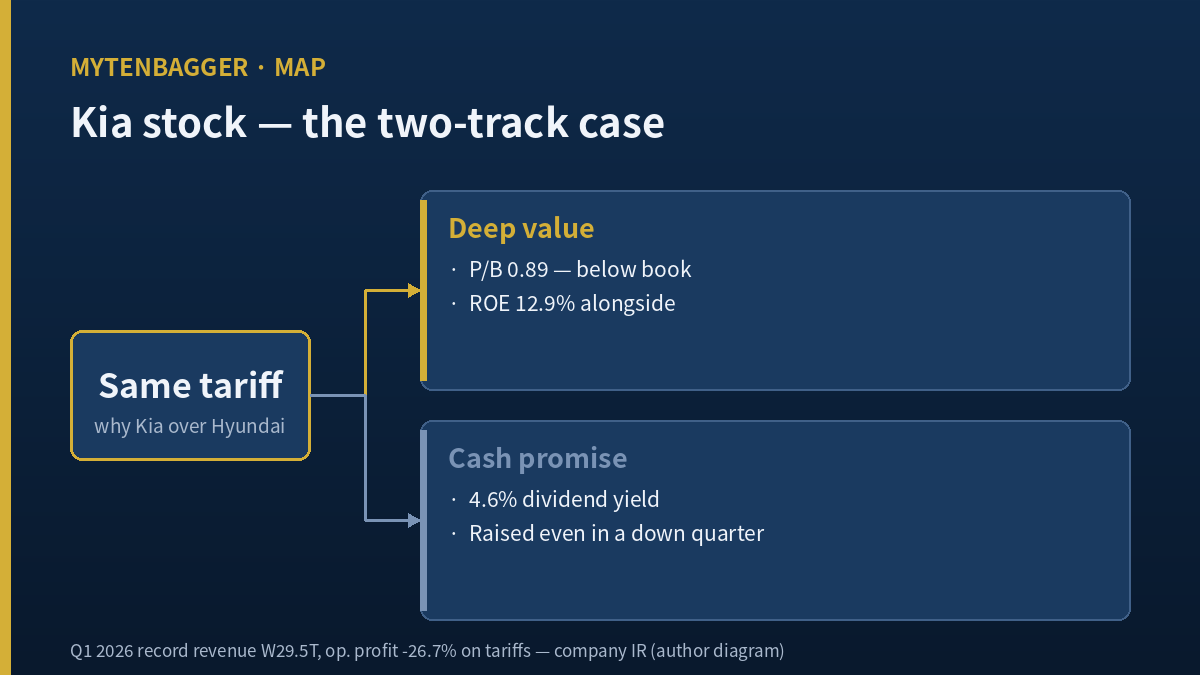
This is the heart of the entry. Hyundai and Kia share a group, a tariff, and a US market, so they usually trade as one body. I treated them differently. Hyundai’s dividend posture carries a question mark right now, so I am still watching it — while Kia is enlarging its dividend.
Kia’s dividend per share has stepped up from ₩3,500 to ₩6,800 over recent years (DART filings, 2022 to 2025). That is three straight annual increases, and on the 2025 payout the yield is 4.6% at today’s price. Raising the dividend in a year when tariffs are denting profit tells me management judges the headwind survivable. A dividend is cash that actually leaves the building, so it is the most honest signal of earnings confidence a company gives.
Then the valuation sits on top. Kia’s PBR is 0.89x — it trades below its own net asset value while earning a 12.9% ROE. Buying a company that compounds book at 13% a year for less than book value is a rare combination even for a cyclical automaker. My arithmetic was plain: buy below net assets, collect a 4.6% dividend while I wait, and let the tariff overhang clear. What split Hyundai and Kia for me was not the business — it was the direction of the dividend and the price tag.
It is worth being precise about why the market lumps the two together, because that habit is exactly the inefficiency I am leaning on. Hyundai and Kia share the group’s platforms, engines and much of their global manufacturing footprint, so a tariff or a demand shock hits both P&Ls at once and index funds trade them as a pair. But they are separate legal entities with separate boards, separate capital-return policies and separate product mixes — Kia skews more heavily to SUVs, RVs and a design-led premium that has lifted its per-unit profitability over the past several years. When a single macro headline pushes the pair down in lockstep, the correlation is real on the revenue line but sloppy on the capital-return line. I am not betting the businesses diverge; I am betting the market’s habit of pricing them identically ignores a dividend and a valuation that already differ. That is a narrower, more defensible bet than “Kia is a better company than Hyundai,” which I am not claiming.
The Numbers Behind Kia Stock: Below Book at 0.89x
Here is Kia in one place (trading data, July 14, 2026).
| Metric | Value | How I read it |
|---|---|---|
| PER | 7.3x | Seven years of earnings — a value stock, not a growth story |
| PBR | 0.89x | Cheaper than net assets — a floor under the downside |
| ROE | 12.9% | Double-digit return on equity despite the low price |
| Dividend yield | 4.6% (DPS ₩6,800) | Cash I collect while I wait (4.87% on DART basis) |
| Foreign ownership | 38.8% | Global money is already heavily in |
The cell I stared at longest is foreign ownership at 38.8%. The cheap-and-yielding thesis is not some domestic-only discovery — foreigners already hold nearly 40% of the shares, which puts weight behind it. “Not a discount only I can see, but one global money has already bought” actually made me more comfortable. The flip side: a high foreign stake means the shares can swing hard on tariff or currency headlines when those holders move.
Zoom out to the full year and the picture holds. In 2025 Kia earned ₩114 trillion (about $83 billion) of revenue, roughly ₩9 trillion of operating profit and an operating margin near 8% (trading data). The forward frame comes from the company itself. At its April 2026 CEO Investor Day, Kia set mid-term targets of 4.13 million units, ₩170 trillion (about $123 billion) of revenue and ₩17 trillion of operating profit — a 10% margin — by 2030, alongside a 2026 revenue goal of ₩122 trillion (company report, via Herald Business). The sell-side leans the same way: Mirae Asset Securities set a ₩200,000 price objective and Hana Securities a ₩210,000 objective, both in April 2026. I do not adopt those objectives as my own. But the gap between a sub-₩140,000 price and objectives near ₩200,000 is a market signal I note.
The line under all of this that reassures me most is cash. In 2025 Kia generated about ₩2.6 trillion of operating cash flow and roughly ₩1.8 trillion of free cash flow, with interest coverage above 13x (trading data). Its dividend payout ratio is only around 36%, which means the ₩6,800 payout is covered several times over by earnings — the dividend is not being financed by stretching the balance sheet. That matters for a below-book thesis: a cheap stock whose dividend is fragile is a value trap waiting to spring, while a cheap stock throwing off free cash and paying out barely a third of profit has room to keep the dividend even if a tariff year drags on. This is the difference I weight most between Kia and a superficially similar low-PBR name.
Pricing Kia Stock Against Global Automakers
Seen only inside Korea, Kia is just “the cheaper of the two Hyundai-group automakers.” I place it next to global peers, because autos are cheap worldwide for structural reasons and I want to know where Kia sits inside that.
| Company | Valuation (July 2026, source noted) | Character |
|---|---|---|
| Kia | PER 7.3x · PBR 0.89x (trading data, trailing) | SUV-and-hybrid mix, high dividend |
| Toyota | Forward P/E about 8.0x (gurufocus) | World No. 1, hybrid leader |
| GM / Ford | Generally single-digit P/E (macrotrends) | US-centric, EV losses a drag |
On a trailing 7.3x, Kia stock is priced at or below world-leader Toyota’s forward 8.0x. The whole auto sector is cheap, true, but Kia is not sitting in an especially expensive corner of it. So my question is not “is Kia cheap” but “does Kia deserve to trade below Toyota and the US names?” I do not think it does. Kia is lifting its hybrid-and-EV mix to 29.7% of sales and improving product mix, and its dividend is richer than the US automakers’. I am betting that gap narrows rather than persists.
There is a caveat I keep in view: cheap can be a trap. Autos trade at low multiples because they are cyclical, capital-hungry, and mid-way through an EV transition, so a low PER can be a warning rather than a bargain. What made me file Kia as value rather than value-trap is not the multiple alone but three things stacked together — a below-book floor, a dividend raised into the tariff hit, and the execution to take share while industry demand shrinks. When those three sit on a cheap price at once, I classify it as underpriced, not a trap.
Kia Stock’s Next Engine — Hybrid Mix and the Investor Day
The tailwind I saw behind the tariff headwind is product mix. In Q1 2026 Kia’s eco-friendly vehicle sales rose 33.1% to 232,000 units, or 29.7% of total sales (company report). Inside that, hybrids were 138,000 units and pure EVs 86,000. I think that is the most favorable mix in today’s market. US demand for pure EVs has cooled, and hybrids are filling the gap — they carry good margins and are less exposed to subsidy swings. When a maker that bet everything on pure EVs gets dragged into a price war, a hybrid-heavy Kia can stand a step back. If tariffs are the short-term headwind, this mix is the medium-term cushion.
The company’s own forward picture rests on that. At the April 2026 CEO Investor Day, Kia laid out 2030 targets of 4.13 million units, ₩170 trillion of revenue and ₩17 trillion of operating profit — a 10% margin (company report, via Herald Business). Against a margin currently pressed to 7.5% by tariffs, 10% is an ambitious number. I do not take it at face value; company targets always lean optimistic. But that Kia raised its ambition rather than trimming it during a tariff quarter reads, to me, as the same confidence signal the rising dividend sends.
On a personal note, I remember Kia as “the company I re-bought on design.” A few years back Kia was the discount brand in Hyundai’s shadow; today it is closer to the sibling that lifted per-unit profitability through its SUV and RV lineup and design premium. I only half-believed that shift at the time and let it drift past me, so this time I am trying not to miss the change in the business hiding behind the tariff noise.
Ford, GM, the Won, and Korea’s Value-Up Push
The comparison that sizes this best runs against the cheap US automakers: if you own Ford or GM for their cash generation and dividend, Kia is a similarly cheap automaker with a richer dividend, a stronger hybrid mix, and share gains — but priced in won, so a stronger won trims the dollar return. I treat that currency exposure as a variable I accept, not one I can forecast. And because tariffs, FX and subsidies are all outside my control, I approach only in stages at a low price rather than in one lot.
One more piece of context sits behind the below-book price, because it is part of why the discount is not just a random quirk. Korea has been running a corporate “value-up” push aimed squarely at the deep discounts that have long sat on its large caps — the very reason so many quality Korean names trade under book value. Kia, with its rising dividend and its Investor Day capital-return ambition, is exactly the kind of stock that policy is meant to re-rate, and a 0.89x PBR on a 12.9%-ROE exporter is a textbook candidate. I do not treat that as a guaranteed catalyst — policy moves slowly and unevenly — but it means the cheapness has a plausible mechanism to close over time, not just a hope that sentiment turns. Weighed against Ford or GM, that structural tailwind is part of what comes alongside the dividend.
The Other Side — What Worries Me About Kia Stock
The harder I lean in, the larger I owe the bear case, and Kia’s is grounded. First, tariffs: a manageable-looking ₩755 billion a quarter can grow or become permanent as US policy shifts with the political calendar, and if it does, my “already priced in” comfort weakens. Second, the direction of earnings: Q1 operating profit down 26.7% sits on a full-year path of roughly −28% (company and trading data); a 0.89x PBR floor still sinks if profit keeps falling. Third, the EV transition: global EV price competition and rising Chinese makers are a structural squeeze on automaker margins, and no one can promise how long Kia’s SUV-and-hybrid mix stays a shield. Fourth, positioning: 38.8% foreign ownership is a trust signal in calm times, but if those holders turn on tariff or currency news, Kia stock can swing sharply short term. Fifth, currency’s double edge: a weak won helps an exporter like Kia, but a strong won stacks on top of tariffs and squeezes profit from two sides at once — in a tariff quarter, FX may not be on the same team. And if US clean-vehicle incentives retreat, the very hybrid-and-EV mix I called a cushion needs its margin assumptions rechecked. In short, even the things I called cushions can thin out on one line of policy.
The Chinese-competition risk deserves more than a clause, because it is the one that could break the thesis on a multi-year horizon rather than a quarterly one. Chinese automakers have moved from cheap domestic players to credible exporters, and their cost structure on EVs is genuinely lower than legacy makers can match today. Kia is largely absent from China itself, which limits the direct hit, but it competes head-on with Chinese brands in Europe, the Middle East and emerging markets — exactly the regions where Kia has been taking share. If Chinese EV pricing compresses the whole industry’s margin pool, a 10% operating-margin target for 2030 starts to look heroic, and the below-book floor I lean on would re-rate lower with it. I do not think that plays out in the next few quarters, which is why I am comfortable accumulating now, but it is the reason I size this as a position to add to on weakness rather than a conviction I max out at once. A moat built on scale and mix is real, but it is not the kind of moat that survives a rival with a structurally lower cost base indefinitely.
So I do not treat this as a buy-and-forget. What I am paying for is not today’s earnings but the combination of a below-book price, a 4.6% dividend, and time for the tariff overhang to clear. On the other side of that combination sit the cracks above, and I list them rather than paint over them.
Why I’m Buying, and Where My Thesis Breaks
To gather it up: I started buying Kia in stages below ₩140,000. Three reasons — a below-book 0.89x PBR against a quality 12.9% ROE, a dividend raised to ₩6,800 for a 4.6% yield even through the tariff hit, and a tariff shock already disclosed in numbers while revenue prints a quarterly record. Where Hyundai and Kia were pushed down together, I chose the one with the better dividend and the better price tag. This is not me telling anyone else to buy — it is a record of why I put my own money in here.
And I nail down, in advance, where I admit I was wrong — in steps. Step one: if next quarter’s tariff charge runs meaningfully above ₩755 billion, the first pillar of my “manageable” premise wobbles. Step two: if the 7%-plus operating margin that held through tariffs slips toward 5%, I have to recompute the below-book floor thesis. Step three: if the company turns the dividend from held to cut — the very reason I chose Kia over Hyundai — I close the stance. Watching whether those three steps get taken in order is my job now.
Of two siblings hit by the same tariff, I chose the cheaper one with the thicker dividend. The market’s habit of treating the pair as one body is exactly what buries the real difference — the dividend and the price tag. When I re-read this later, those three markers, not my mood today, will tell me whether I was right.
Sources I used: JoongangE News — Kia Q1 results, Herald Business — Kia 2026 CEO Investor Day, Economist — record revenue, tariff on margins, GuruFocus — Toyota forward P/E, Macrotrends — GM P/E, StockAnalysis — Toyota statistics.
Related reading
- Hyundai Motor Stock: I Watch Tariffs and Margins, Not Robots
- KG Mobility Stock and Four Years Under One Percent