Shinhan Stock Near Its High: Buybacks vs. a $660M Deal
Shinhan stock is up 53.9% over twelve months and sits just under its 52-week high. I like the engine underneath it — a company that has promised to shrink its own share count to 450 million by the end of 2027 — but I haven’t bought. A roughly $660 million (₩1 trillion) insurance acquisition now competes with the buyback for the same capital. I’m waiting for the July 23 board answer before I move.
On Monday I read a Korean scoop — Money Today, one of Korea’s financial dailies — reporting that Shinhan Financial Group is the likely preferred bidder for Lotte Insurance. The first thing I opened wasn’t an insurance-industry primer. It was my spreadsheet of Shinhan’s share count: 512.8 million shares at the end of 2023, 499.9 million at the end of 2024, roughly 474.7 million today. The numbers walk down like a staircase. And that’s exactly why the deal headline bothered me. The acquisition check and the buyback budget are drawn on the same capital ratio. This isn’t a story about a bank buying an insurer; it’s a story about whether the fuel for the engine I liked gets spent somewhere else.
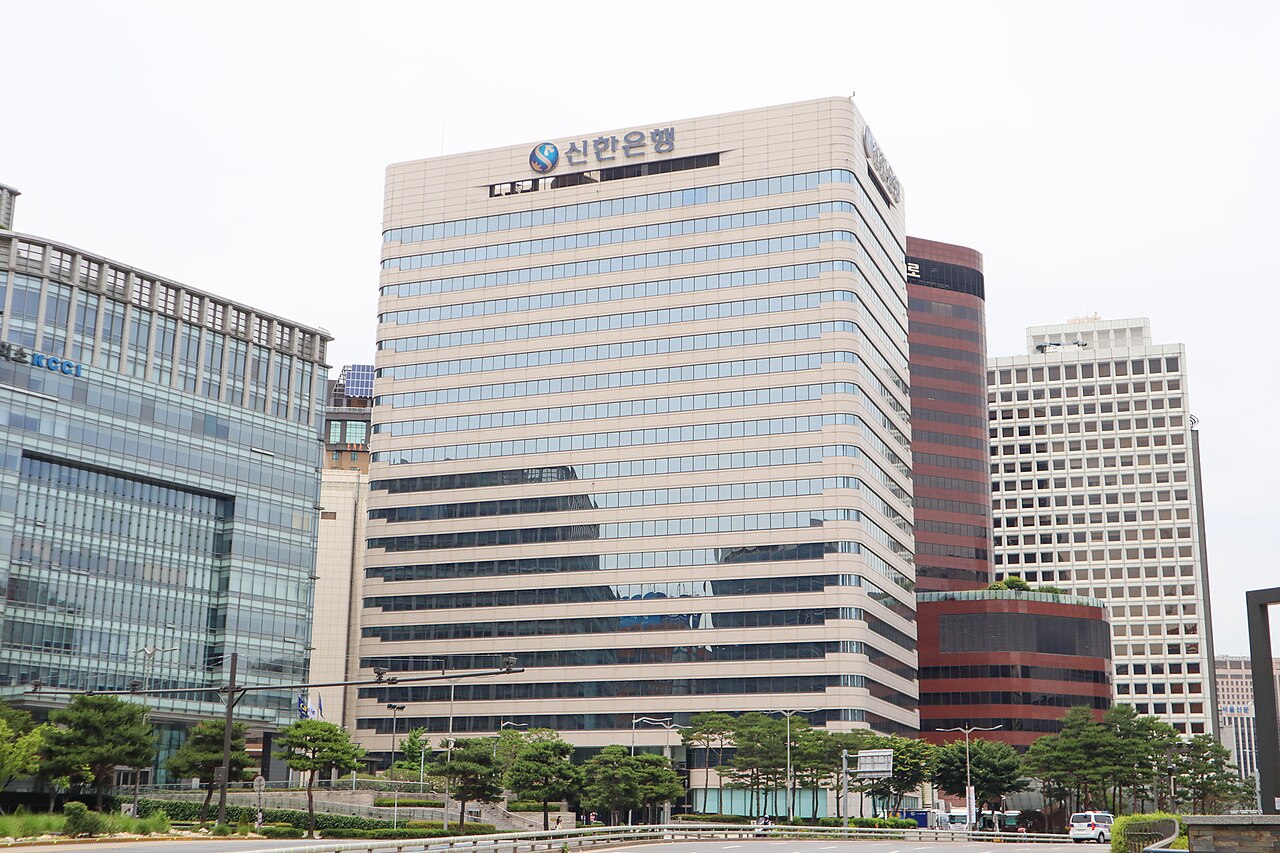
Quick scaffolding for readers new to the name. Shinhan Financial Group is one of Korea’s two largest banking groups, listed on the KOSPI — the main board of the Korea Exchange, home to the country’s blue chips — under ticker 055550, with a market cap around $33.5 billion (₩50.9 trillion). All won figures below convert at roughly ₩1,520 per dollar, the recent rate per Trading Economics.
Contents
Why I Reopened Shinhan Stock: The Shrinking Share Count
A confession first. Last year I crossed Korean bank holdcos off my watch list entirely — “the easy money’s been made” was my exact reasoning. That call has now been wrong twice, first with KB Financial and now with Shinhan, and yes, it stung to watch. So this time I went back and pulled apart why it kept rising instead of assuming it couldn’t.
Engine one — a company deleting its own shares
Under Korea’s Value-up program — the government-backed push, loosely modeled on Japan’s governance reforms, to get chronically cheap listed companies to return capital — Shinhan pinned three numbers into its corporate value-up plan: 10% return on equity, a 50% shareholder return ratio, and a share count of 450 million by the end of 2027. The third number is the one I weigh most. Korean financial outlet Dealsite traced the path: 512.8 million shares at end-2023, 499.9 million at end-2024, and brokerage market data puts it near 474.7 million now. If the plan holds, roughly another 25 million shares disappear.
This year’s execution, per a July 8 note from Korean sell-side firm Sangsangin Securities (as relayed by Financial Today, a Korean outlet): ₩700 billion (~$460 million) of buybacks in the first half and ₩800 billion (~$525 million) planned for the second half — about $1 billion for the year. Since end-2023 the share count is down about 7.4% by my arithmetic. Even if net income never grew a single won, the per-share claim on this business would have grown by roughly that much.
Engine two — record quarterly profit feeding that engine
The company reported first-quarter net profit of ₩1.62 trillion (~$1.07 billion), up 9.0% year over year and a quarterly record, per its April 23 results release as covered by Korean wire service Newspim. The forward view exists too: Sangsangin estimates 2026 full-year profit of ₩5.9 trillion (~$3.9 billion), up 18.5%, with second-quarter profit attributable to shareholders around ₩1.72 trillion, and set a price objective of ₩145,000. Meritz Securities, another Korean house, raised its marks on KB, Shinhan and Hana on July 6 while cutting Woori, IBK and KakaoBank — sorting the sector explicitly by shareholder-return capacity, per Korea Economic Daily. I don’t adopt anyone’s price objective as mine. What I do record is the direction: every revision this year has moved up, and the stated reason keeps being returns, not rates.
Engine three — a dividend walking up its own staircase
Per DART, Korea’s public disclosure system, the annual dividend went ₩2,065 → ₩2,100 → ₩2,160 → ₩2,590 across fiscal 2022–2025, three straight increases with 19.9% growth in the latest year. The company now pays an equal quarterly dividend of ₩740; hold that pace through Q4 and you get ₩2,960 (~$1.95) for the year — my extrapolation, not guidance. Sangsangin pegs this year’s total shareholder return ratio at 49.3%, a rounding error from the 50% target. One honest caveat: because the stock ran first, the trailing yield has compressed to about 2.4%. Nobody should be showing up here for the yield alone anymore — I’m certainly not.
What the local sell side has done with its marks
The trajectory of Korean brokerage estimates tells its own story, and I want it on the record before the board meeting rather than after. Right after Q1 results in late April, Korean outlet Joseilbo rounded up the marks: NH Investment & Securities at ₩119,000, Korea Investment & Securities at ₩125,000, Meritz at ₩128,000, Kiwoom in a ₩130,000–140,000 band. Korea Investment pointed to a 9% return on capital in the quarter with assets growing 5%; Meritz penciled a 53% payout ratio for 2026. Three months later Sangsangin printed ₩145,000. In four months the floor of the spectrum climbed to within hailing distance of the market price, and every stated reason was some flavor of shareholder return rather than margin expansion. None of these numbers are mine and I adopt none of them — what I take from the sequence is only its direction and its monotony. When every revision points the same way for the same reason, the market has effectively made one single bet. That concentration is precisely what makes the July 23 capital-allocation decision binary for the story.
Sector backdrop, briefly. Korea Economic Daily’s July 6 coverage carried an estimate of ₩7.33 trillion in combined Q2 profit attributable to shareholders across Korean banks, helped by net interest margins improving as market rates rose. Hana Securities’ bank weekly dated July 13 ran a headline to the effect that KB and Shinhan had broken through prior highs and that earnings differentiation would widen. The pattern I read: money is not flowing into Korean banks as a bloc; it’s flowing into the two or three holdcos whose return capacity is provable. Shinhan currently belongs to that shortlist. Whether it still belongs after a ₩1 trillion acquisition is the open question.
Shinhan Stock by the Numbers
| Item | Figure | Note |
|---|---|---|
| Price / market cap | ₩107,300 (~$70.60) / ~$33.5B | ~95% of the 52-week high of ₩113,300 |
| 12-month / 6-month return | +53.9% / +34.4% | 52-week low was ₩63,100 |
| P/E / P/B | 10.6x / 0.89x | Trailing basis |
| ROE | 8.7% | Company value-up goal is 10% |
| Q1 2026 net profit | ₩1.62T (~$1.07B), +9.0% | Quarterly record (company release) |
| FY2025 dividend per share | ₩2,590 (~$1.70) | Third straight increase; ~2.4% trailing yield |
| Shares outstanding | ~474.7M | Target: 450M by end-2027 |
Sources: Kiwoom Securities market data, DART filings, company Q1 release | As of July 15, 2026. USD at ~₩1,520.
The cell I stared at longest is 0.89x book. The stock nearly doubled and it still trades below its own equity. My view — and this is the lens for the rest of this journal — is that a Korean bank’s path back to 1x book runs not through earning money but through proving, quarter after quarter, that the money leaves the building and reaches shareholders.
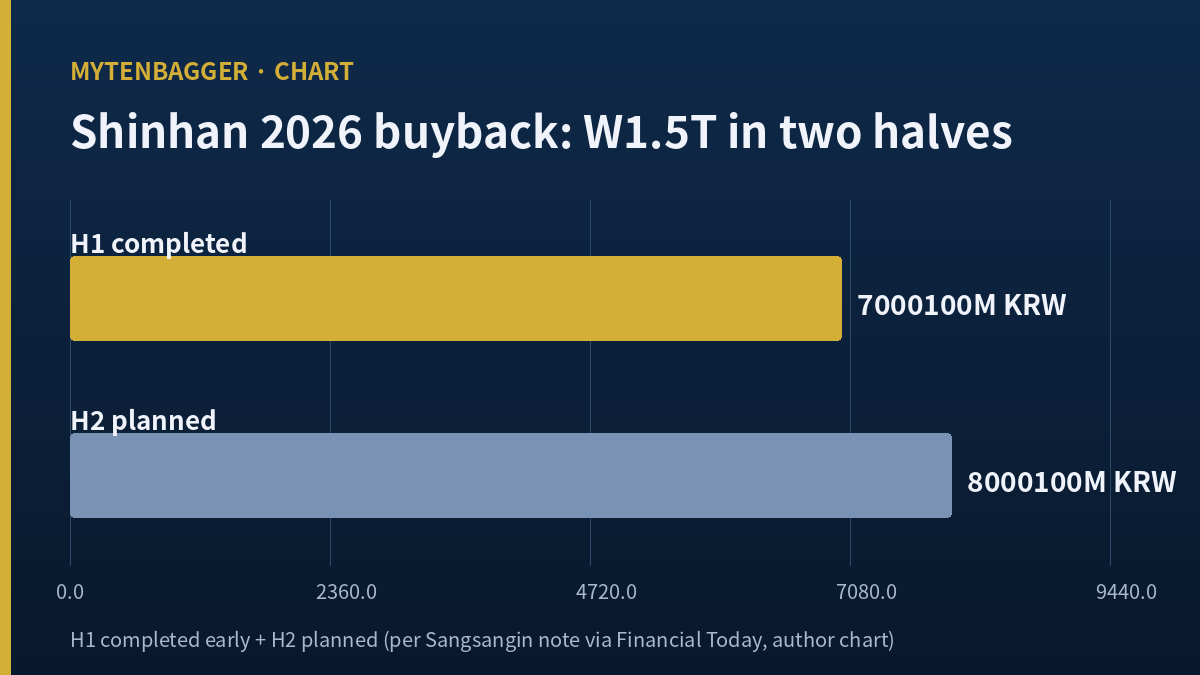
Not Rates but Share Count — the Real Engine Behind Shinhan Stock
Nine out of ten bank-stock write-ups open with rates and net interest margin. I read this one backwards. The past two years of this chart, in my reading, owe more to capital-allocation policy than to any rate cycle. A 7.4% cut in share count lifts per-share earnings by about that much even on flat profits — and profits didn’t stay flat, they hit records. Add Sangsangin’s estimated 18.5% profit growth for 2026 on top of a shrinking denominator, and a +54% year stops looking mysterious.
Here’s the global context that makes the whole thing interesting to me as a value hunter. Per GuruFocus data as of early July, JPMorgan trades at 2.61x book — near a decade high — while the median across the roughly 1,500 banks GuruFocus tracks sits at 1.10x. Shinhan earns record profits, runs a $1 billion buyback, raises its dividend three years running, and still trades at 0.89x. That gap is the “Korea discount” in one number. The Value-up program exists precisely to close it, and Shinhan has been one of the program’s model students. Whether it stays one is, frankly, the entire question of the next section.
There’s a precedent for how this movie can play out, and it’s one American investors already know: Japan. Tokyo’s governance push got the megabanks and trading houses re-rated over several years once buybacks and payout hikes proved durable — durable being the operative word. Korea’s Value-up program is younger and its enforcement softer, which is exactly why the market rewards the handful of names that execute without being forced. Shinhan’s three-year dividend staircase and its published share-count target are that execution, in writing. The flow data says foreign investors have noticed: foreign ownership sits at 61.5% of Shinhan — among the highest on the KOSPI’s large-cap board, per Korean brokerage data — and the stock trades about 11% above its 120-day moving average. I want to be honest about what that last number means for someone like me arriving now: this is not a bottom-fishing setup. Money entering at this level isn’t betting the stock is cheap against yesterday; it’s betting the capital-return policy survives contact with management’s M&A ambitions. Which is a bet you can only underwrite by watching what the board actually does, not what the deck says.
The same lens also exposes the sore spot. By Korean press tallies (Huffington Post Korea’s summary), 2025 annual profit came to ₩4.97 trillion for Shinhan versus ₩5.84 trillion for KB — an ₩871 billion gap. Non-bank businesses contribute 29.3% of Shinhan’s earnings versus 37% at KB; where KB’s insurers earn over ₩1 trillion, Shinhan Life earned ₩508 billion. That’s the itch the Lotte Insurance deal is meant to scratch: the gap is insurance, so buy an insurer. The logic is sound. The problem is which wallet pays. The ₩1.5 trillion buyback and the ₩1 trillion acquisition both draw on the same CET1 capital ratio — 13.19% as of Q1. While the market reads “portfolio diversification,” I read a capital-allocation exam paper with a hard deadline.
The Lotte Insurance Deal — Three Paths I’m Mapping
Table stakes first, from the July 14 Money Today scoop: private-equity seller JKL Partners is asking around ₩1 trillion (~$660 million) for its 77.04% controlling stake — roughly half the ₩2 trillion it hoped for in a failed 2024 sale attempt. Shinhan plans a final decision before its July 23 board meeting and is pushing the sellers to recapitalize the insurer first. A mezzanine investor, IMM, holding about ₩500 billion, wants full principal back and is the late-stage wildcard. The asset itself, per Korean press summaries: ₩13.9 trillion in assets (seventh among Korean non-life insurers), a contractual service margin of ₩2.3 trillion, and long-term policies at 88.6% of the book — a future-profit pantry, but also the body type most sensitive to capital regulation.
The other side of the ledger is heavy, and it comes from a credit desk, not a stock promoter. Korea Investors Service, one of Korea’s big-three rating agencies, flags that Lotte Insurance’s basic-capital solvency ratio stood at −21.4% as of March 2026, against a regulatory metric that becomes binding in 2027, and its K-ICS solvency ratio of 131.9% before transitional relief (113.7% under the strict model) sits below the industry average. Shinhan’s own double-leverage ratio of 116.7% as of 2024 doesn’t leave lavish room for equity injections either. Translation: even bought cheap, this asset may keep asking for money after closing.
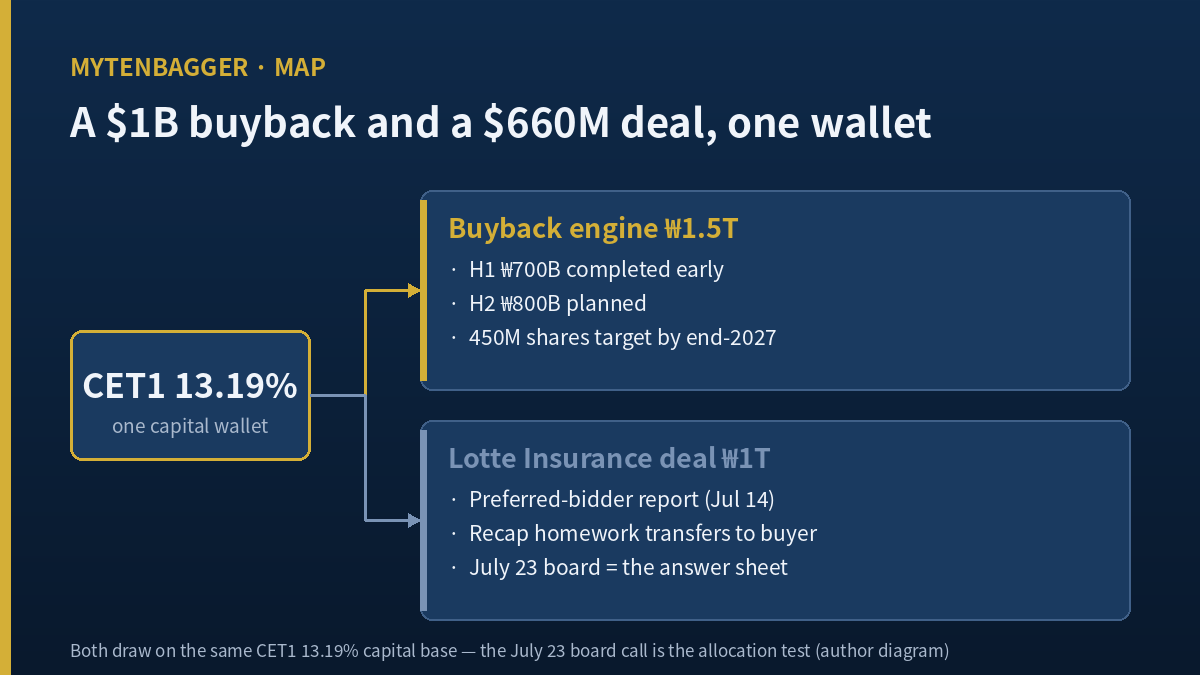
Path one — buy cheap, keep the returns intact (my base case, 45%)
The price stays near ₩1 trillion, sellers shoulder the recapitalization, and the buyback-and-dividend cadence doesn’t miss a beat. Non-bank earnings get their missing leg, and the distance between today’s 8.7% ROE and the company’s 10% goal — a distance I doubt the bank alone can close — becomes a workable project. Sangsangin’s analyst framed the deal verdict as hinging on the purchase price and post-deal profitability, and I’d put it the same way. What makes this path plausible rather than wishful is the recapitalization demand itself: by insisting the sellers repair the solvency ratios before closing, Shinhan is effectively trying to buy the CSM pantry without buying the capital hole attached to it. If that structure sticks, the deal adds an earnings leg without touching the buyback budget. In this path I expect to start building a position — on pullbacks, not on the headline pop.
One more thing I’d watch in this branch: the speed of disclosure. Korean listed companies file material decisions on DART the day they’re made, so a well-structured deal should arrive as a package — price, funding source, capital impact — in one filing. A bare-bones approval with “details to follow” would tell me the capital math wasn’t finished when the board said yes, and I’ve learned to treat that pattern as information.
Path two — the deal collapses (30%)
Price or the IMM standoff kills it. The sellers are aiming for an open auction in August per Korean press, so the asset finds another suitor — the 2024 attempt already died once over price. Shinhan keeps its insurance gap but also keeps its buyback engine whole, and I suspect the market reads it as noise removed rather than opportunity lost, at least short term. In this path I wait for Q2 results and confirmation that the second-half ₩800 billion buyback actually executes, then decide.
Path three — pay up, and the capital gets squeezed (25%)
The price inflates, and post-closing recapitalization lands on Shinhan’s balance sheet. If the solvency hole the rating agency flagged gets filled with Shinhan’s capital, a smaller buyback or a retreat from the 450-million-share path follows. If that happens, the reason I reopened this name evaporates. The nastiest version isn’t even the purchase price — it’s the slow leak afterward, where a solvency ratio that needs feeding turns every future capital-return decision into a negotiation. Korean financial history has enough acquisitions that looked cheap at signing and expensive by the third capital call. I’ll admit I first drafted this section saying “at half the 2024 price it’s a bargain no matter what” — then deleted it. A cheap sticker and a cheap acquisition are different things, and the difference lives in the fine print of who funds the recapitalization.
Where My Thesis Breaks — Shinhan Stock Checkpoints
I don’t own the shares today and I won’t chase them within sight of the high. Instead I’ve written down my conditions and weighted them. The heaviest weight goes to buyback execution, not dividends and not earnings. First, July 23: if the board approves the deal, do the price, the recapitalization split, and the CET1 impact get disclosed together? Second, does the second-half ₩800 billion buyback execute regardless of the deal? If either of those wobbles, the “value-up model student” thesis is broken for me, and no other virtue of the franchise keeps me in. A third checkpoint carries a lighter weight — Q2 results holding CET1 above 13% and the ₩740 quarterly dividend on pace. Those can wobble for seasonal reasons, so they get one extra quarter of patience.
I’ve also pre-written my entry behavior. If both heavy checkpoints clear, I’d rather buy pullbacks in tranches than pay the high. And if the stock runs away while I wait for confirmation — that can absolutely happen — I’ll treat the missed move as an insurance premium I chose to pay. Between repeating last year’s mistake of deleting the sector from my list and the new mistake of buying a top tick unconfirmed, I’ll take the first one twice. It only costs opportunity, never principal.
On sizing, since I’ve already sketched the entry: this would come in as a core-holding candidate for me, not a trade — the kind of position built in three or four tranches over months, where the ₩740 quarterly dividend pays me to be patient while the share count does the quiet work. That’s also why the checkpoint discipline matters more here than for a momentum name. A trader who’s wrong about July 23 loses a few percent; a compounding thesis that’s wrong about the buyback engine loses its entire reason to exist. I’d rather be slow and right about which one of those I’m buying.
What I’m Waiting For
What Shinhan hands its board on July 23 is not really a yes-or-no on an insurer; it’s a priority list for capital. Three years of shrinking the share count versus the itch to catch KB. My read is that Shinhan stock earns its next leg only if the first instinct wins, and I’m happy to pay a few days of opportunity cost to see the answer sheet. This journal gets updated when it lands.
Related reading