Yuanta Securities Korea Burned 3.3% of Its Own Shares
Before I looked at a single price, I looked at who owns Yuanta Securities Korea. A Singapore-incorporated entity called Yuanta Securities Asia Financial Services Private Limited holds 117,936,411 common shares of this company. That is 61.21% of the common stock. Counted together with its related parties, the holding is 118,031,797 shares, or 57.44% of all shares in issue. Two percentages, one owner, and the gap between them is worth an entire section later.
I do not own this stock and I have no order in the market. What pulled me in is a sequence I rarely see laid out this plainly: a company that destroyed a large block of its own shares in the spring of 2026, and a controlling shareholder that has been buying small lots in the open market in the months on either side of that destruction. Both actions shrink what is available to everyone else, and they come from different pockets.

Contents
What Yuanta Securities Korea is, for a reader outside Korea
The company trades on the KOSPI, the main board of the Korea Exchange, under the code 003470. KOSPI is where Korea lists its larger and older companies; the KOSDAQ board next to it carries smaller and younger ones. There is no American depositary receipt for this name that I could find, so what follows is a reading of a listed Korean broker and nothing more.
It is a mid-sized securities firm; the national champions sit elsewhere. Its controlling shareholder sits in the Yuanta group of Taiwan, which is why the company’s English name carries a Taiwanese brand while its business is Korean brokerage, wealth management and underwriting. The name on the door changed in the past: overseas data vendors still file this company under its former identity, Tong Yang Securities, and I had to search both names to be sure I was not missing coverage of it.
What Yuanta Securities Korea told the market about the cancellation
On 7 May 2026 the board decided to retire treasury stock. On 15 May 2026 the company said the retirement was complete. The reported size was about 6.91 million common shares plus about 100,000 preferred shares, roughly 7.0 million in total, with a carrying value of about 62.4 billion won. At the reference rate I use below, that is on the order of 45.8 million US dollars. The company put the share of issued stock at 3.3%.
I wanted to know which share base that 3.3% referred to, because 7.0 million against the 192,680,102 common shares on my screen today would be 3.63%, not 3.3%. So I worked backwards. Today’s register carries 205,491,472 shares in total. Add back the 7.0 million that were retired and the pre-retirement register was about 212,491,472. Seven million against that base is 3.29%, which rounds to the 3.3% the company reported. That 3.3% is measured against every share then outstanding, common and preferred together, before the retirement. That reconciles, and it also tells me the preferred line is not a rounding artefact: the difference between 205,491,472 and 192,680,102 is 12,811,370 preferred shares.
Dividing the two reported quantities against each other gives a third. About 62.4 billion won of carrying value across about 7.0 million shares works out to roughly 8,914 won a share. Set that beside the 9,275 won book value per share reported on the company screen and the retired stock was carried at something close to 96% of stated book. Both inputs are approximate and the two numbers come from different reporting moments, so I would not push this further than the observation itself: the shares destroyed were not sitting on the balance sheet at some token historical cost, and retiring them was a decision of real size against the equity base.
One more line from that reconciliation is worth keeping. The 12,811,370 preferred shares are 6.23% of the 205,491,472 on the register, by my own division. That is not a rounding line. Any value quoted per share on this company is therefore sensitive to whether the preferred count sits inside the divisor or outside it, and the providers I checked do not say which convention they used.
The intent was stated plainly. The company framed the retirement as reducing the shares in circulation to lift per-share value, and its chief executive spoke of strengthening shareholder-friendly returns. I take the statement at face value and note separately that a retirement of this size is a real transfer of cash out of the balance sheet. An accounting gesture would not have cost anything.
The parent has been adding, in very small pieces
Running alongside the retirement is a second thread. Through 2026 the controlling shareholder has been buying the company’s common stock on the exchange in small amounts. Filings summarised in the Korean financial press show purchases on 1 April, mid-April, 17 April, 23 April and 24 April, and again on 4 August. The August lot was 10,500 shares. It took the holder’s own position from 117,925,911 shares to 117,936,411, and the combined holding of the shareholder and its related parties from 57.43% to 57.44% of the total register.
Those are tiny increments against a position of more than 117.9 million shares. One hundredth of a percentage point. If I were looking for a trading signal I would find nothing here worth acting on, and I want to say that before I say anything else about it.
What I read into this at first, and why I was wrong
My first reading was that a controlling shareholder buying in the open market is a signal about price. Somebody with better information than mine thinks the stock is cheap, and is voting with money. That reading does not survive contact with the arithmetic. Ten thousand shares at this price is a few tens of millions of won. Against a group that consolidates a securities business of this size, that sum cannot be a return-seeking decision. I had assigned an intention to the action that its size cannot support.
What the size does support is a different intention: maintenance. My first attempt at that read was mechanical. A holder that wants its stake to stay above a line has to buy whenever the base it is measured against moves, and that base did move in May when 7.0 million shares were destroyed. That does not work either, because retiring stock raises everyone’s proportional holding, the parent’s included, so there was nothing to make up. What survives is the shape of the buying itself: small, regular, odd-lot amounts spread across many months look much more like a programme with a standing target than like a view on value. I cannot see the mandate behind it, so I am describing the shape and stopping there.
The correction I am keeping: when an insider transaction is offered as evidence, size the transaction against the buyer before reading its intent. If the amount would not register on the buyer’s own accounts, whatever it means, it does not mean conviction about price.
Two Yuanta Securities Korea ownership percentages that are both correct
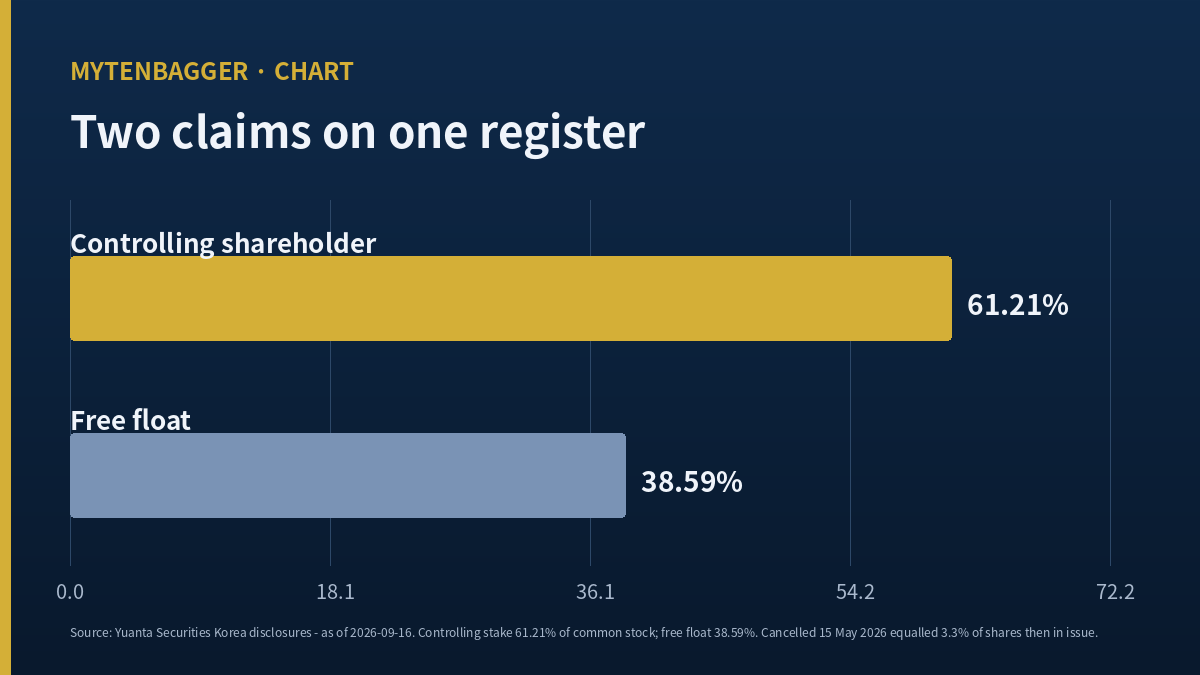
Earlier I flagged 61.21% and 57.44% as the same holder measured twice. Here is the reconciliation. Divide 117,936,411 by the 192,680,102 common shares and the answer is 61.21%. Divide the related-party total of 118,031,797 by the full register of 205,491,472 and the answer is 57.44%. One counts only common stock and only the holder itself; the other counts every share and everyone connected. Neither is wrong, and a reader who takes one of them into a model without checking which base it used will be off by nearly four points.
Beside those sits a third number from a different screen: foreign ownership of 68.77%, with free float given as 38.59%. The foreign reading is larger than the controlling stake, which tells me there are non-Korean holders here beyond the parent. The float line is smaller than the arithmetic complement of the controlling stake, which tells me the float calculation also excludes something else, most likely treasury and other locked holdings. I could not find the full breakdown, so I use these two as description and not as inputs.
Yuanta Securities Korea per-share earnings still counts the burned shares
Here is the consequence I did not expect to find. The screen reports earnings per share of 450 won for the company. Full-year 2025 net profit, as confirmed at the annual meeting on 26 March 2026, was 95.6 billion won. Divide that profit by 450 and the implied share count is about 212.4 million, which is the register as it stood before May 2026. Divide the same profit by today’s 192,680,102 common shares instead and you get about 496 won.
This is not an error. Earnings per share for a financial year uses the weighted average shares of that year, and the retirement happened months after the 2025 books closed. It is doing exactly what accounting asks of it. It is simply describing a register that no longer exists. A second screen made the point for me by reporting 443 won where the first screen reported 450, which tells me at least two providers are handling the same question with two different conventions.
The book value line has the same texture. Book value per share is given as 9,275 won, which against the common shares implies equity of roughly 1.787 trillion won, or about 1.31 billion US dollars. I do not know whether the 12,811,370 preferred shares belong in that divisor, and if they do, the book value line and the 0.51 times book reading beside it are being computed on a base I have not verified. That reading also comes from a screen whose date stamp I found to be a day early. I am reporting both figures and using neither.
What Yuanta Securities Korea pays out
The annual meeting on 26 March 2026 approved 220 won a share on the common stock and 270 won on the preferred. The stated yields were 4.4% and 5.9% respectively. Payout was 53.7% on a separate basis and 47.9% on a consolidated basis. The company has described a policy of keeping payout above 50% on a three-year average.
Those two payout figures carry information beyond the policy. A payout proportion falls when the profit underneath it is larger, so the consolidated result must exceed the separate result, which means entities below the listed company contributed earnings in 2025. How much, and from where, I cannot say from those two numbers alone. What I can say is that the dividend is being sized against a profit number that includes work done outside the listed entity itself.
The 4.4% yield is worth one line of arithmetic. If 220 won is 4.4%, the reference price used was 5,000 won. That happens to equal the par value of the shares, which I assume is coincidence and not method, but I could not confirm which trading days the reference price averaged. So I treat the stated yield as the company’s figure and do not rebuild anything on top of it.
Taken together, the 62.4 billion won retirement and a payout above half of profit describe a company returning a lot of what it earns. That is the part of this story I find genuinely interesting, and it is also the part I am least able to project forward, because no brokerage currently publishes an estimate for this company. The consensus screen carries no rating, no valuation and no forward earnings figure.
The float share deserves one calculation before I leave it. If 38.59% of the 205,491,472 shares are genuinely in circulation, that is about 79.3 million shares available to everyone who is not the controlling shareholder or otherwise locked up. Against that base, the roughly 7.0 million shares retired in May 2026 amount to about 8.8% of the tradable stock, by my own division. Retiring 3.3% of the whole register and 8.8% of the part that actually trades are two very different sentences, and only the first one appeared in the coverage I read. I do not know how the float share was constructed, so I hold this figure loosely, but the direction is not in doubt: the effect of a retirement lands entirely on the shares that move.
It is worth running the register forward one step, because that is the scenario I would be underwriting if I bought. Suppose the company retired another 7.0 million shares on the same scale. The register would fall from 205,491,472 to about 198,491,472, and the controlling holding of 118,031,797 would rise from 57.44% to 59.46% without the holder spending anything. I did that division myself and it is a hypothetical, not a plan the company has announced. But it shows what the open-market buying and the retirements do when they run in the same direction: the parent’s proportion climbs on two engines at once, and only one of them costs that holder money.
There is one more thing the register does not tell me, and I want it on the page instead of in a footnote. A retirement and a parent’s purchases both reduce what is available, but they answer to different people. The retirement was a board decision about capital, funded by the company and paid for by every shareholder in proportion. The purchases are a decision by one shareholder, funded from its own balance sheet, and no other holder participates. When the two are described together as shareholder returns, as they sometimes are, the second one is being credited to the wrong account. I have kept them in separate paragraphs here for that reason, and the only place I let them meet is the arithmetic above, where they happen to push the same proportion in the same direction.
Three Taiwanese comparisons, each with its own problem
For a comparison set I did something different from my usual habit. Instead of reaching for the large Japanese brokers, I looked at the market where this company’s controlling shareholder is itself listed, and took three names from Taipei.
Yuanta Financial Holding trades in Taipei at 61.30 Taiwan dollars with a market value of 817.20 billion, earnings per share of 3.29 and a price-to-earnings ratio of 18.66, on trailing revenue of 150.99 billion and net income of 43.80 billion across 13.33 billion shares, every one of those amounts in Taiwan dollars. The problem with this comparison is obvious and I will say it out loud instead of burying it: this is the group at the top of the chain, a diversified financial holding company with banking and insurance inside it, so its valuation says nothing about Korean brokerage economics.
Capital Securities, also of Taipei, is closer in kind: a broker trading at 34.80 Taiwan dollars for a market value of 75.55 billion, with earnings per share of 3.58, a ratio of 9.72 times, trailing revenue of 19.80 billion and net income of 7.77 billion on 2.17 billion shares. Its dividend of 0.40 works out to a 1.15% yield. The problem here is timing. That net income is up 76.5% year on year, which means I am comparing one firm’s boom half against another firm’s boom half, and two cyclical peaks lined up next to each other prove less than they appear to.
President Securities, the third, trades at 52.20 Taiwan dollars for 83.27 billion of market value, with earnings per share of 9.56, a ratio of 5.44 times, trailing revenue of 25.14 billion, net income of 15.42 billion and a dividend yield of 4.18% on a 2.11 payment. The problem with this one is internal: multiplying its per-share earnings by its share count gives 15.30 billion against the 15.42 billion reported, and dividing its dividend by its price gives 4.04% against the 4.18% shown, so at least two of the figures on that page are drawn from different moments. Small gaps, but they are the kind that widen when you build on them.
All three come from one data provider, none has been adjusted for accounting differences between Taiwan and Korea, and none of them has a controlling shareholder situation resembling the one I started this piece with. I put them here for scale and for market context, and the moment I tried to turn them into a valuation argument they stopped holding.
What I could not establish
I did not read the half-year report footnotes, so the preferred share terms, any conversion or redemption features, and the treasury position after May 2026 are all unread. The retirement figures are press summaries of a filing and not the filing itself, and the exact share counts carry the word “about” in every source I found. I do not know whether the retired preferred shares were of the same class as the ones still outstanding. I could not find the controlling shareholder’s stated purpose for its open-market purchases, and I have inferred shape from pattern, which is weaker evidence than a mandate. The list of purchase dates I compiled may be incomplete, since I worked from press summaries and not from a filing index. I have not confirmed whether the share count on my screen is post-retirement for every provider I consulted. The dividend reference price is unverified. The equity figure is my own multiplication and inherits whatever the book value line assumes. I have made no contact with the company.
Where I stand on Yuanta Securities Korea, and how to argue against it
I am watching, and I am not holding, and the reason is narrow. Everything I have established here concerns the supply of shares, and supply is the half of the question I can measure. The other half is what those shares will earn, and on that I have no estimate from anyone and only one unusual half-year of my own reading. I am not willing to put a value on a claim when I can only weigh one side of it.
My thesis breaks in two places. First, if the 2026 annual report shows the controlling holding drifting back below 57% without a further retirement, then the open-market buying was not a maintenance programme and my reading of it collapses. Second, if there is no further treasury retirement announced through the 2027 annual meeting cycle, then the May 2026 event was an isolated act and not a policy, and the payout-above-half framing loses its second leg. The documents that settle both are the 2026 annual report and the notice of the 2027 annual general meeting.
If someone wants to take this piece apart, here is where to push. Open the half-year footnote on treasury stock and you will see whether the company still holds a block large enough to repeat what it did in May; if it does not, the policy reading weakens immediately. Open the preferred share terms and you will learn whether that 12,811,370-share line is stable or convertible, which decides whether every per-share value in this piece has a moving base. Open the filing index for the controlling shareholder and count the purchases properly; if the pattern is lumpier than the press summaries suggest, my maintenance reading is the wrong shape. Any one of those three would do more to settle this than another screen of ratios.

Related reading
I wrote about how a mandatory-cancellation law reshaped the way I look at Korean brokers in a piece on Korea Investment Holdings, about a house whose earnings rest on client assets instead of trading volume in the Samsung Securities note, and about the one Korean broker I decline to treat as a broker at all in the Mirae Asset note.
Share counts, ownership proportions and per-share values reflect screens checked on 16 September 2026. Won-to-dollar conversions are approximate, at roughly 1,363.51 won per dollar on the 15 September 2026 close, and my own divisions carry rounding differences in the last digit.
Sources: Seoul Economic Daily on the May 2026 treasury retirement · Datatooza on the 4 August 2026 controlling-shareholder purchase · Insight Korea on the March 2026 annual meeting · Edaily on the first-half results · WiseReport company screen · Yuanta Financial Holding data · Capital Securities data · President Securities data