Lotte REIT Stock and Its Dividend: One Table Says It Cannot
Lotte REIT stock closed at 3,955 won on Wednesday, 2026-09-16, which is about 2.89 US dollars a share, and the yield printed beside it on Korean dividend screens is 6.62 percent. I went looking for the line that pays that yield and found it is not on the income statement. In fiscal 2025 the company earned 46.25 billion won of operating profit and paid 27.35 billion won of interest, leaving 18.90 billion won, while the dividend it declared for that year came to 35.54 billion won.
The gap is 16.64 billion won, or about 12.2 million US dollars. Operating cash flow for the same year was 64.02 billion won, and the dividend uses 55.52 percent of it. So the answer to whether this company can afford its dividend depends entirely on which financial statement you open. I ran the same arithmetic on Realty Income, the largest listed retail landlord in the United States, and got the same disagreement. The mismatch belongs to the vehicle. It is a property of how landlords are built, and it is not a verdict on this particular company.

Contents
What I Took Out Before I Read Lotte REIT Stock
I fix the anchor close first. The closing price for Wednesday, 2026-09-16 was 3,955 won on volume of 114,186 shares, marked final and traded on the regular exchange session only. Three separate screens agreed on that figure, which is worth stating because on several recent sessions they have not.
Share count I recovered by division. Korean disclosure filings publish both the dividend per share and the total cash dividend, so dividing one by the other returns the number of shares that received it. Fiscal 2025 gives 35.543 billion won divided by 123 won, or 288,967,480 shares. Fiscal 2024 gives 33.809 billion won over 117 won, and fiscal 2023 gives 32.365 billion won over 112 won. All three land on the same number, so the share count has not moved in three years. Multiplied by 3,955 won it produces a market value of 1.1429 trillion won, or roughly 835 million US dollars at 1,368.6 KRW per USD, the Seoul market close on 2026-09-16.
With those two anchors set I wrote down the two lines that started this piece: operating profit of 46.254 billion won and interest expense of 27.353 billion won, both from the fiscal 2025 annual report. Each is printed. Their difference is not. A real estate investment trust collects rent, services debt, and distributes what survives, so the surviving amount is the number I wanted, and no filing states it.
Rent Comes In on One Side and Interest Goes Out on the Other
Lotte REIT owns department stores, discount outlets, and shopping centers occupied by companies in the Lotte group, and it collects rent from them. It listed on the KOSPI, the main board of the Korean exchange, in October 2019. The smaller KOSDAQ board carries most of the country’s technology and biotechnology names, and this company is not on it. Since listing it has added properties steadily, and the most recent additions include a hotel.
There are only two ways to buy buildings. You issue shares or you borrow. This company did both, and each choice left a trace in a different place.
Two features of the Korean listed property market govern everything that follows, and neither has a close analogue in the United States. The first is sponsorship. Almost every Korean listed trust of this size was assembled by a large industrial group out of buildings that group already occupied, so the landlord and the tenant share a surname. That arrangement makes rent unusually predictable in ordinary conditions and unusually correlated with one balance sheet in bad ones. The second is the distribution calendar. These trusts pay twice a year, not four times, and they close their books on a rhythm that does not line up with the calendar year a foreign screen assumes.
The second feature is why the same 123 won per share appears on one screen as a 2025 figure and on another as a March 2026 figure. Both are correct. One counts by the fiscal year the company closed, the other by the date the cash left the company. I have used the fiscal year convention throughout this article, which means every amount I call a 2025 dividend was actually received in 2026. The trailing twelve month total on the ex-dividend convention is 262 won, made up of 123 won that went ex on 24 March 2026 and 139 won that goes ex on 2 October 2026, and 262 over that close is the 6.6245 percent I quoted at the top.
That also explains why the yield on this company differs by screen. I found four published figures, 6.66, 6.62, 6.07, and 2.79 percent, and none of them is an error. The lowest one counts a single half-year payment against a closing price from a different month. The highest ones count both halves. Anyone comparing Korean property trusts on yield alone is comparing numbers built on four different twelve month windows, and the spread between the extremes here is wider than the spread between most of the candidates.
How much of the rent interest took, year by year
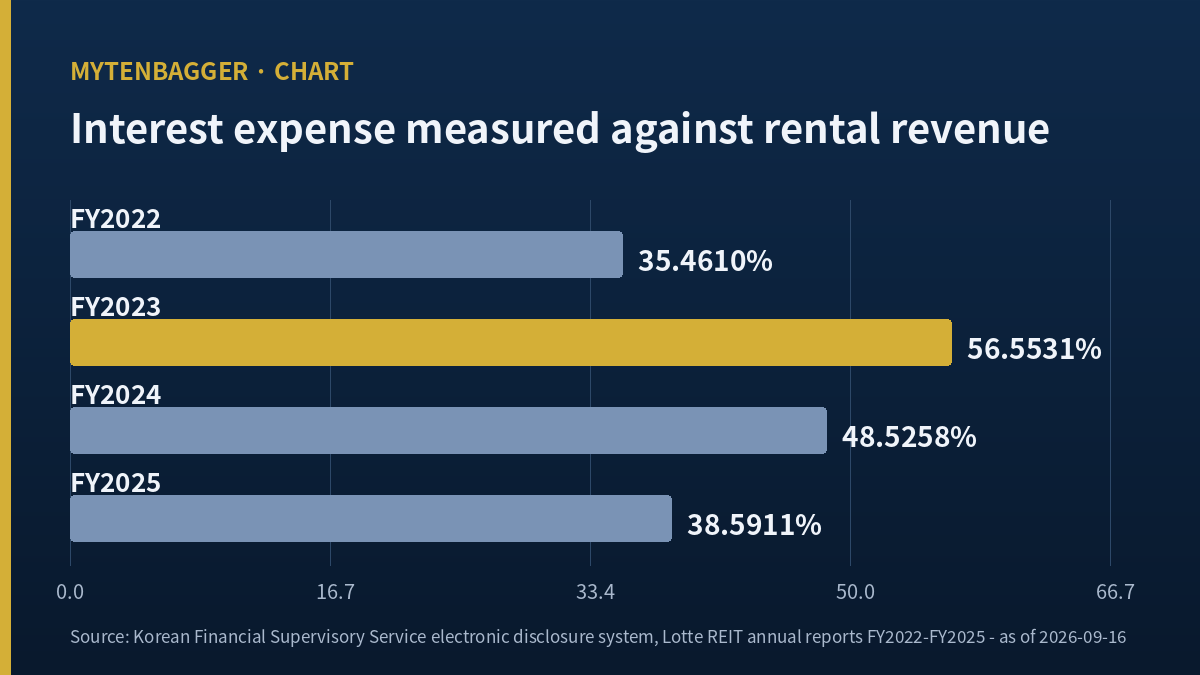
The borrowing shows up as interest expense measured against rental revenue. In fiscal 2022 interest took 35.4610 percent of revenue. In fiscal 2023 it took 56.5531 percent. In fiscal 2024 it took 48.5258 percent, and in fiscal 2025 it came back down to 38.5911 percent. That is a swing of 21 percentage points across four years on a business whose revenue rose in every one of them.
| Fiscal year | Rental revenue | Interest expense | Interest as share of revenue |
|---|---|---|---|
| 2022 | 57.920 billion won | 20.539 billion won | 35.4610 percent |
| 2023 | 59.415 billion won | 33.601 billion won | 56.5531 percent |
| 2024 | 65.629 billion won | 31.847 billion won | 48.5258 percent |
| 2025 | 70.879 billion won | 27.353 billion won | 38.5911 percent |
The interest line rose 63.5961 percent in a single year between 2022 and 2023. That was the year Korean policy rates finished their climb, and it is also the year this company took on the most debt. Since then the line has fallen twice in a row, which matters for anyone reading the current yield as a forward estimate.
Lotte REIT Stock and a Dividend Record With Two Cuts In It
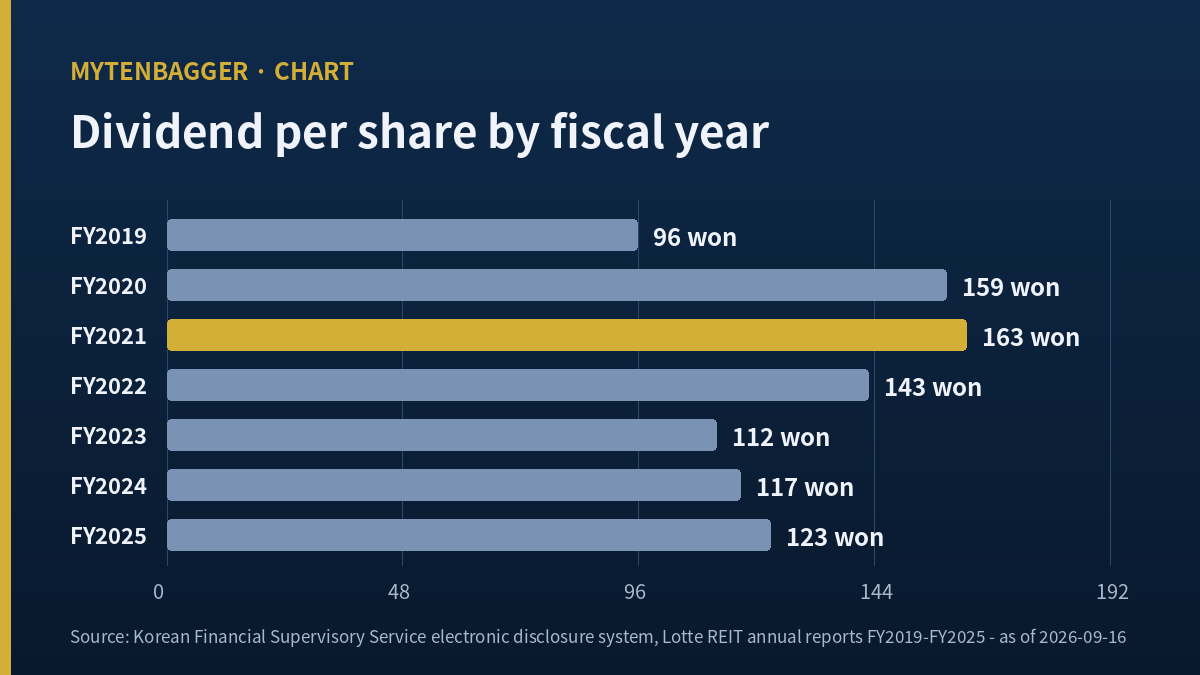
The dividend history is not a straight line either. Per share, by fiscal year: 96 won in 2019, 159 won in 2020, 163 won in 2021, 143 won in 2022, 112 won in 2023, 117 won in 2024, and 123 won in 2025. There are two consecutive cuts in the middle of that sequence, in 2022 and 2023, and the recovery since has not carried the figure back to where it stood in 2021.
In total money the picture is slightly different. The company distributed 39.691 billion won for fiscal 2021 and 35.543 billion won for fiscal 2025, which is 10.4507 percent less in absolute terms while the per share figure fell 24.5399 percent. The difference between those two decline rates is the share count, and that brings me to the second trace.
Where the Share Count Stepped Up Twice
Running the same division across the full dividend record shows a staircase. Fiscal 2019 implies 172,791,667 shares. Fiscal 2020 implies 244,075,472. Fiscal 2021 implies 243,503,068 and fiscal 2022 implies 243,195,804, effectively flat. Then fiscal 2023 jumps to 288,973,214, an increase of 18.8233 percent in one year, and it has not moved since.
Two things follow. First, the share count and the debt both stepped up in the same window, which is why the 2023 numbers look the way they do from every direction. Second, there has been no share count event in the last three years, so nothing in the recent record distorts a per share comparison. I checked for one specifically because a rights issue or a consolidation would reset the price, the market value, and every multiple at once.
Four Earlier Notes I Reopened for Lotte REIT Stock
This is not the first time I have taken a Korean landlord apart this way. In my note on SK REIT and the group that pays its rent I looked at how a single corporate family standing behind the lease schedule changes what a yield means. The tenant concentration question is the same here, and the answer comes out the same way.
Interest eating into operating profit is not unique to property vehicles. My note on Lotte Chilsung, where interest took half of operating profit counted a year in which total debt fell and the interest line did not follow. And because the tenant here is a listed retailer, I reread what I had written about Lotte Shopping paying out more than it earned, since a landlord’s safety margin is really the tenant’s income statement.
The closest structural parallel is outside property altogether. In my note on Hanil Cement holding a per share payment steady through a halved profit the company kept its per share figure flat while earnings collapsed underneath it. That is the pattern I now check for by reflex, and it is why I take interest out before I read any yield.
Lotte REIT Stock Has Five Buy Notes From 2026 On It
Coverage exists and it is recent. Counting only 2026, NH Investment and Securities published on 13 July and again on 26 February under analyst Lee Eun-sang. Samsung Securities published on 1 April under Lee Kyung-ja and Hong Joo-mi. Daishin Securities published on 13 March under Lee Hye-jin. Shinyoung Securities published on 5 January under Park Se-ra and Kwon Hyuk. All five carry a buy rating, and the titles repeat two themes, hotel acquisition and dividend growth.
The Korean consensus screen, dated 24 July 2026, records a buy rating, a valuation of 5,000 won a share, and an estimated 129 won of earnings per share. It also records the price that day as 3,575 won. Measured against the 3,955 won close I anchored on the distance to that valuation is 26.4223 percent. The number of contributing houses is not shown on that screen, so I have not reported one.
I do not think these notes and my arithmetic contradict each other. The analysts are pricing rent that properties not yet fully contributing will produce. I counted four years that have already closed. Those are different tenses on the same company and both can hold.
The Same Arithmetic, Run on Realty Income
To find out whether the mismatch belongs to this company or to the vehicle, I needed a second landlord with the same two figures published on one screen. I chose Realty Income, listed in New York, on one criterion only: its operating margin and its interest coverage ratio sit on the same page, which lets me rebuild operating profit and interest expense and run the identical calculation. Business mix and size did not enter the choice.
| Measure | Realty Income | Lotte REIT |
|---|---|---|
| Reference date | 2026-09-16 | 2026-09-16 |
| Operating profit less interest, against revenue | 26.4313 percent | 26.6666 percent |
| Dividend against that remainder | 1.9161 times | 1.8805 times |
| Dividend against operating cash flow | 0.7372 times | 0.5552 times |
| Dividend yield on the anchor close | 5.6868 percent | 6.6245 percent |
Where the two land together and where they separate
The first row agrees to a quarter of a percentage point. The second row agrees closely too. What that means is plain enough: a landlord whose dividend exceeds operating profit minus interest is behaving normally, not badly. The separation is in the third row, where 0.7372 and 0.5552 are genuinely far apart, and on that measure the Korean company has more room, not less.
Four Realty Income screen figures rebuilt cleanly from their own components. A price of 57.15 dollars times 945.90 million shares gives 54.058 billion dollars against a displayed 54.06 billion. A 3.25 dollar annual distribution over that price gives 5.6868 percent against a displayed 5.69. Net margin of 1.27 billion over 6.07 billion of revenue gives 20.9226 percent against 20.90, and return on equity against book value of 41.80 dollars a share gives 3.2120 percent against 3.22.
Two figures did not rebuild. Price over earnings of 1.37 dollars a share gives 41.7153 while the screen shows 42.90, and price over book value gives 1.36722 while the screen shows 1.40. I have left both out of the table above and out of the argument. There is also a distribution ratio measured against net income on that same page, which I decided not to use, because measuring distributions against net income is an angle I covered on another Korean landlord recently and repeating it would produce the same article twice.
One figure on that page I deliberately did not carry across. Realty Income reports a debt to equity ratio of 0.75, and Korean filings report a liabilities to equity ratio that runs above one for this company. Those two look like the same measure and are not. The American figure counts interest bearing borrowings only, while the Korean figure counts every liability on the balance sheet, including deposits held against leases and deferred items that carry no coupon. Placing 0.75 next to a Korean figure would invite a comparison that the two definitions do not support, so I left the row out of the table instead of footnoting it.
The beta on that page is 0.71 against the American market, which is the number most often cited to argue that landlords are defensive holdings. I have no equivalent figure for the Korean company computed on the same index and the same window, so I am not going to assert that the two behave alike. What I can say is narrower and I think more useful: on the one measure where both companies publish the components, the remainder after interest, they are within a quarter of a percentage point of each other, and that similarity survives despite one of them carrying substantially more total liabilities than the other.

Lotte REIT Stock in Dollars, and the Table I Could Not Date
For readers converting, I used one rate throughout: 1,368.6 KRW per USD, the Seoul foreign exchange market close on 2026-09-16, up 9.2 won on the previous session. At that rate the market value is about 835 million US dollars, fiscal 2025 rental revenue is about 51.8 million dollars, and the fiscal 2025 dividend is about 26.0 million dollars. Every dollar figure in this article comes from that single rate, and I have not mixed it with any conversion done by a source.
There is one more balance sheet I could not place in time. The most recent periodic filing shows total assets of 2,883.2 billion won, equity of 1,114.5 billion won, and liabilities of 1,768.6 billion won. Against the fiscal 2025 year end, assets rose 288.8 billion won, equity fell 25.0 billion won, and liabilities rose 313.7 billion won. Liabilities grew by more than assets did.
Why those three numbers stay out of the judgment
The data source I read labels that row as an accounting period ending 30 June 2026, but the filing acknowledgement number attached to the same row is dated 14 May 2026. A report cannot be submitted 47 days before the period it covers has ended. The four annual rows carry no such problem, since each was filed months after its period closed. Only this one row contradicts itself.
So I wrote the three figures down and then kept them out of the conclusion. Whether liabilities grew 313.7 billion won over six months or over three changes how alarming that growth is, and I could not establish which. A blank I can defend is worth more to me than a plausible number I cannot.
My Position on Lotte REIT Stock and Five Objections
I own none of it and I have no order working. A market value of 1.1429 trillion won puts this outside the size band where I take positions, so it sits on a watch list. I would close the watch on either of two outcomes. If operating profit minus interest covers the declared dividend in a full year, I rebuild my premise. If the dividend rises above 0.8 times operating cash flow in a full year, I move it from watching to avoiding.
Before the objections, one thing about the watch conditions is worth stating plainly, because it is the part I expect to be wrong about. Both of my conditions are measured on full year figures, and full year figures for this company arrive in March. That means I have set myself a checkpoint that cannot fire for roughly six months, and a lot can happen to an interest line in six months. I accepted that deliberately. Half year figures on this company have given me a period label I could not verify once already, and Waiting for a filing I can date beats reacting to one I cannot.
Sorted by whether I can check them, not by how likely they are
- Taking interest out of operating profit is the wrong yardstick for a property vehicle. Checkable, and I checked. Realty Income produces 26.4313 percent where this company produces 26.6666, which supports the objection substantially.
- Buildings really do wear out by roughly the depreciation charge, so the cash flow reading overstates capacity. Not checkable with what I have. I could not obtain remaining useful lives by asset or a schedule of actual capital spending on the existing portfolio.
- Properties still being absorbed will lift rental income and change the arithmetic. Checkable. Five brokerage notes argue that direction and the 5,000 won consensus valuation rests on it.
- Tenant concentration in one corporate group means both tables fail together if rent does. Partly checkable. The listed tenant publishes results I can read, but individual lease terms and remaining lease durations I could not obtain.
- Falling rates shrink interest expense and repair the left hand column on their own. Checkable, and the record already shows it. Interest fell from 33.601 billion won in 2023 to 27.353 billion won in 2025 without any action by me or by a forecaster.
The Two Lines I Will Open Next on Lotte REIT Stock
This article puts two statements against each other and picks one. I picked the cash flow statement. A property vehicle holds buildings, and the annual write down of a building’s carrying value is not money leaving a bank account, so whether a distribution can be funded is settled by cash and not by accrual profit.
Here is what breaks first if that choice is wrong. It is not the dividend. It is equity. If buildings wear out at roughly the depreciation charge and the company does not replace that value, it can keep paying at the current rate while the equity line thins every year. The most recent balance sheet shows equity 25.0 billion won lower than at the last year end, and I read that as the first sign in that direction, although I could not date the table and therefore did not size the signal.
That fixes what I open next. Operating cash flow, one line, and total equity, one line. If the first keeps covering the declared dividend while the second keeps thinning, then my choice of statement was not wrong so much as incomplete, because the two statements were measuring different things all along. The statutory filing deadline for the next periodic report is 15 November 2026.
Sources
- Korean Financial Supervisory Service electronic disclosure system, annual reports with acknowledgement numbers 20230302000408 for fiscal 2022, 20240306000530 for fiscal 2023, 20250312000767 for fiscal 2024, and 20260310002810 for fiscal 2025. Rental revenue, operating profit, interest expense, operating cash flow, dividend per share, and total cash dividend all come from these four filings, which are published in Korean.
- IRGO investor relations page for Lotte REIT, read 2026-09-17, for the list of Korean brokerage reports with analyst names and publication dates, and for the recent disclosure list.
- Hankyung consensus page, dated 24 July 2026, for the buy rating, the 5,000 won valuation, and the 129 won earnings estimate. This is a Korean language screen.
- Stock Events dividend record for Lotte REIT, read 2026-09-17, for per payment amounts by ex-dividend date and the trailing twelve month total of 262 won.
- Realty Income statistics page, as displayed on 2026-09-16, for share price, share count, operating margin, interest coverage, operating cash flow, and distribution per share.
- Money Today report on the Seoul foreign exchange close and Seoul Finance report on the same session, both Korean press, for the 1,368.6 KRW per USD close on 2026-09-16.
- Every calculation in this article is anchored to the 3,955 won close of Wednesday, 2026-09-16. Market value and all ratios were recomputed from that price, and rounding may leave a final digit one unit away from a displayed figure.