KT Nasmedia Earnings Tripled on Sales That Rose Only 23%
KT Nasmedia earnings for April through June came in at KRW 7.82 billion of operating profit, up 200.8 percent from a year earlier, while sales rose just 22.8 percent to KRW 32.26 billion. That is the whole puzzle in one line: roughly three times the profit on less than a quarter more revenue. By my arithmetic, about 87 won of every extra won the company took in during the three months to June ended up as operating profit. I do not own the stock, and after going through the numbers I am watching it until the July-September report arrives in mid-November.
KT Nasmedia is a KOSDAQ-listed Korean digital ad sales house, controlled by the telecom group KT, its largest shareholder.
Its April-June sales rose 22.8 percent.
Its operating profit rose 200.8 percent.
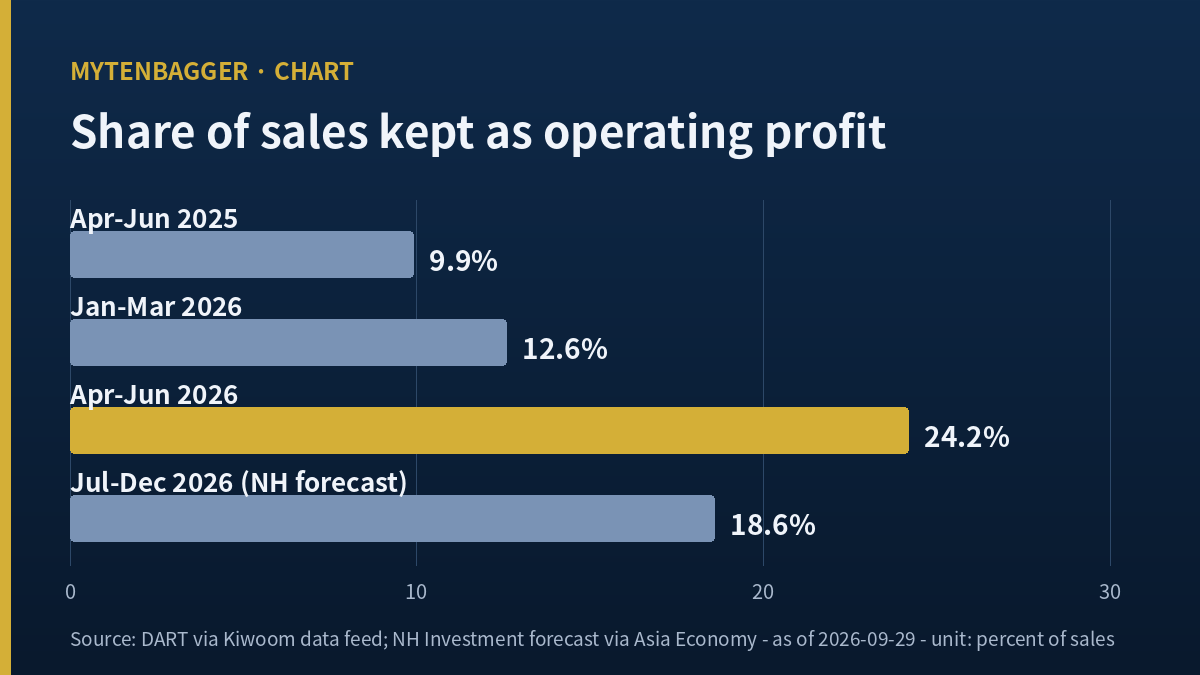
It kept 24.2 percent of sales as operating profit, up from about 9.9 percent a year earlier.
That jump, and whether it lasts, is the only thing I am really tracking.
NH Investment & Securities expects July-December operating profit of about KRW 13.4 billion.
On NH’s own sales figure, that works out to an 18.6 percent share, below what the company just delivered.
DB Securities was cooler in June and blamed a soft Korean ad market.
A US peer, Magnite, kept about 16.2 percent of sales as operating profit over the same months.
I am watching and not buying, and the November report decides my next move.
Some context for readers who do not follow Korea. KOSDAQ is Korea’s growth-stock board, the smaller sibling of the main KOSPI index, and KT Nasmedia’s market value at the September 28, 2026 close was about KRW 141.4 billion, or roughly $103.6 million. That makes it a small company by any US standard. It sells advertising space on portals, streaming services, IPTV and subway screens for those media owners, and records the commission it earns as its revenue. Because the revenue line is already a fee, a small rise in the gross ad spending that flows through it can move profit a lot.

Contents
KT Nasmedia earnings: what the April-June quarter printed
The company’s own release, reported by ZDNet Korea on August 6, 2026, broke sales into two lines (ZDNet Korea, August 6). Digital advertising brought in KRW 13.4 billion, up 21.2 percent, and the platform business brought in KRW 18.8 billion, up 24.1 percent. Ad volume placed on streaming services more than doubled, and ad sales on five Seoul subway lines grew by more than 20 percent. DigitalToday carried the net profit line: KRW 6.82 billion, against a loss a year earlier (DigitalToday). Its article shows the amounts one decimal place off in Korean units, so I took the figures from the company’s DART report via a Kiwoom-based data feed, where they match ZDNet’s.
| Period (company, standalone) | Sales, KRW bn | Operating profit, KRW bn | Share kept |
|---|---|---|---|
| April-June 2025 (backed out) | 26.27 | 2.60 | 9.9% |
| January-March 2026 | 26.45 | 3.32 | 12.6% |
| April-June 2026 | 32.26 | 7.82 | 24.2% |
| January-June 2026 | 58.71 | 11.14 | 19.0% |
| Full year 2025 | 117.89 | 12.32 | 10.4% |
Sources: KT Nasmedia quarterly and annual reports (DART) via Kiwoom data; the 2025 April-June row is my own back-calculation from the company’s stated growth of 22.8% in sales and 200.8% in operating profit. Figures in KRW billions, rounded.
I backed out the year-earlier row from the growth rates the company announced. I did that on purpose. The data feed shows a 2025 April-June operating profit that mixes two reporting approaches, because the company sold its agency subsidiary PlayD in April 2025 and stopped reporting as a group partway through that year. Using the company’s own percentages keeps both rows on the same basis.
Why 87 won of each extra won turned into profit
Sales went from about KRW 26.27 billion to KRW 32.26 billion, an increase of KRW 5.99 billion. Operating profit went from about KRW 2.60 billion to KRW 7.82 billion, an increase of KRW 5.22 billion. Divide the second increase by the first and you get 87 percent. Almost all of the new revenue fell straight through.
That is what a fee business with mostly fixed staff costs should do when volume comes back. The people who sell and run the campaigns were already on the payroll a year ago. When streaming and subway advertising added volume, the commission on that volume arrived without a matching rise in cost. I find the pattern convincing as a description of April through June. What I cannot tell from the release alone is how much of the jump came from one-off campaigns that will not repeat.
The January-March figure is worth a look too, because it shows the jump did not come out of nowhere. In January-March the company kept 12.6 percent of sales as operating profit, already above the 10.4 percent of full-year 2025, on sales of KRW 26.45 billion that were barely higher than the year-earlier April-June level. The first three months of the year are usually the lightest for Korean advertising, so a 12.6 percent share there was an early sign that the cost base had been trimmed after the PlayD sale. April-June then added volume on top of that lighter cost base. Put together, January-June kept 19.0 percent of sales, roughly double the share in the same six months of 2025 by my arithmetic from NH’s growth figures.
I remember reading the April-June release on a Friday evening and being sure I had misread a digit. I checked the operating profit twice against the sales line before I believed it. That reaction is part of why I spent more time on the year-earlier comparison than I normally would.
Inside Korea, the same ad market looks very different through the largest agency. When I wrote about Cheil Worldwide, most of its sector index turned out to be Cheil itself, so I threw out the sector comparison. KT Nasmedia is small enough that no such distortion applies, and its parent, KT, reports this unit’s revenue inside a far larger telecom business.
The longer record, with a caveat attached
I wanted to know whether 24.2 percent was unusual for this company or a return to an old normal. The annual reports give a partial answer. In 2022 the group, which then still owned PlayD, kept 21.7 percent of sales as operating profit: KRW 33.05 billion on KRW 152.39 billion. In 2023 and 2024 that share was 14.0 percent both years, on sales of KRW 146.77 billion and KRW 142.55 billion. In 2025, the first year without PlayD for most of the year, it was 10.4 percent.
The caveat matters. Those earlier years include a subsidiary the company no longer owns, and PlayD ran a different kind of agency business, so the old ratios are not a clean comparison for the unit that remains. Still, the direction is clear. The share of sales the business keeps did not rise in any year from 2022 through 2025, and April-June 2026 is the first quarter in the 2023-2026 reports where it went above the 2022 full-year level.
That reverses how I first framed the story. I began by asking whether 24.2 percent could last. The record suggests a harder question: was 2025’s 10.4 percent the unusual year, dragged down by a sale that removed a profitable subsidiary and left fixed costs behind, or is the new standalone business simply smaller and less efficient than the old group? The July-December figures are the first real test of that, because they will be the first full comparison against a standalone year-earlier period.
KT Nasmedia earnings and NH’s July-December forecast
NH Investment & Securities analyst Lee Hwa-jung raised the valuation on the stock from KRW 14,000 to KRW 16,000 on September 7, 2026, according to Asia Economy’s report of the note. The note’s July-December numbers were KRW 72.0 billion of revenue (the note calls it gross profit, since the company’s revenue already nets out media costs), up 6 percent, and KRW 13.4 billion of operating profit, up 84 percent. I paraphrase the reasoning here from the Korean press account: new media such as streaming and outdoor media, plus a commission-on-sales platform model, give results more stability, and the August share retirement helped shareholders.
Put the two July-December numbers side by side and the note has the company keeping 18.6 percent of sales as operating profit. That is a big step up from the roughly 10.7 percent it kept in July-December 2025, which I back out from the note’s own growth rates. It is also a step down from the 24.2 percent it just printed in April-June. In other words, the forecast already assumes the second quarter was partly a peak.
NH’s forecast sits between last year’s 10.7 percent and this spring’s 24.2 percent. My whole view comes down to which end December ends up closer to.
Two things make me take the forecast seriously. July-December is the heavier part of the year for Korean ad spending, so the company only needs to hold some of the April-June efficiency to hit it. And the platform line, the one that grew fastest, earns on a percentage of transactions, which scales with volume more than with staff numbers.
What last year’s July-December looked like
The reports let me split July-December 2025 into its two quarters. July-September 2025 brought KRW 31.18 billion of sales and KRW 3.75 billion of operating profit, a 12.0 percent share, and both of those figures come from standalone reports on both ends, so they are clean. October-December 2025, which I get by subtracting the nine-month total from the full year, brought KRW 36.94 billion of sales and KRW 3.53 billion of operating profit, a 9.6 percent share.
Two things stand out. First, October-December sales were 18.5 percent higher than July-September sales, which fits the usual Korean pattern of heavy year-end ad budgets. The group’s older figures show the same lift: in 2024 the July-December quarters brought KRW 74.56 billion against KRW 68.0 billion in January-June. Second, the extra year-end revenue did not produce a higher profit share in 2025. It produced a lower one. That is the opposite of what happened in April-June 2026, and it is the single fact that makes me cautious about NH’s 18.6 percent. If year-end volume in 2025 came with extra costs, such as agency incentives or promotional spending, the same could happen in 2026.
I do not know which costs rose in October-December 2025. The quarterly figures do not break them out, and I did not find a Korean press report that explained it. I note the gap and move on.
KT Nasmedia earnings next to a US ad platform
For a US reader, the closest listed comparison I could check is Magnite (NASDAQ: MGNI), a sell-side advertising platform that, like KT Nasmedia, sits between advertisers and media owners. I chose it for one reason: it reports the same April-June period, so the two numbers describe the same ad market months. I am comparing one ratio only, operating profit divided by revenue, and I am not comparing valuations or growth prospects.
Magnite’s April-June 2026 revenue was $192.82 million and operating income was $31.22 million, a 16.19 percent share, up from 12.67 percent a year earlier (Magnite quarterly financials). That is an improvement of 3.52 percentage points. KT Nasmedia’s improvement over the same months was about 14.3 points, from 9.9 to 24.2 percent.
The comparison tells me the April-June jump was large even against a peer that also had a good quarter. It does not tell me the Korean number is sustainable. A company that gains 14 points in a year usually gives some back, and Magnite’s steadier path is closer to what I would expect from a mature fee business over time.
Why a Korean ad seller touches names US readers know
The part of this business that grew fastest is ad sales for streaming services. According to NH’s note as reported by Asia Economy, KT Nasmedia sells advertising for the three largest streaming services in Korea: Netflix, the local service Coupang Play, and Tving. That means a slice of Netflix’s ad-supported tier in Korea reaches advertisers through this small KOSDAQ company.
I find that useful for two reasons. It explains the April-June jump better than any general statement about a recovering ad market, because streaming ad inventory in Korea is still new and growing from a low level. And it names the concentration risk precisely. If one of those services decides to build its own Korean ad sales team, the effect on this company would be immediate and large, and nothing in the quarterly report would warn me beforehand.
Three paths for July-December
I put rough odds on three paths for July-December operating profit, all on NH’s KRW 72.0 billion revenue figure. The odds are my own judgment and nothing more.
- Central case, about 50 percent. The company keeps roughly NH’s 18.6 percent, about KRW 13.4 billion. Full-year operating profit would come in near KRW 24.5 billion, almost double 2025’s KRW 12.3 billion.
- The spring efficiency holds, about 20 percent. If the company keeps 24.2 percent, July-December operating profit is about KRW 17.5 billion and the full year about KRW 28.6 billion.
- It falls back to last year, about 30 percent. If the share drops to 2025’s July-December level of about 10.7 percent, the six months bring in only about KRW 7.7 billion and the full year reaches about KRW 18.8 billion.
To put the three paths against the share price, I divide the September 28 market value of KRW 141.4 billion by each full-year operating profit figure. The central case gives about 5.8 times, the case where the April-June efficiency holds gives about 4.9 times, and the fall-back case gives about 7.5 times. These are pre-tax figures and they ignore everything on the balance sheet, so they are a sense of scale only. What they show is that the market is not paying a high multiple for any of the three outcomes, which is one reason I do not dismiss the stock even while I stay on the sidelines.
Even the weakest path is a bigger full year than 2025. What changes is how strong the rebound looks, and the market value already moved: the shares were already up sharply between the June 30 close and September 28.
The case against my reading
I list five points that could make my reading wrong, roughly from most to least serious.
- The ad market may be weaker than one good quarter suggests. DB Securities analyst Shin Eun-jung set KRW 14,000 on June 30, 2026, down 26.3 percent from the firm’s previous KRW 19,000, and lowered the multiple applied to 9.4 times profit, on a soft Korean ad market (Newspim on the DB note). The DB note had expected April-June operating profit of KRW 5.4 billion. The company beat that by 45 percent, and it beat the note’s KRW 30.2 billion sales forecast by about 7 percent. I read that as good news with a caveat: one beat against a cautious forecast is not a trend.
- Streaming ad volume is concentrated. The company sells ads for the three largest Korean streaming services, according to NH’s note. If one of them takes sales in-house or switches agency, the fastest-growing piece of revenue shrinks at once.
- A possible change of owner could reset the business. DigitalPost reported on September 15, 2026 that KT’s current chief executive has put the unit on his list for rebalancing, and named possible buyers (DigitalPost, September 15). That is one report, with no filing from KT or the company. A new owner could change cost structure in either direction.
- The year-earlier starting point was low. A 200.8 percent rise is partly a comment about April-June 2025, which was a weak quarter. Against 2024’s April-June the picture is less dramatic, though the two years are not on the same reporting basis, so I do not put a number on that.
- The share retirement was small. The company retired a little over one percent of its shares on August 13, 2026, according to the company (share retirement notice). It helps per-share numbers a little. It does not change the profit question.
What would change my view on KT Nasmedia earnings
I do not own the stock and I am not adding it now. With a market value near $104 million, it sits outside the size of company where I record a buy in this journal. These are the four things I will check.
- The July-September report, due by November 16, 2026. A year ago the same three months kept 12.0 percent of sales as operating profit. If the new figure comes in under 15 percent, NH’s full-year path is in trouble; above 20 percent, the April-June result starts to look like a new level.
- If July-September sales grow less than 10 percent from last year’s KRW 31.18 billion, which means anything below about KRW 34.3 billion, the operating leverage story loses its fuel.
- Any filing from KT or the company about the stake. A deal would put a price on the business from outside and I would compare it with this note.
- Any sign that one of the three streaming clients has moved its ad sales elsewhere, in company releases or Korean trade press.
Where I went wrong the first time
A 200.8 percent jump in operating profit was the first thing I saw, and my first instinct was to dismiss it as a comparison effect and move on. I have been burned before by headline growth numbers sitting on a collapsed year-earlier figure. When I backed out the actual year-earlier amounts, the comparison effect was real, but the new level was also real: 24.2 percent is high for this company in any year I looked at. I was about to throw away the most useful number in the release because I assumed it was a trick of the comparison. I kept it, and I kept the caveat with it.
One smaller detail stuck with me. The shares closed sharply higher on August 7, the day after the results came out. The market reacted to the same number I almost ignored.
For now I will leave the stock on my watch list, next to a note that says one number: 18.6 percent. If December looks closer to that than to 10.7, I will look again with a fresh set of figures.
Share prices and market value reflect the September 28, 2026 close of KRW 12,400, matched across ValueLine, Chickstock and Kiwoom data. USD figures are approximate, at roughly ₩1,365 per dollar on the same date. Market value uses the 11,406,560 shares left after the August 13 retirement.
Related reading