Peptron Faces Its Lilly Deadline With KRW 51.8bn in Cash
The Peptron Lilly deadline falls on October 7, 2026 (Wednesday), the last day allowed under the platform evaluation agreement Peptron signed with Eli Lilly two years earlier. What caught my eye while preparing this entry was not the date itself. It was a line in the terms of an exchangeable bond Peptron sold in 2025: holders can swap it for treasury shares at KRW 326,895 each. The stock closed at KRW 140,800 on October 1. That bond was priced for a very different company outlook, and it sits next to a cash pile that is smaller than the factory the company has committed to build.
Peptron is listed on KOSDAQ, the Korean growth-company market that plays a role close to the Nasdaq for local biotech names. It develops long-acting injectable formulations through a microsphere platform called SmartDepot, and its one marketed product is a one-month sustained-release injection for prostate cancer and central precocious puberty. Everything the market pays for sits elsewhere: the hope that a large drug maker adopts SmartDepot for its peptide drugs.
I started this entry by reading the bond terms on BioSpectator and ended up rebuilding the company’s cash position by hand. Here is what I found, and why it keeps me watching for now.
Contents
What the Peptron Lilly deadline actually covers
The agreement dates to October 7, 2024. It gives Lilly a non-exclusive license to test SmartDepot on Lilly’s own peptide compounds. In early December 2025 Peptron said the two companies had agreed to run more in vivo work on a specific peptide formulation, and that the evaluation would run to a maximum of 24 months, meaning October 7, 2026 at the latest. Korean pharma press covered the extension and the plant plan in the same week (HIT News, December 2, 2025).
The word that matters is “maximum.” October 7 is the outer limit of the contract, and nothing in the public record says a decision must be announced that day. The evaluation could end earlier, end without comment, or roll into a different agreement. No upfront payment for the evaluation has ever been disclosed. So the date tells me when the clock runs out. It does not tell me whether any money follows.
There was a sharp scare in July. At a biotech forum in Daejeon on July 9, CEO Choi Ho-il said the Lilly work involved a different peptide formulation and did not include tirzepatide, the molecule inside Mounjaro and Zepbound. The shares hit the daily limit down in after-hours trading that evening, as Korean press reported. Peptron later explained that an earlier 2023 material transfer agreement had covered tirzepatide and had concluded, while the 2024 agreement covers several follow-on compounds. The edaily English desk tied a later two-day slide in early September to the approaching date, while noting that no negative disclosure had been issued (edaily, September 3, 2026).
The price path shows how much of the hope has already drained out. On the LUXRIX terminal, the adjusted 250-day high is KRW 392,500, so the October 1 close sits at about 36% of that peak. The same screen puts the one-month change at minus 23.2% and the six-month change at minus 53.6%. The edaily piece from early September also noted that short-selling volume had jumped 46.2% during that slide. Without a disclosed number to anchor it, the stock swings on each headline.
One more piece of local context. Korean listed companies disclose material contracts through DART, the Financial Supervisory Service’s electronic disclosure system, and the exchange’s KIND service. A license deal of meaningful size would normally appear there first, with the contract amount stated where the company is allowed to state it. That is where I will look on and after October 7, ahead of any press interpretation.
Update, October 8, 2026: Peptron said on its website on October 7 that the SmartDepot technology evaluation with Eli Lilly had ended without a follow-on commercial agreement. The company said the end of the evaluation does not mean the end of possible commercial cooperation, but did not say how or when (Hankyung, October 7, Korean-language report, paraphrased). In Nextrade after-hours trading the shares were quoted at KRW 91,500 at 5:25 p.m., 29.94% below the regular-session close (The Bio News, October 7). With the license path closed for now, what I keep watching is the cash line and the Osong plant spend.
A disclosure that had to be corrected
The way this date reached the market matters as much as the date. When Peptron announced the extension in December 2025, it framed the change as the evaluation running longer than the roughly 14 months it had first expected. The Korea Exchange then pointed out that the underlying contract had allowed up to 24 months from the start, and that the earlier 14-month figure had come from a supplementary document. Korean coverage described it as a disclosure reversal. The stock fell from KRW 340,000 to KRW 291,500 within two days on that episode, according to Sisa Journal-e (Sisa Journal-e).
Peptron’s position is that the contract itself never changed. I accept that. My concern is narrower. For a company whose market value rests on one partner’s decision, the wording of each disclosure is the main information investors get, and here the first version left out the longer limit. That makes me read the next disclosure, the one around October 7, very literally: I will look for amounts, dates and parties, and give little weight to adjectives.
Ownership adds one more layer. Korean wire headlines from March 31, 2026 put CEO Choi Ho-il’s holding at 8.24% after an addition of 20,000 shares. An 8% founder stake is not unusual for a Korean biotech that has raised equity several times, and it means outside shareholders carry most of the funding risk if the plant needs another raise.
Cash on hand at the Peptron Lilly deadline
I pulled the standalone figures from the June 30, 2026 interim report as tabulated by Valueline, a Korean financial data site. The table shows how the money raised in late 2024 has moved.
| KRW bn (standalone) | Dec 31, 2024 | Dec 31, 2025 | Jun 30, 2026 |
|---|---|---|---|
| Cash and equivalents | 1.04 | 4.37 | 12.31 |
| Short-term financial instruments | 108.90 | 75.20 | 39.49 |
| Cash plus short-term instruments | 109.94 | 79.57 | 51.80 |
| Property, plant and equipment | 26.92 | 27.56 | 33.59 |
| Total liabilities | 17.18 | 36.97 | 38.50 |
| Total equity | 151.70 | 142.00 | 129.47 |
Source: Valueline standalone balance sheet built on DART reports | Third row is my sum of the first two
Cash plus short-term instruments fell from KRW 109.94bn at the end of 2024 to KRW 51.80bn at the end of June 2026. In the six months to June alone the pile shrank by KRW 27.77bn. The company’s January-June operating cash outflow was KRW 8.04bn and capital spending was KRW 7.36bn, according to figures drawn from DART on the LUXRIX terminal. Those two add up to KRW 15.40bn. That leaves about KRW 12.37bn of the decline that I could not tie to a line in the data I had, and I am not going to guess. It may be a reclassification into longer-dated deposits, or prepayments on the plant. I will look for it in the third-quarter report.
Two raises paid for most of this
The cash came from two places. A shareholder rights offering that closed in November 2024 raised KRW 138.3bn, of which KRW 65.0bn was earmarked for the new plant. Then in August 2025 Peptron sold a privately placed exchangeable bond of about KRW 24.1bn, backed by 73,961 treasury shares at an exchange price of KRW 326,895, with exchange open until July 5, 2030 (BioSpectator, July 28, 2025). The rise in total liabilities between the two year-ends fits that bond, though I have not seen the bond line itself in the balance sheet.
The company has done this before. A rights offering in late 2020 was set at about KRW 75.0bn through 5,303,530 new shares at a planned price of KRW 14,150, according to edaily at the time (edaily, October 15, 2020). The November 2024 raise followed four years later at a much higher price. Each time, new money arrived after the share price had climbed on partnership hopes. If the next raise comes after a disappointing October, the arithmetic runs the other way: the same won amount would require far more new shares.
At KRW 140,800, the stock trades at 43% of the exchange price. Holders have no reason to swap at this level, so the bond behaves like debt. I could not confirm whether it carries an early redemption right for holders, and that detail matters: if one exists and comes due before a license fee arrives, it competes with the plant for the same cash.
For a sense of what Korean platform licensors actually collect once a big deal is signed, I worked through the numbers on Alteogen, whose disclosed royalty rate reset its valuation in a single day. Peptron has not reached that stage. There is no disclosed fee, no royalty rate, and no milestone plan to model.
Another Korean drugmaker shows the opposite route into obesity drugs. Chong Kun Dang sells Novo Nordisk’s Wegovy in Korea under a co-promotion deal, and I found that it carries slim product economics because the originator keeps the molecule. Peptron is trying to sit on the other end of that trade, as the owner of a delivery technology, and the deadline decides whether it gets a seat at all.
A plant priced against the Peptron Lilly deadline
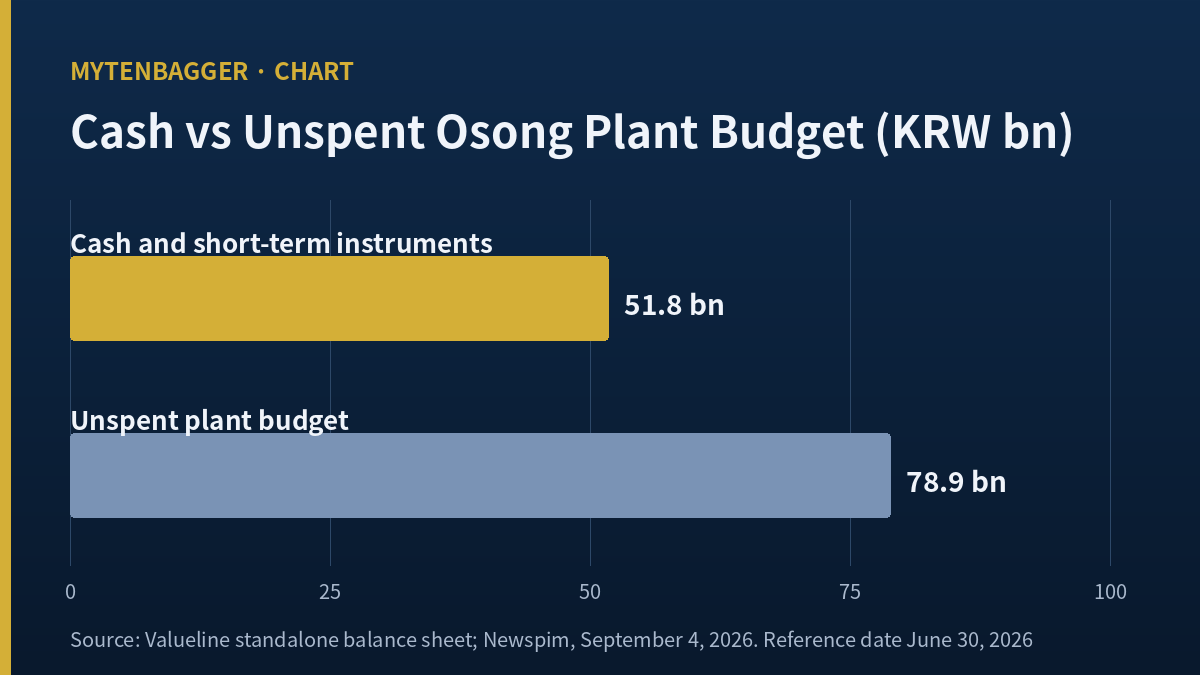
The second Osong plant is the largest commitment on this balance sheet. The budget rose from KRW 65.0bn to KRW 89.0bn, and in early September the company set the investment end date at February 15, 2028 while saying the start of commercial production is still undecided. Spending through June was about KRW 10.0bn, leaving about KRW 78.9bn still to invest, according to Newspim’s reading of the filing (Newspim, September 4, 2026). The same report put the company’s own tally of unspent raised funds at about KRW 79.1bn, which roughly matches the investment still ahead. That tally is a use-of-proceeds figure. It is larger than the KRW 51.80bn of cash and short-term instruments on the June balance sheet, and I could not reconcile the two with the data I had; part of the money may sit in longer-dated deposits that my table does not show. EBN reported that this was the second time the completion date moved, from June 30, 2027 to February 15, 2028 (EBN).
Put the two figures side by side. Investment still ahead of about KRW 78.9bn against KRW 51.80bn of cash and short-term instruments leaves a gap of about KRW 27.1bn (my calculation), before a single won of operating outflow. At the January-June pace of operating cash burn, another KRW 16bn or so goes out each year (my estimate, doubling the six-month figure). The plant is designed for up to 10 million vials a year, ten times the older Osong site’s roughly one million, according to the 2024 rights offering announcement. A plant that size makes sense if a global partner fills it. It is a heavy fixed cost if no partner does.
Valuation with no license fee in it
Multiplying the October 1 close by about 23.3 million shares outstanding gives a market value near KRW 3.28tn, or about $2.42bn. Standalone equity at June 30 was KRW 129.47bn, so the market value is about 25.4 times standalone equity (my calculation). That multiple does not price the plant or the cash. It prices the chance that SmartDepot ends up inside a Lilly product.
I also checked how a European peer priced a comparable bet with the same partner. Camurus (Nasdaq Stockholm: CAMX), a Swedish company with its own long-acting platform called FluidCrystal, signed a collaboration and license agreement with Lilly on June 3, 2025. Camurus disclosed up to $290m in upfront, development and regulatory milestone payments plus $580m in milestones tied to sales and tiered mid-single-digit royalties, covering up to four Lilly compounds (Camurus press release). Peptron said at the time that the Camurus deal would not derail its own work because the two technologies use different mechanisms (Korea Biomedical Review).
I am using Camurus for a single purpose: the shape of a disclosed Lilly deal in this exact niche. I am not comparing valuation multiples or revenue, since the two companies are at very different stages. What the comparison shows is that Lilly has already paid, on the record, for a long-acting platform, and that the non-exclusive structure of Peptron’s evaluation leaves Lilly free to choose among several. To put a size on it, I ran one illustration of my own. Camurus’s first tier bundles the upfront fee with development and regulatory milestones, so its true upfront is smaller than $290m. If Peptron received even a tenth of that tier, about $29m, at the October 1 exchange rate that is roughly KRW 39.4bn, more than enough to close the KRW 27.1bn plant gap. That is an illustration and not a forecast; I have no information on what Lilly would pay.
Three paths after the Peptron Lilly deadline
These are my own probabilities, set for the funding question and not for the science.
A license with a disclosed upfront payment (35%). If Peptron announces an agreement with a cash fee, the gap between the cash and the unspent plant budget closes or narrows, and the plant gets a likely customer. The stock would reprice on terms I cannot model from what is public.
No deal yet, work continues under another form (45%). The evaluation ends or rolls into a new agreement without disclosed money. This is the case I lean toward, since the company has repeatedly described the Lilly work as ongoing research on several compounds. In this path I expect the company to need new funding for the plant within roughly a year, either equity or debt, and the size and price of that raise is what I track next.
The evaluation ends with no follow-up (20%). Peptron would still own SmartDepot, its marketed injection and its own once-monthly semaglutide candidate, PT403, which entered the Korean phase 1 application stage on August 25, 2026. But a plant built for a global partner would face the hardest questions, and the funding need would arrive at the worst possible share price. The PT403 plan, as filed, is small and early: a randomized, single-dose, placebo-controlled, double-blind study with an active comparator arm in healthy adults at Chungnam National University Hospital, run in three dose-escalation cohorts over about 12 months from approval (The Bio, August 25, 2026). It would give the company a second obesity asset, though years away from revenue.
Where my read of the Peptron Lilly deadline could be wrong
- Lilly extended the evaluation instead of walking away in December 2025. Extensions cost both sides time and lab work, and a reader could fairly take that as interest.
- The plant may attract other customers. Peptron has described contract manufacturing for long-acting drugs as part of the plan, which would lower the dependence on one partner.
- Equity of KRW 129.47bn and borrowings of only about KRW 7.0bn at June 30 mean the company has room to borrow against the plant if it chooses to, so a new share issue is not the only funding route.
- I have no named sell-side forecast for 2026 to test my view against. I searched Korean brokerage coverage and found none with figures, so the market’s expectations may be sounder than my cash arithmetic suggests.
What would change my mind, and what I missed at first
Four things would change my read, in the order I expect to learn them:
- A disclosure around October 7 that includes a fee, milestone or royalty figure for any Lilly agreement.
- The third-quarter report due November 16, 2026, showing where the missing KRW 12.37bn of cash went and whether cash plus short-term instruments stayed above KRW 45bn.
- Any announcement of new funding for the plant, with its size and pricing relative to the KRW 326,895 exchange price on the existing bond.
- Regulatory clearance for the PT403 phase 1 trial, which would give the company a second obesity asset that it controls.
Here is what I got wrong when I first looked at this name. I treated the bond as background and the deadline as the story. Reading the exchange price next to the cash table changed the order for me. A company that sold paper priced at more than twice the October 1 close, and then committed to a plant larger than its cash, has already made a bet on the outcome of the evaluation. The deadline only tells me whether that bet pays.
I am watching Peptron ahead of October 7. If a fee shows up in the disclosure and the third-quarter cash holds, I will write the next entry from a buy-side review. Until then I keep two numbers on my screen, KRW 51.8bn and KRW 78.9bn, and wait to see which one moves first.
Prices and multiples reflect the October 1, 2026 close of KRW 140,800 on the regular-session daily bar; other screens showed KRW 140,700 to 140,900, so the market value is approximate. Dollar figures are approximate, at about ₩1,358 per dollar, the Seoul foreign exchange market close on the same date (Newsis). Company figures are standalone, from DART filings.