Why Korea’s PSK Dividend Lags Its KRW 249bn Cash Pile
PSK’s payout is growing, yet it is the smallest of the three by a wide distance. I am watching it.
The PSK dividend is KRW 680 a share for 2025, and it used roughly 27% of the free cash the company generated in the first six months of 2026 alone. Meanwhile cash plus short-term deposits climbed to KRW 249.39bn by June 30, up KRW 55.57bn in six months. That gap between what PSK earns in cash and what it hands to shareholders is the subject of this journal entry.
I came to this one sideways. I had been tracking Korean chip equipment makers for the profit cycle, and when I opened PSK’s June 30 balance sheet the line that stopped me was the treasury stock line. It read zero. A company whose share price rose about 469% in twelve months, per the exchange price history I use, has no treasury shares at all and no buyback in the records I could find. That made me look at who owns it and what they are paid.
PSK Inc. (KOSDAQ: 319660) makes front-end semiconductor process equipment, with dry strip tools that remove photoresist from wafers as its main line. KOSDAQ is Korea’s growth-oriented market, the smaller sibling of the main KOSPI board. At the October 1, 2026 close of KRW 161,900, the company was worth about KRW 4.69tn, or roughly USD 3.45bn.
Contents
The PSK dividend in the numbers it actually paid
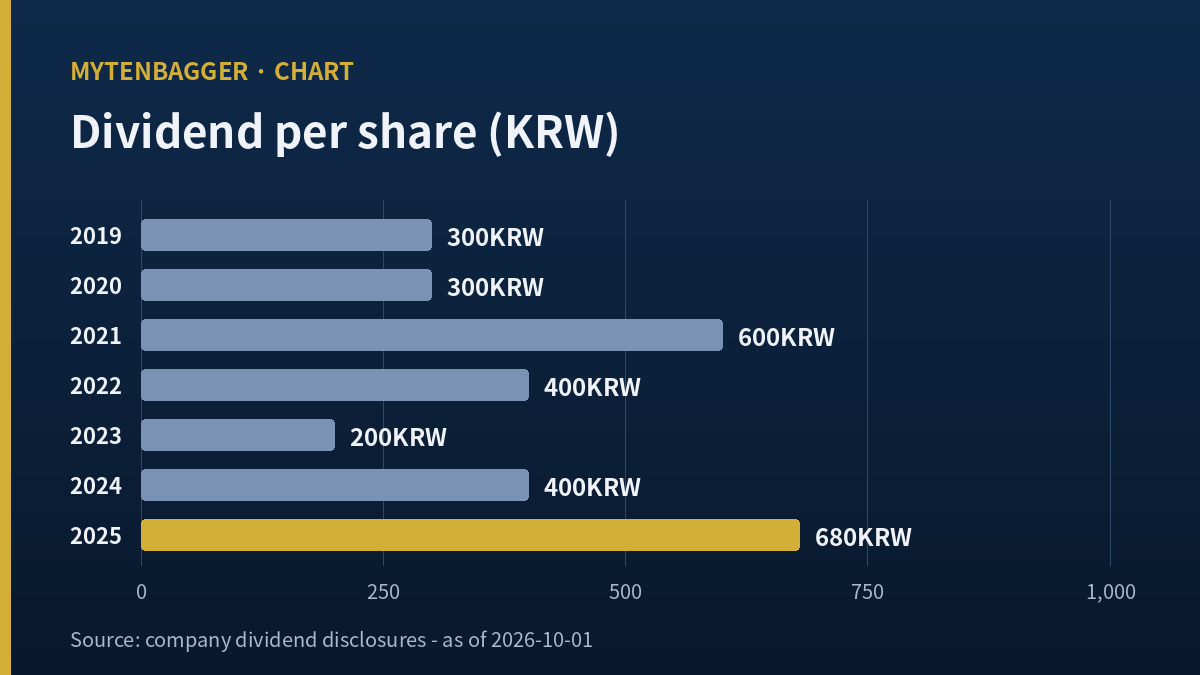
Start with the payout history, because it explains why I do not treat this as an income stock. Per-share dividends from the company’s annual reports, as compiled by the luxrix data service I use, ran KRW 300 for 2019, 300 for 2020, 600 for 2021, 400 for 2022, 200 for 2023, 400 for 2024 and 680 for 2025. The amount tracked the profit cycle up and down. It was cut by two thirds between 2021 and 2023 when demand for memory chips sagged.
Set the per-share amounts beside net income and a pattern appears that I did not expect. In 2023 net income fell 32.2%, from KRW 77.44bn to KRW 52.52bn, and the dividend was cut from KRW 400 to KRW 200. In 2024 net income rose 50.7% to KRW 79.13bn and the dividend doubled back to KRW 400. Those two years look like a fixed share of profit passed through. Then 2025 broke the pattern: net income slipped 0.7% to KRW 78.55bn, yet the dividend jumped 70% to KRW 680. Something other than that year’s profit drove the 2025 decision.
The timing is worth a sentence for readers used to US quarterly checks. Korean companies usually set the year-end dividend at a board meeting in February and pay it after the annual shareholders’ meeting in March. Korean press headlines show the PSK board set the KRW 680 on February 20, 2026, and the annual meeting approved it on March 30, the same day the value-up plan was published. A dividend raised against flat profit, decided weeks before a value-up plan, reads to me like a policy signal. I cannot prove that from the outside.
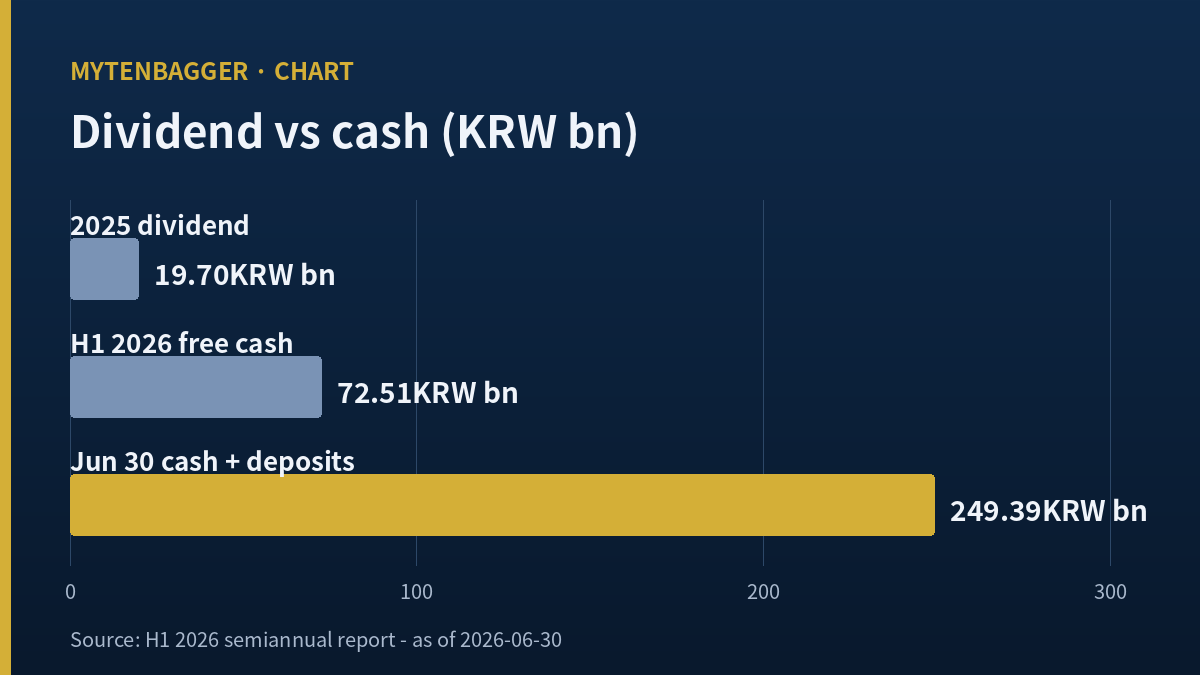
The 2025 payout totals KRW 19.70bn by my calculation, KRW 680 on the shares in issue. Against 2025 net income of KRW 78.55bn that is a payout of 25.1%, which matches the payout ratio the luxrix screen prints. At the October 1 close the yield is 0.42%. A US reader used to equipment makers that pay 1% or more and buy back stock on top will find that small.
There is one equation in the June 30 balance sheet that I like because it closes exactly. Retained earnings were KRW 342.75bn on December 31, 2025, according to the balance sheet table on ValueLine Korea. Add net income belonging to owners of the company for January to June, KRW 84.97bn, subtract the KRW 19.70bn dividend, and the result is KRW 408.02bn. The reported June 30 figure is KRW 408.02bn. No other distribution left the company in those six months.
| KRW bn | Dec 31, 2025 | Jun 30, 2026 | Change |
|---|---|---|---|
| Cash and equivalents | 119.42 | 146.29 | +26.87 |
| Short-term financial deposits | 74.40 | 103.10 | +28.70 |
| Long-term borrowings | 10.97 | 9.84 | -1.13 |
| Retained earnings | 342.75 | 408.02 | +65.27 |
| Treasury stock | 0.00 | 0.00 | none |
| Total equity | 539.03 | 615.02 | +75.99 |
Source: ValueLine Korea consolidated balance sheet (KRW 100m units converted to KRW bn); net income belonging to owners and the dividend total from the company’s six-month report via luxrix, with the dividend total by my calculation.
Where the PSK dividend sits next to six months of cash
The six-month report shows operating cash flow of KRW 81.29bn for January to June 2026 and spending on plant and equipment of KRW 8.78bn, leaving free cash of KRW 72.51bn. The KRW 19.70bn dividend went out in that same window, after shareholders approved it at the March 30 annual meeting. So the payout absorbed about 27.2% of six months of free cash.
What happened to the rest is visible in the table. Cash and short-term deposits together rose from KRW 193.82bn to KRW 249.39bn, an increase of KRW 55.57bn. Free cash minus the dividend is KRW 52.81bn. The remaining gap of about KRW 2.76bn I could not trace to a single line, and currency moves on overseas cash are one plausible source. I am not going to guess further than that.
The table also shows how little debt there is. Long-term borrowings of KRW 9.84bn sit against KRW 249.39bn of cash and deposits. Total liabilities of KRW 135.69bn are mostly the ordinary payables and accruals of a manufacturer. This is a company that could pay several times its current dividend for years without borrowing a won. It is the opposite case to Haesung DS, which kept paying dividends through three years of plant spending funded partly with new debt.
I want to be careful here. Receivables grew from KRW 94.79bn to KRW 113.85bn and inventory from KRW 104.21bn to KRW 129.26bn in the same six months, which is what a business growing this fast needs. Customers in chipmaking order tools months ahead, and an equipment maker has to carry parts and work in progress for them. Some of the cash pile is a cushion for that, and a sensible management would keep it.
I should also put the pile in proportion, because KRW 249.39bn sounds larger than it is next to the share price. Divided by the market value of about KRW 4.69tn at the October 1 close, cash and short-term deposits come to about 5.3% of what the market pays for the company. Net of the KRW 9.84bn in long-term borrowings, the figure is about 5.1%. A buyer at KRW 161,900 is paying almost entirely for future profit, and very little for cash already in the bank. That cuts both ways for my argument. It means a bigger payout would not change the investment case much, and it also means the cash is not a reason to own the stock on its own.
Equity tells a similar story. Total equity rose KRW 75.99bn in six months, from KRW 539.03bn to KRW 615.02bn. Retained earnings explain KRW 65.27bn of that rise, and the other KRW 10.72bn came through items outside the income line, which I did not break down further. In other words, nearly all the growth in the company’s net worth this year has been profit kept inside the business. The board has chosen to let the balance sheet grow faster than the payout, and the six-month report shows that choice with unusual clarity because nothing else happened: no new shares, no buyback, no acquisition.
For a US reader, one piece of local context helps. Since 2024 the Korea Exchange has run a Corporate Value-up Program that asks listed companies to publish plans for raising shareholder value, partly in response to the long-running complaint that Korean stocks trade cheaply because companies hoard cash and favor controlling families. PSK does not trade cheaply on any measure I use. Yet the cash-retention pattern that the program was designed to address shows up here too, in a company the market already prices richly.
Who owns PSK and why the PSK dividend matters to them
The Daishin Securities initiation report of April 2, 2026 lists the largest holder as PSK Holdings plus 12 related parties with 32.86%, and Korea’s National Pension Service with 8.14%. Foreign investors held 21.80% on October 1, per the JoongAng Economy News stock card for that day. Measured on those different dates, the three groups together hold close to two thirds of the shares.
PSK Holdings is itself listed on KOSDAQ and is the parent in the group. Korean press reported that both PSK and PSK Holdings published corporate value-up plans on March 30, 2026, under the Korea Exchange program that asks listed companies to set out how they will raise shareholder value. I could not open the full text of PSK’s plan, so I will not describe its goals. What I can see in the numbers is that no buyback followed in the three months to June 30.
This structure colors my reading of the payout. When a holding company owns about a third of an operating company, every won of dividend paid by the subsidiary goes partly to the parent, and the parent then decides what to pass on to its own shareholders. A buyback at the subsidiary does not send cash to the parent at all; it only raises the parent’s stake. The incentive inside a group like this leans toward dividends over buybacks, and the dividend so far has stayed modest.
I covered a different version of the ownership question at Hana Micron, where a third of reported equity belongs to minority holders in subsidiaries. PSK is the cleaner case: minority interests in its own consolidated figures are tiny, KRW 0.11bn of KRW 615.02bn. The question here sits one step up, at the parent. The harder version of that is a parent carrying real debt against a thin operating line, which is what I found at EcoPro, where April to June finance costs of KRW 91.2bn ran 2.7 times the KRW 33.6bn of operating profit.
The National Pension Service stake is the other piece I watch. An 8% holder can raise the subject of returns at an annual meeting. I have no record of it doing so at PSK. I note it as a possibility and nothing more.
A US equipment maker that hands back far more
For a comparison a US reader knows, I picked Lam Research (Nasdaq: LRCX), because it is a large US maker of etch and strip process tools and it publishes its shareholder returns every year. Its fiscal year ended in June 2026, so its latest full-year figures cover the same six months I am looking at for PSK, plus the six before them.
Per a Zacks article carried by Yahoo Finance on September 10, 2026, Lam returned USD 5.12bn to shareholders in fiscal 2026, USD 3.85bn in buybacks and USD 1.27bn in dividends, and raised its quarterly dividend 27% to USD 0.33. Investing.com’s write-up of Lam’s results slides puts fiscal 2026 revenue at USD 23.23bn. So Lam handed back about 22.0% of a year’s revenue.
The same ratio for PSK is the 2025 dividend of KRW 19.70bn over 2025 revenue of KRW 457.21bn, or about 4.3%. I am comparing only this one ratio. I am not putting Lam’s profitability or valuation next to PSK’s, because the two companies differ by a factor of almost seventy in sales and the comparison would say more about scale than about policy.
The gap of five times on capital returned per unit of sales is wide, and part of it is legitimate. Lam is a mature giant with steady cash; PSK’s profit only doubled this year. Still, the comparison tells me where a richer payout could come from if management chose it. The cash is there.
Three ways the March 2027 payout could go
The next payout decision will come in February 2027, on 2026 profit. I find it useful to put rough odds on three outcomes, as my own view and nothing firmer.
Mechanical rise, about 50%. The board keeps a payout near 25% and the dividend rises simply because profit rose. As an illustration only, if full-year 2026 net income came in at twice the January to June figure, KRW 169.94bn, a 25% payout would be about KRW 42.49bn, or roughly KRW 1,467 a share by my calculation. That would more than double the dividend without any change in stance. This is arithmetic on a hypothetical, and I am not treating it as a forecast.
A real policy step, about 30%. The board lifts the payout toward 30% or above, or announces the company’s first buyback and cancellation. The 2025 raise against flat profit, the value-up plan and the cash pile all point this way. If it happens, I would expect it to be framed in the value-up language the exchange encourages.
Held or trimmed, about 20%. Customers delay their new plants, orders soften in late 2026, and the board protects cash for a downturn the way it did in 2023, when the dividend fell with profit. The company’s record says it will cut when profit falls, and that history is the reason this outcome is not smaller.
None of the three changes my stance by itself. The first keeps the yield below 1% at the current price; the second would matter more for what it says about the board than for the cash it sends out.
The case against my PSK dividend reading
- The cash is spoken for. Korean sell-side reports describe a long investment cycle at PSK’s customers, with KB Securities pointing to new customer plants opening from 2027. An equipment maker heading into that cycle needs inventory and receivables to keep growing, and the cash pile may be smaller than it looks once that is funded.
- The dividend already rose 70%. KRW 400 to KRW 680 in one year is a large step. Judging the policy on one year of payout against one year of exceptional cash may be unfair to management.
- Payout ratios are set on annual profit. A 25% payout on 2026 profit, which is running far ahead of 2025, would already lift the dividend sharply in March 2027 without any change in policy.
- Buybacks at these prices could destroy value. With the stock trading at about 7.6 times equity per share, a buyback would retire very little of the company per won spent. Keeping cash may be the more careful choice.
- The parent’s interests may align with minority holders. PSK Holdings also pays its own dividend, and a parent that wants cash has every reason to push the subsidiary for more. The incentive I described could work in shareholders’ favor over time.
- Lam is the wrong scale. A USD 23bn company with a long record of buybacks is not a fair benchmark for a KRW 457bn company that only recently grew its profit, and the 22.0% ratio may never be a realistic goal.
Number four carries the most force with me. I would rather see a higher dividend than a buyback here, and that is a view the current policy is consistent with.
My checkpoints for the PSK dividend
At KRW 161,900, I am watching. At about 7.6 times equity per share (owners’ equity of KRW 614.91bn works out to about KRW 21,230 a share by my calculation) and a 0.42% yield, the stock is priced for growth and not for returns. Three developments would change my mind:
- Cash plus short-term deposits above KRW 300bn at the September 30 balance sheet, due in the third-quarter report by Monday, November 16, 2026, with no new borrowing. That would show the pile growing faster than any plausible need for operating funds in the business.
- A board decision in February or March 2027 that lifts the payout ratio above 30%, or a buyback or cancellation, which would be the first I have on record for PSK.
- Any public request from the National Pension Service or another large holder on returns at PSK.
The first will answer first, in November. If cash rises past KRW 300bn while the payout stays near 25%, I will treat the policy as a choice and not a constraint, and that would lower how much I am willing to pay.
What I got wrong before I started
When I first saw the zero in the treasury line, I assumed the company had canceled its stock and the zero was the result. That was the story I wanted, because cancellation is the friendliest form of buyback for outside holders. I checked the equity section and found nothing of the kind: the share capital line is the same KRW 14.62bn on both dates and there is no cancellation in the record I could find. The zero means PSK holds none, and I found no record of a buyback.
That error matters because I almost wrote a very different journal entry. Here the correction left me with a plainer fact: the cash allows far more than the dividend pays, and nobody has yet decided to change that.
For now the payout tells me that this company keeps its cash. I can live with that as a fact. I am waiting for the November balance sheet to tell me whether it reflects a cautious streak or a decision about who gets paid.
Prices and ratios reflect the October 1, 2026 close of KRW 161,900, which matches the Kiwoom regular-session daily price and the ChickStock stock page. Dollar figures are approximate, at KRW 1,358.4 per US dollar, the Seoul market close on the same day as reported by BusinessKorea. The ChickStock page for the same day lists a 0.42% yield and KRW 680 per share; see ChickStock.