OCI Holdings Dividend Kept Coming Through a 2025 Loss
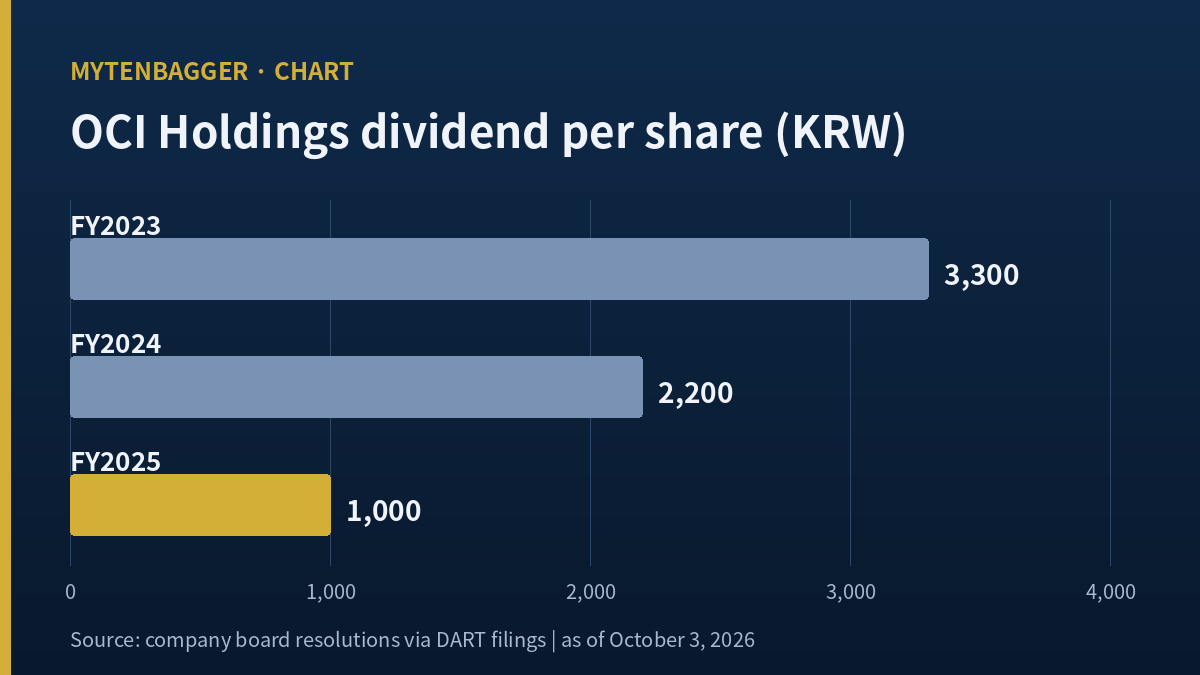
On February 11, 2026 the board set the OCI Holdings dividend for 2025 at KRW 1,000 a share, a total of KRW 18.67bn, in a year when the net result belonging to owners of the parent was a loss of KRW 89.88bn. The payout was cut by 55% from the KRW 2,200 paid for 2024, and it was not suspended. That decision is the whole reason I opened this file: a company kept paying cash out of a loss year while its inventory kept rising.
Paid to shareholders for 2025
KRW 18.67bn
Owners’ net result for 2025
minus KRW 89.88bn
I am watching OCI Holdings from the side. My first check is whether the 74,160 treasury shares bought in 2026 are actually retired before the year ends.
Some context for readers outside Korea. OCI Holdings trades on the KOSPI, the main board of the Korea Exchange, under code 010060. It is a holding company: the polysilicon plant in Malaysia (OCI TerraSus), a US solar and power developer (OCI Energy), a combined heat and power unit, an urban development arm, and a stake in the separately listed specialty chemicals maker OCI. At the October 2, 2026 close the market value was about KRW 4.40tn, roughly USD 3.26bn at that day’s Seoul close of KRW 1,350.6 per dollar (Seoul Shinmun).
What pulled me in this autumn was the payout record, which gets far less attention than the US import price headlines.
Contents
The OCI Holdings dividend record, year by year
The table below lines up the per-share payout against the owners’ result for the same fiscal year. The payout figures are from the regulator’s disclosure system as compiled in the Kiwoom data feed, and the 2025 total is from the board’s February notice.
| Fiscal year | Dividend per share | Owners’ net result |
|---|---|---|
| 2022 | KRW 2,500 | KRW 880.3bn |
| 2023 | KRW 3,300 | KRW 713.5bn |
| 2024 | KRW 2,200 | KRW 97.7bn |
| 2025 | KRW 1,000 | minus KRW 89.9bn |
Sources: Korea’s DART disclosure system via Kiwoom data (consolidated, owners of the parent); 2025 dividend notice of February 11, 2026. USD at KRW 1,350.6 per dollar, October 2, 2026.
Two points stand out to me. First, the per-share payout fell in each of the last two years, from KRW 3,300 to KRW 2,200 (down 33%) and then to KRW 1,000 (down 55%), by my calculation. Second, it never went to zero, even though owners’ profit fell from KRW 713.5bn to a loss over those same years.
The February notice also lets me check the share total. KRW 18.67bn divided by KRW 1,000 gives 18,670,232 shares entitled to the payout. The issued share total in the Kiwoom feed is 18,670,295. I found this gap almost by accident, dividing the notice’s total on a phone calculator while waiting for a late train, and then had to recheck it twice at home. The 63-share gap is, by my calculation, the treasury stock the company held on December 31, 2025. In other words, at the 2025 record date there was almost no treasury stock left on the balance sheet of this holding company. That matters for the next section.
A note on timing for readers used to US dividend mechanics. For fiscal 2025, OCI Holdings fixed the record date at December 31, 2025, then announced the amount on February 11, 2026, and paid it on April 10, 2026 after shareholder approval at the March 26 meeting (DigitalToday). In other words, anyone who owned the stock on the last day of 2025 locked in the right to a payout whose size they would only learn six weeks later. Korean regulators have been pushing listed companies to announce the amount first and set the record date afterwards, but this company used the older order for 2025. That detail matters to me because it means the payout for 2026 will again be decided after the fiscal year closes, with the full-year loss or profit already known to the board.
At the time of the announcement the company put the cash yield at 0.84% of the share price. At the October 2, 2026 close, the same KRW 1,000 works out to about 0.4%, because, going by that 0.84%, the shares have roughly doubled since early February. For an income investor this is a token payout. Its value to me is as a signal of what the board considers untouchable.
Where the OCI Holdings dividend money came from
A dividend paid out of a loss year has to come from somewhere other than that year’s profit. For a holding company, the obvious candidates are retained earnings built up earlier, cash coming in from the operating units, or borrowing.
Retained capacity
Owners’ equity was KRW 4,092.6bn on June 30, 2026, and it had been KRW 3,931.9bn at the end of 2025. A payout of KRW 18.67bn is less than 0.5% of that equity, so in pure capacity terms the company could afford it. One caveat for US readers: under Korean company law a dividend is paid out of the parent company’s own distributable profit, measured on its separate financials, and the consolidated equity I am quoting includes the subsidiaries. I did not find the parent’s separate retained earnings in the sources I used, so I can say the group had room, and I cannot say by how much the parent itself did.
Cash coming in
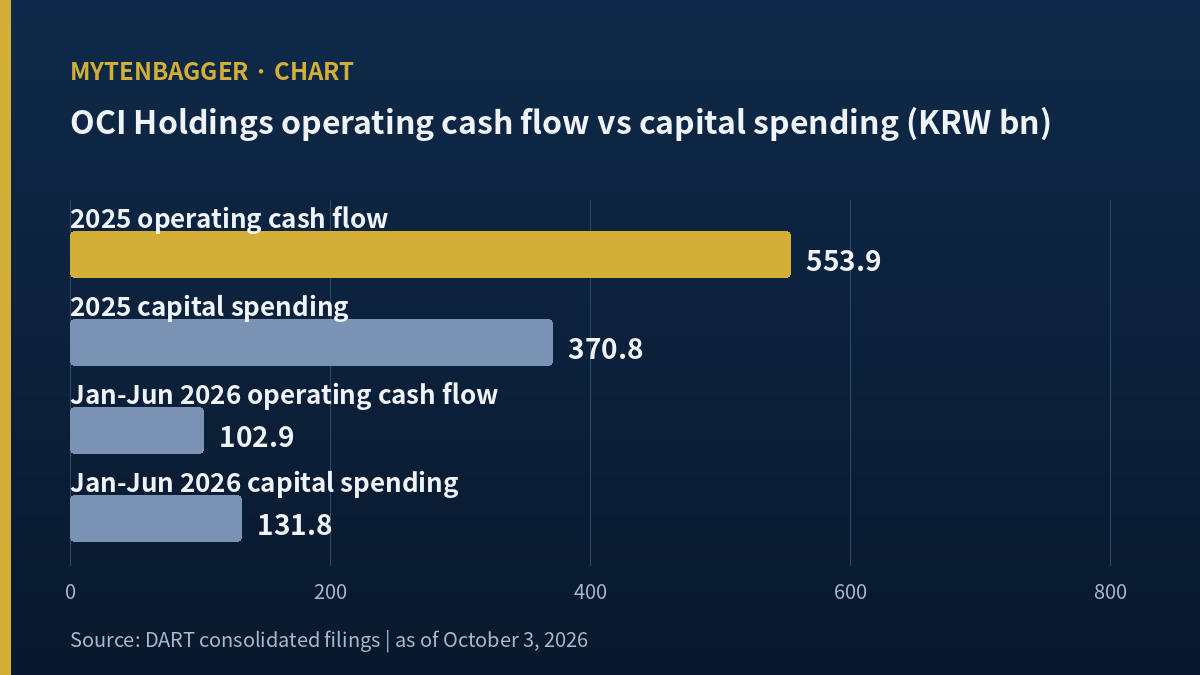
Cash generation is a different question. In 2025 the group produced KRW 553.9bn of operating cash flow against KRW 370.8bn of capital spending. In January to June 2026, operating cash flow was KRW 102.9bn and capital spending was KRW 131.8bn, leaving free cash flow of minus KRW 28.8bn. The dividend was paid on April 10, 2026, inside that negative six months.
So my reading of the money trail is this: the 2025 payout was covered comfortably by the previous year’s cash, and the 2026 cash so far does not cover it. Those are group-level figures. I could not separate how much cash the parent itself received from its units, and I am leaving that gap open in this journal.
The demands on that cash are not getting smaller. On the July results call the company described two capital-heavy plans at once: doubling polysilicon capacity by 2029 and shifting the US power business from selling projects to keeping and running them. Kept projects need equity and debt on the group balance sheet for years before they pay back. I would have expected a board facing that list and a negative first six months of free cash to reach for the payout first. This board trimmed it, and kept it.
The same tension shows up at a customer of this company. I wrote about how Hanwha Solutions earned most of its April to June operating profit from US manufacturing credits, which is policy money and not product money. A buyer of polysilicon whose profit leans on credits is worth keeping in mind when the seller is paying dividends out of past cash.
For a sense of how other Korean chemicals names carry a silicon business inside a wider group, my notes on KCC Corporation look at a company where silicones grew to about 49% of revenue. The parallel is loose, since KCC makes silicones and OCI Holdings makes polysilicon, but both sit inside groups whose reported totals hide which unit is carrying the load.
The buyback promise behind the OCI Holdings dividend cut
The 2024 plan
The payout cut did not come alone. In April 2024 the company said it would buy back and retire 5% of its issued shares by 2026, which was 990,635 shares and about KRW 93.4bn at the time, according to a CEO Score Daily report of April 1, 2024. A later deal-press report said the board also planned to review its dividend policy every three years (Dealsite). The 63-share treasury balance at the end of 2025 suggests that the earlier purchases had already been retired.
The 2026 trust
In 2026 the company signed a fresh trust with KB Securities for KRW 15bn, running from February 11 to August 10. When it ended, the trust had bought 74,160 shares, or 0.40% of the total, and the company said it plans to retire all of them during 2026 (trust termination notice, August 10). That would take the issued total to 18,596,135 shares, by my calculation.
Put the two together and the direction of the policy becomes clearer to me. The cash dividend shrank, and share retirement took over part of the job of returning capital. KRW 15bn of buybacks plus KRW 18.67bn of dividends is about KRW 33.7bn in a single year. That is a modest sum against a KRW 4.40tn market value, roughly 0.8%.
Here is where I have to admit my first read was too generous. When I saw the dividend survive the loss year, I took it as a sign of balance sheet confidence. Then I looked at the next line I care about, which is inventory.
Inventory, the number next to the OCI Holdings dividend
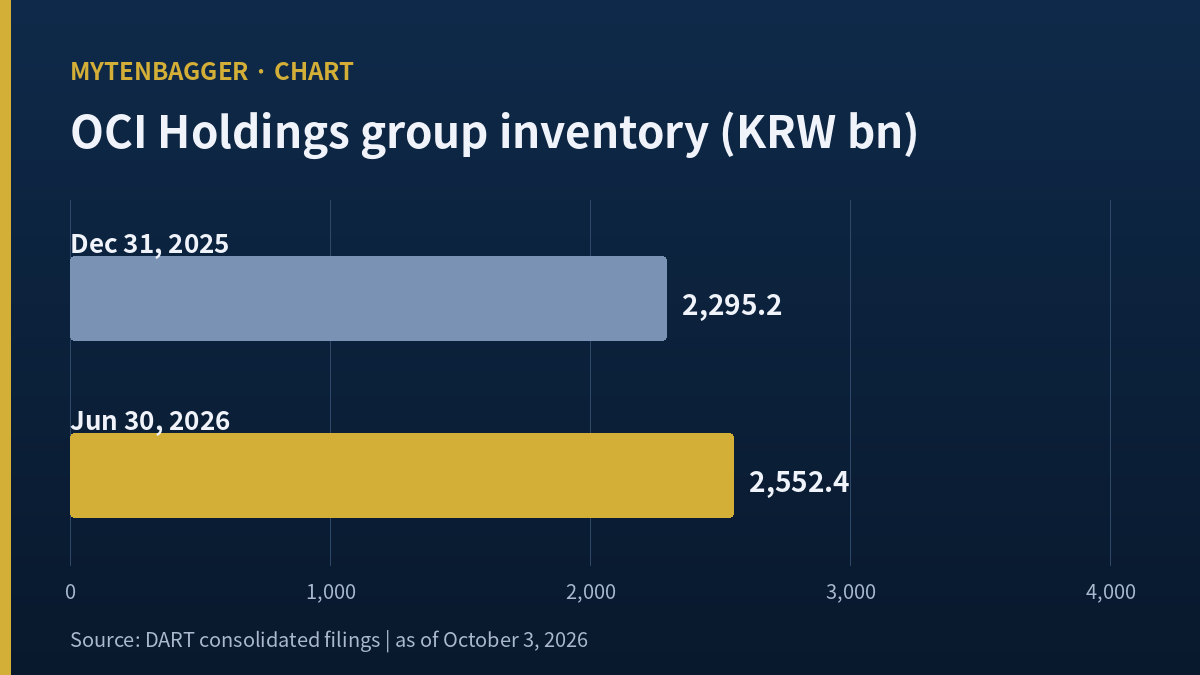
Group inventory was KRW 2,295.2bn at the end of 2025 and KRW 2,552.4bn on June 30, 2026, an increase of KRW 257.2bn or 11.2% in six months, by my calculation. Against owners’ equity of KRW 4,092.6bn, that inventory is 62.4% of all that the parent’s shareholders own on paper. The Kiwoom feed puts inventory at about 227 days of April to June sales. Put plainly, at the pace the group sold goods in April to June, it would take roughly seven to eight months to sell what was sitting in inventory on June 30.
What the inventory might hold
Some of that inventory is not polysilicon at all. The urban development unit develops sites for sale, and property held for sale is usually carried as inventory, so part of the total may be real estate. I could not split the total by unit from the public data I have. So I am careful with what I claim. What I can say is that a business whose polysilicon output is reported as fully contracted should, over time, turn product into cash faster than this. A rising inventory line alongside a falling payout is the pairing that keeps me on the sidelines.
Inventory was not the only line that grew. Total assets went from KRW 7,870.9bn at the end of 2025 to KRW 8,521.5bn on June 30, 2026, up KRW 650.6bn or 8.3%, by my calculation. Total liabilities rose by KRW 409.4bn over the same six months, to KRW 3,548.8bn. Liabilities divided by total equity moved from 66.3% to 71.4%. None of these levels is alarming for a company of this size, and I want to be fair about that. But the direction matters for a dividend reader: the group added obligations in six months worth more than twenty times its 2025 payout, while the payout itself was being trimmed.
There is also the question of who the equity belongs to. Of total equity of KRW 4,972.7bn on June 30, KRW 880.1bn, or 17.7%, belongs to minority shareholders of the subsidiaries. Those include the outside holders of the separately listed OCI, whose shareholders have a claim on its profit and cash before any of it reaches the holding company. When I look at the parent’s ability to pay, that 17.7% is cash the parent can see on the consolidated balance sheet but cannot simply take.
A European polysilicon maker and the OCI Holdings dividend choice
Wacker Chemie (XETRA: WCH) in Germany is one of the few large polysilicon producers outside China, so it is the closest listed comparison I can make on this one point. I am comparing only the dividend decision in a loss year. I am not comparing valuation, growth or profitability.
Wacker reported a 2025 net loss of EUR 805m, driven largely by valuation adjustments that made up roughly three quarters of it, and proposed no dividend for 2025, in line with a stated policy of paying out 50% of net income (Investing.com, March 11, 2026). Its annual meeting on May 6, 2026 confirmed that no dividend would be paid because of the loss (Wacker press release).
So the two companies faced a loss year and chose differently. Wacker followed a formula tied to profit and paid zero. OCI Holdings cut but kept paying, which suggests its payout is a commitment the board wants to keep visible to shareholders, separate from the year’s result. Neither choice is wrong. They do tell me what each board treats as fixed.
It helps me to run the Wacker rule on OCI Holdings numbers, as a thought experiment and no more than that. Fifty percent of a negative owners’ result is still zero, so under a 50% formula the 2025 payout would have been zero. The KRW 18.67bn that was actually paid is, by that rule, entirely discretionary. I am not saying the board should have used a formula. Korean holding companies rarely publish one, and this company’s stated practice is to revisit its payout policy every three years. I am saying that when the payout is not tied to profit, the reasons for it have to be read from other places: the buyback, the balance sheet, and what management says on calls.
There is a second difference worth noting. Wacker’s loss came mostly from non-cash valuation adjustments. The OCI Holdings 2025 loss came with an operating loss at group level for the year. One board skipped a payout over a valuation writedown, and the other kept paying through an operating loss. That contrast surprised me more than the dividend decisions themselves.
Three ways the OCI Holdings dividend for 2026 could go
I am not putting odds on these. I only want to know in advance what each outcome would tell me.
Back up toward KRW 2,200. This would need full-year 2026 owners’ profit comfortably above the KRW 48.41bn earned in January to June, and the 74,160 treasury shares retired on time. If both happen, the board would be signaling that 2025 was a trough and that it is willing to return cash in both forms at once. I would then reread the inventory line with less suspicion.
Held at KRW 1,000. This is the outcome I would call neutral. It keeps the token payout alive and leaves room for the expansion spending the company has described, including doubling polysilicon capacity by 2029. It would tell me the board treats KRW 1,000 as a floor and buybacks as the flexible part.
Cut again or suspended. This would put OCI Holdings closer to the Wacker approach. It would most likely follow a weak second six months, a further rise in inventory, or a decision to keep cash for capacity. If it happens alongside a completed buyback, I would read it as a shift in tools. If it happens without the buyback being completed, I would read it as stress.
Why I might be reading this wrong, and what I will check
I keep the arguments against my own position in the same file, so I can come back to them.
- The 2026 result is already positive. Owners’ net income for January to June 2026 was KRW 48.41bn. If the second six months hold up, the 2026 payout would be covered by that year’s profit again, and the loss year becomes a one-off.
- Inventory may be mostly real estate. If the growth in inventory sits in the development unit, it is a project timing matter and says little about polysilicon demand. I could not rule this out.
- The buyback may be the better tool here. At about 1.07 times owners’ equity (market value divided by owners’ equity, my calculation), retiring shares is close to buying the company at its stated net worth. A board choosing buybacks over cash dividends at that level is a defensible call.
- The operating cash gap may be timing. Free cash flow of minus KRW 28.8bn over six months is small against 2025 operating cash flow of KRW 553.9bn. One strong collection month could close it.
- Strategy is shifting toward holding assets. On the July results call the company said OCI Energy would move from developing and selling projects toward owning and running good power assets (ZDNet Korea, July 23). Owned plants produce steadier cash over time, which could support the payout later even if near-term cash is tight.
And the three checks that would change my stance:
- A disclosure that the 74,160 shares from the 2026 trust have been retired before December 31, 2026.
- The September 30 inventory figure in the Jul-Sep report, due by November 16, 2026 (Mon). A drop below the June level would weaken my main worry.
- The 2026 dividend notice, expected around February 2027. A payout at or above KRW 1,000 with positive full-year owners’ profit would tell me the cut was a floor.
The order matters. The inventory figure arrives first, by mid-November, and it is the one I trust least to move my view, because a single report can swing on project timing in the development unit. The share retirement is a cleaner test: either the 74,160 shares are gone by year end or they are not, and the company set that expectation itself in August. The dividend notice comes last and carries the most weight, since it is the board saying in a number what it believes the year was worth. If the first two go badly, I will treat a held dividend in February with extra caution.
Where I stand until November 16
The board’s February 11 notice is the document I will reread first when the next numbers arrive. I nearly filed it away as good news in February. A company that keeps paying through a loss looks shareholder-friendly at a glance, and I let that impression carry me for longer than it should have. Only when I set the payout next to inventory and free cash did the picture get less comfortable.
My position for now: watching until the Jul-Sep report. I want to see whether the retirement of 74,160 shares happens as promised and whether inventory stops climbing. If both go my way, I will rebuild this table with the 2026 figures and decide then.
Dollar figures are approximate, at KRW 1,350.6 per dollar on October 2, 2026, the Korea Exchange regular session the won figures come from. Balance sheet and cash flow figures are consolidated, from the June 30, 2026 interim report and the 2025 annual report.