KT&G Stock: The 9.5% Buyback Is Burned, Dividends Come Next
Domestic cigarette revenue fell 5.2%. Group operating profit rose 27.6%. And KT&G stock is up about 26% over the past twelve months on my screen. I sat with those three numbers for a while, because they don’t belong in the same company — unless the label I had stuck on this name years ago was simply wrong. KT&G trades in Seoul on the KOSPI, Korea’s main stock exchange, under ticker 033780, and for most of the time I’ve followed Korean markets it wore the most boring label available: a slow-melting tobacco monopoly that pays you to wait. That label no longer describes what the market is pricing.
I read the re-rating in KT&G stock as a capital-allocation story, not a tobacco story. The company burned 9.5% of its shares in April and raised its dividend for a third straight year — the loudest cards have already been played. I don’t own it, and I’m not chasing the high ₩170,000s (about $116 at roughly ₩1,520 per dollar). Two more cards get turned over soon: Q2 results in early August and a new shareholder-return policy promised for the second half. I’ll decide after I see them.
Contents
What Re-Rated KT&G Stock: Capital Allocation, Not Cigarettes
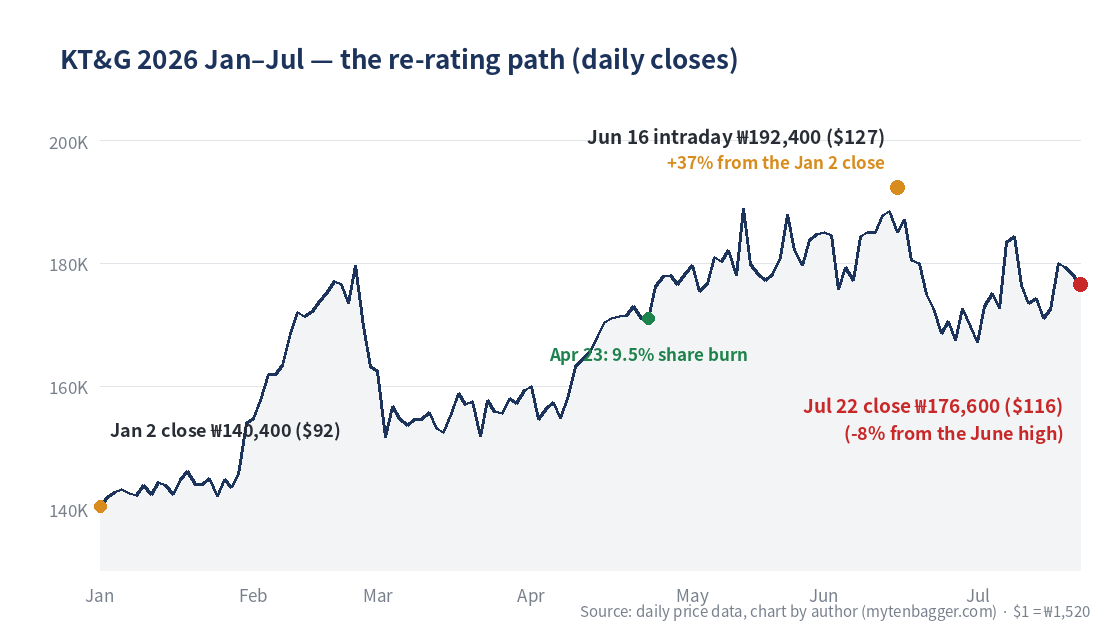
Walk through this year in order and the story assembles itself. In mid-January the shares sat in the low ₩140,000s (mid-$90s), per my daily price data. In February, Korean wire service News1 reported the stock had climbed ten sessions in a row and that sell-side estimates were running ahead of the company’s own plan — the article carried management’s 2026 guidance of 3–5% revenue growth and 6–8% operating profit growth (News1, February 11, Korean). Conservative numbers. Then the first quarter, reported May 7, came in at +14.3% revenue and +27.6% operating profit, with net profit of ₩378.2 billion (about $249 million), up 46.6% (BusinessPost, May 7, Korean). That spread — a company that guides low and then runs well above its own numbers — is the first axis of the move in KT&G stock this year. The shares digested a late-February pullback into the ₩150,000s, rebuilt through the spring, and printed an intraday ₩192,400 (about $127) in mid-June before easing back. From the 250-day low of ₩128,100, the current ₩176,600 close (July 22) is roughly 38% higher (my arithmetic from daily price data).
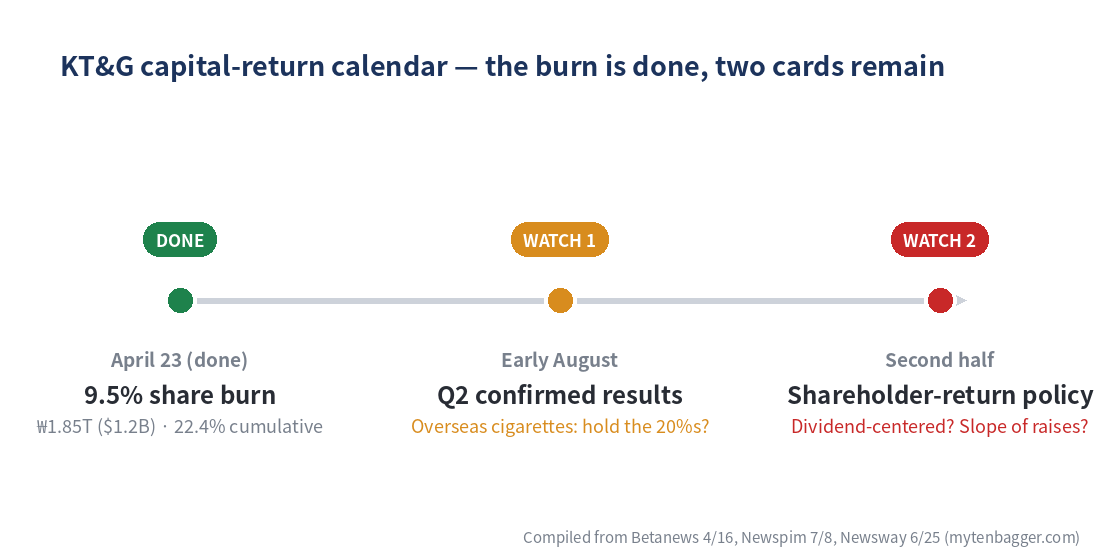
The second axis is heavier. After the March annual meeting, the board resolved in April to retire the company’s entire treasury stake — 10,866,189 shares, or 9.5% of shares outstanding, worth about ₩1.85 trillion (roughly $1.2 billion). The retirement date was April 23 (Betanews, April 16, Korean). The annual dividend was raised ₩600 to ₩6,000 per share (about $3.95). Pull up the filing history and the last four payouts read ₩5,000, ₩5,200, ₩5,400, ₩6,000 — three consecutive raises, and the slope changed: the first two hikes ran around 4%, the last one 11.1% (my arithmetic). A dividend whose growth rate is accelerating is one of the signals I weight most in income names. On top of that, Korean outlet Newsway reported on June 25 that cumulative share retirement has reached 22.4% of shares outstanding, and that a roughly ₩1 trillion (about $660 million) non-core asset sale program — office towers in Bundang and Euljiro, the Courtyard Marriott Namdaemun hotel — wrapped up ahead of its original 2027 schedule (Newsway, June 25, Korean). The same piece framed the coming second-half policy announcement as likely centering on dividends. The treasury shares are gone; the next lever is the payout.
Some context for readers who don’t follow Seoul closely: Korean equities have traded for decades at a discount to global peers — chronically low payout ratios, treasury shares held instead of retired, controlling families with little incentive to share. The government’s “value-up” program, Korea’s answer to Japan’s corporate-governance reform push, has been leaning on listed companies to fix exactly that, and Korean financial daily Hankyung profiled KT&G in its 2026 value-up series as one of the market’s showcase cases, citing the high dividend and the treasury burn (Hankyung, February 12, Korean). That’s the macro current underneath this single name: KT&G isn’t just returning cash, it’s doing so exactly when Korean policy, foreign investors, and index-level sentiment all reward the behavior most. Part of my caution comes from precisely that alignment — when everything rewards a behavior at once, the price of the behavior tends to be paid in advance. The banks are running the same playbook, and I keep separate journal entries on it — Hana Financial, where the buyback budget is throttled by the currency, and Shinhan, weighing a ₩1.5 trillion buyback against an acquisition.
Ownership flows followed the script. Foreign investors hold about 51% of the register, per my market data — for a Korean large cap outside the semiconductor complex, that is a crowded foreign shareholder base. A company where foreigners own more than half the float just torched a tenth of its share count and lifted the dividend three years running. The market’s response is the chart.
A company that has retired more than one in five of its shares is a capital-allocation story wearing a tobacco company’s clothes.
I’ll admit the framing still feels strange to me. A few years back I cut KT&G from my dividend watchlist — shrinking cigarette volumes, a share price going nowhere, better yield elsewhere. I left that judgment untouched through last year, which means I watched this entire re-rating from the outside. A 26% twelve-month move is better than most of what I actually held. That one stings. But admitting I missed it and paying up for it now are two different decisions, and I try hard not to let the first force the second.
Q1 Numbers: Overseas Cigarettes Now Outsell Domestic
The segment detail from the May 7 release, reported by BusinessPost, is where the old label falls apart. Figures below are first quarter 2026, converted at roughly ₩1,520 per dollar.
| Q1 2026 | Amount | YoY |
|---|---|---|
| Group revenue | $1.12B (₩1,703.6B) | +14.3% |
| Group operating profit | $240M (₩364.5B) | +27.6% |
| Overseas cigarettes | $368M (₩559.6B) | +24.6% |
| Domestic cigarettes | $232M (₩352.9B) | -5.2% |
| NGP (heat-not-burn devices/sticks) | $159M (₩241.0B) | +51.6% |
| Health functional foods (ginseng) | $219M (₩332.6B) | +5.8% |
Source: KT&G Q1 2026 results as reported by BusinessPost (Korean). USD conversion at ~₩1,520/$, my arithmetic.
The two rows I kept returning to are overseas versus domestic cigarettes: $368 million against $232 million. Overseas is now 1.6 times the size of the home market business (derived from the table). Korean press had framed 2026 as the year global revenue would overtake domestic for the first time; in the core cigarette business, the crossover already shows up in a single quarter’s numbers. The tobacco segment overall did ₩1,155.9 billion of revenue and ₩321.6 billion of operating profit, up 17.0% and 27.2% respectively (BusinessPost, May 7) — so the group’s profit engine is still tobacco, but the tobacco itself has moved offshore. Add NGP growing 51.6% and the ginseng unit’s operating profit up 53.3%, and Financial Today’s summary of the quarter — overseas cigarettes pulled, NGP pushed, as the Korean outlet framed it — matches what I see in the table (Financial Today, May 7, Korean). This is an export consumer-staples profile, not a domestic utility in decline.
One more derived detail from my spreadsheet: the domestic decline cost roughly ₩19 billion of revenue year over year, while overseas added about ₩110 billion — the growth covered the shrinkage more than five times over (my arithmetic from the reported figures). The pain isn’t absent; it’s being outrun. And the only condition holding that structure together is the overseas growth rate, which is why it sits first among my checkpoints below.
The forward view from Korean sell-side, for the record and clearly not as my numbers: NH Investment & Securities analyst Joo Young-hoon lifted his objective from ₩200,000 to ₩220,000 (about $145) on May 8, citing the share-count effect of the 9.5% retirement and flagging that new buyback-and-burn rounds are slated for the second half (Money Today, May 8, Korean). KB Securities analyst Ryu Eun-ae went to ₩250,000 (about $164) on July 8 (Newspim, July 8, Korean). Both are their objectives, not mine. What interests me is less the width of the range than how the newer one was built — which is where the bear case starts.
The Bear Case on KT&G Stock: Multiple Creep and One-Off Cards
Per the Newspim write-up, KB’s July note applies a 20x multiple to estimated 2026 earnings, up from 18x, and the stated reason is that peer multiples rose. Read that twice: a meaningful slice of the newest, highest objective on KT&G stock comes not from higher profit estimates but from marking the company up because global tobacco got more expensive. That logic works in both directions. If the global complex cools, the same arithmetic walks the number back down.
The peer in question makes the point concrete. Philip Morris International — a $293 billion company against KT&G’s roughly $12 billion (₩18.3 trillion market cap at ~₩1,520/$, my arithmetic) — trades at about 26.5x trailing earnings and 22x forward, with a 3.13% dividend yield and seventeen consecutive years of dividend growth (stockanalysis.com, July 21 close). KT&G on my screen trades around 19x trailing with a yield near 3.4% (₩6,000 on ₩176,600, my arithmetic). Notice what has already happened: the yields are nearly identical. What remains of the gap is the multiple and the length of the track record — and I’m not convinced a three-year raise streak should be priced like a seventeen-year one. The bulls read the remaining multiple gap as room to run. I read at least part of it as the discount a shorter history deserves, inside a sector that is broadly expensive by its own standards.
There’s also a structural wrinkle in the comparison that I find more interesting than the multiples: the peer is also the pipeline. KT&G’s lil heat-not-burn devices travel to many overseas markets through a distribution tie-up with Philip Morris International itself. So the NGP line growing 51.6% is genuinely global demand, but a portion of KT&G’s fastest-growing segment rides on its largest comparable’s sales network. I hold that thought loosely — it cuts both ways, guaranteed reach on one side, dependence on a competitor’s shelf on the other — but it’s the kind of detail a pure multiple comparison quietly skips over.
Next, the share-count arithmetic. Retire 9.5% of the float and per-share earnings rise a bit over 10% even if the business earns not one won more (the inverse of the reduction, my arithmetic). A chunk of this year’s per-share improvement in KT&G stock is that mechanical effect. Blend the business and the share count into one growth number and you will overestimate what next year looks like in any quarter where there’s no burn. The buyback was real money returned to holders — but it is also, by definition, a card that can’t be replayed from the same deck. The treasury stake is gone; repeating the trick means buying shares back first. The asset-sale program that helped fund the returns is equally one-off: towers sell once. That is exactly why the second-half dividend policy matters so much — it’s the only recurring card left on the table.
The same optical illusion runs through the dividend line. Dividing S1 Corporation’s disclosed dividend bill by its per-share dividend returns 33,810,239 shares actually receiving the payout, against 37,998,617 shares issued, a gap of 4,188,378 shares or 11.02% of the register. Treasury stock collects no dividend, so a company that burns its treasury shares and a company that sits on them move that gap in opposite directions. Whichever figure you are reading, per-share or total, ask which share count sits in the denominator first.
Costs cut the other way too. Korean outlet e-Focus, while calling the treasury burn the high point of the company’s value-up program, flagged the fixed costs of new overseas plants and global NGP marketing as a drag on near-term margins, and noted the tension of returning cash aggressively while funding a heavy investment cycle (e-Focus, Korean). The company has kept a policy of returning 100% or more of profits to shareholders, per the same report — inverted, that means the longer the payout exceeds what the business earns, the tighter the room between the vault and the capex plan gets. I’d also flag that Q1’s +27.6% almost certainly carries help from last year’s base and from the weak won near ₩1,520, and I have not been able to decompose how much. That unfinished homework bothers me, so I’m writing it down instead of hiding it.
And domestic cigarettes at -5.2%: I treat that as direction, not noise. It is invisible while overseas grows at twenty-plus percent. The first quarter overseas growth prints in single digits, that minus sign will suddenly read very differently. When I first outlined this piece I had put tobacco regulation at the top of the bear list; writing it out, I demoted it. Regulation is the constant this industry has priced for decades. At this valuation, the live variables are the multiple and the overseas growth rate.
One practical note for U.S. readers: KT&G’s primary listing is the KOSPI line. The currency deserves its own line in that decision. The won near ₩1,520 to the dollar has been a tailwind for every Korean exporter’s translated earnings, KT&G’s overseas cigarette book included — and a dollar-based holder is exposed to the mirror image, since a won recovery that flatters nothing else would still lift the dollar value of a Seoul-listed position. Currency, in other words, sits on both sides of this trade’s ledger, which is not a reason to avoid it but is a reason to size it like the two-variable bet it actually is.
How I See KT&G Stock Playing Out Into Year-End
No probability percentages this time; the fork is simple enough to describe in words.
The continuation path — results keep running above guidance
KB’s July preview expects Q2 to land slightly above market estimates on overseas cigarette growth with domestic and NGP contributing (Newspim, July 8). If that lands, and the second half then stacks an interim dividend, a new payout policy, and fresh buyback rounds on top — the sequence the Korean sell-side coverage sketches — the re-rating of KT&G stock gets another leg, and June’s intraday ₩192,400 stops being the ceiling. In this path my hesitation costs me more upside, and I accept that openly. Missing a further rally in a name I don’t own is a tuition fee I can live with; overpaying at the top is the one I try not to pay twice.
The give-back path — growth reverts toward guidance
Management’s own plan for the year was 6–8% operating profit growth (News1, February 11). If the first quarter’s +27.6% sheds its base-effect and currency help through the back half and settles toward single digits, the case for a 20x multiple thins out fast. The burn is done, and if the dividend announcement underwhelms against expectations that Korean coverage has spent a quarter raising, some slice of this year’s re-rating gets handed back. The current level — about 8% below the June intraday high, my arithmetic — reads to me like the market holding its breath between these two paths.
The tail — the won turns
Lower odds, still worth writing down. The bigger the overseas book gets, the more the P&L moves with the currency. A decisive won rally would shrink the translated value of overseas earnings just as the domestic business keeps declining — a quarter where the table’s top rows cool simultaneously. If that shows up, this stops being a watch-list debate for me at all.
My Four Checkpoints on KT&G Stock
My working hypothesis: the capital-allocation turn is real, and the next card is the dividend. Four things confirm it or break it.
First, the Q2 report expected in early August — does overseas cigarette growth hold in the twenties? It is the single condition underwriting the structure that covers domestic decline five times over, and with KB already penciling in a beat, the bar is not low. Second, the second-half shareholder-return policy — does the dividend actually take center stage, and does the raise extend the steepening slope of the last three years? A company that has burned 22.4% of its float has to show what comes after the matches run out. For scale: at ₩6,000 on roughly 103.8 million shares outstanding (my market data), the annual dividend check already runs about ₩623 billion, or $410 million (my arithmetic) — every further raise is real money against a business whose home market shrinks, which is exactly why I want to see the policy in writing rather than assume the slope. Third, the domestic decline rate — anything steeper than the current -5% area changes the math underneath everything. Fourth, price. The zone where my interest turns into action is a pullback toward the low ₩170,000s (about $112), where the 120-day average sits on my chart. Above that, even three green checkpoints leave me too thin a margin for error.
These four don’t work in isolation. If the earnings and the payout policy point the same way, the price checkpoint matters less and I’d accept paying up somewhat. If overseas growth cracks while the dividend news lands flat, no price is low enough — the old label goes back on the tin and I move on. Until the checkpoints resolve, I watch. That’s the whole position.
What this name taught me this year is that a boring register can hide a regime change: I filed KT&G under slow-melting yield years ago and paid for that filing error with a missed 26% move. I’m not compounding the error by chasing. Early August and the second-half policy announcement are my next two lessons, and this journal gets its update then. I only promise to keep my own checkpoints honestly.
Related reading
- Why Dentium Stock Fell 40% After Retiring 15.9% of Shares
- Hyundai Department Store Stock: A Buyback Not Yet Canceled