Why LS Electric Stock Fell After Its Best Quarter Ever
The 30-second version of what I found
On July 23, 2026, LS Electric (KRX: 010120) posted the best quarter in its history. LS Electric stock closed that session at ₩219,750, then fell to ₩198,900 over the next two trading days.
I did not want to file that under “profit taking.” So I went looking, and the number I hit was this: the company’s full-year 2025 operating margin was 8.6%. Its two domestic peers in the same AI-power basket ran 24.4% and 12.5%.
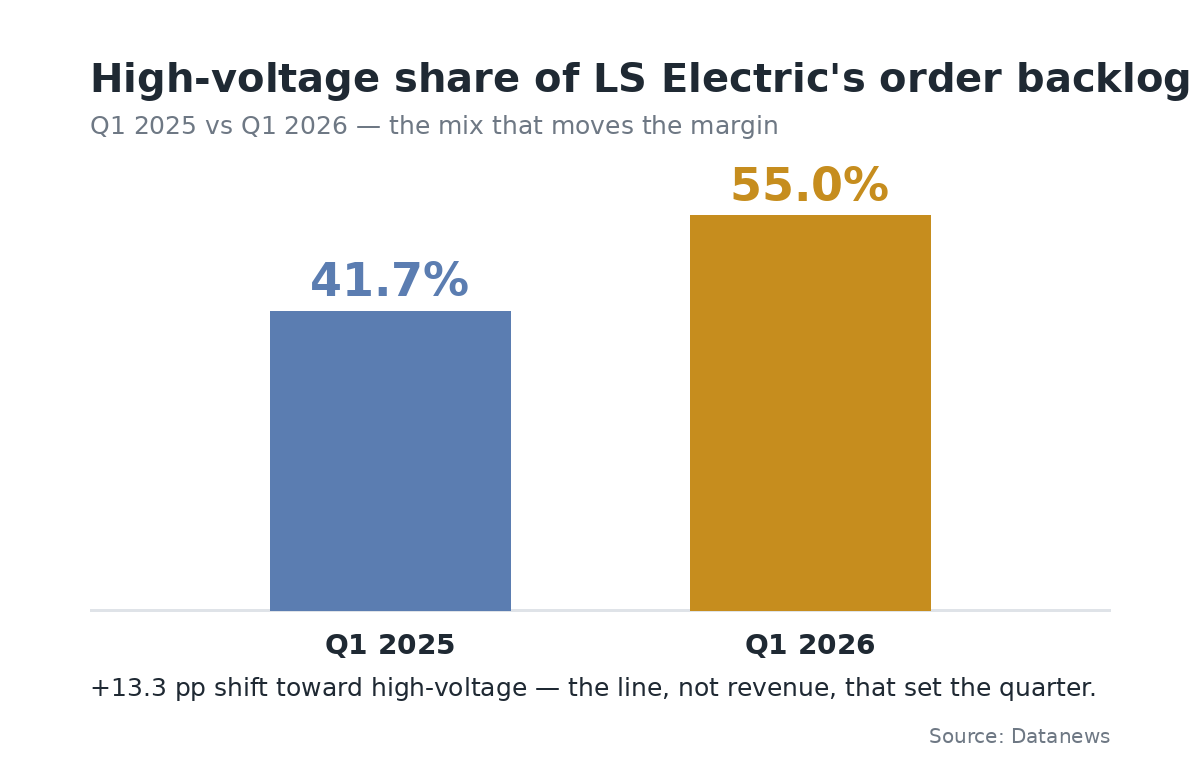
That pushed me off the revenue line entirely and onto the product mix inside the order backlog, where I found 41.7% turning into 55.0%. This is the record of me following that one number.
A quick frame for readers outside Korea. KOSPI is the main board of the Korea Exchange — the senior venue, roughly analogous to the NYSE in its role, where the country’s largest industrials list. LS Electric trades there under 010120.
Figures in this piece are Korean won converted at roughly ₩1,500 to the dollar unless the original source published its own dollar figure, in which case I use theirs.
Contents
What LS Electric stock did around the print
The second-quarter numbers, reported July 23, 2026: revenue of ₩1.577 trillion (about $1.05 billion), up 32% year over year, and operating profit of ₩178.5 billion (about $119 million), up 64%. Both beat the company’s previous record, set in the fourth quarter of 2025. New orders in the quarter cleared ₩2.1 trillion (about $1.4 billion), and the closing backlog reached ₩6.9998 trillion (about $4.67 billion), up 24% from the prior quarter. Those figures come from Korean trade press coverage of the release (Digital Daily).
LS Electric stock jumped hard on the day and closed at ₩219,750. Then it gave the move back: ₩201,500, then ₩198,900 — about 9.5% below the print-day close, and more than 24% below the ₩263,500 close of July 1, less than a month earlier.
I stopped there. When a company’s best-ever quarter is the thing that gets sold, whatever the market is pricing is not this quarter’s numbers. The same session shows up further down the market capitalisation ladder — Kyungdong Navien fell 11.30 per cent on the morning its earnings landed, on 3.38 times the prior session’s volume.
The number that reframed LS Electric stock for me
Same story, one third the margin
Korea’s three listed power-equipment names have traded as one block for a year. They share the AI-data-center demand narrative, and they correct together — in early June 2026, the trailing one-month drawdowns were HD Hyundai Electric -37.39%, LS Electric -34.69%, Hyosung Heavy Industries -30.54%. Nearly identical.
Their economics are not identical at all. Korean business daily Datanews laid out the full-year 2025 operating margins side by side:
| Company | FY2025 operating margin | Product weighting |
|---|---|---|
| HD Hyundai Electric | 24.4% | Heavy on high-voltage transformers |
| Hyosung Heavy Industries | 12.5% | Mixed heavy electric and construction |
| LS Electric | 8.6% | Heavy on distribution solutions |
All three figures are full-year 2025 as reported by Datanews, not quarterly.
Datanews attributed the gap to what it described as a business structure weighted toward distribution solutions. I think that phrase is the whole thesis in one line.
Distribution is the wide part of the market. It sits at the last stretch of the grid, so unit volumes dwarf transmission and high-voltage. Lead times are short, which means orders convert to revenue quickly. What it does not carry is pricing power — switchgear is comparatively standardized, and standardized things get shopped. High-voltage transformers are the mirror image: low volume, long lead time, and a supplier list short enough that the seller sets the terms.
So LS Electric holds the widest door in this theme, on the thinnest margin. There was never a reason for the market to award it the same multiple as the other two.
So I ran the quarter myself
₩178.5 billion of operating profit on ₩1.577 trillion of revenue is an 11.3% operating margin — my own arithmetic from the two reported figures, not a company-disclosed ratio. That is 2.7 percentage points above the 8.6% full-year 2025 level.
Better, clearly. But a single quarter’s margin moves on project recognition timing alone, and I did not want to build anything on one data point. What I wanted to know was whether this was an event or a structure.
Where LS Electric stock’s real variable is hiding
The answer was not in the income statement. It was in the backlog. The same Datanews piece tracked the composition shift:
- High-voltage transformers as a share of backlog: 41.7% in Q1 2025, rising to 55.0% in Q1 2026
- That backlog in absolute terms: ₩1.6223 trillion to ₩3.1024 trillion (about $1.08 billion to $2.07 billion), roughly a 91% increase
- High-voltage transformer capacity: from about ₩200 billion (roughly $133 million) a year to about ₩800 billion (roughly $533 million) a year, via a Busan plant expansion and the acquisition of LS Power Solution
This is the part of the research where I actually sat up. In four quarters, more than half of this company’s future revenue rotated into its higher-margin product, and it quadrupled the capacity to build that product. Which means 8.6% is a photograph taken before the rotation reached the income statement.
The segment detail from the second quarter points the same way. Power accounted for ₩1.0915 trillion (about $728 million), roughly 70% of group revenue. Inside it, high-voltage transformers grew 91% year over year to ₩158.1 billion (about $105 million), while switchgear grew 45% to ₩419.3 billion (about $280 million). Switchgear is still much larger in absolute terms — but high-voltage is compounding at twice the rate.
So I swapped what I track. Not revenue growth. Quarterly operating margin, and the high-voltage share of backlog. Everything else about this name is already public and already priced.
Two things in the quarter that got no coverage
Two details in the same release went almost entirely unremarked in the English-language coverage I could find, and both cut against the simplest version of the bull case.
The first is energy storage. Digital Daily reported roughly ₩130 billion (about $87 million) of ESS orders booked in the second quarter alone. That matters because the Cheonan DC Factory’s flagship product is a battery-integrated power conversion system co-developed with LG Energy Solution using liquid cooling. In other words, the direct-current program is not purely a research posture waiting on Nvidia’s rack roadmap — there is an adjacent storage business already taking orders while the DC architecture matures. I still carry DC-native revenue at zero, but I no longer treat the whole direct-current effort as a 2028 option.
The second is geography. The North American number gets all the attention, and it deserves most of it. But the same quarter showed Vietnam up 34%, the Middle East up 42% and Spain up 21%. For a company whose entire investment narrative is currently indexed to US hyperscaler capital expenditure, a demand base with four separate regions growing double digits is a different risk profile than a pure-play American data center supplier. If US capex pauses, this is not a business that goes to zero — it is a business that goes back to being a global electrical equipment maker growing at some slower rate. That distinction is worth something, and I do not think the current price reflects it in either direction.
There is also a national tailwind worth stating plainly for readers sizing the sector rather than the name. Korean customs data cited in domestic coverage put first-half 2026 exports of ultra-high-voltage transformers above 100kV at roughly $701.52 million, up 6.7% year over year and the first time the category cleared ₩1 trillion in a single half. The high-voltage rotation LS Electric is executing is not a company-specific idea; it is where the whole Korean supply chain is being pulled.
North American orders are already inside LS Electric stock
The demand evidence is not scarce. Here is only what I could confirm to a dated source:
- April 29, 2026 — a distribution solutions award from Bloom Energy worth about ₩319 billion (about $220 million), destined for New Mexico.
- April 2026 — a 345kV high-voltage transformer supply contract worth $70.26 million (about ₩106.6 billion).
- June 17, 2026 — a 38kV high-voltage distribution system for an unnamed global big-tech customer, $70.43 million (about ₩106.4 billion), delivering August through November 2026.
- June 25, 2026 — groundbreaking on the Utah plant expansion: about ₩250 billion (roughly $167 million) of investment, floor area going from 13,223 m² to 79,338 m², switchgear capacity expanding roughly sixfold to about ₩500 billion (roughly $333 million) a year, targeting startup in early 2027 (ZDNet Korea).
Korean energy trade outlet Energy News reported that first-half 2026 cumulative North American big-tech orders reached about ₩1.2 trillion (roughly $800 million) — clearing the entire 2025 full-year North American data center order total of about ₩800 billion (roughly $533 million) in six months. Second-quarter North American revenue of about ₩400 billion (roughly $267 million) was a regional quarterly record.
And here I put the brakes on myself. None of that is news. The Bloom Energy award moved the stock in April. The Utah groundbreaking moved it in June. Re-listing already-absorbed headlines and calling the sum a reason to buy is a way of lying to yourself with a bibliography. Absorbed news is background, not evidence.
The second bet — 800V DC, and the timing problem
The company’s other axis is direct current, and because nobody is booking revenue there yet, I spent longer on it than on the order list.
On July 2, 2026, LS Electric commissioned a “DC Factory” at its Cheonan site — a plant whose entire internal distribution network runs on direct current, using solid-state transformers, solid-state breakers and energy storage. The company puts the efficiency gain at more than 10% versus the conventional configuration. CEO Chae Dae-seok framed it, in Korean-language remarks, as a manufacturing proof case for alternating-current systems extending into direct current (ZDNet Korea).
On July 21 it signed a memorandum of understanding with LG Uplus to jointly develop 800V DC power infrastructure for AI data centers. LG Uplus contributes 27 years of data center operating data and a proof-of-concept environment; LS Electric develops the integrated stack from high voltage down to low voltage and manufactures the DC-native hardware at the Cheonan DC Factory. Korean press covering the signing reported that the partnership explicitly targets Nvidia’s Vera Rubin platform environment (Economic Review). The partner supplying that data center side, LG Uplus, reported its own second quarter separately.
The other side, which I went looking for
The 800V story is almost too clean, so I went to find the argument against it, and found one.
Per TrendForce, published June 25, 2026: Nvidia’s 800V power rack will be offered to Vera Rubin customers as an optional configuration rather than a standard feature. It is slated to be ready for customer shipments in the third quarter of 2026, adoption is expected to increase only after Rubin Ultra launches in the second half of 2027, and widespread deployment is seen in 2028. The physics behind that curve: a Vera Rubin (VR200) rack draws roughly 225 kW, while Rubin Ultra racks are projected at roughly 660 kW, which is the generation where high-voltage architecture stops being optional. Nvidia’s own GTC 2026 program included vendor sessions on 800 VDC rack architecture for Vera Rubin, which tells you the ecosystem is real — and also that it is still in the presenting stage.
So the DC bet is not pointed the wrong way; it is pointed one generation early. Piloting in 2026 the architecture that becomes standard in 2028 is the correct strategic call. It is not a 2026 or 2027 earnings line. I carry DC revenue at zero in everything below.
Three things I subtracted from LS Electric stock
Tariffs. Datanews reported that certain steel and aluminum derivative products, high-voltage transformers among them, carry tariffs around 15% through the end of 2027. The margin-mix strategy runs straight through that window. How much the Utah localization offsets it will not be measurable until the plant is running in 2027.
The absolute gap to global peers. Eaton, the closest large-cap comparison, reported first-quarter 2026 segment margins of 25.6% in Electrical Americas and 19.2% in Electrical Global on revenue of $7.5 billion, with data center orders up 240% year over year and Electrical Americas backlog up 48% (company earnings materials). LS Electric’s 11.3% company-wide second-quarter margin is less than half of Eaton’s Americas electrical segment. Even if the mix rotation works exactly as designed, the destination is not the same neighborhood as the global first tier.
What I find more useful is that Eaton got squeezed too. CFO David Foster attributed the first-quarter shortfall to higher-than-anticipated input costs and accelerated ramp-up costs required to serve 30% higher revenue growth, and CEO Paulo Ruiz described a twelve-factory expansion program concentrating costs through the first half of 2026. Building capacity into a demand spike compresses margins first and expands them later — that is the industry pattern, not a company-specific stumble. LS Electric, currently quadrupling Busan high-voltage capacity and sextupling Utah switchgear capacity, is standing in exactly that spot.
The price already paid. At the ₩198,900 close on July 27, market capitalization was roughly ₩29.8 trillion (about $19.9 billion). Divided by SK Securities’ 2026 operating profit estimate of ₩732 billion (about $488 million), that is roughly 40.8 times — my own division, on operating profit, not a net-income multiple, and not a published figure. Note also that this company executed a share split earlier in 2026, which makes trailing per-share multiples computed across that boundary unreliable; I did not use any of them.
Where the Korean sell side sits
Korean brokerage price objectives moved up in a cluster around the print. What I could verify by named analyst and date:
| House / analyst | Date | Objective (prior → new) |
|---|---|---|
| Korea Investment & Securities — Jang Nam-hyun | 2026-07-03 | ₩285,000 → ₩330,000 |
| KB Securities — Jung Hye-jung | 2026-07-20 | ₩260,000 → ₩280,000 |
| SK Securities — Na Min-sik | 2026-07-24 | ₩240,000 → ₩310,000 |
All three kept a buy rating. Na Min-sik’s framing, as paraphrased from Korean-language coverage of his note, is that the company has entered a phase of accelerating operating leverage and that a rising data-center revenue share supports multiple expansion; his 2026 estimates are ₩6.6 trillion of revenue (about $4.4 billion), up 33.2%, and ₩732 billion of operating profit, up 71.8%. Jang Nam-hyun’s argument is mechanical rather than thematic: because data-center-bound products carry lead times inside a year, orders booked in the first half should show up in second-half operating profit relatively quickly.
The detail I care about is not the objectives. It is the accuracy of the estimates underneath them. In her July 20 note — three days before the print — Jung Hye-jung modeled second-quarter revenue of ₩1.3 trillion and operating profit of ₩156.9 billion. Actuals came in at ₩1.577 trillion and ₩178.5 billion. The revenue miss was roughly ₩277 billion, about $185 million.
I do not read that as an analyst error. I read it as orders converting to revenue faster than the models assume. Korea Investment’s own tally had first-half cumulative orders around ₩3 trillion, or 75% of the full-year guidance, by mid-year. If consensus is chasing this company from behind, the estimates for the next two quarters are more likely to be low than high.
What would prove me wrong on LS Electric stock
My position on this name is narrow. The question is not whether AI data centers need power. That is settled and it is priced. The question is whether a door opened with distribution can be filled with high-voltage margin.
So my thesis splits on a condition rather than a price.
If the condition holds — third and fourth quarter operating margins stay at or above the 11% area, and the high-voltage share of backlog climbs past 55% — then 8.6% becomes a historical artifact and the multiple currently assigned gets its justification late rather than never.
If it fails — ramp-up costs from the capacity build plus the 15% tariff overwhelm the mix improvement and margins fall back into single digits — then this is once again the company holding the widest door on the thinnest margin, and the multiple has nowhere to stand.
My marker is a 10% quarterly operating margin. If the next two prints drop below that line, I treat the mix-rotation thesis as mine and wrong. I am writing down in advance that I will not rescue it by pointing at a growing total backlog — a backlog can grow while refilling with distribution, and that outcome is the same failure.
The reverse case is equally specific: high-voltage share above 60% with margins above 12% for two consecutive quarters, and I move this name out of the watch column.
Where that leaves me
I do not own it. I have LS Electric stock on a screen and nothing more.
The reason is narrow too. The mix rotation I found is confirmed in the backlog and confirmed for exactly one quarter in the income statement. 11.3% is a good number and it is one point. Two more make a line, and the ramp-up costs and the tariff window both pass through that interval.
I will admit the near-miss. Watching it slide from ₩263,500 in early July, I had the order screen open more than once — July 13 especially, when it traded from an intraday ₩209,500 down to ₩179,900 and closed at ₩183,100. But the only thing I was holding at that moment was the observation that it had fallen a lot, and that is a feeling wearing a number’s clothes. It took digging through the backlog mix before I knew what to count, and it turned out not to be the price.
What makes this company interesting is not that the story is exciting. The story has already been paid for. It is that the dullest possible metric — operating margin — has not printed yet. I have decided to count that dull metric for three more quarters. Anyone who wants to count along is welcome to, and if the price runs before the margin arrives, I will write that down as one I missed.
How I split the Korean power infrastructure complex before drilling into any single name is in the piece on Korea’s data center power bottleneck. This one is the distribution-side name taken apart on its own.
Related reading