Samsung’s Record $58B Profit and a 9% Crash: Why I Held
Samsung Q2 operating profit came in at KRW 89.4 trillion — roughly $58 billion, a record, and larger than any single quarter Nvidia has ever printed. The stock fell about 9% intraday the same day. I hold Samsung (005930.KS / OTC: SSNLF) at a cost basis near KRW 300,000, and I did not sell. Strip out the one-off bonus accrual and the company actually earned north of KRW 100 trillion; the supply shortage runs into next year on sell-side estimates. What flips my thesis is a real reversal in DRAM prices and the HBM4 ramp. Those are the two things I’m watching, and I’m staying long.
When the Samsung Q2 operating profit headline hit my screen, I read the number twice. KRW 89.4 trillion. About $58 billion in a single quarter — more than the entire operating profit Samsung earned in all of 2025, doubled. Then the market opened, and the screen went red: the stock dropped roughly 9% intraday, the KOSPI fell more than 8% at one point and triggered a circuit breaker. Record earnings, collapsing stock, same morning. Making sense of that gap is what this entry is about, because I own the thing and I had to decide what to do with it.
Contents
Samsung Q2 operating profit: the numbers, stated plainly
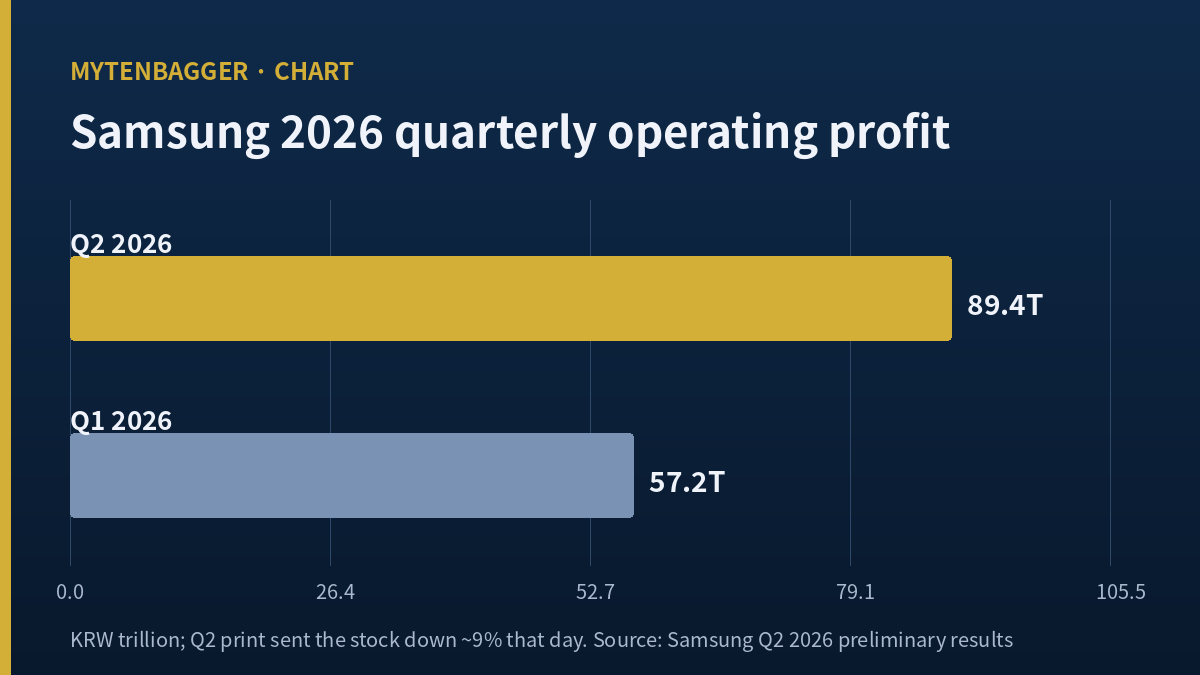
The facts first. In its preliminary Q2 release on July 7, Samsung guided to KRW 171 trillion in revenue and KRW 89.4 trillion in operating profit. That’s up 129.3% in revenue and roughly 1,810% in operating profit year over year, and up 56% sequentially — a record high for the third straight quarter. Per Seoul Economic Daily, it beat the pre-announcement consensus, which had sat in the mid-80-trillion range.
| Metric | Q2 2026 | Note |
|---|---|---|
| Revenue | KRW 171T | +129.3% YoY |
| Operating profit | KRW 89.4T (~$58B) | +1,810% YoY; record |
| Prior quarter (Q1 2026) | KRW 57.2T | previous record |
| Nvidia’s best-ever quarter (op. profit) | $53.5B | Samsung’s Q2 topped it |
| 2026 capex plan | $70B+ | capacity + R&D |
Source: Samsung preliminary Q2 disclosure (2026-07-07) and press coverage | As of: July 2026
One footnote matters. The number is net of a special performance bonus tied to 10.5% of annual results; per Benzinga and Korean coverage, the industry pegs that accrual at roughly KRW 17-20 trillion booked this quarter. Estimates vary, but the direction is the same: after handing employees their cut up front, KRW 89 trillion was still left over, which implies the company actually earned north of KRW 100 trillion before the bonus. And that $58 billion, as the Wall Street Journal noted, edges past Nvidia’s $53.5 billion — the largest operating profit any private company had booked in a quarter until now. For context on scale, KuCoin’s flash summary noted Korea’s government is treating Samsung and SK Hynix as core pillars in the global AI race, with the two conglomerates planning a combined KRW 800 trillion in domestic fab buildout.
This was a preliminary release, so there’s no divisional breakdown yet. Benzinga notes the full report lands July 30, when Samsung will split out semiconductor, mobile and consumer electronics. That date matters for a second reason: pre-earnings coverage flagged that with record profit realized, the market is watching for expanded shareholder returns — Samsung already runs a KRW 9.8 trillion annual dividend and is sequentially cancelling shares under a KRW 10 trillion buyback. Lee Jong-wook of Samsung Securities argued in that same coverage that current investor worry is “noise, not fundamental damage,” and named the LTA disclosures, next year’s HBM pricing, and a more aggressive return policy as the near-term catalysts. I’m not adopting his conclusion — I’m noting that the people closest to the tape see the same setup I do and read the drop as positioning, not deterioration.
Record Samsung Q2 operating profit, and the stock drops 9% — why
The market’s verdict ran the other way. Per Yahoo Finance, investors wiped more than $80 billion off Samsung’s market value in a session, and Benzinga had the stock at KRW 291,500 (about $191), down 8.33% intraday. The shares had touched an all-time high near KRW 358,500 in late June before shedding roughly 14% into the print.
Three layers drove the drop. First, peak-out fear. Morgan Stanley — the house that triggered the 2024 “Winter is coming” memory sell-off — recommended reducing memory exposure, citing slowing DRAM price gains, stabilizing inventory improvement, and EPS revisions topping out. Second, positioning: foreign investors had been heavy net sellers of Korean equities, offloading trillions of won on the session alone. Third, cost-structure reading — some in the market took the bonus accrual as the start of a fixed-cost problem. As Charu Chanana of Saxo Markets framed it in coverage of the KOSPI plunge, strong earnings are no longer enough — investors now want strong earnings and confident guidance and proof of durable pricing power.
The trailer for all this ran the week before. On a day Korean chip exports crossed $40 billion for the first time, Samsung still fell 9%. The triggers, per that same coverage: a month-over-month dip in June DRAM export unit prices, Apple flagging device price hikes on memory costs, and Meta signaling a cap on AI capex — read by the market as an early sign hyperscaler infrastructure spending may have peaked. So yesterday’s drop wasn’t a reaction to one earnings line. It was a week of accumulated peak-out anxiety using the print as an exit.
Honest admission: when the low-290s flashed intraday, I wavered for a minute. When your account is red on the day the company prints the biggest quarter in corporate history, the sell finger twitches. What pinned it down was the data in the next section.
A bonus, not a cost problem — where the market and I part ways
Here’s my read. The market treated the KRW 17-20 trillion accrual as the onset of cost bloat. I read it the other way. It means this is a company that can hand 10.5% of its profit to employees and still clear KRW 89 trillion in a quarter. A performance bonus is an earnings-linked cost — it only exists because the earnings exist. The accrual ballooning is almost a tautology for the core business printing money. It isn’t fixed overhead climbing.
And one more thing: the earnings-day record. Investing.com’s history shows that even when operating profit more than doubled sequentially in Q3 2025, the stock fell 1.82% on the print; when it first cleared KRW 20 trillion in Q4 2025, it dropped 1.56% on the day. Only Q1 2026 — an outright blowout past expectations — rose after the print. In other words, “down on earnings day” is closer to a habit for this stock than a cycle-top signal. The size of this drop is a different order, and I hold that much caution too. But the equation “record earnings, so it fell, so it’s over” isn’t supported by this stock’s own history.
The bonus is an earnings-linked cost, not fixed overhead — and this stock has a habit of falling on the print. Those two facts stayed my hand.
What decides the next Samsung Q2 operating profit chapter — my paths
Base case: the shortage keeps pushing earnings (my 55%)
Samsung was first to ship its sixth-generation HBM4 in volume, and it is taking share in an HBM market SK Hynix had largely owned — SK Hynix still leads at 50-55%, with Samsung around 35-40% per industry trackers. The supply picture is tight: DRAM inventories at major suppliers fell to roughly 3.3 weeks by late 2025, matching 2018 supercycle lows. On valuation, the mismatch is the whole story. Per an UncoverAlpha analysis, Samsung trades at a forward P/E of roughly 5-7x — and that multiple covers the whole company, not just memory — while Micron, the only US-listed memory pure-play, carries a forward P/E near 9. Both are pricing in almost no growth premium. That is the gap I’m long into.
Micron is the cleanest read-across for US-based holders who can’t easily buy Samsung directly. Per that 24/7 Wall St. coverage, Micron’s fiscal Q1 2026 posted $13.64 billion in revenue, up 56.6% year over year, with GAAP gross margin expanding to 56.0% from 38.4% a year earlier — its Cloud Memory unit alone did $5.28 billion at a 66% gross margin as customers locked in future HBM supply. If a pure-play memory maker is running mid-50s gross margins into an AI-driven shortage, Samsung’s own memory economics are running in the same direction — and Samsung is the lower multiple of the two. The counter, of course, is that Samsung is the whole conglomerate: foundry, mobile, and consumer electronics dilute the memory story, and that mix is exactly why the multiple is lower. I hold that both things are true and still find the risk/reward on my side.
Correction case: Morgan Stanley is right (my 30%)
Prices rising and the rate of price increases holding are different things. Morgan Stanley’s argument is that the latter rolls over; once slowing gains show up in the monthly data, the EPS-revision cycle tops and the multiple contracts first. If foreign selling persists into the second half, earnings and price can decouple for longer than feels reasonable. I originally put this in the low teens; after watching yesterday’s reaction, I moved it to 30%. A market this twitchy is itself information.
Worst case: AI capex actually shrinks (my 15%)
The scenario where hyperscaler data-center spending genuinely contracts. Meta’s capex-cap signal was one of last week’s triggers, and as the BlackRock Investment Institute framed it, the core of the AI-bubble debate isn’t today’s valuations but whether future profits stay extraordinary. Albert Yong of Petra Capital Management read the sell-off as attention shifting to the memory cycle’s long-term trajectory rather than the quarter in hand — which is another way of saying the market has stopped paying for a single great print. This isn’t a Samsung-specific risk — it’s a whole-cycle risk, so if it comes I can’t dodge it, only watch for it at the breakpoints.
Where I have to admit the Samsung Q2 operating profit story broke
My breakpoints carry different weight. The heaviest is the direction of DRAM prices. Morgan Stanley warned about slowing gains, not an outright fall — but if the monthly price data moves from decelerating to actually reversing, the heart of my base case (“the shortage keeps pushing earnings”) stops. That’s when I recompute the hold from scratch. Next in weight is HBM4: if the second-half ramp that both the company and the sell-side are counting on doesn’t show up in the full report and Q3 numbers, I cut the probability on the re-rating path. Last, as a secondary gauge, is foreign flow — I won’t sell on that alone, but if the first two signals crack and outflows pile on top, I have to accept a stretch where the numbers are right and the trade is still wrong. I order them on purpose: on a day the stock is crashing, I want this list making the call, not my nerves.
On the day it earned $58 billion, I sat still
My cost basis sits near KRW 300,000, and yesterday’s close came right back to that neighborhood. So I’m sitting roughly at break-even, holding the company that just earned more in a quarter than any private company in history. Writing that sentence still feels strange. The one regret is simple — I watched the low-290s print and had no cash to add. Not keeping dry powder was my portfolio-management mistake, and I paid the tuition in opportunity cost this time. Still beats selling, in my read. The next checkpoints are the full Q2 report and conference call, then whether the third-quarter price hikes actually show up in the numbers. How a 9% drop on the biggest earnings day in corporate history reads later, I’m leaving here with my breakpoints.
I kept a separate journal on adding to the position through this drawdown: Samsung Stock Fell 9% on a $58B Record Quarter: Why I Bought — this post is why I hold; that one is why I bought more.