Kyeryong Construction Order Backlog Covers 4.58 Years of Revenue
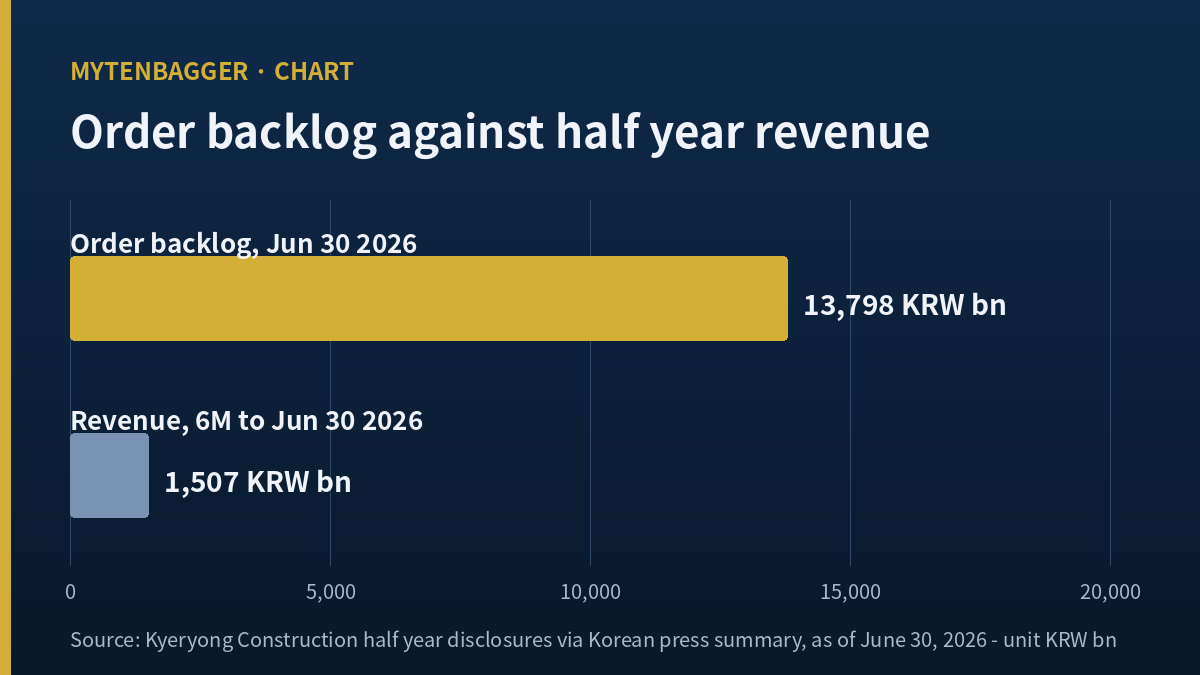
- The company reported an order backlog of KRW 13.798 trillion at June 30, 2026, and KRW 1.507 trillion of revenue for the six months ending that same day.
- The ministry issued a six month construction suspension covering December 1, 2025 to May 31, 2026, and the company won the first instance action to cancel it.
- The market closed Kyeryong Construction stock at KRW 23,500 on September 18, 2026, for a capitalization I calculate at KRW 209.855 billion, roughly $151.71 million.
A backlog is stated in won. A pace is stated in months. Those are separate units, and for most of the time I spend on Korean builders they stay separate. Here they convert into each other cleanly: the June 30, 2026 backlog of KRW 13.798 trillion divides by the KRW 1.507 trillion of revenue booked in the six months ending the same day, and the quotient is 9.1559. Nine and a bit half years. Annualized, 4.5780 years of work already signed.
I do not own Kyeryong Construction stock and I have no order resting. What pulled me in was that the division is unusually clean for this industry, and that the same three weeks of disclosures carried something else entirely in the same quarter.
Contents
Dividing the backlog by the half year behind Kyeryong Construction stock
Two disclosed figures go into this. A Korean press summary of the first half reported consolidated revenue of KRW 1.507 trillion, up 7.7 percent from a year earlier, operating profit of KRW 109.8 billion, up 37 percent, and an order backlog of KRW 13.798 trillion as of June 30, 2026. Every ratio below is mine.
| Figure | KRW | USD approx. |
|---|---|---|
| Order backlog, June 30, 2026 | 13.798 tn | $9.97 bn |
| Revenue, six months to June 30, 2026 | 1.507 tn | $1.09 bn |
| Operating profit, same six months | 109.8 bn | $79.38 m |
| Revenue, second quarter | 840.1 bn | $607.32 m |
| Operating profit, second quarter | 69.0 bn | $49.88 m |
| Market capitalization, September 18, 2026 | 209.855 bn | $151.71 m |
Sources: Korean press summary of the first half; my own multiplication for capitalization. USD figures are approximate, converted at roughly KRW 1,383.3 per dollar, the Seoul close on September 18, 2026.
So: 9.1559 half years of signed work, 4.5780 years annualized. I want to be careful about what that number is and is not. It is a stock of contracted value measured against a flow that was itself measured over six months. It carries no forecast in it, and it says nothing about the margin at which that work converts. KOSPI, the main board of the Korean exchange where this company is listed, is full of builders whose backlogs looked comfortable for years before the conversion went wrong.
There is also a question the ratio cannot reach, and I would rather name it than let it sit. A backlog converts into revenue at whatever margin the contracts carry, and those margins were set when each contract was signed, some of them years ago, under input costs that no longer apply. The operating margin I can observe for the second quarter is 8.2133 percent. Whether the remaining 4.5780 years convert at that rate, or above it, or well below it, is not visible anywhere in the two figures I divided. It is visible only in the mix of contracts inside the backlog, and that mix is not disclosed.
What the division does give me is a plain way of asking how long this company’s committed work would last at the speed it is currently being built. Four and a half years is a long answer. For a company the market values at $151.71 million, it is long enough to be worth asking why.
What a forward estimate does to the number I divide by
Dividing by a half year of realized revenue is one choice. Dividing by a forecast is another, and it changes the answer. One named Korean brokerage analyst has published estimates for this company, reported in Korean coverage dated May 29, 2026: revenue of KRW 2.974 trillion and operating profit of KRW 178.0 billion for 2026, then revenue of KRW 3.295 trillion and operating profit of KRW 213.0 billion for 2027. In dollars at the same September 18 rate, the 2026 revenue estimate is roughly $2.15 billion.
Put the June 30 backlog over that 2026 revenue estimate and I get 4.6395 years, which is close to the 4.5780 years I got from the realized half. The two paces disagree by less than a tenth of a year. That is worth something: the pace I extrapolated from six actual months and the pace one analyst expects for the full year are not far apart, so the length of the order book is not an artifact of picking a slow half as the base.
Two cautions on that, though. The estimate is one house, read through secondary coverage and never through the report itself, and an estimate that agrees with my extrapolation is agreement between two guesses about pace, and confirms neither. The same coverage carries a valuation the analyst attaches to the shares, sitting above the September 18, 2026 close. I have not printed that figure in this entry, because a single house’s valuation printed without the second and third opinions that would frame it reads as an endorsement of a number I cannot check.
How I settled the September 18 close and the share count
The close
Four sources, two prices. Two of them put the September 18, 2026 close at KRW 23,500. A third printed a higher figure in its headline price field, but every derived number on that same page resolved to the lower one: its capitalization over its share count, its earnings multiple times its per share earnings, its book multiple times its per share book. One field stood apart from four of its own neighbors, so I dropped that field and kept the rest. A fourth source agreed on the price but carried a capitalization implying a different share count, so from that one I dropped the capitalization instead.
The share count
I used 8,930,000 shares and multiplied: 23,500 times 8,930,000 is KRW 209,855,000,000. Two independent back calculations agree on the count, both running through per share book value at two different reporting dates. A third path, through a disclosed dividend total, lands close but not identical, and I did not treat the gap as anything in particular. Arithmetic can tell me that two numbers differ. It cannot tell me what the difference is made of.
Where the half year came from, quarter by quarter
The first quarter
The first quarter disclosure of May 15, 2026 carried revenue of KRW 670.7 billion, up 0.3 percent, operating profit of KRW 40.8 billion and net profit of KRW 22.4 billion. Flat on the top line.
The second quarter
The second quarter carried revenue of KRW 840.1 billion, up 14.4 percent from the same quarter a year earlier, and operating profit of KRW 69.0 billion, up 40.8 percent. Sequentially the top line is 1.2526 times the first quarter. The operating margin I get for the second quarter is 8.2133 percent against 7.2860 percent for the half.
Reading the three growth rates together is more useful than reading any of them alone. The first quarter grew 0.3 percent against its own prior year quarter, the second grew 14.4 percent against its own, and the half came out at 7.7 percent. The half year rate sits between the two quarterly rates, which is what arithmetic requires, but the distance from one end to the other is the part I noted. Essentially all of the half year growth was produced in three months. For a business that recognizes revenue as work proceeds, that pattern usually means either that sites started late in the first quarter and caught up, or that the comparison quarter a year earlier was itself unusual. I could not determine which from the figures I have.
Here is a small thing I checked and want on the record. The two quarterly operating profits sum to KRW 109.8 billion, which matches the half year figure exactly. The two quarterly revenues sum to KRW 1,510.8 billion, which is 0.2522 percent above the KRW 1.507 trillion reported for the half. That gap is almost certainly rounding in the reported half year figure, but I did not confirm it, so I am naming it instead of smoothing it.
I have taken apart two other Korean building materials names this way. One paid out almost all of a halved profit, and another turned out to have two cheap multiples that were really the same statement. Neither is a contractor, and neither carries a backlog. That is part of why the division at the top of this entry interests me.
A six month suspension sits inside the same order book
What the September 11 filing says
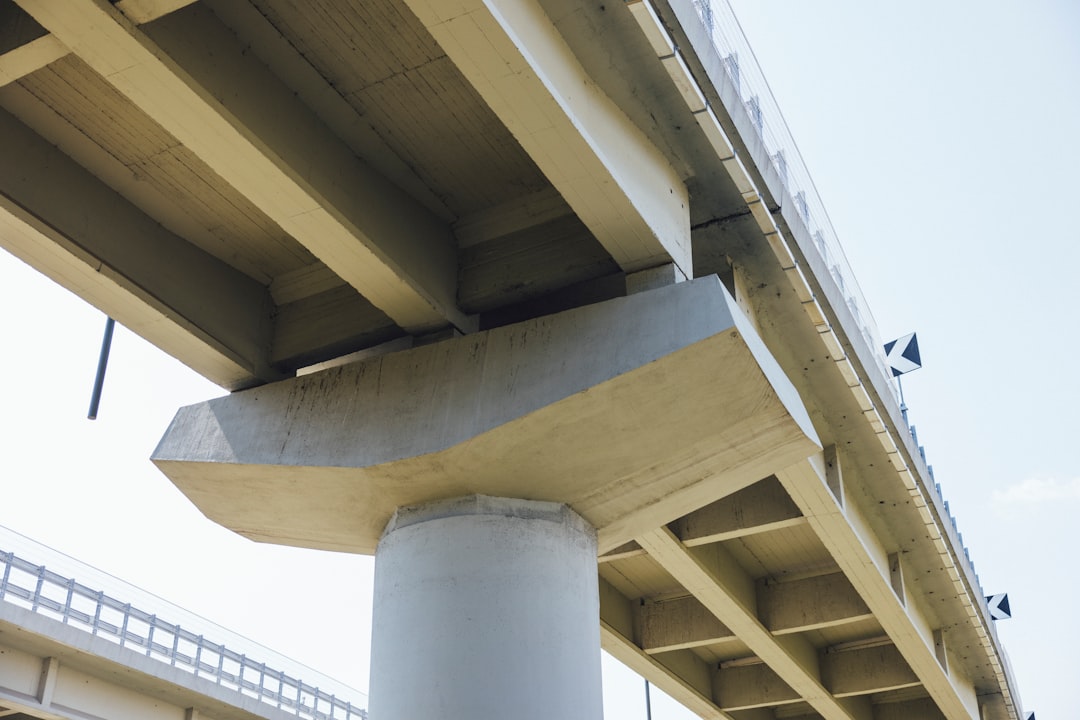
A restated material event report dated September 11, 2026 covers an administrative suspension of construction business, issued by the Ministry of Land, Infrastructure and Transport in connection with a girder collapse on a road project. The stated period ran December 1, 2025 to May 31, 2026, six months. The filing puts the suspended business amount at about KRW 213.6 billion, which it sets against a recent turnover base of about KRW 316.9 billion for 67.4 percent. That base covers the relevant license category alone and excludes the rest of the company.
The company won at first instance in the action to cancel the order, and the filing says it will respond to further steps depending on whether the ministry appeals. Work contracted before the order could continue either way. So the item is neither closed nor running.
Set that beside the backlog and a tension appears. A backlog is a claim on future revenue that depends on the license that lets you keep winning the next one. I am not saying the two cancel out. I am saying they live in the same quarter and I cannot net them against each other, which is why the number at the top of this entry is where I begin and never where I finish.
There is a reason that license question carries real weight here instead of passing as a formality. This is a contractor whose standing rests on public work. Korean trade coverage reports that the company took KRW 1.58 trillion of public sector awards in 2024, roughly double the prior year and first in the country by that measure, and that it reached fifteenth in the 2025 national construction capability assessment, its highest placing, after four consecutive years of improvement. A suspension of the construction license does not work as a fine for a company built that way. It is a bar on the door of the room where the next award is decided.
Two September awards sit on the other side of the same three weeks. A contract for a small scale housing redevelopment association was disclosed on September 17, 2026, and a designation as main contractor for a housing redevelopment project was disclosed on September 14, 2026. Each filing sets its own value at a low single digit share of recent revenue. Both are association driven projects, which in Korea means long lead times between designation and ground breaking. Neither is public work, which is where this company has done its best winning.
The peer I looked for and did not take beside Kyeryong Construction stock
My axis here is an order backlog expressed in years of revenue. That concept should travel. Japanese general contractors publish an equivalent line, and Kajima Corporation on the Tokyo exchange is the same kind of business: civil engineering and building construction, heavy on public infrastructure, with real estate development alongside. It is the obvious place to look.
I took nothing from it. No figure, no ratio, no direction. The reason is definitional. A Korean contractor’s backlog and a Japanese contractor’s equivalent are both translated into English as order backlog, but what each includes for awards not yet under way, and for a partner’s portion of a joint project, is settled in each country’s own reporting practice. I did not read either set of notes. Putting a number from one beside a number from the other would have produced a comparison that looks precise and means nothing.
I want to be concrete about what could have gone wrong, because “definitions may differ” is the sort of caution that gets written and then ignored. Suppose the Japanese figure counts only work under way and the Korean figure counts everything signed. Then a ratio built from the second is mechanically larger than one built from the first, and a reader comparing them would conclude that the Korean contractor holds the longer order book when the two companies might hold the same one. The error would not announce itself. Both numbers would be correct inside their own reporting systems, and the sentence joining them would be the only false thing on the page.
What the peer gave me, then, is a judgment and not a datum: the concept exists elsewhere, and I could not verify that it is the same concept. I am recording the judgment because the absence of a peer table here is a decision and never an oversight.
Three paths I can see from here for Kyeryong Construction stock
These weights are mine and they are opinions and nothing like measurements.
The path I weight most, at about 41 percent. The ministry does not appeal, or appeals and loses, the September awards keep arriving at roughly the observed cadence, and the third quarter report shows the backlog holding near KRW 13.798 trillion while revenue grows. In that world the 4.5780 years is being replaced as it is consumed, and the question moves to margin.
Where I could be wrong, at about 37 percent. The backlog declines through the third quarter without revenue rising to explain the drawdown, which would mean the stock of work is being eaten while nothing replaces it. A named Korean broker does publish forward revenue and operating profit estimates for 2026 and 2027 and attaches a valuation above the September 18, 2026 close. I did not print those figures, and I explain why further down.
One thing worth separating out: none of these paths turns on the price. They turn on two lines in one document. That is unusual for me, and it is a consequence of choosing an axis that has no price term in it. The capitalization appears in this entry once, in the opening summary, and never enters a ratio I rely on.
The remaining paths, about 22 percent. Better, at roughly 15 percent: conversion improves and the second quarter margin of 8.2133 percent proves to be a floor. Worse, at roughly 7 percent: the suspension is revived on appeal while an association project slips, and both hit the same reporting period.
What would break my reading of Kyeryong Construction stock
- The third quarter report shows a backlog below KRW 13.798 trillion while revenue does not rise, which would mean the years were being consumed and not replaced.
- The ministry appeals and the suspension is restored, which changes the basis on which new awards can be won.
- The second quarter operating margin of 8.2133 percent does not hold into the third quarter despite higher revenue.
- A second Korean broker publishes forward estimates that sit materially below the one I found, which would tell me the single estimate I saw was an outlier.
The first and third are answered in one document, the third quarter report, whose statutory filing deadline is November 16, 2026.
The case against what I just wrote about Kyeryong Construction stock
- A backlog measured at one date against a flow measured over six months is a stock set against a flow, and the two are not the same kind of quantity.
- The backlog figure came to me through a press summary, and I did not open the half year report itself.
- I do not know how this company defines its backlog for awards that have not started on site.
- I do not know what portion of the backlog belongs to partners in joint projects.
- Four and a half years of work at current pace can also describe a company that cannot execute quickly enough.
- Revenue growth of 7.7 percent over the half is not obviously consistent with a backlog of that size being worked through.
- The two quarterly revenues do not sum exactly to the reported half year figure, and I assumed rounding.
- Operating profit growth of 37 percent against revenue growth of 7.7 percent is the kind of gap that usually has a cause I have not identified.
- The second quarter margin of 8.2133 percent is a single observation.
- I did not look at how much of the first half profit survived to the bottom of the statement.
- The suspension was canceled at first instance only, and first instance decisions are reversed.
- The 67.4 percent in the suspension filing applies to a license category base of about KRW 316.9 billion, and I verified nothing about that base beyond the filing text.
- The two September awards are small next to a backlog of this size, on the percentage of revenue that each filing states for itself.
- Association led redevelopment carries schedule risk that a backlog figure does not show.
- A designation as main contractor does not put a shovel in the ground.
- Only one named broker’s forward estimates turned up, and I read them through secondary coverage.
- Korean press reported two fatal site incidents at this company during 2025, and safety costs surface in accounts later than they happen.
- The balance sheet carries more liabilities than twice equity, and I did not work through the funding of the current expansion.
- I declined the one cross border comparison available to me, which leaves the backlog number without external context.
- This company sits outside the largest hundred listings on its own exchange, and my default for that group is to hold no position at all.
Closing this Kyeryong Construction stock entry
My position is unchanged: nothing held, nothing ordered, watching. The stance default for a listing this far down the board says nothing about the business itself.
The backlog label is where I nearly went wrong in this entry. I had Kajima open in one window and my own division in another, and for a few minutes I was composing a sentence that set the two backlog-to-revenue ratios side by side. It would have read well. I stopped because I could not name the document in either country that defines what goes into that label, and a comparison whose terms I cannot name is decoration. The rule I am keeping: before setting two identically named lines from two countries beside each other, name the document that defines the name in each. If I cannot name it, take nothing.
Of what I have written here, the lines most likely to survive a year are the two disclosed figures, KRW 13.798 trillion and KRW 1.507 trillion, and the quotient 9.1559 that follows from them. The line that ages first is KRW 23,500, which is already stale when the market opens on September 22, 2026.
My question changed while I was writing. I came in asking how much work this company has. I am leaving asking who else owns part of it, and on what terms it was counted.
Prices and multiples reflect the September 18, 2026 close. USD figures are approximate, converted at roughly KRW 1,383.3 per dollar on the same date, and rounded.
Related reading