Korea’s Handsome Corp Earnings: Markdowns Took the Margin
Contents
Two Companies, One Line Pulled From Each Balance Sheet
I keep a note where I copy one line out of two filings and set them side by side. This week I put Handsome Corp stock (KRX: 020000) next to Ralph Lauren (NYSE: RL), and the line I pulled was inventory.
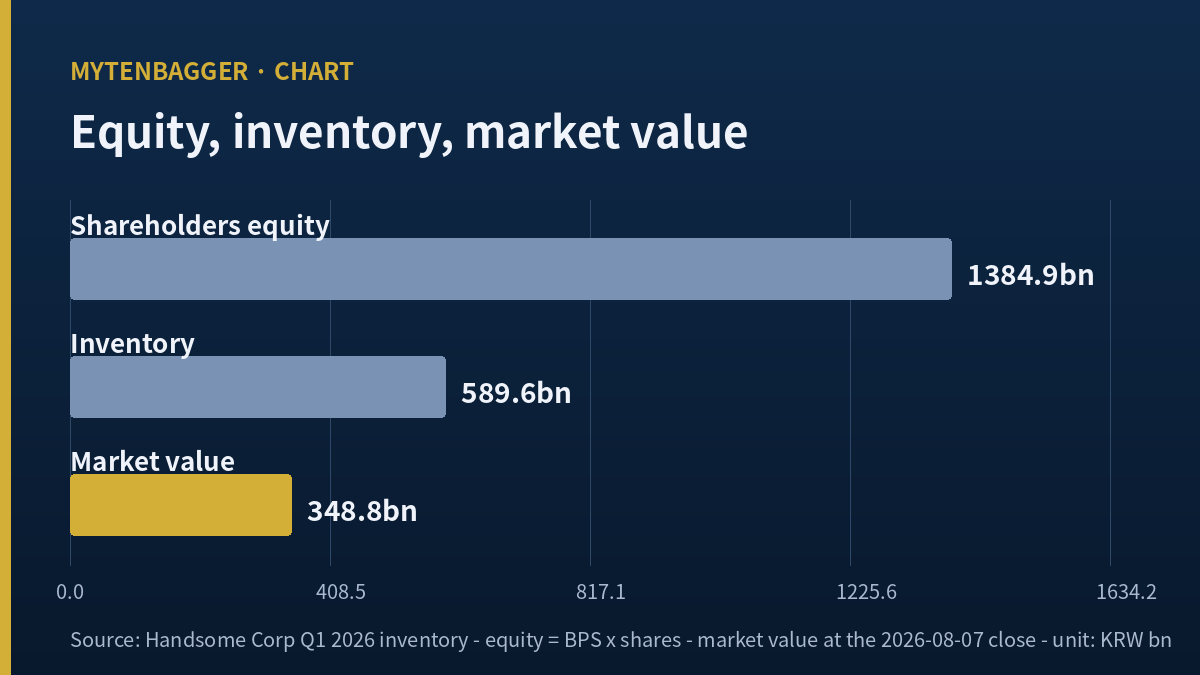
Handsome carries 589.6 billion won of clothes, about $416 million. Its entire equity market value on the August 7, 2026 close was 348.8 billion won, roughly $246 million. Ralph Lauren carries $1.16 billion of clothes and the market values the company at $23.57 billion. Divide each market value by each inventory figure and you get 0.59x for the Korean company and 20.25x for the American one. That is a gap of 34.23 times on the same accounting line, in two companies that both make clothes, ship them to stores, and discount whatever does not sell.
What follows is my attempt to work out whether the Korean number is a mistake by the market or a mistake in my arithmetic. I did not resolve it, and the second quarter is the reason.
What Handsome Corp Stock Costs Against Its Own Inventory
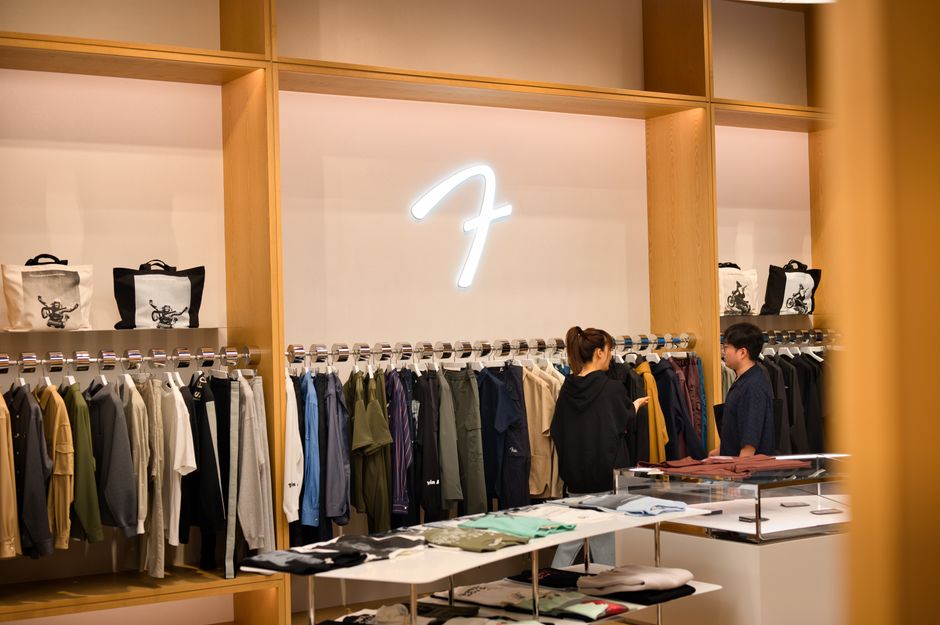
Handsome Corp is a Korean apparel company listed on the KOSPI, the main board of the Korea Exchange, and it belongs to the Hyundai Department Store Group. It runs domestic designer labels such as Time and System and also imports and distributes foreign brands. Almost all of its revenue comes from South Korea, and department store concessions are its main channel.
The inventory figures come from Bloter, a Korean trade outlet that reads the filings, in an article dated July 14, 2026 (Tue). At the end of the first quarter of 2026 inventory stood at 589.6 billion won, which the article puts at 34.3% of total assets. Working backwards, total assets are roughly 1,719 billion won. Year-end levels barely moved for three years: 610.5 billion won in 2023, 624.3 billion in 2024, 620.1 billion in 2025.
The split is disclosed too. Purchased goods, meaning imported brands the company buys in, were 178.1 billion won. Self-designed products were 325.0 billion won. Those two add to 503.1 billion, leaving 86.5 billion in raw materials and merchandise not yet received (my calculation). And the company has already written down part of it: the valuation allowance ratio on inventory was 9.4% at the end of the first quarter, about 55.4 billion won (589.6 × 9.4%, my calculation).
So here is the comparison I keep coming back to. The market capitalization of 348.8 billion won equals 59.16% of that one inventory line. Match the dates and use the December 2025 figure of 620.1 billion won and it is 56.25%. Either way, even if every other asset and every liability cancelled out exactly, you would be paying about half of what the clothes are carried at.
I want to be precise about what that does not mean. It is not a statement that the market has marked the inventory down by 40%. Market value is equity after liabilities, and inventory is one asset among many, so the ratio is an upper bound built on an extreme assumption. The assumption is less violent here than at most companies, because Handsome’s debt-to-equity ratio is 18.75% and its interest coverage is 41.56 times, implying interest expense of about 1.26 billion won a year (52.2 ÷ 41.56, my calculation). Still, one division does not settle anything. What interested me was the distance between the 9.4% the company itself has recognized and the roughly 41% implied by that upper bound.
The Quarter That Tested What Handsome Corp Stock Is Buying
Revenue up, margin down
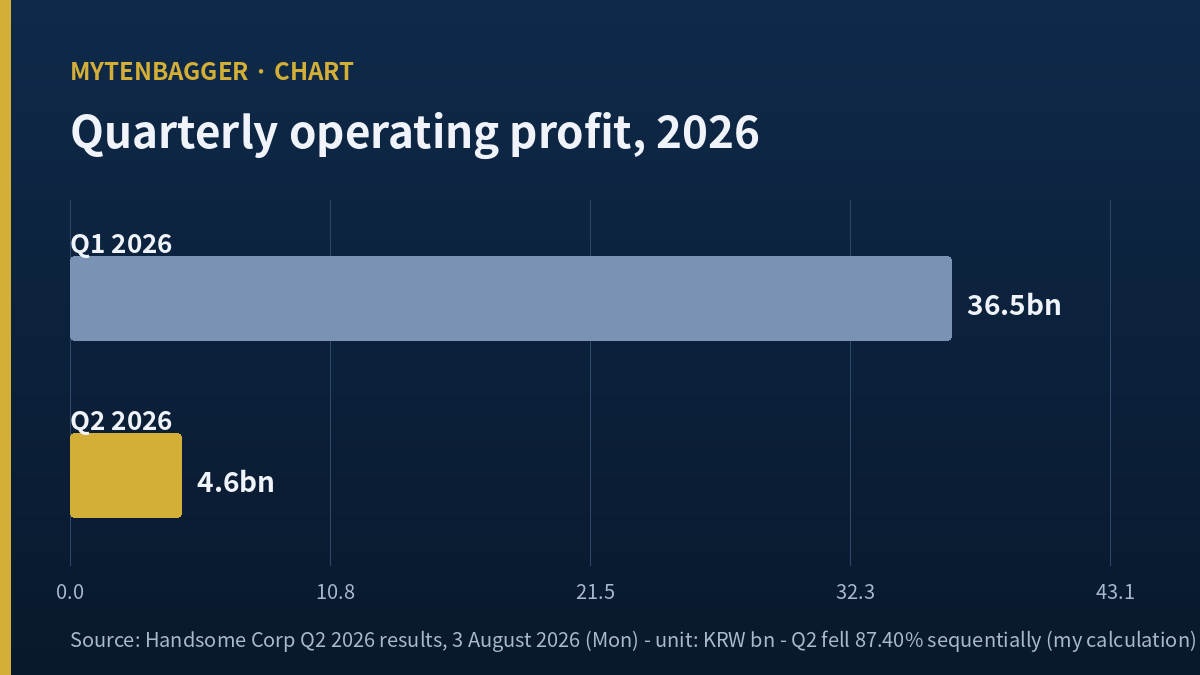
On August 3, 2026 (Mon), Handsome reported second-quarter consolidated revenue of 363.2 billion won (about $256 million), up 7.4% year on year; operating profit of 4.6 billion won (about $3.2 million), up 525%; and net profit of 3.3 billion won, up 34.7%. All three lines grew. The prior-year operating profit behind that 525% was 736 million won (4.6 ÷ 6.25, my calculation). Newspim called the increase a base effect on the day of the release and headlined the piece around a profitability warning hidden behind it.
Set against the previous quarter the direction inverts. First-quarter revenue was 410.4 billion won with operating profit of 36.5 billion won, so second-quarter operating profit fell 87.40% sequentially (4.6 ÷ 36.5 − 1, my calculation). Quarterly operating margin went from 8.89% to 1.27%. First-half totals were 773.6 billion won of revenue, up 7.7%, and 41.1 billion won of operating profit, up 82.7%, and the quarters sum exactly to the halves.
The cause was the inventory itself
Daishin Securities, in a note dated August 3, 2026 (Mon), put the margin compression down to the liquidation of imported brands launched in 2022 and 2023, with gross margin down 0.9 percentage points year on year. Bloter reported the resulting gross margin of 53.8% on August 4 (Tue) and carried a second figure in the same piece: purchased-goods revenue grew 12.8% while self-designed product revenue grew 5.4%. The bought-in clothes moved 2.37 times faster than the made-in-house ones (my calculation). That ratio is the fingerprint of the discount.
There is a limit to what the quarter settled, and it is worth sizing. Purchased goods were 178.1 billion won of the 589.6 billion total, or 30.21%, while self-designed products were 325.0 billion, or 55.12% (my calculations from the figures Bloter reported). The clearance that cost 0.9 percentage points of gross margin came out of the smaller slice, the imported labels the company had bought in. The larger slice, the clothing it designs and makes itself, has not been pushed through the same exercise, and how it behaves under discount is unknown to me. So my one measured observation covers under a third of the line I am trying to price. That is the honest size of the evidence.
Two Korean houses cut their numbers within two days and both kept a buy rating. NH Investment & Securities lowered its valuation from 34,000 won to 25,000 won on August 4 (Tue), noting that July revenue in women’s and men’s lines was recovering at a mid single-digit pace and calling the worry about the second half overdone. Daishin reset its own figure from 40,000 won to 30,000 won and pointed to a possible year-end consumption pickup. Cuts of 26.47% and 25.00% off the back of one quarter are not routine housekeeping (my calculations).
What the quarter gave me is a single measured point. The company discounted part of its inventory, gross margin gave up 0.9 percentage points, and the operating margin for the quarter came in at 1.27%. Nobody knows what happens if all 589.6 billion won goes out that way. But it is now on record that the clothes do not convert to cash at the value they are carried at. One observation is not enough for me to price the whole line, so I am only watching.
The Numbers Behind Handsome Corp Stock
| Item | Value | How I checked it |
|---|---|---|
| Close | 16,240 won | August 7, 2026 (Fri), Kiwoom data |
| Market capitalization | 348.8bn won / ~$246m | 16,240 × 21,477,833 shares, exact to the won |
| P/E | 7.88 | 16,240 ÷ EPS 2,060.91 = 7.880 |
| P/B | 0.25 | 16,240 ÷ 64,479 per share = 0.2519 |
| P/S | 0.23 | 348.8 ÷ 1,491.8 = 0.2338 |
| FY2025 revenue / operating profit | 1,491.8bn / 52.2bn won ~$1,053m / ~$36.9m |
Consolidated, 3.50% margin (my calculation) |
| FY2024 revenue / operating profit | 1,485.3bn / 63.5bn won | Restored from +0.44% and −17.79% growth |
| Shareholders’ equity | 1,384.9bn won / ~$978m | 64,479 × 21,477,833 (my calculation) |
| ROE | 3.3% | Vendor display |
| Debt to equity / interest cover | 18.75% / 41.56x | Implies ~1.26bn won of interest expense |
| Dividend per share / yield | 750 won / 4.62% | FY2025, 750 ÷ 16,240 = 4.618% |
| Payout ratio | 36.4% | Three routes agree, see note below |
| 250-day high / low | 28,750 / 14,180 won | Intraday basis |
| Position vs high / low | 56.49%, −43.51% / +14.53% | All three on the closing price |
| vs 20 / 60 / 120-day averages | −18.34 / −25.69 / −29.22% | Below all three |
| Foreign ownership | 25.67% | Kiwoom data |
The three payout routes: the vendor prints 36.4%; total dividends of 16.11bn won (750 × 21,477,833) over 44.26bn won of earnings restored from EPS (2,060.91 × 21,477,833) gives 36.39%; and yield 4.62 × P/E 7.88 gives 36.41. They close within 0.02 percentage points. One by-product: consolidated net profit for FY2025 was 46.2bn won, which is 1.94bn more than the EPS route produces. Since the payout closes on the smaller figure, the earnings the vendor uses for that ratio are not the consolidated total, and I read the 1.94bn gap as the minority interest share, about 4.19% of consolidated profit. I have written before about consolidated profit that is not entirely mine; here the slice is far smaller than in that case.
Prices and multiples are the August 7, 2026 (Fri) close as checked at the time of writing. I am writing early on a Monday, so the last trading day is Friday (markets were shut on August 8 and 9). Korean won is the primary currency throughout; dollar conversions are approximate, at roughly 1,416 won per dollar on the same date.
Ralph Lauren and Handsome Corp Stock, 34x Apart on the Same Account
I usually pick a peer by industry and geography. This time I picked one by a different rule: a company holding the same kind of inventory at a similar weight in its equity, which the market prices at the opposite multiple. Ralph Lauren fits.
| Item | Handsome Corp | Ralph Lauren |
|---|---|---|
| Market capitalization | ~$246m | $23.57bn |
| Inventory | ~$416m end of Q1 2026 |
$1.164bn as of June 27, 2026 (Sat) |
| Market cap ÷ inventory | 0.59x | 20.25x |
| P/B | 0.25 | 8.66 (my calculation) |
| Inventory ÷ equity | 44.78% December 2025 |
35.69% as of March 28, 2026 (Sat) |
| Trailing revenue | ~$1,053m | $8.36bn, up 14.7% |
| Last-quarter margin direction | gross margin −0.9pp on imported-brand clearance |
expansion on full-price sales and fewer promotions |
Ralph Lauren figures as displayed by stockanalysis.com after the August 7, 2026 (Fri) US close. The inventory multiple gap is 20.25 ÷ 0.59 = 34.23x; on P/B it is 8.66 ÷ 0.2519 = 34.38x. Both are my calculations.
The point of the table is not that one company is 34 times cheap. Inventory sits at a comparable weight inside each company’s equity, 44.78% for Handsome and 35.69% for Ralph Lauren, with the Korean company carrying the heavier load. The multiple gap therefore cannot be about how much inventory exists. It is about the price at which it leaves the building, and in the last reported quarter the two companies moved in opposite directions on exactly that. So the 34x is not evidence of mispricing to me. It is a signpost telling me which number to watch.
Fields I Left Out
- The vendor’s total equity field, 1,353.1bn won. Dividing market value by it produces a P/B of 0.26, and the printed figure is 0.25. The per-share route (1,384.9bn) reproduces 0.2519 exactly, so I used that one and treated the other as a different as-of date. A multiple moving the wrong way against its own inputs is something I have run into before.
- Operating cash flow 52,728, free cash flow 35,750, EBITDA 36,527. The units differ from the rest of the screen. Read as millions of won, free cash flow of 35.75bn matches the printed 10.25% free-cash-flow yield precisely (35.75 ÷ 348.8), but the EBITDA of 36.53bn is smaller than FY2025 operating profit of 52.2bn, which cannot be right. Picking whichever field happens to close would be arbitrary, so the cluster is out.
- Three-year revenue CAGR of −1.1% and the raw payout ratio of 57.7%. Period definition unclear on the first; the second diverges from the three routes that agree.
- Margin loan balance 0.9% and EV multiple 2.93. Not load-bearing here.
- The allowance write-back amounts of 7.2bn, 8.3bn and 6.0bn won for the first quarters of 2024, 2025 and 2026. First-quarter only, so they cannot be matched to a second-quarter income statement. Direction noted, nothing more.
- One coincidence I deliberately dropped. Recompute inventory over equity using each company’s latest quarter and you get 42.57% for Handsome and 42.76% for Ralph Lauren, which is a fifth of a percentage point apart. It looked good enough to put in the table. But on the Korean side the two inputs come from different quarters, so the agreement is something I arranged and not something I found. It stays out.
Nine Ways I Could Be Wrong
- Operating profit has fallen four years running. Newspim traces it from 168.3bn won in 2022 to 52.2bn in 2025, a drop of 68.98% (my calculation). Whether that is an inventory problem or a business problem, I cannot separate yet.
- The second quarter missed by a wide margin. Bloter put the market expectation above 10bn won against the 4.6bn reported. Two secondary reports rendered the same fact as “60% of expectations” and “60% below expectations”, which cannot both be right, so I used only the absolute figure.
- Overseas subsidiaries have lost money for a long time. Insight Korea reported in September 2025 that the French unit has run losses for over a decade and the Chinese unit likewise, on revenue of only a few billion won each. Small in absolute terms, persistent in structure.
- Self-rebuttal A: my two headline numbers have different as-of dates. Inventory of 589.6bn is end of Q1 2026 and the market value of 348.8bn is August 7. Four months apart, and the company cleared inventory during the gap, so the actual balance is probably lower and my 59.16% is understated. I have no way to close that gap before the next filing.
- The company already recognized impairment. The 9.4% allowance ratio is its own number, and it was 10.6% at the end of 2024. When I say the clothes will not fetch their carrying value, I am repeating something management has already conceded. The question is only whether the right figure is 9.4% or several times that.
- Demand indicators turned down. Bloter reported department store menswear revenue growth falling from 15.6% in May to 1.5% in June. The article did not name the body that compiled those figures, so I take direction from it and nothing else.
- Both covering houses cut hard. NH from 34,000 to 25,000 won, Daishin from 40,000 to 30,000. Buy ratings survived, but a quarter of the valuation did not.
- The 4.62% yield is a function of the share price. The dividend has been 750 won for four consecutive fiscal years. The yield rose because the share price fell, and not because the company paid more.
- Self-rebuttal B: I never saw the quality of the inventory. The breakdown by brand and by age sits in the notes to the semi-annual report, and the 2026 first-half version is not out. I have a total and a two-line split. How much of that inventory is several seasons old, I do not know, and I called it “59% of the clothes” anyway.
What I Chose on Handsome Corp Stock
The stance is observation.
Two things would move me from watching to working. Gross margin in the third or fourth quarter climbing clearly above the second quarter’s 53.8%, which would say the clothes leave without a discount. Or the inventory total finally dropping out of the 600 billion won band it has occupied for three years, which would say management has started to deal with it.
The verdict on my error comes from New York, not Seoul. If Ralph Lauren keeps widening margin on full-price selling next quarter while Handsome moves the other way, this is a company story. If Ralph Lauren’s margin compresses in the same period, then what I called specific to one Korean apparel maker was a condition on the whole trade, and the single-stock frame of this article was the wrong container. The overseas peer’s movement on the same accounting line is what settles it.
So two accounts of this company survive. If the 589.6 billion won is broadly real, the company is available at 59.16% of its own clothes. If those clothes only move at a discount, as the second quarter of 2026 suggests, then 589.6 billion was never 589.6 billion. I do not know which is more likely, and between owning it without knowing and passing on it without knowing, I picked the second.
What I am taking out of this one is a question I did not have before, and I will now put it to every cheap balance sheet I open: which single asset line is carrying the discount, and has the company recently been forced to sell any of it? Handsome answered the second half of that question by accident, in one quarter, and the answer cost 0.9 percentage points of gross margin.
Sources. Results and inventory: Newspim, August 3, 2026, Bloter, July 14, 2026, Bloter, August 4, 2026. Sell-side: Etoday on NH Investment & Securities, Ajunews on Daishin Securities. Share reaction: Hankyung, August 4, 2026. Overseas units: Insight Korea, September 2025. Currency: Money Today, August 7, 2026. Peer: stockanalysis.com. Indicators and benchmark decomposition from Kiwoom data, August 7, 2026 close.