Pulmuone ROE Explained: Minority Interests Hold 48% of Equity
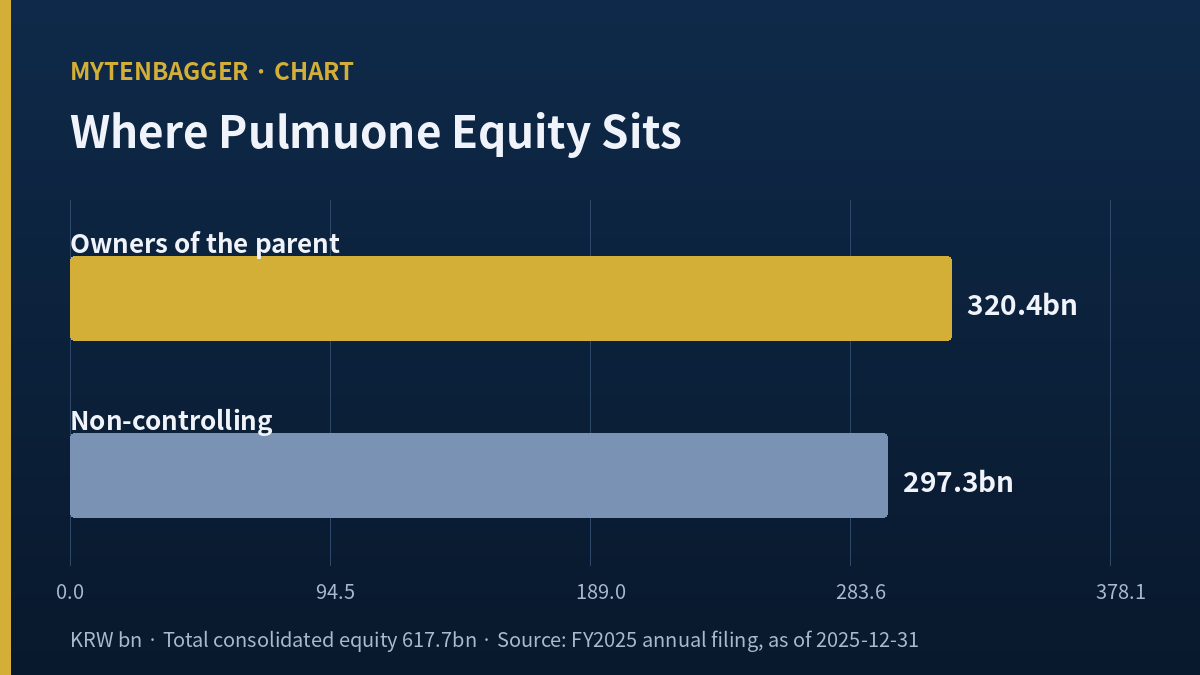
Pulmuone stock closed at KRW 9,360 (about USD 6.61) on Tuesday, August 11, 2026, which puts the market value of the listed company at KRW 356.8 billion, or roughly USD 252 million, on 38,123,012 shares. There is a KRW 297.3 billion item inside this company’s accounts that I cannot find on any screen I use, and it is 48.13% of the reported equity. Nothing about it is hidden. It is simply not the number that the per-share ratios are measured against, and until I worked out the size of it I had the scale of this business wrong.
KRW 617.7bn minus KRW 320.4bn = KRW 297.3bn (48.13%)
How I got each of the three figures:
1. KRW 617.7bn is the consolidated total equity in the fiscal 2025 annual filing, submitted on Monday, March 23, 2026.
2. KRW 320.4bn is my own multiplication: reported book value per share of KRW 8,405 times 38,123,012 shares.
3. KRW 297.3bn is what is left. The Korean filing states it directly as non-controlling interests; I did not open that line, so I subtracted my way to it.
Contents
What every Pulmuone stock ratio is actually measured against
Pulmuone trades on the KOSPI, the main board of the Korea Exchange, where roughly 950 companies list and where most of the large industrial and consumer names in Korea sit. The company makes tofu, chilled noodles, kimchi and packaged fresh food, runs a food service and distribution arm that supplies corporate canteens, military catering, airport lounges and highway rest stops, and operates manufacturing subsidiaries in the United States, China and Japan. Fiscal 2025 consolidated revenue was KRW 3,380.2 billion, about USD 2.39 billion. Consolidated operating profit was KRW 93.2 billion, about USD 66 million, the highest the company has recorded. Consolidated net profit was KRW 15.2 billion, about USD 10.7 million.
Those revenue and profit figures come from the consolidated income statement, and the consolidated income statement covers every subsidiary the parent controls, whether it owns 100% of them or 60%. The balance sheet works the same way: total assets of KRW 2,348.2 billion, total liabilities of KRW 1,730.4 billion, total equity of KRW 617.7 billion. The company’s own 2026 shareholder report carries the same four headline figures as the regulatory filing, digit for digit, so I have no quarrel with any of it.
The per-share numbers are a different measurement. WiseReport, a Korean financial data service, lists fiscal 2025 book value per share of KRW 8,405 and earnings per share of KRW 475, and states its basis plainly: net profit and total equity are stated on an owners-of-the-parent basis. That sentence is the whole article. It means the equity standing behind the ROE, the PBR and the book value per share is not the KRW 617.7 billion on the balance sheet.
Three steps, and a check that the steps hold
KRW 8,405 times 38,123,012 shares gives KRW 320.42 billion, about USD 226 million. That is the owners-of-the-parent equity at the end of fiscal 2025, by my calculation. Subtracting it from KRW 617.72 billion leaves KRW 297.30 billion, about USD 210 million, which is 48.13% of the total.
I wanted a check that did not depend on the same source, and the return on equity supplies one. The regulatory dataset reports a 2025 ROE of 2.45%. Dividing consolidated net profit of KRW 15.159 billion by consolidated equity of KRW 617.724 billion gives 2.4540%, which reproduces that figure exactly. The 5.9% ROE shown on the Korean brokerage screen cannot be produced from those two inputs at all. It requires owners’ net profit of KRW 18.108 billion (KRW 475 times 38,123,012 shares, my calculation) measured against owners’ equity of KRW 320.42 billion, which gives 5.6513%, within 0.25 percentage points of the displayed value.
So this company carries two returns on equity. On a consolidated basis it earned 2.45%. On an owners’ basis it earned 5.65%. Both computations are correct. The 2.3x spread between them is ownership structure showing through, and it is the reason I now think the screen was telling me something I was not reading.
Two book values, and I am keeping both
The Kiwoom Securities dataset gives book value per share of KRW 8,444, which is 0.46% above the WiseReport figure of KRW 8,405. Run my arithmetic on the Kiwoom number and owners’ equity becomes KRW 321.91 billion, leaving KRW 295.81 billion outside, or 47.89%. A third Korean service, Valueline, publishes a March 2026 book value per share of KRW 8,560, and pairing that with first-quarter consolidated equity of KRW 614.17 billion puts the outside share at 46.86%. My three routes land between 46.86% and 48.13%. I could not narrow that to a single figure and I am not going to write as though I had. What I can defend is that it is close to a half.

In 2025 the outside share absorbed a loss instead of taking profit
Here the numbers run against my expectation. Consolidated net profit was KRW 15.159 billion. Owners’ net profit, by my calculation, was KRW 18.108 billion. The parent’s share is KRW 2.949 billion larger than the consolidated total, which means the non-controlling share of 2025 earnings was negative KRW 2.949 billion, about negative USD 2.1 million.
The usual reading of a large minority interest is that a meaningful slice of what the group earns belongs to somebody else. In 2025 the opposite happened at Pulmuone. Losses at subsidiaries were shared with the outside investors in those subsidiaries, and the parent’s reported earnings came out above the group total as a result. When I covered HK inno.N I was separating a number the market quotes from the number a shareholder actually buys, and this looks like a cousin of that problem. It is not the same one. There the gap sat in the income statement between prescriptions and recognized revenue. Here it sits in the equity section, and its sign flipped in my favor for one year.
The same year, taken four quarters at a time
Discrete quarterly net income for 2025 runs negative KRW 3.027 billion, negative KRW 8.209 billion, positive KRW 21.732 billion and positive KRW 4.663 billion. Those four add to KRW 15.159 billion, matching the annual figure to the last won. The same exercise on operating profit gives KRW 11.263 billion, KRW 19.560 billion, KRW 38.093 billion and KRW 24.257 billion, summing to KRW 93.173 billion, again an exact match. The company lost KRW 11.236 billion at the net line across the first six months and made KRW 26.395 billion across the second six to finish the year in the black.
Operating profit of KRW 93.173 billion was 1.46% above 2024 and the best in the company’s history. Revenue of KRW 3,380.189 billion was 5.18% higher and also a record. What reached the owners of the listed company from all of that was KRW 18.1 billion, which is 0.54% of revenue by my calculation.
What Pulmuone stock does not price inside that KRW 297.3 billion
Korean credit reporting gives the outline of what fills that item. According to Bloter on Thursday, June 25, 2026, NICE Investors Service flagged that hybrid capital securities issued by Pulmuone Foods, the main operating subsidiary, had grown from KRW 68.5 billion in 2021 to KRW 228.5 billion in 2025, about USD 161 million. Hybrid securities of that kind carry no effective maturity, which is why accounting standards let them sit in equity. When the issuer is a subsidiary, they land in the non-controlling portion of consolidated equity.
The rest of that report points the same way. On NICE’s adjusted basis, net borrowings were roughly KRW 1,340 billion, about USD 946 million; the adjusted debt-to-equity ratio was 520%; short-term borrowings maturing inside a year were KRW 605.8 billion, about USD 428 million; cash and equivalents were around KRW 140 billion. The reported first-quarter debt-to-equity ratio is 288.70%. I am not subtracting one from the other, because the first is a consolidated accounting measure at March 31, 2026 and the second is a rating agency’s own adjustment, and they are not built to be differenced. The point is only that a professional creditor declines to count some of this equity as equity.
Thursday, July 30, 2026 added another KRW 70 billion
Bloter reported on Thursday, July 30, 2026 that the listed parent issued KRW 40 billion of redeemable convertible preferred shares, about USD 28 million, together with KRW 30 billion of hybrid securities, about USD 21 million. The preferred shares were priced at KRW 11,849 each, a 35% premium, and the investor holds one vote per share immediately. The report puts the investor’s voting stake at 8.14%.
Working backwards from that: KRW 40 billion divided by KRW 11,849 is 3,375,812 shares, rounding down. Added to 38,123,012 existing shares and measured against the enlarged 41,498,824, that gives 8.13%, which is 0.01 percentage points off the reported 8.14%. Either the actual proceeds differ slightly from a round KRW 40 billion or the allotment rounding works differently, and I could not settle which. What is not in doubt is the direction: if these preferred shares convert, the share count rises 8.86%, and every per-share number in this article changes with it.
The purpose of the raise is to retire expensive perpetual paper. The same report describes what is being repaid, a perpetual convertible bond carrying a 2% coupon but a guaranteed 9.5% compound yield on early redemption. Getting out of that looks like a sensible move to me. What holds my attention is different: this KRW 70 billion enters as accounting equity, and none of it enlarges the common shareholder’s claim.
The rating agencies separated this equity before I did
In June 2026, NICE cut Pulmuone Foods’ long-term credit rating from A minus with a negative outlook to BBB plus with a stable outlook, and moved the hybrid securities of both Pulmuone Foods and the listed parent from BBB plus negative to BBB stable. Korea Investors Service had made the same move on the parent’s hybrids a month earlier. The stated cause was a high borrowing burden and the resulting deterioration in financial structure.
The ratings went down and the outlooks went up, and quoting only the first half of that would be unfair to the company. Management’s response is specific: manage capital expenditure through investment efficiency, reduce the hybrid balance in stages, and keep growing food service distribution while improving overseas profitability. The July raise reads as the first step of that plan.
The operating picture supports them too. Newspim reported on Friday, May 15, 2026 that first-quarter consolidated revenue rose 7.2% to KRW 850.4 billion and operating profit rose 68.9% to KRW 19.0 billion. The filed figures are KRW 850.352 billion, up 7.17%, and KRW 19.020 billion, up 68.87%, which agree with the press to one decimal place. The overseas manufacturing and distribution segment grew 13.8% to KRW 189.8 billion and returned to roughly breakeven; the United States has now posted three consecutive profitable quarters and Japan cut its loss by more than 40%.
Pulmuone stock fell 43.48% over twelve months
Across 244 trading days from August 11, 2025 to Tuesday, August 11, 2026, the shares lost 43.48% on a closing basis. Over the same window the KOSPI gained 97.88% and the Korean food sector index fell 9.70%. That leaves the stock 141.36 percentage points behind the market and 33.78 percentage points behind its own sector, both of which fall in the heaviest loss band. Within the 77 food names measured, it ranks 69th, in the bottom 10.4%, beating eight of them against a sector median of negative 12.0%. Switching the sector to a market-value weighting still leaves it 37.21 percentage points behind, so the verdict does not depend on the weighting. Decomposing the shortfall against the market puts 76.1% of it on the sector and 33.78 percentage points on the stock itself.
On closing prices the peak was KRW 16,560 on August 11, 2025 and the trough was KRW 8,610 on Thursday, July 30, 2026, a maximum drawdown of 48.01%, with the stock now 8.71% off that low. The trough date is the same day as the preferred share report. I notice that and I am leaving it as a coincidence of dates, because I have no evidence connecting them.
Against the 250-day intraday range of KRW 18,490 and KRW 8,100, Tuesday’s KRW 9,360 close sits at 50.62% of the high, 49.38% below it and 15.56% above the low. I recomputed all three from the KRW 9,360 close. The screen shows 51.0%, negative 49.0% and 16.4%, which are calculated from Monday’s KRW 9,430 close, so they differ slightly.
At Hain Celestial the equity figure means one thing
For a comparison here I chose The Hain Celestial Group (NASDAQ: HAIN), an American organic and plant-based food maker. I did not choose it because the businesses resemble each other. I chose it because the accounting structure does not. Hain has none of what I have spent this article measuring.
In results released on Monday, May 11, 2026 for its fiscal third quarter, which ended March 31, 2026, Hain posted net sales of USD 338.4 million, down 13%, a GAAP operating loss of USD 42.1 million against adjusted operating income of USD 12.8 million, a GAAP net loss of USD 106.3 million, and adjusted EBITDA of USD 26.3 million, down 22%. Total debt stood at USD 549 million, down USD 156 million since the start of its fiscal year, with net debt of USD 505 million. Stockholders’ equity was USD 215.5 million, down from USD 475.0 million at June 30, 2025. On the operating numbers alone, Hain is having a worse year than Pulmuone.
What it also has is a single equity figure. That USD 215.5 million, roughly KRW 305.1 billion at Tuesday’s rate, belongs to common shareholders, and the release makes no mention of any minority interest. Saying net debt is 2.34x equity at Hain takes one calculation and one figure. Saying anything comparable about Pulmuone requires me to pick an equity figure first, and the answer moves depending on which one I pick.
Three limits on that comparison
First, the product mixes differ. Pulmuone is weighted toward chilled fresh food and a large food service distribution arm; Hain is a portfolio of organic packaged brands. Second, the fiscal years start at different points. Hain closes in June, so the quarter I quoted is its third and not its first. The quarter-end of March 31, 2026 happens to match Pulmuone’s first quarter, so on this occasion the periods line up, but that will not hold next time. Third, I read Hain’s earnings release and did not open its quarterly filing. The accurate statement is that no minority interest appears in that release. Whether one exists is something I did not check.
Every document behind this argument exists only in Korean
Every document that carries the argument in this article exists only in Korean. The annual filing that states equity attributable to owners of the parent and non-controlling interests as two separate lines is written in Korean. The NICE rating action that names the hybrid balance is a Korean-language release. The preferred share issuance from July is a Korean disclosure and a Korean news report. A reader working only in English can hold this stock for a year without ever seeing the sentence that made me stop and check. Foreign ownership stands at 1.46%, which is consistent with almost nobody having gone looking.
If somebody reading this wanted to do the work instead of taking my word for it, the order I would use is: the equity section of the semi-annual filing due Friday, August 14, 2026, for the two ownership lines; the notes for hybrid securities and the July preferred share issuance; then the NICE rating rationale for the adjusted borrowing figures. That is three Korean documents and perhaps an hour with a translation tool. It is more work than a screen, and it is the whole difference between the two ROEs in this article.
Ten things that cut against my reading of Pulmuone stock
1. A large minority interest is not by itself a defect. It can mean subsidiaries funded their growth without diluting the parent, and in 2025 the structure worked in the parent’s favor by pushing KRW 2.949 billion of loss outside.
2. My central figure is two calculations deep. I derived owners’ equity from book value per share and then subtracted to reach the minority interest. I never opened the filed line.
3. Because of that, the answer will not converge. Depending on the source it sits anywhere between 46.86% and 48.13%, and that width is a real weakness in what I have written.
4. I could not pin down the earnings basis behind the 19.87x trailing price-to-earnings multiple, because the dataset derives its EPS from price divided by that multiple, which is circular.
5. The 2026 consensus carried by WiseReport is EPS of KRW 1,241, book value per share of KRW 9,091, 7.60x earnings and 1.04x book. The expensive-looking 19.87x that caught my eye disappears on forward estimates.
6. Hybrid securities have no maturity and no immediate repayment obligation. Step-up coupons can be managed by refinancing or conversion, and the July raise is management doing exactly that.
7. The credit ratings fell but the outlooks improved. Reporting only the downgrade would carry half the information.
8. First-quarter operating profit up 68.87% and overseas operations back at breakeven have nothing to do with the capital structure I am measuring. The business is improving and my argument explains none of that improvement.
9. Newspim reported on Friday, July 31, 2026 that the company is raising prices on 30 items across seven product groups by an average of 6.7%, effective at major retail channels from Thursday, August 13, 2026, citing packaging, imported raw material and freight costs. That lands in second-half margin, and there is no place for it in my argument.
10. The preferred shares were issued on Thursday, July 30, 2026, after the June 30 balance sheet date. The semi-annual filing will show them only in the notes. The document I am waiting on will not answer everything I want to ask it.
Numbers I left out
Vendor fields I discarded
The EBITDA field reads 19,020 in millions of won, which is identical to first-quarter operating profit of 19,020. No depreciation has been added, so it cannot be used as EBITDA and I dropped it. The total equity field reads KRW 301.8 billion, which matches neither the fiscal 2025 close of KRW 617.7 billion nor the first-quarter figure of KRW 614.2 billion, so I dropped that too and used the filed values. Reversing the 288.70% debt-to-equity ratio gives KRW 1,773.107 billion over KRW 614.167 billion, confirming a first-quarter consolidated basis. The 1.21x interest coverage reverses to first-quarter operating profit of KRW 19.020 billion over first-quarter interest expense of KRW 15.717 billion, or 1.2101, which makes it a single trailing quarter and not an annual figure. Three-year revenue CAGR and the payout ratio field I set aside for the same reasons as in previous pieces.
Paid-in capital of KRW 19.1 billion divided by 38,123,012 shares gives KRW 501.0, which effectively closes against a KRW 500 par value; KRW 500 times the share count is KRW 19.062 billion, which rounds to the reported figure. That check will stop closing cleanly from the next annual accounts, because preferred shares now exist.
Where two sources disagree
The twelve-month return comes in two versions. The benchmark dataset gives negative 43.48% over a stated 244-day window; the Kiwoom price trend field gives negative 34.41%. The start dates evidently differ and I could not establish how, so I used only the figure whose window is stated. Fiscal 2025 interest expense also comes in two versions: KRW 67.76 billion on a consolidated basis in the filing, against KRW 62.8 billion in the Bloter report, and I could not determine whether the difference is a parent-only basis or an excluded item. The 2026 estimates carried by Joseilbo on December 9, 2025, revenue of KRW 3,526 billion up 4.4%, operating profit of KRW 113.1 billion up 21.6%, and an overseas loss narrowing from KRW 16.6 billion to KRW 7.6 billion, carry no broker name, so I have quoted them exactly as printed and credited them to the article itself, with no analyst named.
How thin the forward view is
The forward EPS, forward multiple and peer multiple fields in my dataset were all empty. What I hold is one consensus average with no contributor list and one press summary with no house named on it. I did not read a single signed research note on this company, in Korean or English. I could have padded the piece by treating those two as though they were three, and the honest version is the sentence you just read.
The direction I would rather be wrong in on Pulmuone stock
I have not called it cheap or expensive, and that is not a suspended judgment. It is that the answer depends on which equity figure I measure against, and I did not want to pick one and then quietly forget I had picked it.
On Friday, August 14, 2026 I will replace three of my own calculations with filed values: owners’ equity of KRW 320.42 billion, non-controlling interests of KRW 297.30 billion, and a non-controlling share of 2025 earnings of negative KRW 2.949 billion. If I am wrong, there are two ways to be wrong, and they are not equivalent to me. If the filed owners’ equity comes in above my figure, I have understated what a share is a claim on and the stock is a little larger than I made it look. If it comes in below, the outside share is bigger than 48.13% and everything in this article understates the case. I would rather be wrong the first way, and I am writing that down now so I cannot congratulate myself later for having predicted whichever one arrives.
My thesis breaks if the outside share grows and the growth comes from subsidiary earnings, because then the loss-absorbing behavior of 2025 was a single year and never a feature of the structure. When I looked at Handsome Corp the gap was between a stated asset value and what it would fetch, and at Hite Jinro it was between where a payout is earned and where it is decided. This one is a third kind of gap, and unlike those two it is settled not by the company and not by me, but by which way the other shareholders’ stake in these subsidiaries moved.
Prices and ratios reflect the Tuesday, August 11, 2026 close as checked at the time of writing. Financial statement figures are consolidated values from Korea’s regulatory filing system. Owners’ equity, non-controlling interests and the non-controlling share of earnings are my own calculations from per-share data and were not compared against the filed lines. The won is the currency I count in here, and dollar figures are a convenience for readers, converted at roughly KRW 1,416 per dollar on the same date.