Cosmo AM&T Earnings and a Battery Customer That Bought Elsewhere
One contract signed on March 24, 2026 (Tue) was worth 3.51 times everything this company sold in all of 2025. It was not signed with this company.
Cosmo AM&T stock is what I have been reading for the past few hours, and that contract is where I kept returning. Cosmo Advanced Materials & Technology, ticker 005070 on the KOSPI (Korea’s main board, the larger of the country’s two exchanges and the one that holds Samsung Electronics and Hyundai), makes cathode active material for lithium-ion batteries and release film for multilayer ceramic capacitors. It closed at KRW 42,200 on Friday, August 14, 2026, roughly USD 29.75, for a market value near KRW 1.40tn or about USD 988m.
The contract was Samsung SDI’s three-year, KRW 1.6tn (about USD 1.13bn) award for domestically produced LFP cathode material, and it went to L&F, as Bizwatch reported that day. Samsung SDI matters here because, by IBK Securities’ account, it took 100 percent of Cosmo AM&T’s EV cathode shipments in the first quarter of 2026, up from 80 percent in the third quarter of 2025, with LG taking the other 20 percent until North American EV subsidies lapsed and that channel stopped.
Battery-materials margin, most recent reported period, companies that publish the segment separately
| Segment | Margin (I divided) |
|---|---|
| Sumitomo Metal Mining, Materials (April to June 2026) | +10.23% |
| Cosmo AM&T, whole company (April to June 2026) | +3.34% |
| POSCO Future M, Energy Materials (April to June 2026) | +0.76% |
| Umicore, Battery Materials Solutions (H1 2026) | −13.48% |
Spread from top to bottom: 23.71 percentage points. Every figure is revenue and operating profit as each company published them, divided by me. Cosmo AM&T does not break out a battery segment, so its whole-company number stands in.
Contents
What Cosmo AM&T stock costs and where that price came from
I am writing on Monday, August 17, 2026, in the small hours. August 15 fell on a Saturday and is also Liberation Day in Korea, August 16 was a Sunday, so the last session was Friday. That Friday close of KRW 42,200 multiplied by 33,215,640 shares gives KRW 1,401,700,008,000, which matches the market capitalization on my data screen to the last digit. That multiplication is how I pinned the pricing date, instead of trusting the screen’s own label.
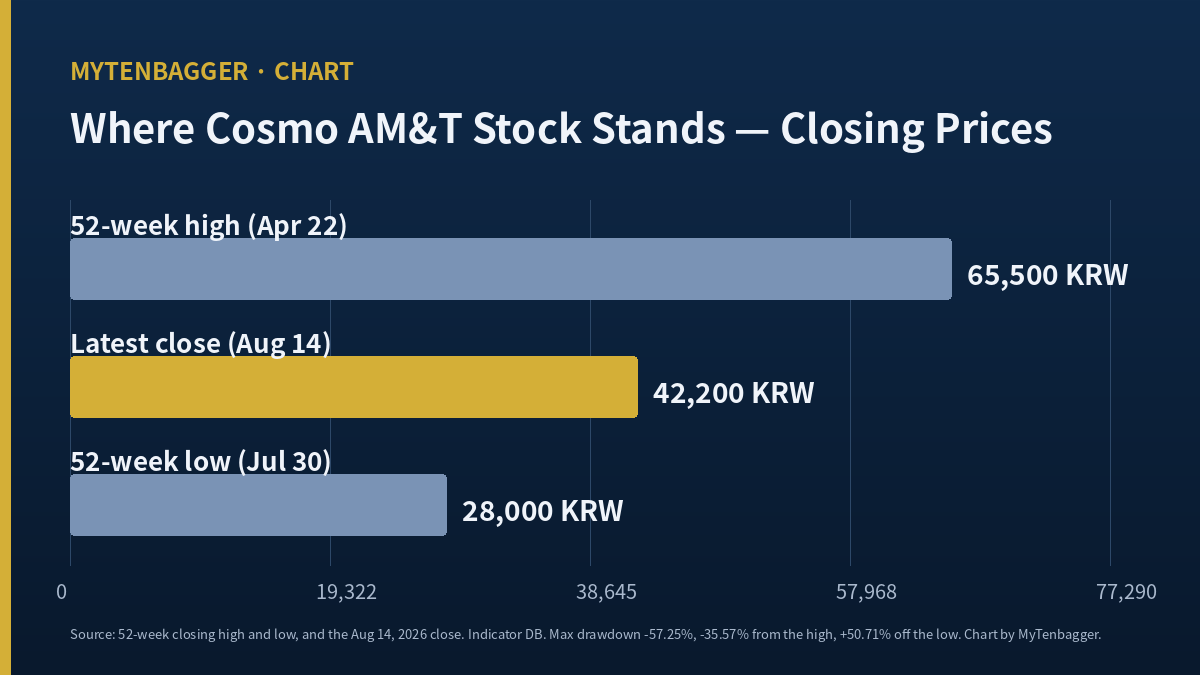
On a closing-price basis over the last 244 trading days, the high was KRW 65,500 on Wednesday, April 22, 2026, and the low after it was KRW 28,000 on Thursday, July 30, 2026. From that peak the shares are down 35.57 percent; from that trough they are up 50.71 percent. The maximum drawdown was 57.25 percent. Getting back from a 57.25 percent fall requires a 133.92 percent rise, by my calculation, and 50.71 percent of that has happened. Half the fall recovered and half the way home are two different statements.
The July trough was not company-specific. The KOSPI fell 33.19 percent during that single month, and the fall swallowed a good earnings print: the company published second-quarter provisional numbers on Wednesday, July 22, 2026, and the low still came eight sessions later.
Twenty-six quarters, and the six I counted
The company’s own headline number is twenty-six consecutive quarters of operating profit. That is true and it is the first thing it says about itself. I took the same income statement and pulled one line further down.
Interest expense exceeded operating profit in six straight quarters, from the fourth quarter of 2024 through the first quarter of 2026. Quarter by quarter, in KRW hundred millions: 62.54 against 79.44, then 10.44 against 34.31, 5.28 against 60.16, 1.35 against 41.56, 6.71 against 71.27, and finally 8.73 against 148.78. The second figure is larger every time.
The widest gap is the most recent one. In the first quarter of 2026, interest expense was 17.04 times operating profit, by my calculation. Put in dollars at the rate given in the closing note, the company earned about USD 0.62m from operations in those three months and owed about USD 10.49m in interest. Its entire interest bill for the year 2022 was KRW 11.45bn, or roughly USD 8.07m; one quarter of 2026 was larger than that full year.
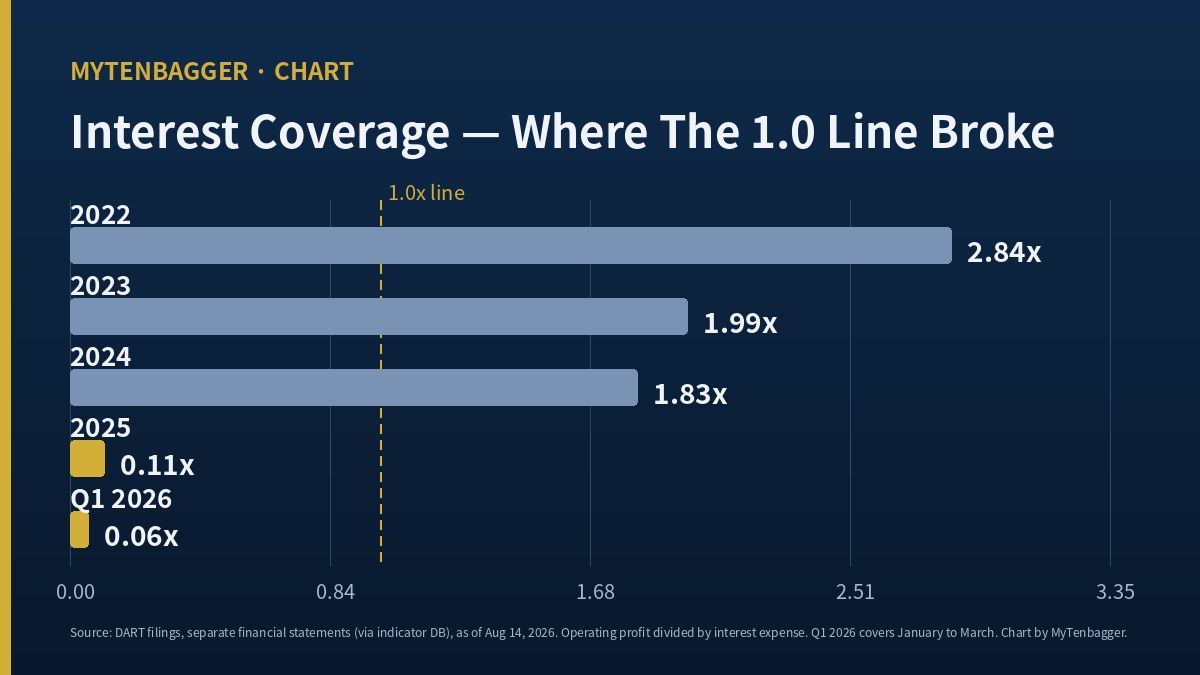
Interest coverage here means operating profit divided by interest expense. Below one, the year’s operations did not cover the year’s interest and something else paid the difference. The crossing happened in 2025.
| Year | Operating profit | Interest expense | Coverage |
|---|---|---|---|
| 2022 | KRW 32.48bn | KRW 11.45bn | 2.84x |
| 2023 | KRW 32.32bn | KRW 16.25bn | 1.99x |
| 2024 | KRW 25.00bn | KRW 13.65bn | 1.83x |
| 2025 | KRW 2.38bn | KRW 20.73bn | 0.11x |
| Q1 2026 | KRW 0.87bn | KRW 14.88bn | 0.06x |
Two lines moved at once. Operating profit fell 90.49 percent between 2024 and 2025 while interest expense rose to 1.52 times its prior level, by my calculation. Either move alone would not take the ratio this far down.
Two screens give Cosmo AM&T stock two different interest bills
Here is something I could not settle. IB Tomato, a Korean financial outlet, wrote on Wednesday, May 6, 2026 that the 2025 interest bill was KRW 7.1bn and coverage was 0.34 times. The DART filing account I pull reads KRW 20.73bn and 0.11 times for the same year. Nearly three times apart.
The explanation I find most plausible is capitalized borrowing cost. Interest attached to assets under construction is added to the asset instead of being expensed, so the income statement shows less of it while the plant is being built and more of it once construction ends. Capital spending was heavy in 2023 and 2024, which fits. But I did not open the note in the filing, so this is my reading and not a verified fact.
What the gap does not do is move my conclusion. Divide by KRW 7.1bn and you get 0.34; divide by KRW 20.73bn and you get 0.11. Both sit under one. The disagreement costs me precision about how far under, and it costs me nothing about which side of the line. So this piece leans on the boundary and not on the decimal.
Where the interest came from
Capital spending in 2023 and 2024 was KRW 102.13bn and KRW 187.96bn, KRW 290.09bn together, about USD 204.5m. Operating cash flow across those same two years was negative KRW 28.88bn and positive KRW 9.07bn, negative KRW 19.81bn together. That two-year outlay came to about a fifth of the company’s current market value, and operations produced nothing to fund it.
Widen to four years, 2022 through 2025, and cumulative capital spending is KRW 356.16bn against cumulative operating cash of KRW 118.97bn. The KRW 237.19bn difference was borrowed, and the interest on it is what now sits below the operating line. Short-term debt stood at KRW 126.8bn at the end of 2025, and current assets of KRW 187.2bn fell short of current liabilities of KRW 211.4bn by KRW 24.2bn. The current ratio went from 106.7 percent in 2024 to 88.6 percent in 2025.
Korean industrials handle this crossroads in different ways, and it is worth seeing one that went the other direction. Hanon Systems issued equity to cut debt and halved its per-share profit doing it. Cosmo AM&T did something else: in the first quarter of 2026 its equity rose and its liabilities rose too, from KRW 224.26bn at the end of 2025 to KRW 271.95bn three months later.
KRW 155bn arrived at Cosmo AM&T stock in eight weeks
Two financings landed early in 2026. A KRW 120bn private convertible bond was resolved on Friday, January 16, 2026 and paid in on Friday, January 30, 2026, carrying a 1.2 percent coupon and a 4.8 percent yield to maturity, conversion price KRW 44,051, conversion window opening January 30, 2027 (Digital Today). A KRW 35bn third-party allotment to the controlling shareholder followed, disclosed Friday, March 13, 2026 at KRW 49,729 per new share (MT News). January 16 to March 13 is fifty-six days, eight weeks exactly.
KRW 155bn, about USD 109.3m, is 65.18 times the KRW 2.38bn of operating profit the company earned in the whole of 2025, by my calculation. I did not expect a financing-to-earnings ratio in the double digits when I opened this name, and it is nearly triple digits.
The balance sheet shows equity rising from KRW 496.84bn at the end of 2025 to KRW 538.38bn at the end of the first quarter, up KRW 41.54bn against a KRW 3.57bn net loss in that quarter, so at least KRW 45.11bn came from outside. The rights issue plus a conversion-option component of the bond would roughly account for that. I could not confirm it: the statement of changes in equity is in a filing I did not open, and Korean outlets disagree on whether the rights issue was paid in April or May.
Two prices are worth holding side by side. The controlling shareholder paid KRW 49,729 per share in March; Friday’s close was KRW 42,200, which is 15.14 percent below it, by my calculation. The convertible’s KRW 44,051 strike sits 4.20 percent above Friday’s close. Full conversion would create 2,724,115 new shares, 8.20 percent of the current count, and the window opens January 30, 2027.
The group context is not decoration. Dealsite reported on Monday, March 16, 2026 that the bond came from an SG Private Equity vehicle as part of a broader package with the holding company. Etoday, citing bankers, described that holding company as fully impaired on a capital basis and the two deals as a package that let the buyer set favorable terms. Money arriving is not the same event as money arriving because someone liked the business.
The second quarter was good, and I want that on the record
ZDNet Korea reported the provisional second-quarter figures on Wednesday, July 22, 2026: revenue KRW 137.7bn (about USD 97.1m) and operating profit KRW 4.6bn (about USD 3.24m), which the company put at 15 percent and 780 percent above the year-earlier quarter. Management credited steady MLCC release-film orders and recovering cathode utilization.
Dividing by the KRW 528m single-quarter operating profit I have for the second quarter of 2025 gives 771.2 percent, 8.8 percentage points off the company’s figure. I could not determine whether that difference is a consolidation-scope question or rounding; the provisional release does not state which basis it used, which is itself worth noting.
Adding the two quarters gives first-half revenue of KRW 260.42bn and operating profit of KRW 5.47bn, by my calculation. The first quarter’s interest expense alone, KRW 14.88bn, is 2.72 times that half-year operating profit. I do not have the half-year interest figure. Three months of it already exceeds six months of operating profit.
No earnings multiple for Cosmo AM&T stock survives contact
Price-to-earnings does not compute: trailing earnings per share is negative KRW 16. Price-to-book shows 2.76 times on my screen, and I dropped it. The screen’s book value per share of KRW 15,288 times the share count implies equity of KRW 507.80bn, while the DART filing for the first quarter of 2026 shows KRW 538.38bn, which is 5.68 percent apart. Dividing the filed equity by the share count myself gives KRW 16,209 and a multiple of 2.60 times at Friday’s close. I used the one I divided.
Price-to-sales survives. Market value over 2025 revenue is 3.07 times, and that one reproduces exactly against the screen. Against the 2026 revenue estimates below it becomes 2.03 to 2.64 times.
Anyone wanting an earnings-based figure can have this one: market value divided by 2025 operating profit is 589.44 times, by my calculation, and 79.2 to 140.2 times against the 2026 operating-profit estimates. I treat that as a distance reading and not as a valuation.
Four Korean houses cover the name. I quote what they set against the shares as fact and do not adopt any of it.
| House, analyst | Dated | Figure set against the shares | Stance |
|---|---|---|---|
| IBK Securities, Lee Hyun-wook | Monday, May 18, 2026 | KRW 53,000 (from 50,000) | Trading Buy |
| Sangsangin Securities, Baek Young-chan | Friday, April 17, 2026 | KRW 70,000 | Buy |
| Heungkuk Securities, Jung Jin-soo | Monday, February 23, 2026 | KRW 68,000 | Buy |
| SK Securities, Park Hyung-woo and Jung Young-hwan | Thursday, July 23, 2026 | could not verify | Buy |
Their 2026 operating-profit estimates are KRW 17.7bn (Sangsangin), KRW 14.0bn (Heungkuk) and KRW 10.0bn (IBK). Four times the first quarter’s interest expense is KRW 59.51bn, by my calculation. Even the most optimistic of the three lands at under a third of that. Believe every sell-side estimate on the table and coverage still does not reach one this year. I have written before about a company whose supporting arithmetic had a date attached to it; here the arithmetic has a boundary attached instead, and the estimates do not clear it.
One customer, and the thing I could not settle
Back to the contract. Samsung SDI took all of this company’s EV cathode volume in the first quarter of 2026. In March, Samsung SDI awarded three years of domestic LFP cathode supply, KRW 1.6tn, to L&F. That award is 3.51 times this company’s entire 2025 revenue, by my calculation. One order, three and a half years of sales.
The complication is chemistry. Cosmo AM&T’s strength is single-crystal nickel-cobalt-manganese material; LFP is a different cathode chemistry with a different cost and performance profile. So there are two ways to take it. Either the company competed for that volume and lost it, or it was never a bidder because it does not make the product. I could not determine which, and I want to be clear that I could not.
My conclusion does not move between those two versions. Under the first, the customer chose someone else. Under the second, the customer moved a large volume into a chemistry this supplier does not serve. Both descriptions end in the same place: the decision that sets the next generation of volume was made outside this company, by the one buyer its cathode revenue currently depends on. Counting outside estimates for cathode volume runs thin further up the chain as well — for POSCO Future M’s 2027 cathode shipments I could find one outside house, against six that had published a full-year 2026 operating profit figure.
The industry backdrop is not hostile. Samsung Securities’ battery-materials monthly of Tuesday, August 4, 2026, by analysts Jang Jung-hoon and Cho Hyun-ryul, projected third-quarter cathode prices up 17 percent quarter on quarter on an NCM8 basis and 59 percent year on year. MLCC is tighter still: TrendForce put late-June book-to-bill at 1.31 for Samsung Electro-Mechanics and 1.30 for Murata, and this company said in June that it had begun producing an ultra-smooth release film aimed at AI-server MLCC. Pointing the other way, SNE Research data cited by Digital Daily on Wednesday, August 5, 2026 has LG Energy Solution’s global EV battery share falling from 9.6 to 8.6 percent in the first half and SK On’s from 4.0 to 3.1 percent. Korean cell makers losing share is a headwind for every Korean cathode supplier, including this one.
How Cosmo AM&T stock compares with the peers I could divide
My rule for this table was narrow: a company qualifies only if it published revenue and operating profit for its battery-materials activity as two separate lines I could divide myself. That rule threw out most of the obvious names, because group totals at Umicore and Sumitomo bury cathode inside catalysis, recycling and mine output.
| Company, basis | Period | Revenue | Operating profit | Margin |
|---|---|---|---|---|
| Cosmo AM&T, whole company | April to June 2026 | KRW 137.7bn | KRW 4.6bn | 3.34% |
| EcoPro BM, consolidated | April to June 2026 | KRW 576.7bn | KRW 18.0bn | 3.12% |
| L&F, consolidated | April to June 2026 | KRW 885.0bn | KRW 20.8bn | 2.35% |
| POSCO Future M, Energy Materials segment | April to June 2026 | KRW 327.9bn | KRW 2.5bn | 0.76% |
| Umicore, Battery Materials Solutions | H1 2026 | EUR 230m | EUR −31m | −13.48% |
| Sumitomo Metal Mining, Materials segment | April to June 2026 | JPY 89,619m | JPY 9,170m | 10.23% |
Two cautions belong with this table, and I would rather print them than let the numbers look cleaner than they are. Umicore reports revenue excluding metal value, so the figure it divides by is built differently from a Korean cathode maker’s; its improvement this half also came partly from take-or-pay compensation accruals and not from volume. Sumitomo publishes under IFRS with no operating-profit line at all, so its segment profit is the company’s own segment measure. I converted no currencies in this table. I did not have same-day EUR/KRW or JPY/KRW closes, and inventing them to make one column would have been worse than leaving three.
What the table does show is a 23.71 percentage point spread across companies doing recognizably the same thing in the same three months. This company’s 3.34 percent is 4.39 times POSCO Future M’s cathode segment and just under a third of Sumitomo’s materials segment. The band is wide enough that “cathode margins are X” is not a sentence anyone should finish right now.
Where this listing sits, and what the register shows
What I verified about ownership is narrow and I will state only that. This company is listed on the KOSPI, and it does not appear in the published top holdings of the two Korea ETFs I check. The only ownership fact I hold is a vendor line reading 6.75 percent foreign ownership as of Friday, August 14, 2026, and that line does not say how those holders got there. At a market value near USD 988m this sits well below the size where index inclusion moves the shares on its own, so whatever demand reaches this name is arriving through deliberate purchases rather than passive flows.
Figures I checked and did not use for Cosmo AM&T stock
The 2.76 price-to-book
Dropped, as above. Three equity figures disagree: KRW 507.80bn implied by the screen’s book value per share, KRW 538.38bn filed for the first quarter of 2026, and KRW 488.90bn on the screen’s own equity field. The last is 1.60 percent from the 2025 year-end figure and 9.19 percent from the first-quarter one. When three views of the same quantity disagree, I use the filing and divide it myself.
The 52-week high and low
My screen shows KRW 66,400 and KRW 26,600 over 250 sessions, and its own basis field says these are adjusted closing prices. They are not. Pulling 260 daily bars, KRW 66,400 is the intraday high of Wednesday, April 22, 2026, whose close was KRW 65,500, and KRW 26,600 is the intraday low of Thursday, July 30, 2026, whose close was KRW 28,000. The label says close and the values are intraday. So I used 35.57 percent for the drawdown instead of the screen’s 36.4, and 50.71 percent for the recovery instead of 58.6. The low end diverged by 7.93 percentage points, far more than the high end.
The 12-month return
The screen shows positive 13.59 percent. A tool that states its window explicitly gives negative 17.25 percent for the 244 sessions from August 14, 2025 to August 14, 2026. That is a 30.85 percentage point disagreement. Tracing the daily bars, positive 13.59 percent reproduces only from the close of August 1, 2025, which is twelve months and thirteen days back. The three-month and one-month figures reproduce from sensible dates; the six- and twelve-month ones drift early. Return fields that do not print their window start do not go into my reasoning.
The three-year revenue growth rate
Negative 2.05 percent, and it reproduces cleanly from 2022 to 2025. I still left it out. The 2022 starting point sits in the middle of the EV materials boom, and moving the start by one year flips the sign. Reproducible and usable are separate tests.
The seven-metric checklist score
Two of seven pass: revenue scale and positive operating profit. I did not lean on the score, because one of the two passing items is the item this whole piece is about.
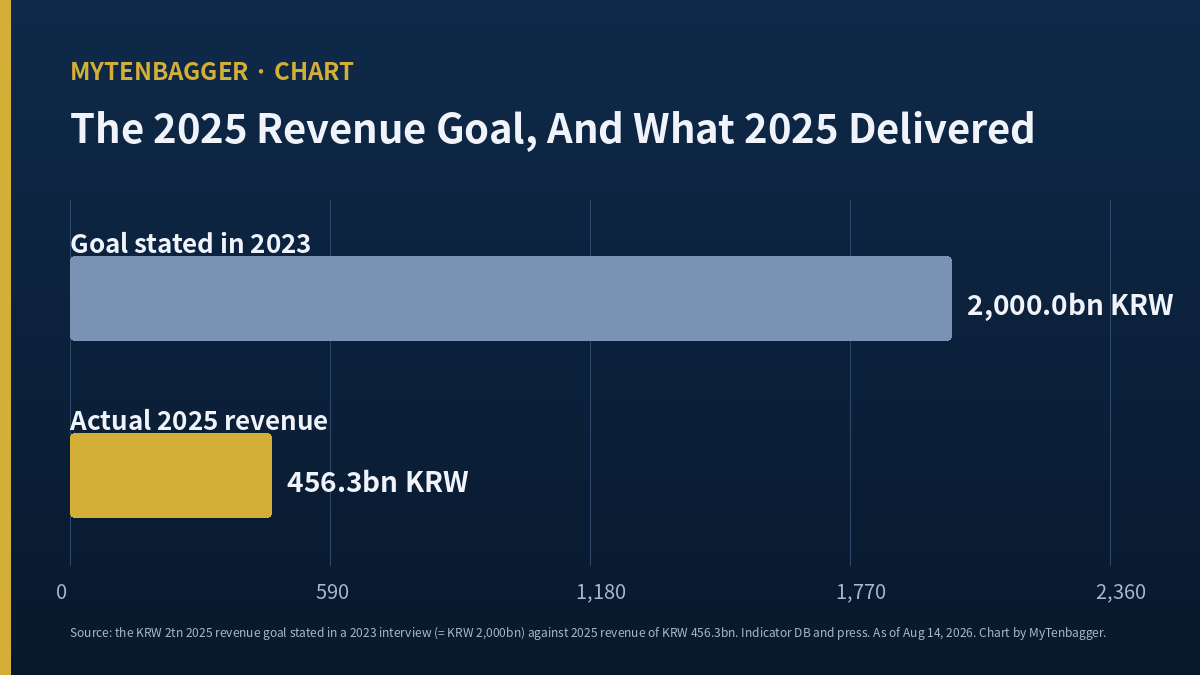
A capacity number is the thing I got wrong here, and I got it wrong by copying instead of checking. I carried “100,000 tonnes by the end of 2025” in my head for this company, because that is what the 2023 coverage said and I repeated it without a date attached. IBK’s May 2026 note puts capacity at 30,000 tonnes at the end of 2025 and 100,000 tonnes at the end of 2026. The target moved a full year and I never noticed, because a target with no date attached cannot be seen to slip. The same 2023 interview carried a KRW 2tn revenue goal for 2025; actual 2025 revenue was KRW 456.3bn.
Sixteen things arguing against Cosmo AM&T stock, or against me
Things I could not verify (four)
- The half-year report was filed on Friday, August 14, 2026 and I did not open it. The interest note and the statement of changes in equity are both in there.
- Whether the 2025 interest bill is KRW 7.1bn or KRW 20.73bn. My capitalization explanation is a reading.
- The payment date, share count and listing date of the KRW 35bn third-party allotment. Korean outlets split between April and May.
- Whether the second-quarter provisional figures are consolidated or parent-only, and the quarter’s net income.
Facts arguing for the shares (four)
- Third-quarter NCM8 cathode pricing is projected up 17 percent quarter on quarter (Samsung Securities, August 4, 2026). Rising prices against earlier, cheaper input costs widen margin on the way through.
- MLCC release film is tight on AI-server demand, and this company runs roughly 70 million square meters a month of capacity with Samsung Electro-Mechanics and Samwha Capacitor as customers.
- The Ohio cell plant that LG Energy Solution runs with GM restarted production on Monday, August 17, 2026 after seven months down (Financial News, Thursday, August 13, 2026). One of the conditions the sell-side built its recovery case on has actually occurred.
- Global ESS battery volume ran 461.3GWh in the first half, up 71 percent. Demand outside passenger EVs is alive.
Facts arguing against them (three)
- EV cathode supply narrowed to a single customer in the first quarter of 2026.
- That customer awarded KRW 1.6tn of LFP cathode supply to a competitor.
- Korean cell makers lost global share across the first half, and this supplier sells into them.
Structural items (five)
- The convertible’s conversion window opens January 30, 2027, and full conversion adds 8.20 percent to the share count.
- The controlling holding company was described as capital-impaired in the reporting on this financing package, so the money arriving carries a reading other than confidence.
- The 100,000-tonne capacity target slipped from end-2025 to end-2026, and the 2023-vintage KRW 2tn revenue goal for 2025 landed at KRW 456.3bn.
- Input costs cut both ways and the timing is not mine to control. I have watched a cheaper raw material take quarters to reach the income statement before; higher cathode prices reach it on the same kind of delay, in the other direction.
- The load-bearing calculation in this piece is one income-statement line that two sources report three times apart. If that line moves, what moves with it is the precision of my sentences. What does not move is the boundary at one.
What I am waiting on
At KRW 1.40tn this is not a small company by Korean standards, and that has nothing to do with why I am only watching. I look at who a profit belongs to before I look at whether there is one, and this company’s operating profit currently belongs to its lenders.
Here is what would break my reading. If full-year 2026 operating profit exceeds full-year interest expense, putting coverage above one for the year, then I was wrong to treat this profitability as the lenders’ and not the owners’. A single quarter will not do it, because quarterly earnings here swing with when one customer decides to take delivery. And I should say plainly that no published estimate gets there this year. The highest of the three lands at under a third of the required amount. I am writing a condition I already know the current forecasts do not meet, because the point of writing it down is that the forecasts might be wrong in my direction.
The other thing I am waiting on is the chemistry question I could not settle: whether losing that LFP award was a competitive defeat or a category the company never entered. If some future disclosure separates those two, one of my sentences gets sharper. Neither answer changes what I decided, which is a strange position to end in, holding open a question whose resolution I have already priced as irrelevant. I would rather leave it open and say so than close it by picking the version that reads better.
Prices and multiples reflect the Friday, August 14, 2026 close as checked at the time of writing. Financial data combines DART electronic disclosure parent-only statements through the first quarter of 2026, the company’s provisional release, and a vendor indicator database refreshed 17:04 on August 14, 2026; each paragraph names its source. USD conversions are approximate, at roughly KRW 1,418.3 per dollar on that same date, the Seoul market daytime close (Newsis). The Korean won is the reference currency throughout, and no EUR or JPY conversions were attempted.
- Why Foosung Traded 30% of Its Shares in a Single Session
- Sungeel Hitech Earnings: Battery Metal Prices Drive Its Revenue