Nature Cell Convertible Bond Pricing After an 8-Year Court Win
I opened Nature Cell stock this morning by clicking on a single spreadsheet cell, capital reserve, before I looked at anything else. That is not usually where I start. The screen showed me a book value per share of 978 won against a Tuesday close of 22,600 won, which prints a PBR of 23.11 times, and a market capitalization of 1.4562 trillion won ($1.031 billion at the August 18 close of 1,413.0 won per dollar). Total equity is only about 63 billion won, and yet across the last four fiscal years this company posted a cumulative net loss of 20.108 billion won. The number in the equity account should not have been able to survive that. I opened the capital-reserve line to see what did survive there, and while I was in the balance sheet I laid out how a July 9 court win and a July 22 convertible bond decision, thirteen days apart, move through the same account in opposite directions. This piece is my trading journal on that relationship.
| What I checked | What I concluded | Verified against source? |
|---|---|---|
| Court ruling in favor of Nature Cell on JointStem, Seoul Administrative Court, July 9, 2026 (Thursday) | Overturned an 8-year rejection sequence (2018, 2023, August 2024) | Yes on the ruling itself. No on its financial implication, because the MFDS has appealed. |
| 17.0 billion won convertible bond, decided July 22, 2026 (Wednesday) | Thirteen days after the court win, at a conversion price of 24,307 won and a coupon of zero | Yes on the terms. Partly on the intent, because the largest use is 10.0 billion won for a Baltimore facility already partly built |
| Four fiscal years of income-statement losses reconciled to equity changes | A cumulative net loss of 20.108 billion won, but equity rose 5.871 billion won over the same window. That is a 25.979 billion won inflow from somewhere off the income statement | Partly. I did not open the 1H2026 report (legal deadline was August 15, which was Independence Day), so the specific accounts that carried that inflow are inferred, not verified |
Contents
Nature Cell stock: I started at the capital-reserve line
Two screen numbers made me start there. The first is the trailing PBR of 23.11 times against a book value per share of 978 won, and the second is the fact that the PER prints as N/A because the last twelve months carry a net loss. When the earnings multiple cannot be computed, valuation collapses to a single equation, price divided by book, and this company’s book is small relative to its market value. Total equity of 63.029 billion won sits under a market capitalization of 1,456.20 billion won. That is 4.33 percent, the same 4.33 percent that shows up when you divide 978 by 22,600.
What the two numbers together made me ask was this. How does a company that has been losing money on the income statement keep the equity account at this size? A screen does not answer that. The DART consolidated statements do, at least at the row level.
| Fiscal year | Revenue (KRW bn) | Operating (KRW bn) | Net (KRW bn) | Total equity (KRW bn) |
|---|---|---|---|---|
| FY2022 | 21.554 | −9.503 | −6.814 | 57.158 |
| FY2023 | 19.350 | −10.273 | −11.681 | 61.419 |
| FY2024 | 32.333 | +0.597 | +1.226 | 64.624 |
| FY2025 | 20.734 | −3.647 | −2.839 | 63.029 |
Source: FY2025 annual report filed with KIND on Monday, March 23, 2026, receipt number 20260323001523. Net income is on an owner-attributable basis. Figures in billions of Korean won.
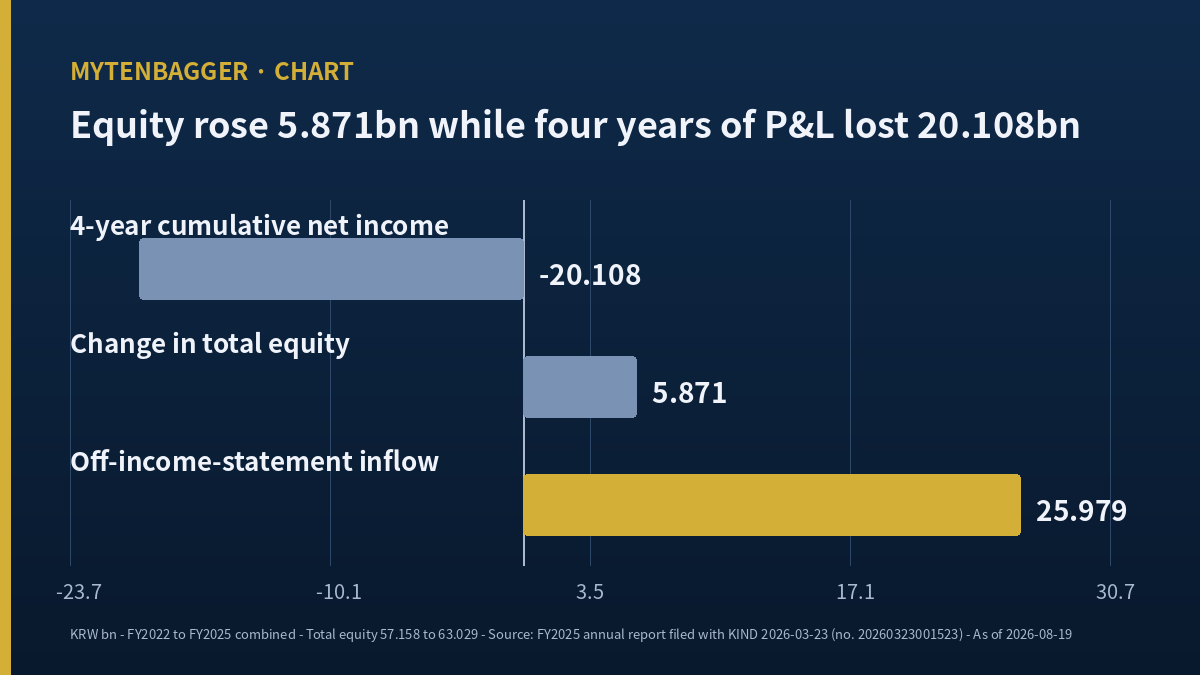
Adding the four annual net-income figures downward gives a cumulative loss of 20.108 billion won. Equity across the same window rose by 5.871 billion won, from 57.158 to 63.029. The difference, 25.979 billion won, entered from somewhere other than the income statement. Candidates are share issuance, additional paid-in capital, conversion of a prior convertible bond, or other equity components. To pin the specific line I would need the statement of changes in equity from the 1H2026 report, which was due August 15 and did not print for me at the time of writing because that Saturday was a public holiday. I am flagging that I did not verify the line item.
Two July events touched Nature Cell stock at the capital-reserve line
The sequence, laid out on a calendar of trading days.
- July 9, 2026 (Thursday), Seoul Administrative Court ruled for Nature Cell in the challenge to the MFDS rejection of JointStem. The application history has three rejections spread across the sequence: an initial 2018 conditional application that was turned back, a 2023 formal submission that did not clear, and an August 2024 rejection that became the direct trigger for this administrative suit. According to CBC News reporter Sim Woo-il in a piece dated July 10, 2026, Korean coverage of the ruling day itself reported the stock closing limit-up at 28,250 won, a move of 6,500 won or 29.89 percent. The next trading day, July 10 Friday, closed at 25,200 won on volume of 1,421,682 shares, which was the highest single-day volume in the twelve-month window I looked at.
- July 22, 2026 (Wednesday), the company decided to issue a 17.0 billion won series-five unregistered private placement convertible bond. Deposit date August 7 Friday, maturity August 7, 2029. Coupon 0 percent, yield to maturity 6 percent, conversion price 24,307 won, conversion request window August 7, 2027 through July 7, 2029. Per CBC News reporter Kwon O-seong, July 22, 2026, the use of proceeds is split as 7.0 billion won operating capital and 10.0 billion won for acquisition of another company’s securities, where the latter funds a Baltimore global-campus production facility through the U.S. subsidiary Nature Cell America Inc.
Court win to CB decision is thirteen days. The market was reading the ruling in one direction while the company priced a debt security that will, if the stock holds above 24,307 won during a two-year conversion window, walk 25.979 billion won… I have to stop that sentence because I was about to overstate what I know. The CB, if fully converted, adds 699,386 shares to a base of 64,433,628, which is 1.085 percent (the company’s disclosed figure rounds to 1.09 percent). Today it sits on the liability side as a bond and not on equity. It becomes capital only if a specific price condition is met after August 7, 2027.
What I am left with is a question I cannot answer without opening the 1H2026 statement of changes in equity. Where did the 25.979 billion won inflow across the last four years come from, and is this CB the next chapter of the same story? I cannot close that question in this piece. I can only lay out the balance-sheet trace that suggests the answer.
Debt collapsed, then partly returned
The debt side of the balance sheet moved sharply in the opposite direction. Total liabilities at FY2022 year-end were 36.862 billion won. At FY2023 year-end, 6.979 billion won. That is a 29.883 billion won reduction in a single year against a same-year net loss of 11.681 billion won. Cash cannot reconcile those numbers by itself. Something moved from the liability account to the equity account, and the mechanical way that happens in Korea is a convertible bond that got converted, or a debt-for-equity conversion. I cannot confirm which without the changes-in-equity statement.
Debt then walked back up. FY2024 year-end 7.373 billion, FY2025 year-end 11.701 billion, 1Q2026 year-end 23.659 billion, up 11.958 billion won in a single quarter. The debt-to-equity ratio moved from 64.49 percent at FY2022 year-end down to 11.36 percent at FY2023 year-end, and then back to 37.5 percent at 1Q2026. The company that shed most of its debt three years ago is, on the balance-sheet trace, partly returning to it. The CB decision belongs to this trace.
The single-quarter table changes the Nature Cell stock story
The annual view flattens what happened inside the year. The single-quarter view (discrete, computed from cumulative statements) shows a different pattern.
| Quarter | Revenue | Operating | Net | OCF | CAPEX |
|---|---|---|---|---|---|
| 2025Q1 | 4.077 | −1.706 | −1.241 | −1.576 | 1.432 |
| 2025Q2 | 6.404 | −0.287 | −0.667 | +4.521 | 1.491 |
| 2025Q3 | 3.900 | −1.393 | −1.270 | −3.279 | 1.613 |
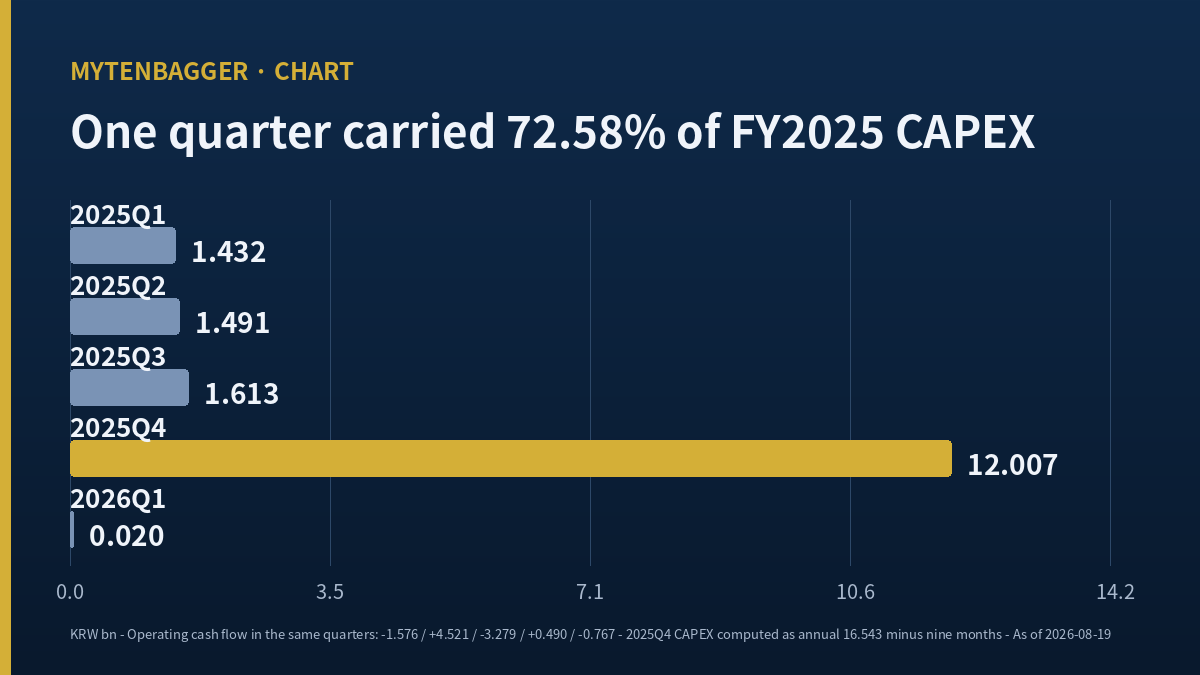
| 2025Q4 | 6.353 | −0.261 | +0.339 | +0.490 | 12.007 |
| 2026Q1 | 4.059 | −1.323 | −1.143 | −0.767 | 0.020 |
All figures in billions of Korean won. 2025Q4 CAPEX is computed by subtraction: annual 16.543 − (Q1 1.432 + Q2 1.491 + Q3 1.613) = 12.007.
Two facts, laid side by side. FY2025 CAPEX totaled 16.543 billion won, of which 12.007 billion or 72.58 percent landed in a single quarter, 2025Q4. That quarter’s CAPEX was 57.91 percent of the full year’s revenue. The other fact is that FY2025 operating cash flow across the four quarters netted to +0.156 billion won, with only 2025Q2 (+4.521) meaningfully positive, two quarters clearly negative (Q1 −1.576, Q3 −3.279), and Q4 only marginally positive (+0.490). A company that cannot generate cash from its own operations spent 12.007 billion won on property and equipment in one quarter. That combination is what makes the July CB decision legible: the money is going in after the outlay, not before it.
Nature Cell stock: two numbers frame where I would revisit
A market capitalization of $1.031 billion falls outside the top 100 by size on the Korean market, and my default for that tier is watch. But watching does not mean nothing; it means I know which two numbers change my stance if they resolve.
- Number 1, Seoul High Court appellate ruling. Per CBC News, the MFDS filed an appeal to reconfirm what it calls the illegality of the trial-court reasoning. The trial court’s reasoning rested on the point that the MFDS effectively required superiority to existing therapies, not the statutory safety-and-efficacy standard. If that reasoning survives on appeal, the financial implication of the ruling holds. If it does not, the balance-sheet story I sketched above stays a candidate, not a conclusion.
- Number 2, the CB conversion window that opens August 7, 2027 (Saturday). The conversion price of 24,307 won is 7.55 percent above the August 18 close of 22,600 won. If the stock holds above 24,307 won across the 23-month conversion window, the CB moves off the liability line and onto capital reserve, adding 699,386 shares. If it does not and enters the early-redemption option, the company pays back principal plus yield in cash. I will not predict which. When August 2027 arrives, the balance sheet will show me which side of the door this money walked through.
What I did not compute, and why
Naming what I left out is part of the record.
- I did not compute a JointStem revenue projection. The IR materials show a target patient population and a potential price per treatment. Multiplying those to get a revenue estimate in a piece where I cannot open the trial data would be a self-quoting number. Analyst coverage on the screen reads “no opinion issued in the last three months,” which is tier-4 territory for a synthesized figure.
- I did not compute depreciation for the Baltimore facility. Start-of-operations date, useful life, method — none is specified in the public materials I could reach. Estimating a future operating margin off those blanks would be building the answer into the question.
- I did not read the trial-court judgment itself. Two Korean-language outlets carried the operative reasoning (“the MFDS required superiority to existing therapies, which is beyond the statutory standard”). I could not open the ruling text. The appellate outcome likely turns on how strictly that single sentence is read, and I did not read it firsthand.
- I did not add a second interpretation for the PBR of 23.11 times. Book value here does not carry the JointStem sales-right asset or the Baltimore construction. If the appellate ruling holds and JointStem becomes a marketable product, some portion of that value would migrate to capital reserve and lift BPS, which would compress PBR. This calculation would be building on an unresolved court case. I set it aside.
- I did not build a peer multiples table against U.S. or Japanese autologous stem-cell therapy names. The listed comparable set is single-digit, most of the members carry either no revenue or one-product concentration, and the pipeline stages are different enough that a mean multiple across the group would be a false anchor. I noted the set exists and did not compute the mean.
The price series shows where Nature Cell stock stopped falling
Where the price sits, in the record: 250-trading-day high 36,950 won, low 16,550 won, August 18 close 22,600 won. That close is 61.16 percent of the 250-day high and 36.56 percent above the 250-day low. The recent chapter runs like this.
- June 4, 2026 (Thursday), 34,550 won, the one-year high on close.
- July 9, 2026 (Thursday), the Seoul Administrative Court decision. Close 28,250 won on volume 609,286 shares, limit-up.
- July 10, 2026 (Friday), close 25,200 won on volume 1,421,682, the highest single-day volume of this 12-month window and 2.33 times the previous day. Close fell 3,050 won from the previous session.
- July 22, 2026 (Wednesday), the 17.0 billion won CB decision printed.
- August 3, 2026 (Monday), 21,150 won, the low of this chapter.
- August 18, 2026 (Tuesday), 22,600 won, where the record ends for this piece.
I read that sequence one way. The ruling itself was priced on the ruling day at limit-up. The very next session, volume more than doubled and the close fell 3,050 won, which is what a long-held holder using the news as an exit looks like on a chart. Then the CB decision printed on July 22 and reintroduced the funding-risk story shared by other Korean clinical biotechs, of the kind where interest cost has already outrun revenue. The August 18 close sits near the point where those two forces met.
What the market comparison shows, and does not show
Twelve-month benchmark (August 18, 2025 through August 14, 2026, per KRX): stock +15.56 percent, KOSDAQ +8.35 percent, sector (biotechnology, equal-weighted excluding self) −4.11 percent. Market excess +7.21 percentage points, narrow beat. Sector excess +19.66 percentage points, clear beat. Sector rank 10 of 51, top 19.6 percent, beat 41 of 50 peers. Beta 0.709, correlation 0.391. On a 20-trading-day window, the divergence turns to −18.51 percentage points against the sector, meaning that during the four weeks into August the sector was rising while this name was giving back. The one-year headline says “beat”; the last four weeks say “gave back what a win would have added.”
Seven arguments against what I wrote above
- The 2023 Supreme Court acquittal of Chairman Ra Jeong-chan on prior stock-manipulation charges cleared the shadow that had constrained capital-raising here. Per the Supreme Court announcement, the acquittal was affirmed in March 2023. If the company has been operating on a normal capital-markets footing since, my reading of the equity account inflow as unusual is overweighting the past.
- The fact that the equity account has absorbed four straight years of losses is itself a measure of capacity. A total equity of 63.029 billion sitting under a market capitalization of 1,456.20 billion means the company has room to raise on the debt side, which is precisely what the CB does. Reading that as risk instead of capacity is one lens; the other lens is available.
- If the ruling holds on appeal, JointStem sales rights would migrate to intangible assets, lifting BPS and compressing the PBR of 23.11 times. The PBR number is calculated on a book that assumes no product. I do not attach a probability to the appellate outcome in this piece.
- The U.S. FDA path is running independently of the Korean court case. Per Daum / Chosunbiz reporter Yeom Hyun-a, August 5, 2026, the company has applied for a pre-BLA meeting with the FDA, targeting formal approval by 2028. If the Korean ruling and the U.S. approval are two independent binary events, the current market capitalization may be pricing at most one of them, not the combined probability of both.
- The 2021 Shanghai Pinjue contract-fulfillment episode (contracted 56.5 billion won, actually delivered about 0.3 billion won) is now five years old. If no comparable contract-disclosure episode has repeated in the interval, that risk is likely already priced into the current level. I cannot measure the price of a memory.
- Two of the last five quarters (2025Q2 and 2025Q4) were the better ones on revenue. If that reflects seasonality and not noise, the 2H2026 quarters would be the better ones again. Five quarters is too small a sample to declare seasonality, but it is also too small to declare against it.
- The CB conversion price of 24,307 won is only 7.55 percent above the August 18 close. If the market is already reading this CB as likely to convert instead of surviving as debt, the negative reaction was probably absorbed in the August 3 low of 21,150 won, and today’s 22,600 sits after the absorption, not before it.
the biotechnology exposure that goes through Samsung Biologics-heavy Korea funds
Prices and multiples reflect the August 18, 2026 close as checked at the time of writing. USD conversions are approximate, at roughly 1,413.0 won per dollar on the Seoul market close of the same date. Balance-sheet figures are from the DART consolidated statements, with the receipt number noted at the source line. This is a personal journal. It is not a call to trade, and it does not tell anyone to buy or sell.
- ENCell Earnings: Costs That Ignore Sales, Plus a Convertible Bond
- Teuksu Construction Stock Trades Below 3 Years of Capex
- Korea’s BHI Price to Book: Why 10.45x Rests on a Stale Book Value