Asia Cement Valuation: Why Low P/E and P/B Point to One Number
Asia Cement stock closed at KRW 9,770 on Tuesday, August 18, 2026. Against book value per share of KRW 30,144 that is 0.32 times book. Against the 2026 consensus earnings estimate of KRW 1,110 per share it is 8.80 times forward earnings. I had been carrying those two figures in my head as two separate reasons to look harder. They are one reason, and I want to show the arithmetic that convinced me.
Contents
What I checked before I opened Asia Cement stock
Asia Cement Company (KOSPI: 183190) makes cement in South Korea. It bought Halla Cement in 2018 and consolidates it, which puts the combined operation third by domestic share according to industry write-ups I could find. Market capitalisation is KRW 351.5 billion, roughly USD 249 million at the exchange rate cited at the foot of this piece. KOSPI is the senior board of the Korea Exchange; the junior board is KOSDAQ, and this company sits on the senior one.
What came out of the check was three things. Consensus expects 2026 earnings per share of KRW 1,110, which is 2.46 times the KRW 452 the company actually reported for 2025. Capital expenditure in 2025 came to KRW 126.99 billion against operating profit of KRW 77.13 billion, so the company spent more on plant than it earned from operations. And free cash flow turned negative for the first time in the four years I pulled, at minus KRW 33.58 billion.
What I did not confirm sits alongside all three. I could not open the half-year filing text to check the second-quarter figures against the aggregators, and two data providers disagree on second-quarter revenue by 9.8 percent. I could not size the share cancellation the company approved on June 10, 2026. And I could not find a current credit rating from any of Korea’s three rating agencies, so nothing in this piece leans on one.
The two multiples on Asia Cement stock point the same way
A price-to-book ratio tells you what the market pays for a company’s net assets. A price-to-earnings ratio tells you what it pays for the company’s profit. They sound like separate tests, and it is easy to treat them that way, checking one and then the other and feeling better when both come back low.
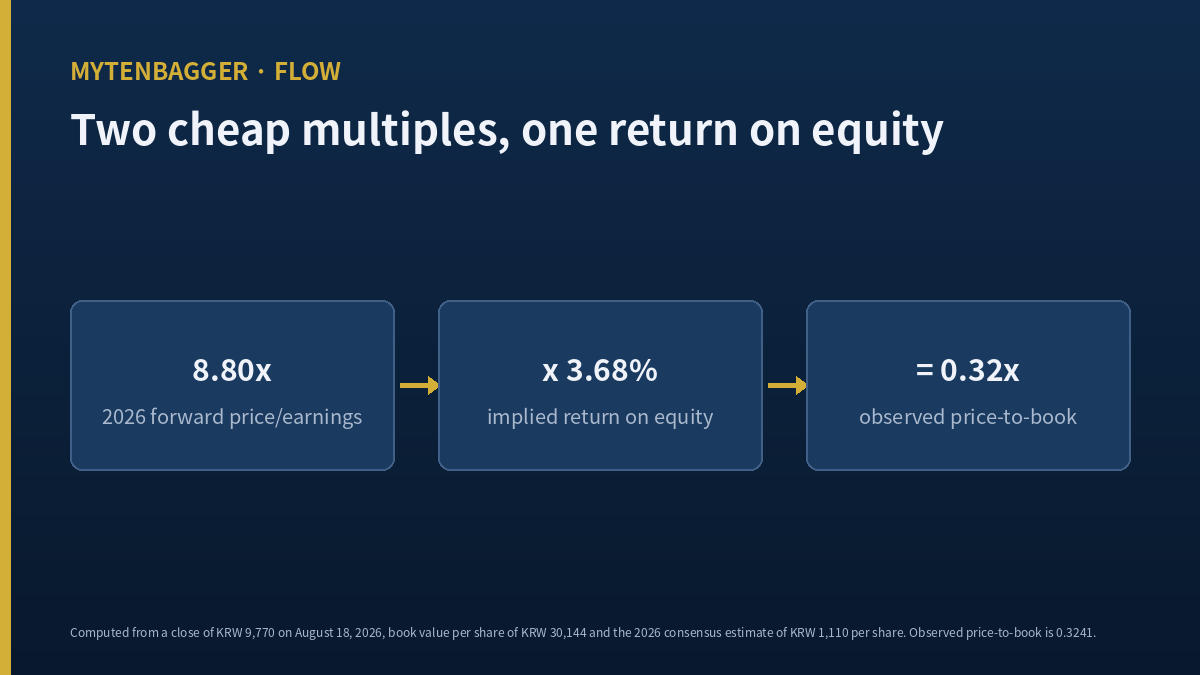
They are joined by an identity. Price divided by book equals price divided by earnings, multiplied by earnings divided by book. That last term is return on equity. So price-to-book equals price-to-earnings times return on equity, always, with no assumptions attached. If two of the three are known, the third is fixed.
For this company all three are available, and they close. The consensus earnings estimate of KRW 1,110 against book value per share of KRW 30,144 implies a return on equity of 3.68 percent. Multiply that by the forward multiple of 8.80 and you get 0.324. The observed price-to-book is 0.3241. The two sides agree to the fourth decimal place, which is what you would expect from an identity but is still satisfying to watch happen with real numbers.
The number both multiples resolve to
3.68 percent, and what the market charges for it
So the low price-to-book and the low forward multiple are not two witnesses. They are one witness saying the same sentence twice, and the sentence is that this company is expected to earn 3.68 percent on its own equity in 2026. That is the whole of it. A business earning 3.68 percent on book is worth a fraction of book to anyone whose required return is higher, and the fraction is arithmetic, not sentiment.
You can run it backwards to see what the market is charging. In a no-growth Gordon frame, price-to-book equals return on equity divided by the required return. Solving with 3.68 percent and 0.3241 gives a required return of 11.36 percent. I would not defend that figure to two decimal places, because the no-growth assumption is doing heavy lifting and Korean cement volumes are shrinking and not merely flat. But the order of magnitude is the point: nothing exotic is being priced in. An investor demanding roughly 11 percent from a shrinking-volume industrial, and getting 3.68 percent, arrives at about a third of book without any pessimism beyond the arithmetic.
The trailing multiples do not contradict it
There is a third multiple floating around and it looks like it disagrees. On 2025 results the shares trade at roughly 21 times earnings, which is not the sort of figure that appears in a value screen. That number and the 8.80 are both correct. Market capitalisation of KRW 351.5 billion over 2025 profit attributable to owners of KRW 16.89 billion gives 20.81 times; over consolidated net income of KRW 16.43 billion it gives 21.39 times, which is close to the 21.63 the data vendor prints. The same market capitalisation over the consensus 2026 profit gives 8.80.
The three I computed are one price over three different earnings figures. Nothing is wrong with any of them. What the pair of them tells you is how much of this valuation rests on the consensus being right about 2026, because the 2025 profit implies a 1.49 percent return on equity and the estimate implies 3.68 percent. The market is roughly splitting the difference and leaning toward the estimate.
There is one more figure worth running through the same arithmetic, and it produced the result that surprised me most. WISEfn’s compilation on August 18, 2026 puts the three-house average valuation at KRW 15,000 a share. Divide that by the same consensus earnings estimate of KRW 1,110 and you get 13.51 times forward earnings. So the sell-side view is not that the earnings estimate is too low. It is that the multiple applied to that estimate should be roughly half again what the market currently applies, with the earnings number left exactly where it is.
That reframes the disagreement usefully. If the houses were forecasting a stronger recovery than the published estimate, I would be arguing about cement volumes and coal prices. They are not. They are arguing about what a Korean cement producer earning under four percent on its book should be worth, and 13.51 times sits between the 11.69 times that Heidelberg Materials trades on and the 15.73 times CRH trades on, both diversified global aggregates businesses of a different order of size. Whether a shrinking single-market producer deserves that neighbourhood is the actual question, and it is a judgement, which a calculation cannot settle.
Where the cash behind Asia Cement stock actually goes
Plant spending outran operating profit in 2025
Return on equity is a ratio, and ratios hide where money physically went. So I pulled the consolidated cash flow statements from the Korean regulatory filing system for four fiscal years and looked at three outflows: interest, plant, and dividends.
| KRW billion, consolidated | FY2023 | FY2024 | FY2025 |
|---|---|---|---|
| Operating profit | 146.89 | 140.75 | 77.13 |
| Capital expenditure | 142.82 | 128.76 | 126.99 |
| Interest expense | 29.46 | 30.92 | 29.26 |
| Operating cash flow | 198.38 | 168.32 | 93.41 |
| Free cash flow | +55.56 | +39.55 | -33.58 |
Read the rows across and one of them behaves differently from the others. Operating profit fell 47.49 percent over two years. Capital expenditure fell 11.09 percent. Interest expense moved by less than one percent. The bottom row is what happens when the top row moves and the middle rows do not.
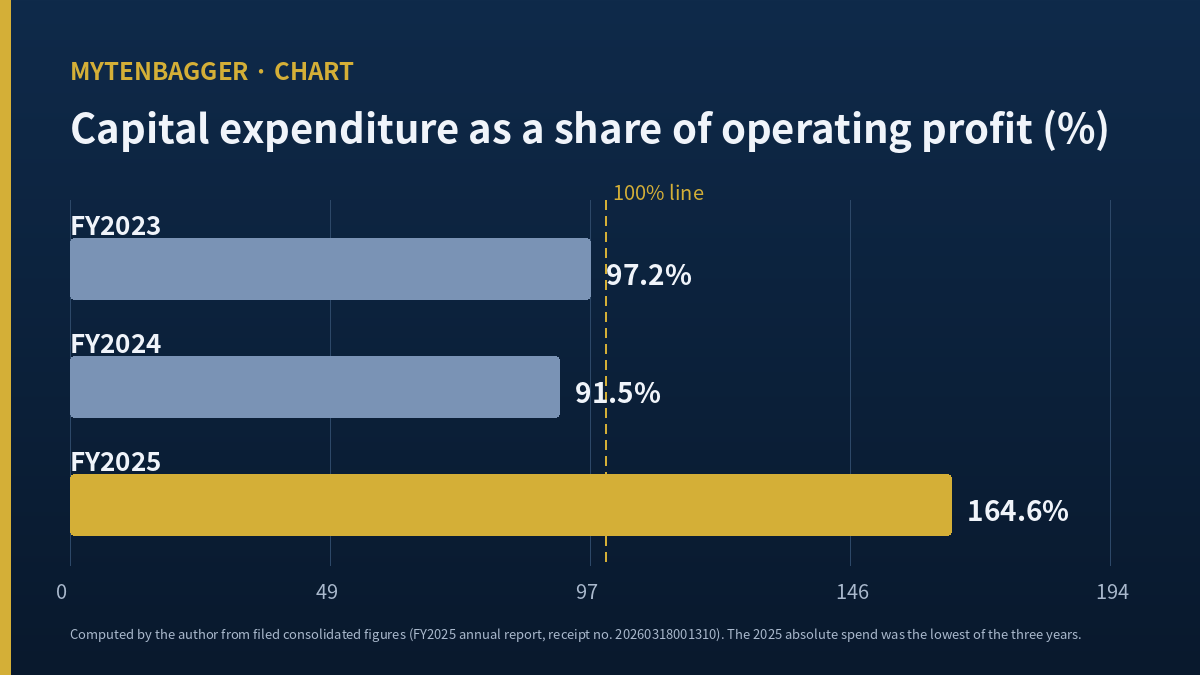
Capital expenditure as a share of operating profit went 97.2 percent in 2023, 91.5 percent in 2024, and 164.6 percent in 2025. All three are computed by me from the filed figures. The 2025 reading is not the result of a spending programme starting up; the absolute spend was the lowest of the three years and below the three-year average of KRW 132.86 billion. The ratio inverted because the earnings side halved.
Why the plant line is hard to cut further
The obvious response is to spend less on plant for a year or two. Korean industry conditions make that harder than it sounds. The Korea Cement Association estimates the sector needs more than KRW 5 trillion of core equipment investment by 2035 to meet the national emissions target, and sector-wide capital spending plans for 2026 have already fallen for a second consecutive year, running 13.9 percent below the five-year average, with roughly 86 percent of the planned spend classified as environmental and safety work (Financial News, Korean-language report, June 26, 2026).
Carbon allowance costs sit on the same side of the ledger and are not in my table at all. Korean allowance prices closed at KRW 28,200 per tonne on June 9, 2026, more than 60 percent above where they had been a month earlier, as the fourth allocation period opened (Energy Economy, Korean-language report, June 10, 2026). I have no model for how that flows through this company’s income statement and I am not going to invent one.
Interest expense held between KRW 29.26 billion and KRW 31.95 billion across all four years, a spread of 9.2 percent by my calculation. Interest cover therefore tracks operating profit almost exactly: 4.99 times in 2023, 4.55 in 2024, 2.64 in 2025, and 1.48 in the first quarter of 2026. I have watched the same mechanism in another Korean materials name where capital spending kept eating what the business earned, and the pattern reads the same way here even though the industries share nothing.
The book value per share has been getting help
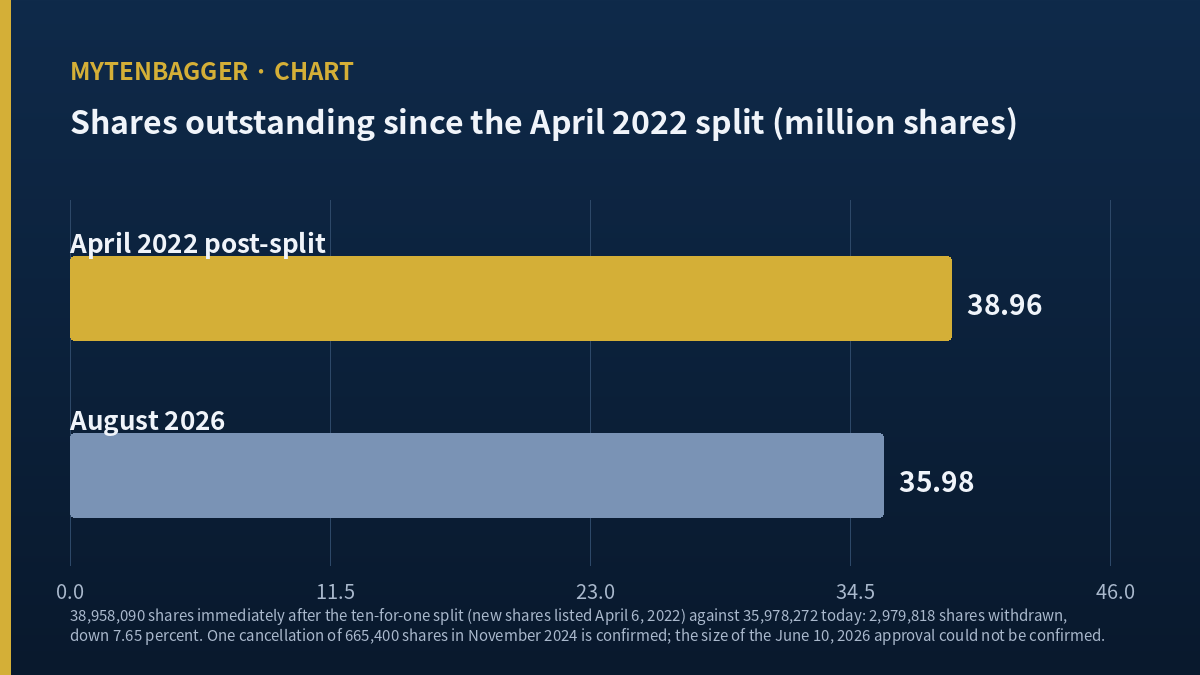
One more thing sits underneath the 0.32 multiple and it is easy to miss, because it works on the per-share side instead of the profit side. Shares outstanding went from 38,958,090 immediately after the April 2022 split to 35,978,272 today. That is 2,979,818 shares withdrawn, a 7.65 percent reduction, achieved through repeated cancellations including one approved on June 10, 2026 whose size I was unable to confirm.
Retiring 7.65 percent of a share count lifts every per-share figure on the remaining shares by 8.28 percent, mechanically and with no operating improvement required. So the book value per share of KRW 30,144 that anchors the price-to-book ratio is a number the company has been actively supporting. I read that as a management choosing to return capital in a difficult stretch, and it deserves the credit.
What it does not do is offset the other side. Profit attributable to owners went from KRW 89.60 billion in 2023 to KRW 16.89 billion in 2025, a fall of 81.15 percent. An 8.28 percent lift and an 81.15 percent decline are separated by an order of magnitude. The retirement programme is real and it is not the reason this stock trades where it does.
Japan has been priced this way for years
I usually reach for a global comparison to find a difference. This time the comparison is useful because there is almost none, and that changed how I read the discount.
Taiheiyo Cement (TSE: 5233) is Japan’s largest cement producer, operating in a mature domestic market with a declining population, which is the closest structural analogue to Korea I can name. Screening data checked on August 19, 2026 shows it at a forward price-to-earnings ratio of 9.76 times and a return on equity of 3.87 percent (stockanalysis.com, TSE 5233 statistics). A second source puts its 2027 estimated multiple at 9.12 times (MarketScreener, valuation page, August 18, 2026 basis).
Set the pairs beside each other. Korea: 3.68 percent return on equity, 8.80 times forward. Japan: 3.87 percent, 9.76 times. The two businesses are separated by 0.19 percentage points of profitability and roughly one turn of earnings. I deliberately did not build a table of price-to-book figures across five global cement majors, because a spread of book multiples without the matching returns on equity would repeat exactly the error this piece is about.
Taiheiyo’s own filing is worth one line for scale, since it shows a mature-market operator can still grow. Its April to June 2026 quarter produced revenue of JPY 221.9 billion and operating profit of JPY 11.5 billion, up 5.1 and 13.9 percent respectively, and management left full-year guidance unchanged (Taiheiyo Cement earnings summary, August 6, 2026). Larger comparators trade differently for reasons of scale and geography: Heidelberg Materials shows 11.69 times forward and 1.43 times book, CRH shows 15.73 times and 2.66 times, on the same screening source and date. Those are diversified aggregates businesses across many markets, and I mention them for context, not as a valuation argument.
Nine arguments against my reading of Asia Cement stock
- The consensus estimate could be conservative, and my whole identity runs on it. If 2026 earnings come in above KRW 1,110 per share, the implied return on equity rises and the 0.32 multiple stops describing the same thing.
- Book value is an input I did not audit. Cement assets are long-lived, carried at depreciated cost, and quarry and kiln land in a country with expensive land may be worth more or less than the carrying figure. Every ratio here inherits whatever error is in that number.
- Three Korean brokerages disagree with the tone of this piece. NH Investment, Shinhan Investment and Hyundai Motor Securities all carried buy ratings in mid-2026, and the three-house average valuation compiled by WISEfn on August 18, 2026 stands at KRW 15,000, which is 53.5 percent above the closing price by my calculation.
- The policy backdrop turned in August. A housing supply package announced on August 13, 2026 shortens the path from land designation to construction start from 68 months to 37, and the KOSPI construction index rose 25.15 percent during the month (Financial News, Korean-language report, August 17, 2026).
- A named Korean analyst puts the turn in 2027, and my window may simply be short. Shinhan Investment’s Kim Sun-mi was quoted in the Korean press saying that rising construction starts translate directly into cement shipments and that a real earnings recovery is expected from 2027 (Etoday, Korean-language report, August 17, 2026).
- Interest expense holding flat is arguably a strength. Total liabilities moved without direction across four years and the debt-to-equity ratio came down from 108.44 percent to 97.79 percent. A company that got through a demand collapse without disturbing its funding structure is not obviously fragile.
- The company keeps retiring shares. Shares outstanding fell from 38,958,090 after the April 2022 stock split to 35,978,272 now, a 7.65 percent reduction, with cancellations approved repeatedly including one on June 10, 2026 whose size I could not confirm.
- Capital expenditure exceeding operating profit is normal at a cycle trough. Any capital-intensive industrial produces this shape when earnings halve. One year of an inverted ratio may be a cycle artefact and I may be over-reading it.
- Volumes are already at a level that historically precedes a turn. Domestic shipments fell 12.8 percent in 2025 to 38.1 million tonnes, the lowest since 1991 (CEO Score Daily, Korean-language report, February 20, 2026). Thirty-four-year lows do not usually persist indefinitely.
which division actually carried a quarter at Hyundai Steel
What would break this reading
I should admit what this piece corrected in me. A low price-to-book and a low forward multiple look like two independent pieces of evidence, and having both feels twice as reassuring. The identity says they were never independent. Treating them that way counts one fact twice.
My reading of this company is narrow. The market is pricing a business expected to earn under four percent on its equity, and it is pricing that correctly by ordinary arithmetic. Meanwhile the cash that leaves the company each year for plant, interest and dividends has held its size while the cash coming in has halved, which is why free cash flow turned negative in 2025.
Two things would break it. If the consensus proves right and 2026 earnings arrive near KRW 1,110 per share, the implied return on equity moves toward four percent and every multiple here has to be recomputed on a different base, at which point the discount is a timing question and not a structural one. And if 2026 full-year capital expenditure lands below operating profit with free cash flow back in positive territory, then 2025 was a trough year and the cash observation loses its force.
The line I will check first is not a headline. It is the property and equipment purchase figure in the third-quarter cash flow statement, due around mid-November 2026, read against operating profit for the same nine months. That single cell decides which of the two branches above I am on. Until then this stays on the watch list, and the Korean-language edition of this journal carries a separate piece on the cash side of the same company.
Prices and multiples reflect the Tuesday, August 18, 2026 close of KRW 9,770 as checked at the time of writing. Korean won is the reference currency throughout and dollar figures are approximate, converted at roughly KRW 1,413.0 per dollar, the Seoul market close on the same date. Financial statement figures are consolidated filings from Korea’s electronic disclosure system for fiscal years 2022 to 2025 and the first quarter of 2026, restated by me in KRW billions; anything described as my calculation is arithmetic I performed on those filed figures. Price, valuation and flow indicators are from Kiwoom data refreshed at 17:30 KST on August 18, 2026. Korean-language sources are cited as such and paraphrased in translation.