Korean Auto Lamp Maker SL Corp: Margin Rank vs Valuation Rank
I keep a running file on companies whose profitability looks out of place next to their peer group. SL Corp stock, listed in Seoul under 005850 as SL Corporation, sat at the top of that file this week. A gap like that is usually telling me one of two things: either the company found something its competitors did not, or those competitors have already fallen to a level it has yet to reach. I worked the numbers until I could say which of the two I believe.
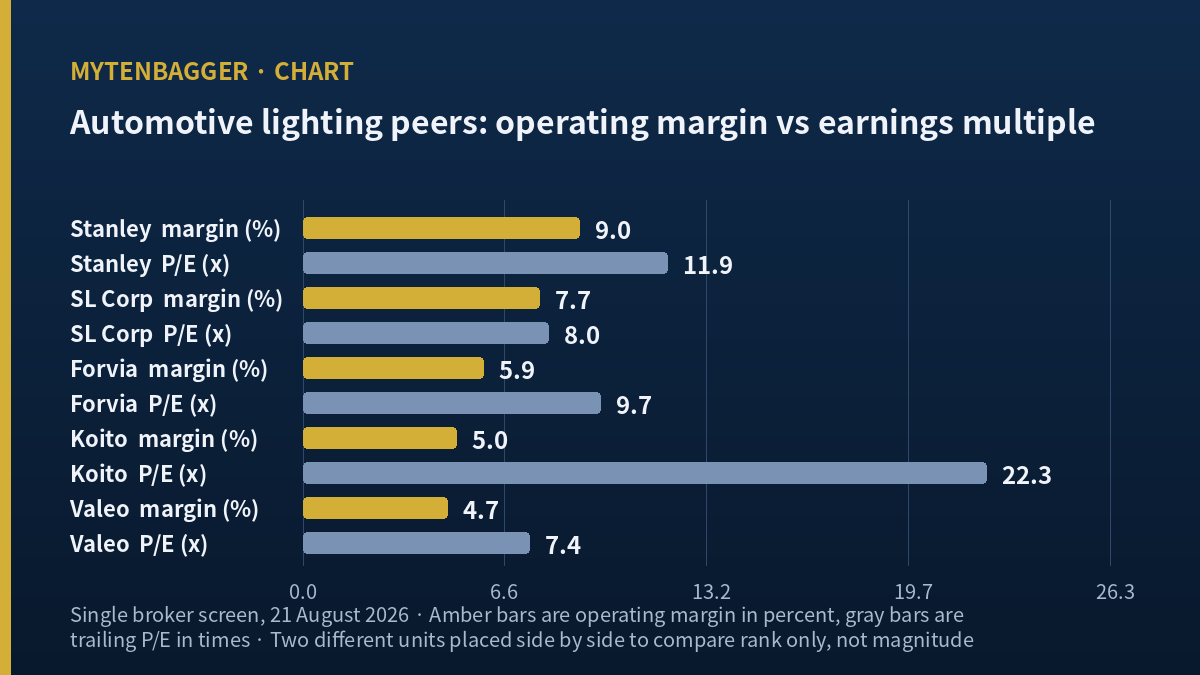
Here is the outline. Across the five largest suppliers of automotive lighting, this company carries the second-widest operating margin and the fourth-highest earnings multiple. Both facts come from a single broker table published on one date, so both come off the same page. The rest of this piece is my attempt to work out whether that gap is a discount I should respect or a warning I should heed.
What I am claiming
SL Corporation’s margin advantage over the global lighting group is real in the filings, and fragile in the industry data.
The number the claim rests on
Koito, the largest lamp maker in the world, earned a 5.43% operating margin in the fiscal year ended March 2026. SL Corporation earned 7.77% in calendar 2025 and 9.78% in the first half of 2026.
What would break the claim
SL Corporation’s operating margin falling under 6.43%, the figure implied by Koito’s own guidance for the year now running.
Contents
What SL Corp stock is, for readers outside Korea
SL Corporation makes headlamps. Lamps produced 78.41% of revenue in the most recent annual filing, with electrification and chassis parts at 12.85% and everything else at 8.74%. The company started in Daegu in 1954, listed on the Korea Exchange main board on 8 November 1988, and employed 5,171 people as of March 2026. Calendar 2025 revenue was KRW 5.24 trillion, roughly USD 3,779 million at the reference rate footnoted below. Customers include Hyundai Motor and Kia at the core, with GM, Ford, Stellantis, BMW and Honda alongside them. Plants sit in Korea, the United States, Mexico, China, India, Poland and Brazil.
Two structural facts matter for anyone reading from abroad. First, KOSPI is the senior board of the Korea Exchange, the equivalent of a main-market listing, one tier above the growth board, and 005850 has traded there for close to four decades. Second, the founding family controls the register: as of 31 December 2025 the chairman’s son held 26.46%, the founder 14.68%, a second son 10.00%, and related parties including a family foundation brought the bloc to 62.97%. Korea’s National Pension Service held 8.13%.
One shareholder is also a competitor
The register holds an item I had not expected. Stanley Electric of Japan, one of the five suppliers in the comparison below, owns 7.01% of SL Corporation. I have not found a public statement explaining the origin or the intent of that holding, so I am recording it as a fact and going no further. It does mean that when I place the two companies side by side on margin, one of them has a direct financial interest in the other.
Where SL Corp stock sits in the lighting group
Cross-border multiples are easy to get wrong, because prices come from different dates and margins come from fiscal years that end in different months. To hold the whole table to one basis, I used a single broker comparison published on 16 March 2026 by Samsung Securities, which put all five companies on 2026 estimates as of that one date and included SL Corporation itself. Market value and revenue are stated there in US dollars.
| Company | Market cap (USD m) | Revenue (USD m) | Operating margin | P/E | P/B |
|---|---|---|---|---|---|
| Stanley Electric | 2,283 | 3,197 | 9.0% | 11.9 | 0.8 |
| SL Corporation | 1,963 | 3,856 | 7.7% | 8.0 | 1.0 |
| Forvia | 2,186 | 27,090 | 5.9% | 9.7 | 0.6 |
| Koito Manufacturing | 5,015 | 5,830 | 5.0% | 22.3 | 1.1 |
| Valeo | 2,911 | 23,981 | 4.7% | 7.4 | 0.6 |
Source: Samsung Securities company report dated 16 March 2026, 2026 estimates, sorted by operating margin. These are that broker’s forecasts as of that date, quoted as published, and they are close to six months old at the time I am writing. I did not recalculate them and I did not adopt them.
Read down the margin column and SL Corporation is second of five. Read down the P/E column and it is fourth of five, ahead of only Valeo. Koito trades at 22.3 times against a 5.0% margin, so its multiple is close to three times SL Corporation’s while its margin is roughly two-thirds as wide. That inversion is the whole question, and I do not think a simple “Korea discount” answers it, because Stanley Electric is also Japanese and also trades under 12 times.
What the lighting industry actually reported
Broker estimates are one source. Filed results are another, and they are the ones I weight more heavily. Here is what each company put in its own accounts for its most recent completed fiscal year.
| Company (fiscal year end) | Revenue | Operating result | Bottom line |
|---|---|---|---|
| Koito (March 2026) | JPY 947,610m | JPY 51,438m, a 5.43% margin | JPY 16,539m |
| Stanley Electric (March 2026) | JPY 518.4bn, up 1.7% | JPY 50.8bn recurring, down 8.3% | JPY 32.8bn |
| Valeo (December 2025) | EUR 20.9bn | EUR 977m, a 4.67% margin | EUR 200m |
| Forvia group (December 2025) | EUR 26.2bn | EUR 1,456m, a 5.56% margin | EUR 2.1bn loss |
| Forvia Lighting division | EUR 3,625m, down 6.5% | EUR 106m, a 2.92% margin, down 190bp | not disclosed |
| SL Corporation (December 2025) | KRW 5.24tn | KRW 407.1bn, a 7.77% margin | KRW 320.8bn |
Sources: Koito consolidated earnings report filed 13 May 2026; Stanley Electric statutory filing as filed to TDnet on 24 June 2026; Valeo full-year release of 26 February 2026; Forvia full-year release of 24 February 2026; SL Corporation figures from its Korean regulatory filing, receipt number 20260318000781. Fiscal years end in different months and the margin definitions are the ones each company uses, so I have quoted each in its own currency and have converted nothing across the row. Stanley Electric reports a recurring profit line, which is not the same measure as operating profit, and I have labeled it as such.
The largest lamp maker is guiding revenue down and profit up
Koito’s guidance for the fiscal year now running calls for revenue of JPY 933,000m against JPY 947,610m delivered, a decline of 1.54%, with operating profit rising to JPY 60,000m, a gain of 16.65%. That implies a 6.43% margin. The company at the top of this industry is planning to shrink its top line and widen its margin at the same time, which reads to me as a repair plan, and it gives me a clean threshold: if SL Corporation’s margin ever falls under the level Koito is targeting on less revenue than it earned last year, the advantage I am describing has gone.
SL Corp stock sits next to a bankruptcy and a write-off
Two data points sharpen the picture. Marelli, formerly Magneti Marelli and one of the largest lighting suppliers in the world, filed for Chapter 11 protection on 11 June 2025 with about USD 4.9 billion of debt and USD 1.1 billion of debtor-in-possession financing. And Forvia’s Lighting division earned a 2.92% operating margin in 2025 on revenue that fell 6.5%, with the margin itself down 190 basis points year on year.
There are two honest readings of those facts, and I hold both at once. The generous one says capacity is leaving the industry and the survivors inherit the volume, which is the argument a bull would make for a supplier that is profitable and holds net cash. The severe one says a business where the number-one player earns 5.43%, a top-five player writes off EUR 2.1 billion, and another top-five player files for bankruptcy protection is a business whose economics are deteriorating, and that a Korean supplier at 7.77% has further to fall than anyone. I lean toward the generous reading, which is exactly why I wrote the threshold into the box at the top of this piece before I could talk myself out of it.
The competitor that is missing from the table
The five-company comparison leaves out the company I find most interesting. Changzhou Xingyu Automotive Lighting, listed in Shanghai under 601799, reported 2025 revenue of CNY 15.257bn, up 15.12%, and attributable net profit of CNY 1.624bn, up 15.32%. It ranks seventh globally and first in China with an 11.6% domestic share, and in smart lighting specifically it claims the largest global share at 10.2%. On 29 July 2026 it filed for a secondary listing in Hong Kong. It carries no net debt.
Its own listing document contains the number that explains why lamp suppliers can grow faster than car production. Its average selling price per front lamp went from CNY 473.6 in 2023 to CNY 614.5 in 2025, a rise of 29.75%. Lamps are becoming a larger line item on each vehicle because the optics and the electronics inside them keep expanding. That trend supports SL Corporation and it also funds the company most likely to compete away its margin. Xingyu’s overseas revenue is still only around 4.1% of its total, so the collision has not happened yet.
The regulatory clock in the largest export market
Adaptive driving beam headlamps, which shape the beam around oncoming traffic, were legalized in the United States by a final rule on 22 February 2022. Petitions asking the regulator to relax the test conditions were denied in full on 30 December 2024, leaving the American standard tighter than the European one. So the high-value lamp content that lifts average selling prices arrives more slowly in the market where SL Corporation has just built out its North American footprint. The wider market is projected to grow from USD 31.27 billion in 2026 to USD 45.87 billion by 2033, a compound rate of about 5.6%, according to a MarketsandMarkets release dated 21 August 2026.
Where SL Corp stock trades right now
The last close I have is KRW 52,400 on Friday 21 August 2026. I am writing on Saturday 22 August, so that is the prior business day’s close, not an intraday quote. Against 46,448,520 shares outstanding, market value is KRW 2.43 trillion, or about USD 1,755 million. Note that this is lower than the USD 1,963 million in the broker table above, because that table was priced in March; the two are five months apart and should not be read as a contradiction.
| Measure | Value |
|---|---|
| Close, 21 August 2026 | KRW 52,400, about USD 37.79 |
| Market value | KRW 2.43tn, about USD 1,755m |
| Trailing P/E, P/B, P/S | 7.83, 0.95, 0.46 |
| Twelve-month return, 244 sessions | up 55.03% |
| Against the 16 June 2026 peak of KRW 76,200 | down 31.23% |
| Dividend on 2025 earnings | KRW 2,770 per share, about USD 2.00 |
| Balance sheet, 30 June 2026 | liabilities 56.89% of equity, interest cover 38.38 times |
Price, multiples and the 250-session range come from Kiwoom Securities data as of the same close. The dividend figures are cross-checked against Korean press coverage of 23 February 2026 and a Korean dividend history database. Balance-sheet ratios are calculated from the semi-annual regulatory filing, receipt number 20260814002776.
The half-year the market has not priced yet
The first half of 2026 was the strongest six months this company has filed. Revenue reached KRW 2.755 trillion, about USD 1,987 million, up 8.97% on the same period a year earlier. Operating profit reached KRW 269.6 billion, about USD 194 million, up 19.70%, for a 9.78% margin against 8.91% a year before. The second quarter on its own produced KRW 1,367.3 billion of revenue and KRW 125.8 billion of operating profit, with net profit up 59.79% year on year. Interest cover on the half-year cumulative figures stands at 38.38 times, up from 6.25 times in 2022, and cash from operations ran at 152.4% of operating profit.
What I find odd is what happened afterward. Eight analysts cover the name, with a mean published valuation of KRW 86,500, a high of KRW 100,000 and a low of KRW 57,000, a spread of 1.75 times between the extremes. The most recent report I could locate is dated 22 May 2026. In the three months since, the share fell 31% from its June peak and the semi-annual accounts were filed, and I found nothing published against either event. A 65% distance between the mean valuation and the last close reads to me less as a statement about the company and more as a statement about the age of the estimates. That matters here because the same desks were wide of the mark before: the 2025 consensus range of KRW 340 billion to KRW 360 billion in operating profit was beaten by 13.1% to 19.7%, with that consensus range as the denominator, while quarterly earnings per share missed by 45.6% and 28.7% in the middle of that same year.
Tariffs are lower and they are still charged
United States duties on Korean automotive parts moved from 25% to 15% under the bilateral trade arrangement, applied retroactively to 1 November 2025 and set out in the Federal Register notice of 4 December 2025. Headlamps fall inside the HS 8512 codes on the customs authority’s parts list, so the 15% still applies to every lamp shipped from Korea. A Korean broker put the tariff cost in the second quarter of 2025 above KRW 10 billion and judged that customer reimbursement would follow. The cost is documented and the reimbursement is a judgment, and I keep those two in separate columns.
Ten ways SL Corp stock proves me wrong
- The peer table is six months old. Every multiple in it was struck on 16 March 2026, before the first-half results and before this share fell 31% from its June peak. The ranking I built the piece on could already have moved.
- Margin definitions are not uniform. Stanley Electric reports recurring profit, Forvia reports an adjusted operating income, and the Korean figure is the operating profit line as presented in the statutory accounts. Comparing them to two decimal places would be false precision.
- A wide margin at a parts supplier can mean pricing that has yet to be negotiated away. Chinese sector research names annual price-down demands from carmakers as a standing pressure on lamp suppliers, and Xingyu’s own gross margin has sat under 20% for three years.
- Customer concentration cuts both ways. A broker described SL Corporation as holding effectively all of the Hyundai group’s lamp business in North America and India. Read the other way, that group’s volume is this company’s earnings, and Hyundai set its 2026 sales target at 4,158,300 units, below the prior year’s target.
- Koito’s premium multiple may be information. I treated 22.3 times as an anomaly. It could instead reflect an order book, a customer mix or a balance sheet that I have not examined, in which case the gap is not a discount at all.
- I did not read the primary broker documents end to end. The Samsung Securities table and the Korean estimates behind it reached me through the published PDF and through secondary coverage in the Korean press.
- Marelli’s restructuring may already be resolved. I confirmed the June 2025 filing and the financing package, and I did not confirm whether the company has since emerged, which changes whether its capacity is leaving the market or returning to it.
- SL Corporation’s global market share is unknown to me. No source I could reach publishes it. What exists is a customer-and-region figure, which is a much narrower claim than a share of the world market.
- The stronger won works against export revenue. Roughly half of this company’s sales are outside Korea, and the won at 1,386.5 is at an eleven-month high.
- The part that troubles me most. My entire ranking argument depends on the five-company set being the right set. Xingyu is the seventh-largest lighting supplier in the world and it appears nowhere in that table; had it been included at a 2.32 price-to-book and an 11.49% operating margin from a separate data source, both of my rankings would shift. I chose a table that excluded the fastest-growing participant in the industry, and I chose it because it was internally consistent, which is a reason of convenience.
multiple only counts as cheap, payout ratio
My line on SL Corp stock
SL Corporation earns more per unit of revenue than Koito, Valeo and Forvia, and the market pays less for each unit of its earnings than it pays for three of the four. That is the observation. My reading is that the discount is partly the Korean market, partly the controlling family, and partly a well-founded suspicion that a 7.77% margin in a business where the leader earns 5.43% is a number under pressure. I find the first two acceptable and the third worth watching closely.
So my line is Koito’s own guidance. If SL Corporation’s operating margin drops below 6.43%, the level the largest lamp maker in the world is targeting on a shrinking revenue base, then the premium I have described has closed and this piece is finished. I did not pick that threshold myself; a competitor published it, which is the part I like about it. Until then I am watching, and I will write again when the number moves.
Prices and multiples reflect the 21 August 2026 Korean close as checked at the time of writing. Dollar figures are approximate, converted at 1,386.5 won per dollar on that same date, and the Korean won is the currency of record throughout. Peer figures are quoted in each company’s own reporting currency and have not been converted or restated. Where a number comes from my own calculation, I have said so in the table footnote.
- POSCO Future M Forecast: Strong 2026 Estimates, Thin 2027 Data
- Hyundai Wia Stock Has Traded Below Book Value for a Full Year