SNT Motiv Capex and Free Cash Flow: Spending Above Every Peer
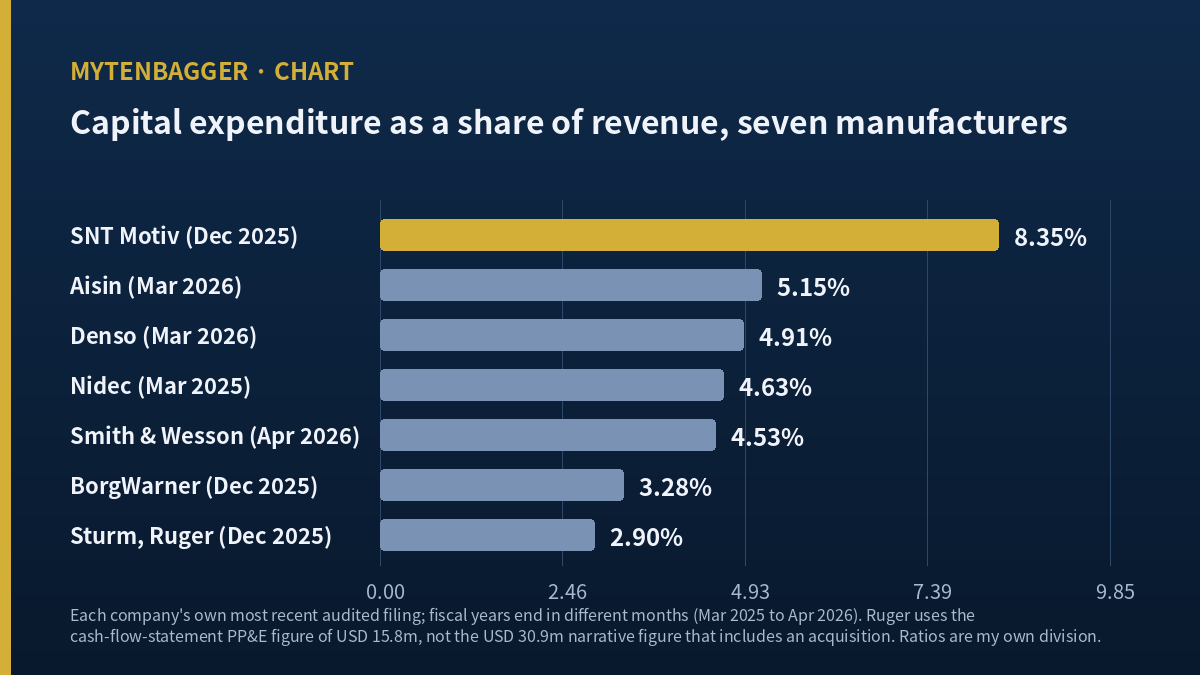
I went looking for what SNT Motiv stock is priced against and ended up counting capital expenditure instead. In 2025 the company spent KRW 83.99 billion on capex against KRW 1,006.4 billion of revenue. That is 8.35 percent of revenue. I then pulled the most recent audited figures for six larger companies that make the same two kinds of things this company makes, and none of them spent that proportion. The highest was Aisin at 5.15 percent.
SNT Motiv is a KOSPI-listed Korean manufacturer. KOSPI is the main board of the Korea Exchange in Seoul, the larger of the country’s two equity markets. The company builds drive motors and engine components for cars, and it also makes small arms for the Korean military. Its shares closed at KRW 26,100 on Friday, August 21, 2026, which puts its market value at roughly KRW 692.7 billion, or about USD 500 million.
Capital spending as a share of revenue, most recent audited year
| SNT Motiv (Dec 2025) | 8.35% |
| Aisin (Mar 2026) | 5.15% |
| Denso (Mar 2026) | 4.91% |
| Nidec (Mar 2025) | 4.63% |
| Smith & Wesson (Apr 2026) | 4.53% |
| BorgWarner (Dec 2025) | 3.28% |
| Sturm, Ruger (Dec 2025) | 2.90% |
Every ratio here is my own division of two figures each company published. Fiscal years end in December, March and April, and the underlying amounts are in three currencies, so the ratios can sit side by side while the absolute sums cannot.
Contents
What SNT Motiv Stock Costs and What the Company Spends
Here are the figures I am working from. The share price and market value are as of the Friday, August 21, 2026 close, which is the last session before I wrote this on Sunday, August 23. Everything on the income statement comes from the audited annual filing lodged with Korea’s electronic disclosure system on February 19, 2026.
| Item | 2024 | 2025 | Change |
|---|---|---|---|
| Revenue (KRW bn) | 968.9 | 1,006.4 | +3.87% |
| Operating profit (KRW bn) | 98.1 | 102.6 | +4.51% |
| Operating cash flow (KRW bn) | 130.1 | 73.8 | −43.28% |
| Capital expenditure (KRW bn) | 49.0 | 84.0 | +71.44% |
| Free cash flow (KRW bn) | +81.1 | −10.2 | sign flips |
| Capex ÷ revenue | 5.06% | 8.35% | +3.29pp |
Prices and multiples reflect the August 21, 2026 close as I checked them while writing; this piece can appear on a later date, so live quotes may differ. Korean won is the currency of record throughout. The two dollar figures I give are approximate, converted at about KRW 1,386.5 per dollar, the Seoul market close on that same Friday afternoon.
The one line that moved while everything else held still
Revenue moved 3.87 percent. Operating profit moved 4.51 percent. Operating margin went from 10.13 percent to 10.19 percent, which for a components maker is close to standing perfectly still. Against that, capital expenditure moved 71.44 percent, and free cash flow crossed from plus KRW 81.1 billion to minus KRW 10.2 billion. I watched capex climb against a falling top line in TheBorn Korea stock.
I want to be careful about what that sign change means. Free cash flow here is simply operating cash flow minus capital expenditure, and both terms moved at once: cash from operations fell 43.28 percent while spending rose. So the negative figure is not purely a capex story. It is a story about the two lines meeting from opposite directions in the same twelve months.
The first half of 2026 pulled the ratio back a little without changing the picture. Six-month capex of KRW 34.3 billion against six-month revenue of KRW 473.6 billion works out to 7.24 percent, still above every company in my table. Operating cash flow of KRW 39.1 billion left free cash flow at KRW 4.8 billion, positive but thin.
SNT Motiv Stock Against Six Global Peers on Capital Spending
I chose these six because each one overlaps with at least one half of what this company does. Nidec, Denso, Aisin and BorgWarner all build electrified drivetrain hardware. Sturm, Ruger and Smith & Wesson build firearms for civilian buyers, which makes them an imperfect comparison, but they are the closest listed match I could reach for a small-arms line.
| Company | Year end | Revenue | Capex | Capex ÷ rev |
|---|---|---|---|---|
| SNT Motiv | Dec 2025 | KRW 1,006,373m | KRW 83,987m | 8.35% |
| Aisin | Mar 2026 | JPY 5,117.7bn | JPY 263.5bn | 5.15% |
| Denso | Mar 2026 | JPY 7,539,975m | JPY 370,170m | 4.91% |
| Nidec | Mar 2025 | JPY 2,607,094m | JPY 120,711m | 4.63% |
| Smith & Wesson | Apr 2026 | USD 523.8m | USD 23.7m | 4.53% |
| BorgWarner | Dec 2025 | USD 14,316m | USD 469m | 3.28% |
| Sturm, Ruger | Dec 2025 | USD 546.1m | USD 15.8m | 2.90% |
Two cells in that table need a sentence each before anyone leans on them. Ruger’s annual release gives two capital-spending figures: USD 30.9 million described in the narrative, which includes a USD 15.0 million acquisition, and USD 15.8 million of property, plant and equipment purchases in the cash flow statement. I used the second. The first would put Ruger at 5.66 percent and move it above three companies in the table. And BorgWarner’s 2025 results put its capex at USD 469 million on a tooling-inclusive basis, which the company states plainly.
The Denso figures and the Aisin figures come from each company’s own year-end materials, and Smith & Wesson’s from its fiscal 2026 release. Nidec is the row I trust least, for a reason I take up further down.
Why the ratio jumped in a single year
The increase in absolute terms is KRW 35.0 billion, from KRW 49.0 billion to KRW 84.0 billion. I spent longer than I expected trying to find out what that bought, and I did not close it.
There is one event of almost exactly the right size at almost exactly the right time. In late August 2025, Korean media reported that the SNT group had completed the purchase of a plant site in Louisiana, with SNT Motiv leading and an affiliate participating. Newsis reported the completion on August 29, 2025, and a Korean trade outlet put the consideration at KRW 35.4 billion for an 86.7 percent stake. A Korean brokerage separately described about USD 26 million of investment going into the Louisiana facility with first-quarter 2026 startup as the goal, and those two amounts are consistent with each other.
KRW 35.4 billion against a KRW 35.0 billion increase is close enough that the temptation is to call it solved. I am not going to. Buying 86.7 percent of an entity is an acquisition, and an acquisition normally travels through the investing section of the cash flow statement as a business combination, which would keep it out of the property and equipment line altogether. If that is what happened, then the KRW 35.0 billion rise in the capex line came from something else entirely, and the coincidence of size is just a coincidence. I could not open the cash flow note that would settle it.
SNT Motiv Stock, Free Cash Flow, and the Year It Went Negative
The company paid dividends of KRW 40.52 billion for 2025, a figure it stated in the corporate value enhancement plan it filed in early March 2026 and which Digital Today reported on March 3, 2026. The prior year’s total was KRW 20.44 billion, so the payout grew 98.28 percent by the company’s own arithmetic.
Set that next to the free cash flow line. In 2025 this business generated KRW 73.8 billion from operations, spent KRW 84.0 billion on capital expenditure, and distributed KRW 40.5 billion to shareholders. The dividend was covered by the balance sheet, because the year’s cash generation did not reach it.
That is a survivable position for a company with very little debt. Liabilities were 26.89 percent of equity at the end of June 2026, and a Korean brokerage put net cash at KRW 486 billion in mid-2025, which at that time was over half the market value. I have not been able to verify the current net cash figure from a primary filing, so I use it only as a direction; it does not enter my judgment as a number. But direction is enough to say that a single year of negative free cash flow does not threaten anything here.
What it does do is remove the easy reading. A company spending 8.35 percent of revenue while distributing double the prior year’s dividend is doing two demanding things at once, and I would like to know which one the board considers the priority. The value enhancement filing does not say. Its stated goal is expanding overseas revenue in vehicle components and defense, with US production and sales infrastructure as the method, and it carries no numerical target for return on equity, payout ratio or treasury share cancellation. The opposite arrangement, where capital spending stays inside the cash the business earns, is in Dongwon Industries stock.
SNT Motiv Stock and the Operating Profit That Held at Ten Percent
One thing this company does with unusual consistency is land its operating margin near ten percent. Across 2022, 2023, 2024 and 2025 the annual figures were 10.71, 10.26, 10.13 and 10.19 percent. The first half of 2026 came in at 10.00 percent, and the second quarter alone at 10.01 percent. Five years of a components business with a customer base concentrated in one automaker group, and the margin barely moves.
Below that line it is a different matter. Profit attributable to owners fell 33.27 percent in 2025, to KRW 69.6 billion from KRW 104.3 billion, while operating profit rose. Almost all of the damage sits in the fourth quarter, where a discrete operating profit of KRW 30.9 billion produced net income of only KRW 12.8 billion. The fourth quarter of 2023 did something similar, turning KRW 32.4 billion of operating profit into a small net loss.
I do not know what caused either quarter. Interest expense grew by KRW 6.2 billion between 2024 and 2025, which covers under a fifth of the gap. Impairment, equity-method losses and tax settlement are all candidates and I can rank none of them, because the note that would answer it sits inside a filing I could not open. I raise it here because the price-to-earnings ratio of 9.95 that screens show for this company is built on that reduced profit, and on the prior year’s profit the same price would be 6.64 times.
Where SNT Motiv Stock Sits Against KOSPI and Its Sector
Over the 244 trading sessions from August 21, 2025 to August 21, 2026, the shares fell 21.74 percent. KOSPI rose 120.04 percent over the same window, an extraordinary run for the Korean market. The auto parts sector, measured as an equal-weighted index of 147 constituents with this company excluded, fell 1.52 percent. HL Mando sits in that same parts group, and I counted its order book against its price in a separate entry.
Splitting the 141.77 percentage point shortfall against the market gives 121.55 points of sector effect and 20.22 points of company effect. Roughly 86 percent of the underperformance belongs to the sector and about 14 percent to the company itself. Within those 147 names this one ranks 98th, against a sector median of minus 10.87 percent. Its beta to the market is 0.466 and its correlation 0.53, both low.
The peak close for 2026 was KRW 39,450 on Wednesday, January 21, and the trough KRW 24,650 on Wednesday, July 29, a maximum decline of 37.52 percent measured close to close. The August 21 price of KRW 26,100 is 5.88 percent above that trough.
What Korean Sell-Side Wrote About SNT Motiv Stock
Fifteen Korean brokerage notes on this company appeared in 2026 according to the disclosure portal listing, and I could confirm the figure attached to six of them. DB Securities analyst Nam Ju-shin moved his to KRW 46,000 on Monday, February 2 from KRW 41,000, and held it on Monday, February 23. Daishin Securities analyst Kim Gwi-yeon cut his to KRW 49,000 on Wednesday, February 4, though I could not establish what it had been before. Hyundai Motor Securities analyst Jang Moon-soo has carried KRW 48,000 since October 2025. Hana Securities analyst Song Sun-jae has held KRW 40,000 since Wednesday, March 25, the lowest of the group. Samsung Securities showed KRW 45,000 in a sector document dated Monday, June 15.
Nine notes from July and August carry figures I could not read. Their titles are visible in the listing and their authors are named, but the numbers themselves are behind brokerage walls. Since the newest confirmed figure I have is from mid-June, and the consensus screens now sit below the February notes, I take the February numbers as stale and do not use any of them as a view on the present.
Consensus itself does not agree with itself. One aggregator shows a seven-broker average of KRW 41,857, another KRW 42,667, a third KRW 41,286, all around the same August date. Their 2026 earnings-per-share estimates differ by a factor of nearly two, at KRW 3,516 and KRW 1,829. I did not pick between them and no consensus figure enters my thinking here.
As for what the analysts argue: DB’s February note credited expanding brake motor and electric oil pump volumes for the Hyundai group, plus the US and India plants driving motor revenue, and it was reported by Edaily Marketin on February 2. Daishin’s cut, reported by Etoday on February 4, named concern over the robot actuator business as the reason and noted the shares had gained 2 percent year to date against 26 percent for KOSPI and 36 percent for the auto sector. Both of those are Korean-language reports, so I am giving the substance in English without quoting.
Why I Am Only Watching SNT Motiv Stock
At roughly USD 500 million of market value this sits well outside the range where I take a stance, so watching was always the likely outcome. But the specific reason I stopped is narrower than size.
I built a comparison, found the company at the top of it, and then could not explain the number that put it there. A capital expenditure ratio above every peer in the table is either a company investing hard into a product shift or an artifact of one accounting entry I have misread. Those two explanations point opposite ways, and the document that separates them is one I could not reach. I am not willing to build a view whose central fact rests on a coincidence of magnitude between two numbers I found in different places.
There is a second thing. If the spending is real and deliberate, I still cannot say what it is building, because I cannot establish how this company’s revenue splits between motors and small arms. Brokerage notes I found put the defense share anywhere from 4 to 17 percent depending on how they group the segments. A capital program is a bet on a specific product line, and I do not know which line.
Figures I checked and set aside
The interest coverage of 15.52 that appears on my data screen is six-month operating profit of KRW 47.4 billion over six-month interest expense of KRW 3.05 billion. It is a half-year ratio and cannot be placed beside another company’s annual coverage. The free cash flow yield of 0.70 percent on the same screen divides six-month free cash flow by a full-year market value, so its periods do not match either. I used the underlying amounts and dropped both ratios. The seven-factor checklist scores this company 86, failing only on return on equity of 7.0 percent, and that 7.0 percent is computed on the same reduced 2025 profit I have already flagged, so the score would be counting one problem twice.
A press release about a factory purchase
A press release about a factory purchase is as close as I got to explaining the central number in my own table, and I want to record how that happened. I had assumed, without ever testing it, that a rising capital expenditure ratio reads the same way in every company: management building capacity ahead of demand. This time the ratio rose and I could not establish whether anything had been built at all. It took me most of a session to notice that my confidence in the ratio came from the arithmetic being clean. It did not come from knowing what the arithmetic described.
The other side, five places this breaks
One, and this is the worst of them. The entire comparison assumes the KRW 84.0 billion sits in the property and equipment line and represents plant. If the Louisiana transaction was recorded as a business combination and something else drove the capex increase, my ratio still computes but my explanation of it is empty. I could not open the cash flow note.
Two. Nidec’s row is unstable. On Monday, April 27, 2026 the company told the market it would delay its results for the year ended March 2026 indefinitely, citing an ongoing restatement of statements going back to the year ended March 2022. The figures I used are from the March 2025 year, which falls inside the period being restated. One of six rows in my table may be rewritten by its own auditors.
Three. Fiscal years end in December, March and April across this table, and three currencies are involved. Ratios survive that; rankings survive it less well when two companies are within half a percentage point of each other.
Four. Ruger’s two capital-spending figures move it by 2.76 percentage points depending on which I take, as I set out above. I chose the narrower definition because it matches how the other six report, but that is my judgment and someone could reasonably choose the other.
Five. The demand backdrop for the small-arms half is narrowing. Korea’s defense ministry said on Wednesday, August 5, 2026 that it will reduce total military manpower to about 500,000 by 2040 and shift the enlisted share of that force from 60 percent to 37 percent, as Newstomato reported. Individual weapons procurement follows soldier counts. Separately, this company spent about KRW 90.5 billion in 2026 buying affiliate stakes from its holding company and its controlling shareholder, and then lost the board vote at the target company’s March 31 shareholder meeting, as Hankyung reported. Where the cash goes matters to anyone weighing the capital program.
What Would Make Me Redo This Comparison
My position here does not rest on a price level, so a price level is the wrong thing to write down as a trigger. What it rests on is a table of seven rows, and the table dissolves under either of two events.
The first is Nidec publishing its restated figures. If the corrected March 2026 accounts put its capital intensity above 8.35 percent, the sentence that organizes this entire piece stops being true, and I will have learned that my top row was only top because one company had not reported.
The second is the Louisiana question resolving the wrong way. If that purchase turns out to sit outside the capital expenditure line, then the KRW 35.0 billion increase has an unknown source and I have been describing an effect while naming the wrong cause for it.
The nearer checkpoint is the third-quarter report. Korea’s statutory deadline is November 15, which falls on a Sunday in 2026, so the filing lands on or after Monday, November 16. Three things there would move me: the nine-month capital expenditure figure, whether net income again separates from operating profit before the fourth quarter arrives, and whether the treasury holding is still 2,706,000 shares.
Sources consulted: company investor notices (Korean) and the six filings and reports linked above.
- Moorim Paper Cash Flow Turned Positive as Capex Ended
- Hyundai Greenfood Revenue Growth and a Ten-Month First Year