Woori Technology (032820) Valuation After Six Quarterly Losses
How does a company that has posted an operating loss in six consecutive quarters end up with a printed earnings multiple of 2,503 times? That is the number sitting beside Woori Technology stock (KOSDAQ: 032820) on the August 21, 2026 close of KRW 11,890, or about USD 8.58. Beside it are a 15.76x book multiple and a 23.59x sales multiple. The consolidated filings this company submits to Korea’s Financial Supervisory Service show an operating loss in every quarter from the first quarter of 2025 through the second quarter of 2026.
I reproduced all three multiples and they all hold. The interesting part is what the earnings multiple is built on. Dividing KRW 11,890 by 2,503.16 returns KRW 4.75, and that KRW 4.75 is the earnings-per-share figure the vendor used. The vendor’s own metadata field for that figure reads computed_price_div_per, meaning it was produced by dividing the share price by the multiple. The share price therefore appears above and below the division line. A ratio built that way cannot tell me the shares are expensive and cannot tell me they are cheap.
A sentence someone wrote, and the arithmetic I ran against it
| The written line | What I got when I checked it |
|---|---|
| “Shares issuable on conversion equal 2.11 percent of shares already outstanding” (August 6, 2026 board resolution, as reported by the Korea Economic Daily) | 3,732,387 divided by 172,783,852 shares is 2.16 percent. Getting to 2.11 percent requires a base of 176,890,379 shares. I could not confirm the 4,106,527-share difference. |
| “Proceeds are entirely for working capital” (same resolution) | First-half 2026 operating cash flow was negative KRW 8.524 billion, about USD 6.15 million. |
| “Revenue at an all-time high” (Numbers, Korean business press, August 10, 2026, in my own translation) | Correct. Fiscal 2025 consolidated revenue was KRW 87.135 billion, about USD 62.85 million. Operating loss the same year was KRW 5.487 billion, about USD 3.96 million. |
| Trailing earnings multiple of 2,503.16x (Kiwoom data, August 21, 2026 close) | The KRW 4.75 underneath it comes from dividing the price by the multiple. The same price sits on both sides. |
My position: watching only. Market capitalization of KRW 2,054.4 billion, about USD 1.48 billion, places this outside Korea’s top 100 listed companies.
Contents
Where Woori Technology Stock Sits Against Its Own Revenue
One multiple survives the circularity problem, and it is the sales multiple. Revenue is an audited figure that does not move when the share price moves, so dividing market capitalization by it produces something I can argue about.
Market capitalization of KRW 2,054.4 billion divided by fiscal 2025 revenue of KRW 87.135 billion gives 23.577 times. The vendor prints 23.59, so the reproduction holds to the third decimal. I also checked the market capitalization itself by multiplying the August 21 close of KRW 11,890 by 172,783,852 shares outstanding, and the difference from the printed figure was zero won.
So the question I can actually ask is this one: what does the market normally pay for a won of revenue from a nuclear instrumentation supplier? To answer it I need a comparison outside Korea, because Korea’s listed nuclear names are engineering, maintenance and heavy-equipment businesses. None of them supplies reactor control systems. I go to that comparison further down.
The Case That Cuts Against Me
Everything above leans one direction, so I want the opposing material on the page before I go further.
First, revenue has grown for four straight years. Consolidated revenue ran KRW 49.494 billion in 2022, KRW 63.166 billion in 2023, KRW 71.250 billion in 2024 and KRW 87.135 billion in 2025. The 2025 figure alone was up 22.29 percent from KRW 71.250 billion. Numbers, a Korean business outlet, counted the same trend from a longer base: KRW 52.1 billion in 2021 to KRW 87.1 billion in 2025, a 67.18 percent increase.
Second, Korea Hydro and Nuclear Power signed a vendor-managed inventory agreement with this company. Newspim reported it on August 10, 2026. The structure commits the utility to long-term supply of reactor instrumentation and control parts, starting with power supply units. The same report noted that this was the utility’s first such agreement with a small or medium-sized enterprise, and carried a company expectation that widening the scope to CPU boards could add more than KRW 10 billion of annual contracts. That KRW 10 billion is a company projection and no order of that size has been booked.
Third, whoever bought the new convertible bond gave up all of the interest. Both the coupon and the yield to maturity are zero on a six-year instrument. Someone accepting no interest for six years is putting a price on the equity that comes after conversion, which is a judgment about this business that I do not share but cannot dismiss.
Fourth, the conversion price already sits below the market. At KRW 10,717, or about USD 7.73, the conversion price is 10.95 percent under the August 21 close. Money went in at that level in August 2026, and that is an outside party’s weight against my watching stance.
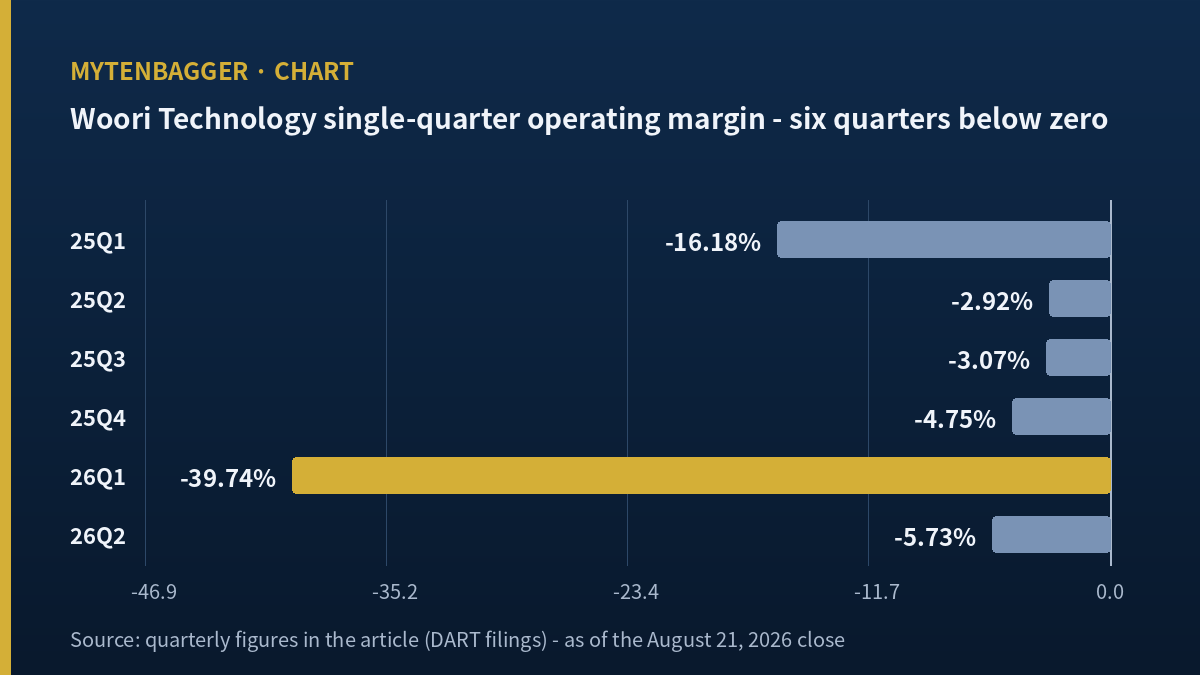
Six Quarters Behind Woori Technology Stock, Counted From the Filings
Korean quarterly filings report income statement lines cumulatively, so I subtracted each prior cumulative figure to recover single quarters. All amounts are consolidated.
| Quarter | Revenue (KRW bn) | Operating result (KRW bn) | Operating margin |
|---|---|---|---|
| Q1 2025 | 18.536 | -3.000 | -16.18% |
| Q2 2025 | 22.584 | -0.659 | -2.92% |
| Q3 2025 | 21.183 | -0.650 | -3.07% |
| Q4 2025 | 24.832 | -1.179 | -4.75% |
| Q1 2026 | 16.957 | -6.739 | -39.74% |
| Q2 2026 | 19.793 | -1.134 | -5.73% |
Six quarters of revenue add to KRW 123.885 billion, about USD 89.35 million, and six quarters of operating result add to a loss of KRW 13.360 billion, about USD 9.64 million. First-half 2026 on its own shows revenue of KRW 36.750 billion against an operating loss of KRW 7.873 billion. A year earlier the same half produced revenue of KRW 41.120 billion and an operating loss of KRW 3.658 billion, so revenue fell 10.63 percent from KRW 41.120 billion while the operating loss grew to 2.15 times its year-earlier size.
One more line belongs beside the operating result, because it shows where the money went. Capital expenditure ran KRW 29.006 billion in 2023 and KRW 39.812 billion in 2024 against revenue that never reached KRW 90 billion in either year, and free cash flow came in at negative KRW 25.294 billion and negative KRW 35.869 billion across the same two years. The first half of 2026 added KRW 11.029 billion of capital expenditure and negative KRW 19.553 billion of free cash flow. Numbers, working from a longer series than mine, counted free cash flow negative for four straight years and put the 2025 figure at negative KRW 65.4 billion. I keep the two sources apart because their aggregations differ, but they point one way: this business has spent well ahead of what it collects, and the twentieth convertible bond is what closes that distance.
The bottom line swings in a way the operating line does not
Consolidated net result for the same six single quarters runs negative KRW 5.477 billion, positive KRW 20.151 billion, negative KRW 3.290 billion, negative KRW 15.489 billion, positive KRW 27.424 billion and negative KRW 22.156 billion. The sign flips four times across that span while the operating line stayed negative all six times.
Net profit attributable to owners of the parent moves further still. Q1 2025 was negative KRW 3.854 billion. Q4 2025 was negative KRW 15.272 billion. Q1 2026 was positive KRW 28.889 billion, about USD 20.84 million. Q2 2026 was negative KRW 18.347 billion, about USD 13.23 million. In Q1 2026 the operating loss was KRW 6.739 billion and the bottom line was a profit of KRW 28.889 billion, a gap of KRW 35.628 billion in one quarter. The next quarter the gap ran KRW 17.213 billion the other way.
I could not identify which below-the-line item produces that swing. Interest expense for the first half of 2026 came to KRW 18.068 billion, about USD 13.03 million, which is 2.87 times the KRW 6.297 billion of a year earlier, and interest alone does not flip a sign. Korea’s exchange disclosure viewer blocked me from opening the individual filing documents, so I never read the half-year report footnotes directly. Because of that, this piece uses the operating line and leaves net profit out of the judgment entirely.
Mirion Technologies Charges Less for More Sales
Mirion Technologies (NYSE: MIR) is the closest listed comparison I could find: a nuclear measurement and detection business selling into reactor operators, medical and defense customers. I picked it for one specific reason. Both companies sit at roughly zero earnings, which makes earnings multiples useless for both, and that forces the comparison onto sales, which is exactly where my Korean analysis ended up.
| Measure | Woori Technology | Mirion Technologies |
|---|---|---|
| Market capitalization | USD 1.48bn | USD 3.73bn |
| Revenue | USD 62.85m (FY2025) | USD 1.02bn (trailing) |
| Sales multiple | 23.58x | 3.66x |
| Trailing net result | Operating loss six quarters running | USD 24.50m profit |
| Forward earnings multiple | None published | 25.06x |
Mirion sells 16.23 times as much as Woori Technology does and carries 2.52 times the market capitalization. Run those together and the Korean company costs 6.45 times as much per unit of revenue. Mirion’s own numbers reproduce cleanly: USD 14.98 multiplied by 249.04 million shares gives USD 3,730.6 million, which matches the printed USD 3.73 billion. One caution on the Mirion figures. The USD 14.98 was an intraday quote captured at 3:49 p.m. Eastern on August 21, 2026, not a closing print, and Mirion’s displayed trailing earnings per share of USD 0.09 does not reconcile with its stated trailing net income: USD 24.50 million over 249.04 million shares works out to USD 0.0984, a 9.31 percent gap. I use the market capitalization and revenue lines, which do reconcile, and stay away from the earnings line on both sides of this table.
I want to be careful about what this gap proves. A 6.45 times premium on sales is not by itself evidence of overpricing. Woori Technology is a domestic monopoly supplier of reactor instrumentation and control systems in a country building new units, and Mirion is a diversified detection business with slower growth. But a premium of that size has to be paid for by something, and the something has been an operating loss in each of the last six reported quarters.
The Convertible Bond That Sets the Share Count in 2027
On August 6, 2026 the board approved a twentieth series of unsecured privately placed convertible bonds worth KRW 40 billion, about USD 28.85 million. Every multiple above puts share count on the dividing side, and this instrument changes share count on a schedule that is already written down.
| Term | Detail |
|---|---|
| Size and series | KRW 40 billion, twentieth series, unsecured, privately placed |
| Conversion price | KRW 10,717 per the Korea Economic Daily, KRW 10,700 per Numbers. My handling is below. |
| Shares on conversion | 3,732,387, described in the filing as 2.11 percent of shares outstanding |
| Conversion window | August 13, 2027 through July 13, 2031 |
| Maturity and interest | Matures August 13, 2031. Coupon zero, yield to maturity zero. |
| Stated use | Working capital in full, directed at Shin-Hanul units 3 and 4, control system deliveries, and i-SMR development per the Korea Economic Daily |
Division settles which conversion price is right
Two Korean outlets published different conversion prices. I did not average them and I did not simply take the newer report. I divided the issue size by each candidate. KRW 40 billion over KRW 10,717 returns 3,732,387.8 shares, matching the 3,732,387 shares stated in the filing. KRW 40 billion over KRW 10,700 returns 3,738,317.8 shares, leaving 5,930 shares unaccounted for. This piece therefore uses KRW 10,717. The KRW 10,700 in the second report looks like a rounded presentation, though I could not open the original filing to confirm which figure it actually carries.
I could not find the share base that yields 2.11 percent
Working backwards from the stated 2.11 percent gives a base of 176,890,379 shares. My data shows 172,783,852 shares outstanding, and that count reconciles to the printed market capitalization with a difference of zero won. The two numbers sit 4,106,527 shares apart. Conversions from earlier series that have not yet flowed into the vendor’s share count are the most likely explanation, but I could not source anything to support that, so every percentage in this piece uses the 172,783,852 figure I verified and the 2.11 percent appears only as a quotation.
The timing matters more than the size. Conversion rights do not open until August 13, 2027, so this KRW 40 billion leaves the share count alone for roughly a year. When Numbers wrote that frequent convertible issuance has built up potential selling pressure, it was pointing at the accumulation across twenty series. This latest KRW 40 billion is the twentieth of them.
Vendor Fields I Left Out of Woori Technology Stock
These are the derived fields on my data screen that failed to reproduce from source figures. Leaving a blank where a check failed beats putting a plausible wrong number into the text.
- Book value per share of KRW 755. Equity attributable to owners at the end of Q2 2026 was KRW 189.131 billion, which over 172,783,852 shares gives KRW 1,094.61. The end-2025 figure of KRW 125.844 billion gives KRW 728.33. Neither date produces KRW 755, so the 15.76x book multiple derived from it is out of my judgment as well.
- Earnings per share of KRW 5. The field arrives rounded to whole won. My own calculation from fiscal 2025 profit attributable to owners of KRW 792 million over 172,783,852 shares gives KRW 4.58, and KRW 11,890 divided by the rounded KRW 5 produces 2,378x, which diverges again from the printed 2,503.16x. When earnings per share is under KRW 5, where you cut the decimals moves the multiple by hundreds.
- Payout ratio of 91.5. This company has disclosed no dividend and the vendor response flags dividend data as undisclosed. A payout ratio without a payout has nothing behind it to check.
- Annual growth fields. Revenue growth of 22.29 percent and operating growth of negative 1,092.22 percent both compare the last completed fiscal year to the one before it. They describe a different window from the first half of 2026, where revenue fell 10.63 percent from KRW 41.120 billion.
The checks that did pass are worth recording too. Market capitalization reconciled to zero won. The sales multiple came back at 23.577 against a printed 23.59. The debt-to-equity ratio of 123.87 percent reproduces as KRW 226.433 billion of liabilities over KRW 182.806 billion of equity, or 123.865 percent.
Where I Stand on Woori Technology Stock and What Would Break It
Watching, for three reasons. There is no operating profit to build an earnings multiple from. The printed earnings multiple divides the price by something derived from the price. And I could not identify what makes the bottom line change sign from quarter to quarter.
The price path through August 2026 runs like this. From KRW 7,740 on July 30 to KRW 11,890 on August 21 is a 53.62 percent gain over fifteen trading sessions measured close to close. On August 6, the day the convertible bond was approved, the shares fell 4.18 percent from KRW 11,730 to KRW 11,240. On August 10, the day the utility agreement was reported, they rose 9.38 percent from KRW 11,200 to KRW 12,250 on volume of 4,214,327 shares, the third heaviest session in the twenty-five sessions through August 21. Against the 250-session high of KRW 30,200 the current price is 60.63 percent lower.
Four ways this piece gets proven wrong
- A positive single-quarter operating result in Q3 2026 ends the premise of six consecutive losing quarters immediately. The statutory filing deadline is November 15, 2026.
- A Q3 operating margin worse than negative 5.24 percent moves me from watching to avoiding. Negative 5.24 percent is the median of the six quarterly margins in the table above.
- Q3 footnotes identifying the source of the net-profit swing as a non-recurring item would mean I was too conservative in dropping the bottom line from my judgment.
- Two or more named brokerages opening coverage would require rewriting the third reason for my stance, since one of my three reasons is that no such estimates exist to check the price against.
On that last point: I looked for named sell-side estimates and found none. I widened the date filter to twelve months, moved from financial dailies to trade press and wire services, and searched by business line and by ticker, not only by company name. What came back was individual-publisher and community material, which cannot carry a number in a piece like this. A company worth more than USD 1.4 billion with no published broker estimate is itself a fact about how this price is being set, though it is not a fact that argues either direction on value.
Sources
- Financial series: consolidated statements filed with Korea’s Financial Supervisory Service (half-year 2026 receipt 20260814003825, first quarter 2026 receipt 20260515002520, fiscal 2025 annual receipt 20260323001668). Cumulative quarterly flows were converted back to single quarters.
- Price and screen metrics: Kiwoom data on the August 21, 2026 close, screen refreshed 16:31 Korea time that day.
- Convertible bond terms: Korea Economic Daily, August 6, 2026, read in Korean and summarized here in my own words.
- Utility agreement: Newspim, August 10, 2026, Korean-language report.
- Multi-year revenue and cash flow trend, and the note on accumulated convertible issuance: Numbers, August 10, 2026, Korean-language report.
- Issue summary: Digital Today, August 2026.
- Comparison company figures: Mirion Technologies data page, captured 15:49 Eastern on August 21, 2026.
- Exchange rate: KRW 1,386.5 per US dollar, Seoul daytime session close on August 21, 2026. Every dollar figure in this piece uses that single rate.
- Related Korean nuclear names I have written up: KEPCO Engineering and KEPCO KPS.
Korea’s exchange disclosure viewer refused the individual filing documents from this environment, so I never compared the bond resolution or the half-year footnotes against their originals. That limitation is why the conversion price above was settled by arithmetic across two secondary reports.
- Korean Component Maker KMW: Sales Halved, Interest Bill Did Not
- Daejoo Electronic Materials Missed Profit Forecasts, Not Sales
- Why Pearl Abyss Cut Its 2026 Guidance and What It Leaves Out
- LG Display Q2 Results: A Fifth Second-Quarter Operating Loss