GKL and Korea’s Proposed Casino Levy: Profit Impact Estimates
One Korean brokerage put the damage at about 26 billion won of lost operating profit. Another said the added cost would be zero. Both notes reached the Korean press within a month of each other, in July and August 2026, and both were reading the same draft bill about the same company. That company is Grand Korea Leisure, and GKL stock closed at 9,320 won on August 26, 2026, which is 6.73 dollars at the August 26, 2026 Seoul close of 1,384.80 won to the dollar.
The gap between those two readings is not a disagreement about the company. It is a disagreement about a number the Korean government has not written down yet.
I want to be plain about what I did here. I could not settle which brokerage is right, so I stopped trying. Instead I split the company’s costs into the ones that already carry a signature and the ones that depend on a rule still being drafted, and I let that split decide my position. It left me on the sidelines, and the rest of this journal entry is the arithmetic that put me there.
Three ways this resolves, and where I sit in each
If the decree sets the top bracket at or above 300 billion won of annual revenue per site, all three of this company’s casinos fall under it and the added levy is nothing. NH Investment and Securities reached that conclusion. In that case the August 26, 2026 price is a discount on an event that never happens.
If the bracket lands lower, or if the charge is assessed on the corporate total instead of site by site, the arithmetic moves toward Hana Securities. Their figure, about 26 billion won by 2028, is close to half of what this company earned in operating profit for all of 2025.
If nothing is fixed and the drafting simply continues, the present state persists. Earnings keep arriving, and the multiple stays compressed because nobody can price what has not been defined.
My position is watching. I am not able to value a company when its largest single variable does not yet exist as a number, and I would rather say that than pretend the coin has already landed.
Contents
One line in the levy proposal decides GKL stock
What the Korean bill actually says
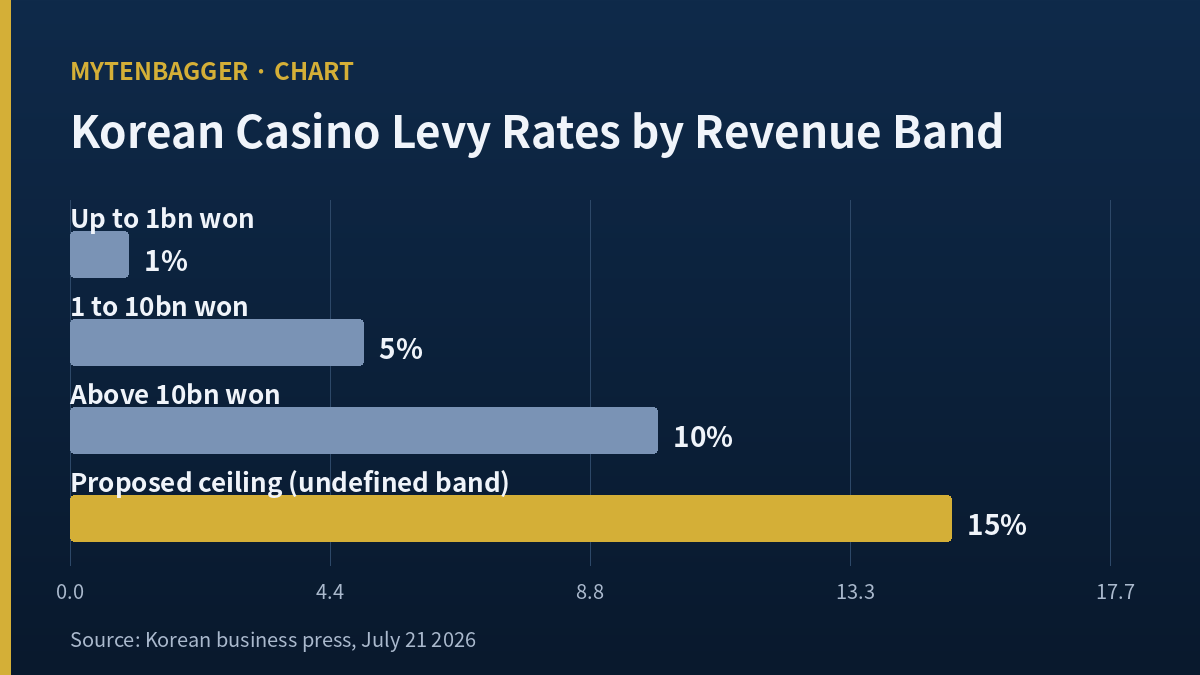
Foreigner-only casinos in South Korea pay into the Tourism Promotion and Development Fund, and the charge is levied on gross casino revenue, not on profit. Korean business press reported in July 2026 that the current enforcement decree runs a progressive schedule: 1 percent on annual revenue up to 1 billion won, 5 percent on the band from 1 billion to 10 billion won, and 10 percent above 10 billion won.
The proposal lifts the statutory ceiling from 10 percent to 15 percent and adds a new top band above the existing 10 percent band by decree. Korean coverage of the plan says in as many words that the threshold for that new band has not been decided. The government is also pursuing a five-year license renewal regime for casino operators, which the industry has objected to separately.
| Annual gross casino revenue band | Current rate | Under the proposal |
|---|---|---|
| Up to 1 billion won | 1 percent | Unchanged |
| 1 billion to 10 billion won | 5 percent | Unchanged |
| Above 10 billion won | 10 percent | Retained |
| New top band, to be created | Does not exist | Up to 15 percent |
Schedule as reported by Korean business press on July 21, 2026. The same report states that the starting threshold for the new top band is undecided.
The charging unit is the site, and that settles the arithmetic
The same Korean report carries one sentence that matters more than the rate itself: the levy is assessed per site, and this company holds three casino licenses, each charged separately.
If that is right, the whole question becomes a piece of division that anyone can do. The largest of the three sites, Seven Luck Gangnam COEX, produced 205.6 billion won of revenue in 2025 according to Korean press. Consolidated revenue for the same year was 422.947 billion won, which is 305.42 million dollars at the exchange rate above. Subtracting one from the other leaves 217.347 billion won for the other two sites combined, a figure I worked out myself. Because that is the total for two properties, neither of them can individually exceed it.
So on 2025 numbers, no single site of this company reaches 300 billion won. If the new band starts anywhere near that level, the added charge for this operator is zero. If it starts below roughly 200 billion won, the Gangnam site is caught first and the others follow as they grow.
That is the pivot. Everything else in this note hangs off whether the charging unit really is the site. I have not read the statute or the draft decree myself, and I say so again at the end because it is the weakest joint in my own argument.
The cost GKL stock already carries for ten years
On August 21, 2026 the company signed a new lease for that same Gangnam COEX site. Korean press reported the terms: ten years, expiring October 4, 2035, total rent of 168.8 billion won, which is 121.89 million dollars at the same exchange rate. The rent is adjusted once a year from October 1, 2026 against the Korean consumer price index.
This number needs no ministry, no decree and no bill. It is signed. Dividing the total evenly across the term gives 16.88 billion won a year, and I set that beside the company’s other figures below. The even split is my own simplification; with an index-linked escalator the later years will almost certainly cost more than the earlier ones.
| Compared against | Amount | Share taken by 16.88 billion won a year |
|---|---|---|
| Gangnam COEX site revenue, 2025 | 205.6 billion won | 8.21 percent |
| Consolidated operating profit, 2025 | 52.644 billion won | 32.06 percent |
| Market capitalization at the August 26, 2026 close | 576.5 billion won | 2.93 percent |
| The full ten-year total against that market capitalization | 576.5 billion won | 29.28 percent |
Every share figure in the right column is my own division. Market capitalization is 416.31 million dollars at 1,384.80 won to the dollar.
Seven months before that signature, the picture from the company was different. Korean press reported on January 19, 2026 that the chief executive told a culture ministry briefing the company faced real difficulty building what customers want inside leased premises, and that management was weighing a five-star-scale integrated resort of its own in central Seoul at an industry-estimated cost of around 1 trillion won including land. The same article put annual rent across the sites at an industry-estimated 30 billion to 40 billion won.
I am not treating the reversal as a scandal. Korean press framed the renewal as locking down the stable operation of the company’s core earnings base, and that reading is reasonable. What I take from it is narrower: either the capital allocation direction turned in the seven months between January 19, 2026 and August 21, 2026, or the trillion-won plan was never at an execution stage. Neither version is confirmed by disclosure, and I have not found one that is.

Four houses put four numbers on GKL stock
Here is what Korean media reported from four sell-side notes. I did not open any of the reports themselves, so every figure below is as quoted in the press.
| House and analyst | Reported | Valuation | Read on the levy |
|---|---|---|---|
| Hana Securities, Lee Ki-hoon | July 16, 2026 | 16,000 to 13,000 won | About 26 billion won of operating profit lost by 2028, near 28 percent. Sector multiple cut from 18 to 15 times |
| Eugene Investment, Lee Hyun-ji | August 12, 2026 | Cut 18.8 percent to 13,000 won | Only revenue above the top band is charged at 15 percent. Even a single large site stays under 300 billion won, so the market fear is overdone |
| NH Investment and Securities, Lee Hwa-jung | August 12, 2026 | 16,000 to 15,000 won | Every site is projected below the threshold through 2027, so there is no actual cost increase. Multiple cut from 19 to 17 times |
| Yuanta Securities, Lee Hwan-wook | May 22, 2026 | 18,000 to 15,000 won | Published before the proposal. The reduction was an earnings adjustment |
All four were reported as maintaining a buy rating. Korean market data pages separately showed an aggregated consensus valuation of 17,500 won as of August 11, 2026, which sits above all four individual figures above. I have no way to reconcile the aggregate with the four, so I am printing both and using neither.
The most bearish figure does not match the banded structure
The report carrying the Hana estimate gave two numbers together: projected 2028 casino revenue of about 520 billion won, and about 26 billion won of operating profit lost if the rate rises. Divide one into the other and you get 5.00 percent. The statutory ceiling in the proposal rises by exactly 5 percentage points, from 10 to 15.
In other words, 26 billion won is what you get by applying the full 5 percentage points to all 520 billion won of revenue. A banded structure cannot produce that figure, because charging only the excess above a threshold always yields less. Eugene Investment read the same bill as charging only the excess.
I will not overstate this. I have not seen the Hana report and I do not know how the number was built. Press coverage rounds figures, and two rounded values can land on a clean ratio by accident. What I can state is that the two published numbers divide to 5.00 percent, and that one house produced a figure the size of a flat application while another house described the bill as banded. Those two things cannot both be careful readings of the same text.
Two of the cuts were multiples, and the notes say so
NH concluded there is no real cost increase for this operator and still lowered its valuation, and the reported reason was a cut in the applied multiple from 19 to 17 times. Hana reported cutting the sector target multiple from 18 to 15 times.
Those are different acts. One lowers the earnings estimate because a cost was calculated. The other leaves the earnings estimate alone and lowers the number those earnings are multiplied by. The second is a statement about what the market will pay for the industry, not about what the company will earn.
I do not think that judgment is wrong. Multiples do move on sentiment, and sentiment around Korean casino regulation is plainly poor. But to buy that view I would need some idea of when sentiment turns, and I have none. I ran into a related problem with a Korean casino operator before, when a single ratio outside management control decided a quarter at Paradise Co. There the uncontrollable variable was statistical. Here it is administrative, and it has not been written yet.
Macau charges more and still trades near GKL stock
This is the comparison that changed how I read the discount. I picked the peer on one criterion: an operator in a jurisdiction where the government already takes a defined slice of gross gaming revenue, so that a settled high rate can be set beside an unsettled low one.
Macau levies a special gaming tax of 35 percent on gross gaming revenue from its concessionaires under Law 7/2022, according to an international tax reference. That is more than triple Korea’s current 10 percent top rate and well over double the 15 percent ceiling now being proposed.
| Line | Melco Resorts and Entertainment, Macau | Grand Korea Leisure, South Korea |
|---|---|---|
| Statutory levy on gross gaming revenue | 35 percent special gaming tax, fixed by law | 10 percent top rate in force, ceiling proposed at 15 percent, band undefined |
| Is the rate a known number | Yes, set by Law 7 of 2022 | No, the top band has not been drafted |
| Market capitalization | 2.14 billion dollars | 416.31 million dollars |
| Forward earnings multiple | 9.29 times | 9.48 times |
| Pricing date used here | August 12, 2026 close | August 26, 2026 close |
Melco figures from a US market data site at the August 12, 2026 close of 5.52 dollars on 388.29 million shares, which reproduces the stated 2.14 billion dollar market capitalization exactly. Its trailing net income of 229.35 million dollars over that share count gives 0.591 dollars against the published 0.58 dollar figure, a 1.84 percent spread that I read as basic versus diluted, and I use the published one. The GKL forward multiple is the August 26, 2026 close divided by the 983 won consensus earnings estimate carried on a Korean market data page, which is my own division. The two market capitalizations are 14 days apart and I have not adjusted for that.
The company facing a settled 35 percent charge trades slightly cheaper on forward earnings than the company facing a possible move from 10 to 15. Size explains part of that, since Melco is more than five times larger and far more liquid. But it does not explain the direction. What this suggests to me is that the discount here is not being applied to the level of the tax. It is being applied to the fact that the level is unknown.
What the first half of 2026 actually earned
Strip the regulation out and the operating recovery is real. Consolidated figures come from the company’s Korean regulatory filings, and I converted the reporting unit from millions of won to billions.
| Discrete quarter | Revenue | Operating profit | Operating margin |
|---|---|---|---|
| First quarter 2025 | 109.86 billion won | 20.17 billion won | 18.36 percent |
| Second quarter 2025 | 100.94 billion won | 15.96 billion won | 15.81 percent |
| Third quarter 2025 | 109.38 billion won | 17.32 billion won | 15.83 percent |
| Fourth quarter 2025 | 102.76 billion won | negative 0.80 billion won | negative 0.78 percent |
| First quarter 2026 | 110.65 billion won | 18.15 billion won | 16.40 percent |
| Second quarter 2026 | 120.45 billion won | 20.84 billion won | 17.30 percent |
The fourth quarter of 2025 is the annual figure less the nine-month cumulative, since Korean filings do not publish it separately.
The June 2026 quarter is the largest revenue quarter in that table. Industry press reported casino drop of 1.0529 trillion won for the quarter, up 15.1 percent, which was the strongest growth among the three listed Korean casino operators that period, against 12.2 percent at Paradise and 13.8 percent at Lotte Tour Development.
Two things sit awkwardly against that. First, first-half net profit went nowhere. Revenue for the six months rose 9.63 percent and operating profit rose 7.90 percent, but net profit came in at 33.107 billion won against 33.063 billion won a year earlier, a rise of 0.13 percent, or 23.91 million dollars against essentially the same amount. Operating profit gained 2.853 billion won while net profit gained 0.044 billion won, so the difference of 2.809 billion won went somewhere below the operating line, and press figures showing pretax profit up only 4.3 percent in the June quarter against operating profit up 30.5 percent point the same way. I have not opened the half-year notes to find the item, so I am leaving it unresolved.
Second, the fourth quarter keeps failing. Discrete operating margin was negative 1.04 percent in the December 2023 quarter, 5.17 percent in the December 2024 quarter against 6.18 percent in the September 2024 quarter, and negative 0.78 percent in the December 2025 quarter. In all three years the fourth quarter was the weakest of that year. I suspect year-end settlement of bonuses or wage arrears at a company majority-owned by a state agency, but I found no disclosure or report saying so, and I am not filling a gap with a guess. I have looked at a Korean casino operator whose profit lines pulled in opposite directions before, at Kangwon Land, where operating profit fell while net profit rose. Here the split is not between two profit measures but between one quarter and the other three, in the same slot, three years running.
Hotel Shilla, where the sector, not the company itself, produced most of the shortfall aga
Where I stand on GKL stock and what would move me
Watching, at 9,320 won and a 576.5 billion won market capitalization on August 26, 2026.
The case against me is not weak and I want it on the page. NH Investment concluded this operator faces no added cost at all, and my own division of the 2025 revenue supports that on the latest full-year figures. Eugene Investment described the forward multiple of 8.8 times as a historic low. Yuanta reported that total drop in the first quarter of 2026 had recovered to 82 percent of the same quarter of 2019, with Chinese visitors at 49 percent and other foreign visitors at 51 percent, which means a large part of the recovery has not happened yet. The balance sheet is not thin: the debt to equity ratio was 40.1 percent at the end of June 2026, and first-half operating profit of 38.983 billion won covered interest expense of 1.163 billion won 33.52 times, a figure I reproduced from the filings. The confirmed dividend for the 2025 fiscal year was 414 won a share, a 4.44 percent yield at the August close by my own division. And a ten-year lease on the site that produces close to half of revenue removes one uncertainty instead of adding one.
I still sit out, because the largest input to this company’s value has no value yet. Any one of the four items below would reopen the file.
- The culture and finance ministries fix the top band and set it at or above 300 billion won per site. That confirms the NH reading and turns the August 26, 2026 price into a discount for an event that will not occur.
- Operating profit turns positive in the December 2026 quarter. The three-year pattern of a failing fourth quarter breaks, and since I never identified its cause, the break itself is new information.
- Nine-month cumulative net profit for 2026 exceeds 47.732 billion won. That would mean the flat first half was a half-year artifact. The statutory filing deadline for the third quarter report falls on a Sunday, November 15, 2026, so the filing itself lands on November 16, 2026 or later.
- The trillion-won owned-resort plan moves to execution. Committing to build while the Gangnam rent is fixed to 2035 would make the capital allocation question a different one, and I would rebuild the view from the start.
The three things this GKL stock entry stands on
I want to close by pulling my own supports apart one at a time, because the useful part of a journal is knowing in advance which brick removes the wall.
Support A, that the 168.8 billion won ten-year lease is a settled figure. My source is Korean press, in two places, and I did not open the filing. If the amount turns out to be different, the settled-cost side of my comparison gets lighter, but the undefined-bracket side is untouched. The entry loses an arm, not its spine.
Support B, that the levy is charged per site. This is the heaviest brick and it rests on a single Korean business report. I did not check the statute or the draft decree. If the charge is assessed on the corporate total, then 422.947 billion won of 2025 revenue goes into the threshold test as one number, the NH conclusion collapses, and Hana is closer to right. If B falls, my conclusion falls with it, and that is why it is first on my list to verify.
Support C, that 26 billion won is 5.00 percent of 520 billion won. This is an observation more than a support. It may be coincidence between two rounded press figures. Even if it is, what survives is that four houses read one bill and produced four different costs, and that two of them wrote down that they were cutting the multiple and not the earnings. My reason for standing aside is A and B. C is the thing that made me look twice.
Sources
- Financial News, Korean coverage of the 15 percent tourism fund levy proposal, July 21, 2026
- The Public, Korean coverage of the levy plan and the Hana Securities valuation cut, July 16, 2026
- Etoday, Korean coverage of the NH Investment and Securities note, August 12, 2026
- Aju Business Daily, Korean coverage of the Eugene Investment note, August 12, 2026
- Newspim, Korean coverage of the Yuanta Securities note, May 22, 2026
- The Guru, Korean report on the ten-year Gangnam COEX lease, August 13, 2026
- Hankyung, Korean report on the owned-resort review, January 19, 2026
- Focus Gaming News, second quarter 2026 results and the COEX lease renewal, August 11, 2026
- Edaily, Korean comparison of drop across the three listed casino operators, July 13, 2026
- PwC tax summaries, Macau special gaming tax under Law 7/2022
- Stock Analysis, Melco Resorts and Entertainment key figures
- Company Monitor, Korean shareholder register and dividend estimates for Grand Korea Leisure
- Gukje News, Korean market close and the won to dollar rate on August 26, 2026
Prices and market capitalization are at the August 26, 2026 Korea Exchange close, with the share price at 9,320 won. One exchange rate is used throughout: 2026-08-26 close, 1,384.80 won to the dollar, from the Seoul foreign exchange market. Financial figures come from Korean regulatory filings on a consolidated basis; the filings report in millions of won and I converted to billions, rounding at the third decimal. Sell-side figures are as quoted in Korean media and I did not open the reports. Wording attributed to Korean sources is my paraphrase in English and not a translation of any published quotation. Anywhere I write that I divided or subtracted something, the result is mine and not a published figure.