Hyundai Motor Stock Fell 34%: Is the Tariff Priced In?
Hyundai Motor stock is down 34% in a month even as the company heads into a record quarter. I own zero shares and I am watching, not buying. The tariff hit is real but already in the numbers; what I need to see is whether the 15% rate sticks and whether the Georgia plant actually lifts local production. Until then, cheap-looking is not the same as safe.
Here is the contradiction that stopped me. Over the past month, Hyundai Motor stock (KRX: 005380) fell about 34%. Over that same stretch, the second-quarter revenue the company is about to report is tracking toward a record — roughly ₩49.9 trillion ($36B) on its own and close to ₩82 trillion ($59B) with Kia included. Record top line, and the stock is back where it traded half a year ago. I have been staring at that gap for days, and I still have not bought a single share. This is my record of why I am sitting on my hands, and what number has to print before my hands move. (KOSPI, for readers who track US indices, is Korea’s benchmark — the rough equivalent of the S&P 500. I convert won at about ₩1,380/$ throughout.)
One thing up front: I have followed this company for years, but there is no Hyundai in my account right now. So this is not a holder talking his own book, and it is not a nudge for you to buy. I am writing to explain to myself why I passed, not to justify something I already own.
Contents
Hyundai Motor Stock Fell 34% — What Actually Happened
Start with the tape. On the data I track (mid-July 2026), the 20-day moving average sits in the ₩500,000s ($365) and the 60-day near ₩585,000 ($424), while the price is down in the ₩425,000 zone (about $308). That is roughly 15% below the 20-day line and 27% below the 60-day. Widen the lens to twelve months and the stock is still up around 100% — this is a name that more than doubled off last year’s low and then coughed up much of that run in a single month. Its 250-day range runs from about ₩204,500 ($148) to ₩783,000 ($567), so volatility here is not theoretical.
I like this shape, honestly. A long-term uptrend that is still intact while short-term sentiment breaks is the setup I find most worth watching. But watching is not buying. On valuation, Hyundai trades around 12.6x trailing earnings and 1.02x book, with return on equity near 8.4% — below the 10% line I prefer. So the stock carries “cheap” and “capital efficiency I wish were better” in the same body. Which one you weight decides whether you watch or buy. I have not shifted my weight yet.
Why Hyundai Motor Stock Slipped on a Record Quarter
Korean financial press compiling the Q2 consensus puts Hyundai’s standalone revenue near ₩49.9T ($36B), up about 3% year on year, with operating profit around ₩3.24T ($2.35B), down roughly 10%. Add Kia and the group revenue lands near ₩82T ($59B) — a record — while combined operating profit slips about 5% to ₩6.03T ($4.4B). Record revenue, lower profit. It is hard to find a cleaner illustration that the market prices these shares off the direction of profit, not the size of the top line.
The weight on that profit line is the US tariff. Korean coverage of the group’s own estimate puts the 2026 annual tariff burden near ₩7.4T ($5.4B), of which roughly ₩4.1T ($3.0B) is Hyundai’s share; the Q2 slice alone is about ₩960B ($0.7B). I read the income statement in two layers here — money earned in the core business, and money the tariff ate. If the core margin holds and profit fell only because of an external tax, that is not competitive damage; it is a levy. That is my first reason for reading the drop as sentiment rather than a broken business.
Here is the picture on one screen, the way I laid it out in my own notes before deciding to sit still:
| Metric | KRW | USD (~₩1,380/$) |
|---|---|---|
| Price (mid-Jul 2026) | ₩425,000 zone | ~$308 |
| 20-day / 60-day MA | ₩503K / ₩585K | ~$365 / $424 |
| 250-day range | ₩204.5K–783K | ~$148–567 |
| Trailing P/E · P/B · ROE | 12.6x · 1.02x · 8.4% | same |
| Dividend FY25 · yield | ₩10,000 · 2.2% | ~$7.2 |
| Q2 revenue (Hyundai, consensus) | ₩49.9T | ~$36B |
| 2026 tariff burden (Hyundai) | ~₩4.1T | ~$3.0B |
Sources: KRX / company data as of mid-July 2026; Q2 figures are Korean-press consensus (not yet reported). USD converted at ~₩1,380/$.
What jumps out of the grid, for me, is the split personality. The valuation rows read cheap — 1x book, a low-teens multiple. The quality rows read soft — an ROE under 10%, a dividend that just got cut, an annual tariff line the size of a mid-cap’s entire profit. I do not resolve that tension by averaging it; I resolve it by deciding which row leads. Today the tariff row leads, and it is the one row whose value is set outside the company. That is precisely why I want a number, not a narrative, before I act.
Splitting the ₩7.4 Trillion Tariff Into Three Pieces
Taken as one lump, ₩7.4T ($5.4B) is frightening — close to a third of group annual operating profit. So I break it into three. First, the part already locked into results: per CNBC’s reporting on the late-2025 US–Korea deal, the auto rate that started at 25% was cut to 15%. What is flowing through current numbers is the 15% regime. Second, the reversion risk: the group’s own framing, as carried in Korean press, is that a return to 25% could push the combined Hyundai-Kia burden past ₩10T ($7.2B) a year. Third, the self-offset: every car built in the US is a car that does not pay the import duty.
Pull those apart and the fear gets specific. The price is discounting the 15% world; the real variable is “25% reversion versus 15% permanence.” I watch that fork rather than the settled bad news. If 15% holds, part of the discount the market has stapled on loses its basis. If it snaps back to 25%, my watching was right. That is a negotiation outcome, not something I can forecast — so I chose verification over prediction. That is my second reason for still standing aside.
There is a nuance I do not want to skip. A tariff is a cost line, but part of it passes into price. Push the full 25% onto the sticker and US demand softens; absorb it and the margin thins. Hyundai’s actual path has been the middle — holding share by tuning incentives rather than hiking prices hard. So when I judge the tariff’s P&L effect, I look past “how much did they pay” to “how did price and volume respond.” Korean financial press pegs first-half group US sales near 920,000 units, up about 3% to another record half — evidence the brand still holds pricing leverage under the tariff.
The Georgia Metaplant and Hyundai Motor Stock
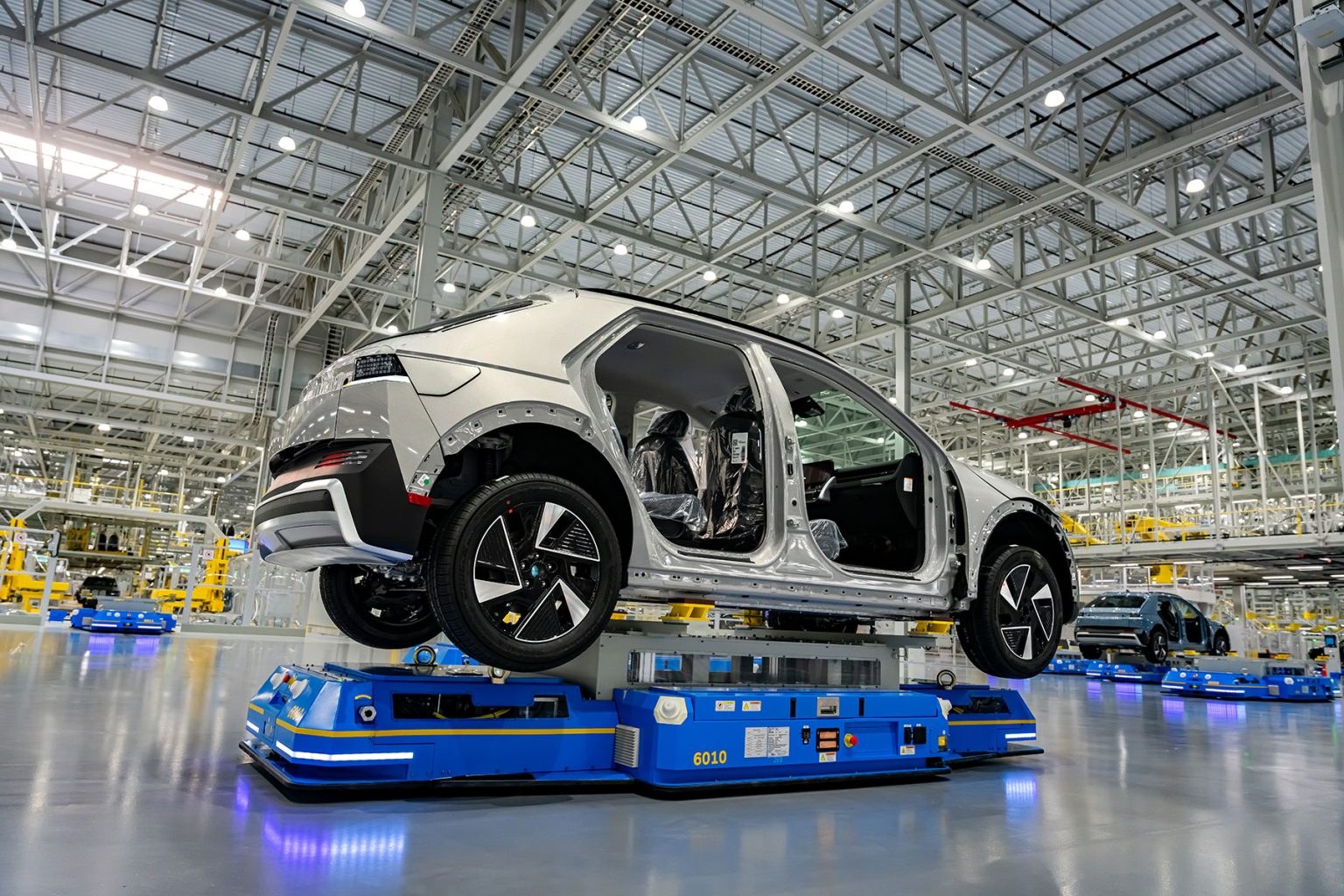
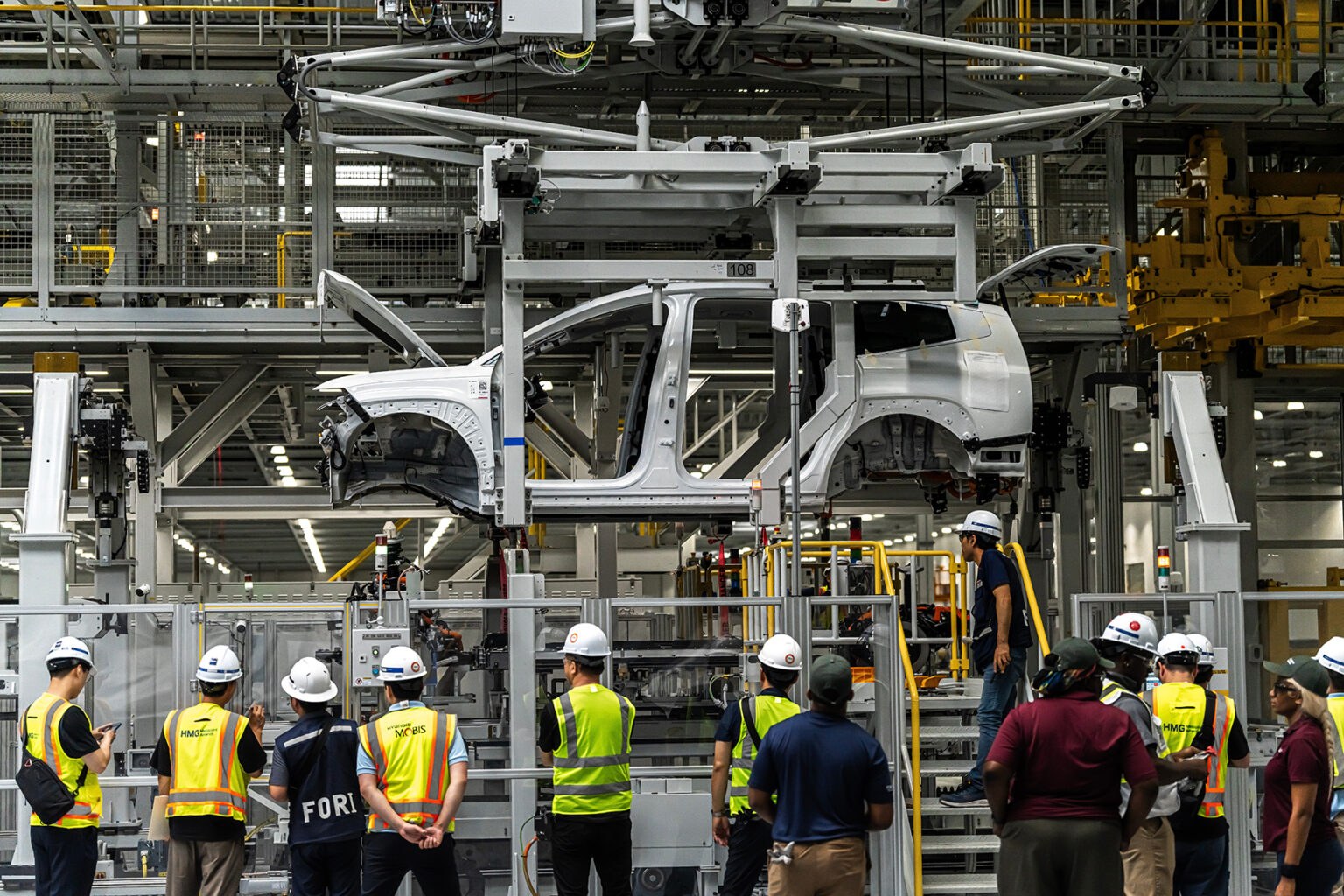
The company’s own shield against the tariff is HMGMA — the Hyundai Motor Group Metaplant America in Georgia. Per the group’s official Metaplant page, the site opened in late 2024 and now builds the Ioniq 5 and Ioniq 9, with Kia models joining the line in 2026. As InsideEVs put it, the plant is not just a factory — it is tariff armor. And local reporting on the Kia Sportage Hybrid line makes the mechanism concrete: a car assembled in Georgia stops paying the import duty. Hyundai crossed about 1.007 million US wholesale units in 2025 — the US is roughly a quarter of global group sales, per manufacturing-industry coverage of the US scale-up — so for a company this US-dependent, local ramp is the main line of defense.
That is why I read the second half for this name through the Georgia utilization rate. When the share of US sales built locally visibly climbs, the slope of the tariff burden flattens. I plan to hunt for that ratio first in the next quarterly disclosure. Until it shows up in a number, I will not buy on the “there is a shield” narrative alone. A story is not a data point.
Seeing Georgia only as a tariff dodge is seeing half of it. The plant was designed as an EV hub, and the more volume runs through it, the higher the electrified mix in Hyundai’s US lineup climbs. The short-term shock — the tariff — is paradoxically pulling forward a structural shift toward local, electrified production. I like that. If a plant built to dodge a tax ends up changing the character of earnings, that is investment, not cost. But the payoff takes time: early ramp carries depreciation and learning costs that push margins down before they lift them. So I file Georgia as a two-to-three-year story, not a today catalyst — I will not price it in a hurry.
The Dividend Cut That Bothered Me
What nagged at me most was not the tariff or the profit dip — it was the dividend. From Korea’s DART filings, the per-share dividend rose from ₩7,000 in 2022 to ₩11,400 in 2023 and ₩12,000 in 2024, then dropped to ₩10,000 ($7.2) for fiscal 2025 — down about 17%. Cutting the payout in a year that produces record revenue tells me the company chose to spend cash on something other than the dividend: local plants, EV capex, tariff ammunition. That reading fits, given the group announced a large domestic reinvestment after the trade deal — Reuters reported an ₩86 billion-plus investment plan tied to the tariff cut.
Long term, that may not be a bad choice. But for anyone who came in for the 2.2% yield, the basis just wobbled. I never held this name for yield, so the cut is not a sell trigger for me — yet if I had been leaning on “shareholder returns march up and to the right,” this is the spot to stop and recompute. As a failure I will admit: I once took “record results equals a bigger dividend” for granted on a different automaker and got cut. What that taught me is that results and dividends do not move in the same direction on command.
Foreign Selling and Hyundai Motor Stock
I watch flows as much as price. On the data I track, foreign ownership sits near 25% and margin-loan balances are under 1% — low. Low leverage means little forced selling to cascade in a drawdown, which reassures me. The trouble is the foreigners. Automakers are sensitive to global macro — the dollar, rates, tariffs — and sustained foreign selling presses the price regardless of value. I read much of the 34% drop as foreigners trimming weight under tariff uncertainty rather than a verdict on the business.
So my watch signal is simple. The first day foreign net selling stops and flips even briefly to net buying is my first read of a sentiment floor. I do not catch a falling knife just because value is cheap; I confirm that flows have stopped, then approach in tranches above that. Right now that stop is not confirmed. Given a 250-day range that ran from the ₩204,500s ($148) to ₩783,000 ($567), I would rather wait for the signal than guess the bottom.
Where Hyundai Motor Stock Sits Against Toyota and GM
Compared only against domestic peers, Hyundai always sits next to Kia. I prefer to measure automakers on a global yardstick. Large global carmakers generally trade around 1x book and on low single-digit-to-around-10x earnings — Toyota’s forward P/E is near 8x, and US names GM and Ford sit lower still, around 5–7x. The industry is capital-intensive and cyclical, so the market withholds high multiples. Hyundai’s 1.02x book is in line with that global band, but its 12.6x trailing P/E is actually above Toyota, GM and Ford. So I do not treat the shares as “uniquely cheap on a Korea discount.” The whole sector trades on low multiples, and within it Hyundai is not the cheapest — which, if anything, reinforces my decision to watch.
The direction, though, is a different argument. Some sell-side voices carried in Korean press argue that if Hyundai executes on electrification and software-defined vehicles, it could challenge Toyota’s market capitalization. I am not betting on that conclusion, but the premise is valid: a re-rating in autos comes not from how many cars you sell but from whether software and electrification change the quality of earnings. That is exactly why the Georgia plant matters as more than a tariff dodge. I keep this company on the watch list not just as a tariff-battered cyclical, but as a name with an option on a change in the character of its profit.
My Breakpoints Before I Touch Hyundai Motor Stock
Sell-side is far more optimistic than I am. BNK Investment Securities set a ₩650,000 ($471) objective in late January on “2026 profitability normalization,” and Korea Investment & Securities raised its objective to ₩700,000 ($507) reflecting a large sum-of-the-parts value. Both sit well above the current price. I do not adopt those numbers as my own — I note where the brokerages look, but I manage my entry with breakpoints, not price objectives.
Three things have to verify before I touch this. Chronologically, the fastest to answer is the tariff: does the 15% rate hold, or do reversion signals toward 25% appear? Renegotiation headlines will give the direction. Next, does the Georgia-built share of US sales actually rise in the disclosures? Last, does the Q2 print show the core margin — operating margin excluding the tariff — holding up? I start from the tariff because it resolves first, then weight the plant and the margin behind it. If two of the three land favorably, the ₩425,000 zone becomes my starting point for buying in tranches. If the rate snaps to 25% and core margin erodes with it, the cheap-looking 1x book becomes a trap and I keep watching.
Let me split that into scenarios so I can score myself later. In the bull path, the rate settles at 15%, local production climbs, and core margin defends — the discount loses its basis and I put a first tranche to work near ₩425,000, adding on dips. In the base path, the rate holds at 15% but headlines seesaw and margin recovery lags volume — I expect a range and only nibble on sharp drops. In the bear path, the rate reverts to 25% and core margin cracks — annual tariff drag heads past ₩10T ($7.2B), 1x book stops being a floor and becomes a chute, and I stay out. The reason I write the three paths down before the event is to keep my judgment from bending afterward. When a stock rises, the mind reaches for the bull story; when it falls, for the bear. So I nail down now what I do at each fork. The one mistake I guard against most is shoving the whole position in when the bull path is only half-confirmed — as with the dividend, I have skipped a premise on one good-looking number before and paid for it.
There is one metric I will watch harder than any headline: the ratio of US-market cars that are actually built in the US. That single number ties every thread together — it caps the tariff bill, it fills the Georgia plant, and it raises the electrified mix all at once. A US peer like GM leans on domestic plants and a smaller import share, so it wears the tariff more lightly; Hyundai’s gap to that position is exactly what the Georgia ramp is meant to close. When I can see that ratio moving quarter over quarter in the filings, the bull path stops being a story and starts being arithmetic. Until the arithmetic prints, I keep the account empty and the thesis on paper.
How I See It From Here
To recap, I read today’s Hyundai Motor stock as “cheap, but for a reason.” The ₩7.4T ($5.4B) tariff is an event that already entered the income statement, and the 34% drawdown is sentiment’s reaction to that event. I am watching the lag between the two, and I will keep my account empty of this name until the confirmation arrives in data. Follow along if you want; see it differently if you do. This is my breakpoint sheet, not a signal for anyone else.
One last note to myself. The place I am most likely to be wrong here is getting drunk on “it’s cheap” and skipping the verification. A 1x book is not a floor guarantee in autos — it is just the sector average — and the tariff is a variable that sits on a negotiating table, not in my hands. So whenever I feel the itch, I reread this: confirm at least two of three, enter only in tranches, and if the bear path lights up, walk back to watching without regret. Which fork the next quarter’s print and the tariff headlines light up — I will be right back here to write it down.
Related reading