Dongkuk Steel Stock: What the Plate Duty Was Worth
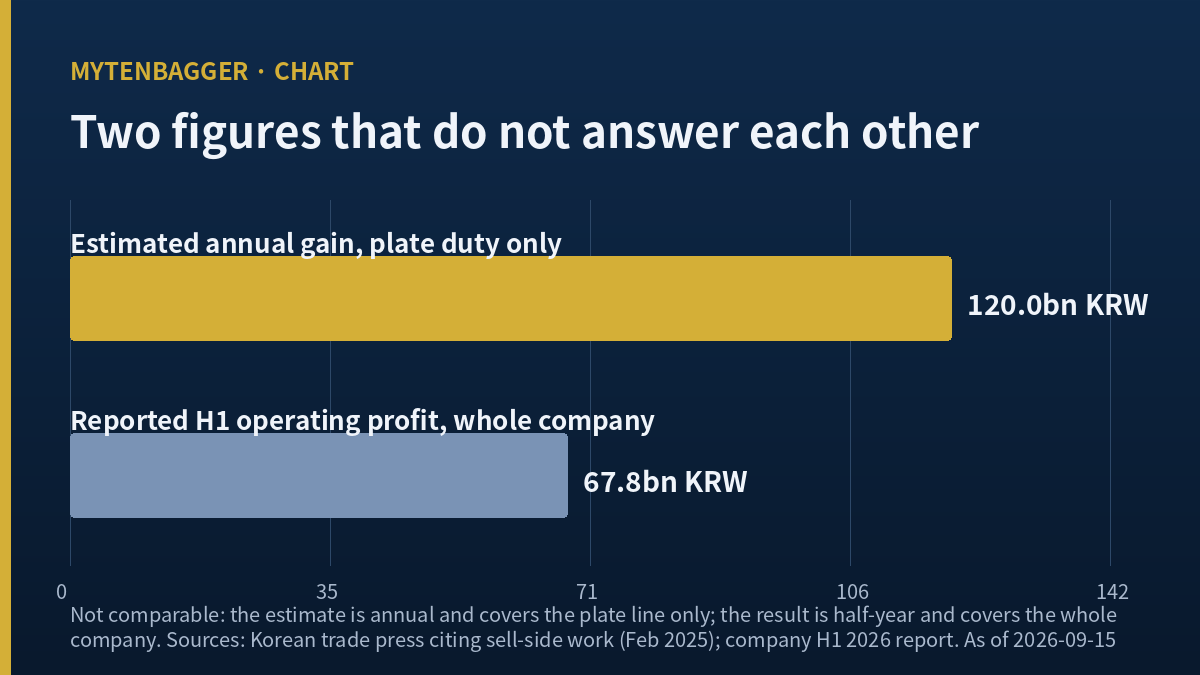
KRW 120 billion. Before anything else I want to be precise about what that number was a forecast of, because I spent part of an evening treating it as a forecast of something it was not. It comes from Korean trade-press coverage in February 2025, when the Ministry of Trade issued a preliminary anti-dumping finding against Chinese steel plate, and analysts put per-company figures on what the duty might be worth. POSCO drew KRW 870 billion. This company, Dongkuk Steel, drew KRW 120 billion. The mechanism cited was a plate spread widening by 164,000 won per tonne.
Reported, July 2026 · First-half operating profit of KRW 67.0 billion, against KRW 34.2 billion a year earlier.
Delivered increase: KRW 32.8 billion in six months. Annualized, KRW 65.6 billion, or 54.7 percent of the estimate (my calculation).
The estimate covered plate only. The reported delta covers the whole company, including a bar-and-section business the duty does not touch. Those are different objects and I say so below.
Contents
Dongkuk Steel Stock and the Number Attached to a Trade Case
Dongkuk Steel is a KOSPI-listed steelmaker, ticker 460860, created in the June 2023 demerger of the old Dongkuk group into a holding company and two operating companies. It runs two businesses that matter here: bar and section products, which is rebar and H-beam sold into Korean construction, and heavy plate, which is sold mainly into Korean shipyards. For readers outside Korea, KOSPI is the senior board of the Korea Exchange; the junior board is KOSDAQ, and this company sits on the senior one.
The shares closed at 10,400 won on Thursday, September 10, 2026, with 49,608,017 shares outstanding. That is a market value of roughly US$386 million at 1,338.24 won per dollar, which makes this a small company by any global standard and a mid-tier one inside Korean steel. The 52-week range runs from 7,760 to 17,710 won, a high 2.28 times the low (my calculation), which is a wide band for twelve months even by commodity-steel standards.
I do not own this. I have no order in. What drew me in was the arithmetic above, and specifically the discipline of checking whether a number I had seen quoted for eighteen months describes what I assumed it describes.
What the estimate actually covered
The February 2025 figure was a plate-spread calculation. Chinese plate imports were being priced below the level Korean mills could match; a duty in the high twenties to high thirties in percentage terms would push those imports up; Korean mills would recapture spread on the tonnes they sell. The 164,000 won per tonne figure is the spread assumption, and each company’s number is that spread multiplied by its plate volume.
There is direct evidence that the cost side moves on its own. In January 2026, Yuanta’s Lee Hyun-soo estimated fourth-quarter 2025 operating profit at KRW 5.0 billion on revenue of KRW 775 billion, noting that the bar-and-section spread had narrowed by 30,000 won per tonne quarter on quarter, and that plate volumes had risen after the duty while a weaker won pushed import unit costs up at the same time. Two of those three forces have nothing to do with the trade case, and together they were enough to take the quarter close to breakeven. The reported result landed below even that estimate. Any number that says what a duty is worth is holding those other forces still, and they do not hold still.
So the estimate answers a narrow question: if the duty holds and volumes hold, what does plate alone add? It does not say anything about rebar, and rebar is roughly half of what this company sells. It does not net out the cost side, and scrap prices moved over the same period. And it was written when the finding was still preliminary.
My reported delta answers a different question: what happened to the whole company’s operating profit between two half-years. Bar and section improved over that window for reasons that have nothing to do with plate duties, which I get to below. Setting KRW 32.8 billion against KRW 120 billion is therefore not a verdict on the estimate. It is a check on whether the estimate has been quoted as if it were one.
Dongkuk Steel Stock Against the Half-Year It Delivered
| KRW billion, IFRS separate | H1 2025 | H1 2026 | Change |
|---|---|---|---|
| Revenue | 1,619.2 | 1,852.7 | +14.4% |
| Operating profit | 34.2 | 67.0 | +96.1% |
| Net profit | 11.7 | 17.9 | +53.5% |
| Operating margin | 2.11% | 3.62% | +1.51pp |
Second-quarter figures alone: revenue KRW 995.5 billion (+11.4%), operating profit KRW 45.6 billion (+52.3%), net profit KRW 11.6 billion. Source: company preliminary results reported by Korean press on Friday, July 24, 2026. Margins are my calculation from the reported figures. H1 2025 lines are my own arithmetic on the reported year-on-year change rates.
Two things stand out. The margin moved by roughly one and a half percentage points, which for a commodity steelmaker running near breakeven is the difference between a business and a liability. And the profit growth is far ahead of the revenue growth, which is what spread recapture looks like when it happens: you sell a similar quantity into a better price gap.
That pattern is consistent with the duty working. It is not proof the duty caused it, and I cannot separate the two from published figures. I have written a related piece on how a Korean steelmaker’s two divisions can move in opposite directions inside one quarter, and the same caution applies here with the two product lines swapped.
The duty rates, and which ones are final
Precision matters here, because “the duty” in Korean steel coverage covers two separate cases at two different stages, and the two are frequently run together.
On February 20, 2025 Korea issued a preliminary determination on Chinese heavy plate, with company-specific rates of 38.02 percent for Xiangtan, Sino and Xiamen, 29.62 percent for Jiangsu Shagang, and 27.91 percent for Baoshan, as reported by The Korea Times at the time. That case originated in a complaint Hyundai Steel filed in July 2024. Separately, on Monday, February 23, 2026 Korea moved on hot-rolled coil from China and Japan, with provisional duties of up to 33 percent across nine foreign suppliers including JFE Steel, Nippon Steel and Baoshan.
One is an older case now in force; the other was still provisional as of that February 2026 announcement, and I have not seen a final ruling on it. A provisional measure can be narrowed, extended, or set aside. Treating the two as one settled fact makes the demand picture look more locked-in than the record supports, and it does so quietly, because each sentence is true on its own. So I name the case and its stage wherever both appear below.
The other side of this is that Korean shipbuilders opposed the plate case, since plate is an input cost for them. A duty that helps this company’s margin raises a customer’s costs, and that customer is a bigger export earner than the mill supplying it. Trade measures are a policy variable. The company does not set them, and the same ministry that granted them can revisit them.
Dongkuk Steel Stock and the Quarter the Broker Says Comes Next
The company’s own second quarter was its best in some time, and the sell-side does not expect the third to repeat it. Korean coverage in late July 2026 carried a Hana Securities projection of KRW 18.1 billion of operating profit in the third quarter, putting the fall down to seasonal weakness and planned maintenance shutdowns at both the bar-and-section and plate mills. Against the second quarter’s KRW 45.6 billion, that is a reduction of KRW 27.5 billion in one step (my calculation).
Three named Korean brokerages carry buy calls with published valuations: Hyundai Motor Securities at 12,500 won, Hana Securities at 14,000 won, and BNK Investment at 17,000 won, averaging 14,500 won. Yuanta’s Lee Hyun-soo had cut to 10,000 won back in January 2026 after a weak fourth quarter. I am reporting these as market facts and I adopt none of them as my own. What interests me more is the spread: the highest and lowest published figures are far enough apart that the group plainly does not agree on what a normalized year looks like for this business.
One caveat on all of it. The consensus panel on the data screen I use returns “no opinion issued within the past three months” for this name, even though those individual published valuations are visible. Forward coverage here is thin, and thin coverage is itself information about how much institutional attention the shares get.
Where the demand came from
The company’s own explanation for the first half is worth quoting in substance instead of in quotation marks, since the original is Korean and I do not want to present a translation as an English original. Management put the bar-and-section improvement down to large industrial infrastructure demand, naming semiconductor fabs and AI data center construction, and traced the plate improvement to strong shipbuilding orders.
Both of those are global themes reaching a Korean mill through domestic construction and domestic shipyards. That is the part I find genuinely interesting about this name. Its rebar goes into data center shells; its plate goes into hulls being built for foreign owners. Neither demand source is something the company originates, and neither is visible in its own order intake as a global number.
It also means the bar-and-section recovery has a different clock from the plate recovery. Data center construction is a multi-year build cycle with visible pipelines. Shipyard plate demand follows a newbuild backlog that Korean yards have already filled several years out. The duty affects only the second of those.
Dongkuk Steel Stock Against a Global Peer’s Same Quarter
The closest listed comparison I can reach in English is Gerdau, the Brazilian long-steel producer listed in New York as GGB. Gerdau closed the second quarter of 2026 with adjusted EBITDA of BRL 3.4 billion, driven by its North American operations, and used the results to raise shareholder payouts. The structural parallel is exact enough to be useful: a long-steel producer in a mid-sized economy, exposed to domestic construction, facing Chinese import pressure, with a second business in a different geography.
I have deliberately not built a multiples table out of that. Gerdau reports adjusted EBITDA on a consolidated basis in Brazilian reais; the Korean company’s headline figures here are operating profit on an IFRS separate basis in won. Those are two different measures on two different reporting perimeters in two currencies, and lining them up in adjacent columns would create a precision the underlying disclosure does not support. What the comparison does establish is direction: long steel improved on both sides of the world in the same quarter, which weakens any story that treats the Korean recovery as company-specific execution.
The capacity number behind all of this
The OECD’s Steel Outlook 2026 projects global steel excess capacity reaching 745 million tonnes by 2028, a figure the OECD notes exceeds the entire current steel production of its own member economies by 319 million tonnes, while demand growth stays subdued at around 0.9 percent a year. Coverage of the release frames it as a problem that is still deepening.
That number is the reason trade cases keep arriving. It is also the reason each individual case buys a limited amount of time: surplus tonnes that cannot enter Korea look for another market, depress prices there, and come back around through export competition. A duty is a local answer to a global arithmetic problem, and the arithmetic is getting larger every year.
Domestically the picture is no better. Korean steel demand has fallen to the low-to-mid 40 million tonne range, with electric-arc producers holding on through production cuts and shutdowns, according to Korean industry-press analysis published in January 2026. Average import unit prices ran at US$946 per tonne across 2025.
Dongkuk Steel Stock: Five Things That Cut Against What I Wrote
One. The gap I opened this piece with may not be a gap at all. If the estimate’s plate-volume assumption was met and the shortfall sits entirely in a cost line, then the duty did what it was projected to do and something else took the money. I cannot decompose the delta by product from published figures, so I cannot rule this out.
Two. The third-quarter projection above is the same sell-side apparatus whose February 2025 estimate I have just spent a section qualifying. Using one of its numbers to cast doubt on another of its numbers, then leaning on a third for my own forward view, is not a coherent position, and I hold it anyway because published estimates are the only forward figures I have.
Three. The maintenance shutdowns driving the weak third quarter are planned. A planned outage is not deterioration, and a reader who sees the reported number in November without knowing the maintenance plan will draw the wrong conclusion in the opposite direction from mine.
Four. The hot-rolled measure is provisional. If the final ruling comes in materially narrower, part of the 2026 margin improvement loses its support, and the part that loses it is the part I have least visibility into.
Five. Half of this company’s revenue depends on Korean construction starts, and Korean construction has been contracting. Data center and fab work is a genuine offset, but it is a small share of national construction volume, and a national volume decline can swamp a project-type improvement without either fact being wrong.
Dongkuk Steel Stock: My Position and What Would End It
No position, no order, watching. The reason is the one this whole piece has been circling. The figure I built the entry around is an estimate of one product line’s contribution, and the figure I measured it against is a whole-company result. I can state both accurately and still not know how much of the second was produced by the thing the first describes. That is a decomposition I would need segment-level disclosure to do, and this company reports on a basis that does not give it to me in the sources I can reach.
I have also written the Korean-language entry on this company around a completely different question, the composition of its equity accounts, and deliberately kept these two sets of figures apart so that neither piece leans on the other’s work.
Two conditions would settle it for me:
- The second half against the first. If full-year operating profit lands such that the second half falls back to something near the KRW 34.2 billion the company managed in the first half of 2025, then the improvement was a spread window, the level never changed, and the duty story was a timing story. The third-quarter report is due by Monday, November 16, 2026.
- The final hot-rolled ruling. If it comes in materially below the provisional range announced on Monday, February 23, 2026, one of the two supports under the 2026 margin is removed, and I would want to see the company hold margin without it before doing anything.
Related reading: a piece where the steel business was not the thing moving the shares at all
Prices and share counts reflect the Thursday, September 10, 2026 close as checked at the time of writing. The USD conversion is approximate, at roughly 1,338.24 won per dollar on that same date. Korean won is the reference currency throughout, and financial figures are IFRS separate basis unless stated. Lines marked as my calculation come from my own arithmetic on published figures and appear in no filing.