Kumho Tire Stock Costs the Same as a Goodyear Share
Two cents. That is the whole distance between what one share of each of these two tire makers cost at the September 14, 2026 close. Kumho Tire stock finished the Korean session at a price that converts to about $5.30 at the exchange rate I am using in this piece. Goodyear Tire and Rubber closed at $5.32 in New York the same day. I did not go looking for that. I went looking for the share register of a Korean company whose plant burned down, found that its share count sits at 287,260,287, and noticed that the American company I had opened in the next tab reports 287.66 million. Same price, near enough. Same count, near enough. So I stopped and asked the only question that coincidence is good for: what is standing behind each of those two shares?
| What I actually did here | Converted one close, divided two balance sheets |
| Book equity behind one Korean share | About $6.29, from the owners of the parent line |
| Book equity behind one American share | About $10.43, from total equity as reported |
| Share of Korean book equity that is paid in | 53.88 percent |
| Share of American book equity that is paid in | 115.49 percent, so the remainder is negative |
| Where I ended up | No position, no order, and one document I want first |
Contents
Kumho Tire Stock and a Two Cent Coincidence
Let me put the conversion on the table before anything rests on it. I am using 1,341.59 won per dollar, the September 11, 2026 close, because the pair did not print a fresh figure over the weekend and I was not going to hold a piece for a rate. Every dollar number in this piece that started life in won came through that one rate, and I did not mix in a second one anywhere.
Kumho Tire is listed in Seoul under the code 073240. For readers who do not follow the Korean market, KOSPI is the main board of the Korea Exchange, the larger and older of the country’s two listed venues, and the place where the industrial names sit. There is no American depositary receipt for this company. A US investor who wanted it would be buying the Seoul line through a broker that offers Korean market access, which several do, and the Korea country funds that hold many KOSPI names at once give exposure to the whole market; what weight, if any, this company carries inside them is something I did not check.
The coincidence itself is worth stating carefully, because coincidences invite more meaning than they carry. Two companies whose shares happen to cost almost the same amount, and who happen to have issued almost the same number of them, are not therefore comparable businesses. One of them sells roughly five times the revenue of the other. What the coincidence does is strip out two variables that usually make cross-border comparison mushy. When the price per share and the count of shares are both nearly matched, the only thing left moving is what each share is a claim on. That is a narrow question, and narrow questions are the ones I can actually answer from public screens.

What Forty Five Percent of the Shares Was Made Of
The Korean company’s share count has not moved in eight years. The corporate screen that lists changes in paid-in capital shows five events, and the most recent of them is dated July 20, 2018: a third party placement of 129,267,129 new shares. Before that placement there were 157,993,158 shares. After it there were 287,260,287, and that is still the number today.
Divide the placement into the total and you get 45.00 percent. Not approximately. The block created on that single day is exactly the stake that the largest shareholder holds now, and Korean reporting still puts it at 45.00 percent with no change. Every share of it has stayed put for eight years while everything else about the company moved, including a fire at its largest plant complex.
The 646.3 billion won subscription
The par value of these shares is 5,000 won. Multiply that by the 129,267,129 shares issued in 2018 and you get 646.3 billion won. That is my multiplication; I did not find a filing that states the subscription amount, and on its own the product proves nothing about the price the buyer actually paid. What gives it some support is a separate detail in Korean reporting on the restructuring stock: the banks that hold the remainder are described as carrying their shares at a cost of 5,000 won each, which is par. If the lenders were subscribed at face value, the strategic buyer in the same restructuring most likely was too.
That detail matters more than it looks. It means the controlling block and the accounting line called paid-in capital are the same event seen from two sides. The company’s share capital today is 1.4363 trillion won, which is 5,000 won multiplied by every share outstanding. Nothing in that line came from a market price. All of it came from subscriptions at face value, across five separate events stretching back to 2012, of which the 2018 one was by far the largest.
Kumho Tire Stock and the Lenders Who Are Still Selling
If the controlling block has not moved, something else has. Korean reporting on the ownership filings puts the combined holding of the controlling shareholder and its related parties falling from 60.49 percent to 58.84 percent as of August 20, 2026. Subtract the untouched 45.00 percent from each and you can see exactly where the movement came from: the related party side went from 15.49 percent to 13.84 percent.
Those related parties are the banks that once restructured this company and have been unwinding the position ever since. One of them sold 4.75 million shares on the open market over July and August of 2026. Divide that into the share count and you get 1.65 percent, which is the drop reported to the decimal. The arithmetic is tidy in a way that tells me the filing and the press account are describing the same trades and not two overlapping sets.
Korean reporting put that bank’s average sale price in a range of 7,055 to 8,112 won, against a cost of 5,000 won a share, for a gain described as roughly 53.8 percent. Note what the cost basis is. It is par again. The lenders received their shares the same way the controlling holder did, at face value, in a restructuring. The banks have simply reached the point where selling is profitable, and the controlling vehicle has not sold at all.
What the remaining 13.84 percent is and is not
A July 2026 Korean report broke the register into the controlling vehicle at 45.00 percent, the state policy bank at 7.43 percent, and retail holders at 38.28 percent. That was before the August sales, so the pieces have shifted since, and I am not going to net two dated snapshots against each other and present the result as current. What survives across both snapshots is the structure: one very large holder who cannot fully exit until 2028 under the terms reported at the time of the deal, a shrinking bank position that has been selling into strength, and everybody else.
Splitting Book Equity Into Paid In and the Rest
Here is where the two companies go in opposite directions, and where the price coincidence earns its keep.
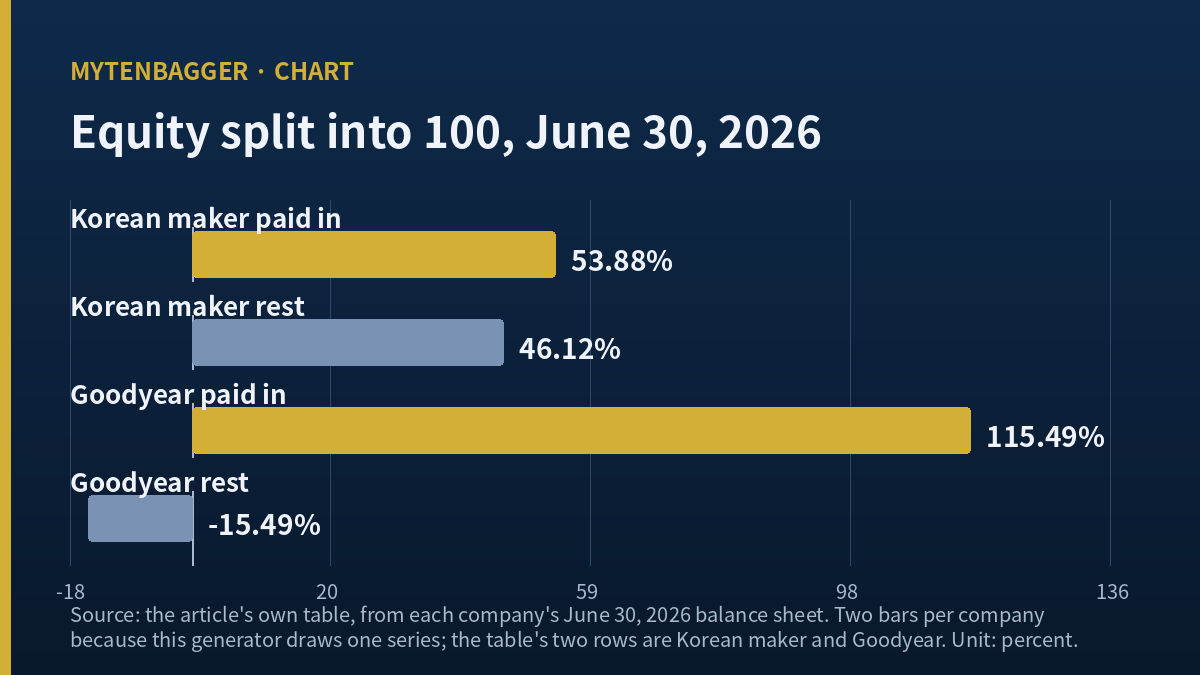
The Korean balance sheet at June 30, 2026 shows total assets of 6.36691 trillion won, total liabilities of 3.70120 trillion won, and total equity of 2.66571 trillion won. Liabilities run to 138.84 percent of equity, by my own division; I did not take a ratio off a vendor screen for this one, because the ratio one screen showed me did not reproduce from the three lines printed beside it. Of that equity, 1.4363 trillion won is the paid-in line I described above. So 53.88 percent of what the balance sheet calls equity was simply handed over in cash at par, and the remaining 46.12 percent is everything the company has retained, revalued or translated in the years since.
Goodyear’s most recent reported balance sheet, for the period ended June 30, 2026, shows total assets of 18,650 million dollars, total liabilities of 15,649 million dollars, and total equity of 3,001 million dollars. Its common stock line is 288 million and additional paid-in capital is 3,178 million, which together come to 3,466 million. That is 115.49 percent of total equity. The remainder is therefore negative 15.49 percent: retained earnings of 2,907 million are more than offset by other components that the summary I used does not itemize.
| Equity split into 100 | Paid in at subscription | Everything else |
|---|---|---|
| Korean tire maker, June 30, 2026 | 53.88 | 46.12 |
| Goodyear, June 30, 2026 | 115.49 | -15.49 |
Why I did not put margins side by side
The obvious comparison to reach for is profitability, and I left it out on purpose. Goodyear reports revenue of 17.69 billion dollars and a net loss of 2.54 billion dollars on a trailing twelve month basis. The Korean company is profitable and much smaller. Putting two margin figures in one row would imply that the two numbers were built the same way, and they were not: different accounting regimes, different segment boundaries, different treatment of the very kind of one time item that has dominated the Korean company’s recent statements. A ratio of two balance sheet lines survives that translation.
Kumho Tire Stock Against a US Balance Sheet
Now divide equity by share count on each side and see what one share is a claim on.
For the Korean company I use the owners of the parent line, 2.42247 trillion won, because that is the portion the ordinary shareholder has a claim on. Divided across 287,260,287 shares it gives 8,433 won a share, which converts to about $6.29. Against a price of about $5.30, that is 0.84 times book.
For Goodyear, 3,001 million dollars across 287.66 million shares gives $10.43 a share. Against a $5.32 close that is 0.51 times book. Its fifty two week range runs from $5.30 to $10.62, so the September 14 price sits at the very bottom of its own year.
Two shares that cost the same, then, are claims on book amounts that are not the same size: the American share is a claim on about 66 percent more book than the Korean one, by my division. And the composition differs in the way the table above shows: the Korean share is backed by an equity balance that is half subscription money and half accumulation, while the American one is backed by an equity balance where subscriptions exceed the total and accumulation has gone the other way. Neither reading is a verdict. A low multiple of book can mean the market disbelieves the book, and a company with a negative remainder in its equity has usually earned that remainder honestly, through losses and charges that were real.
I have written before about a Korean supplier whose per share figures collapsed because the share count nearly doubled while the business held steady. That piece is here, and the axis is the mirror image of this one. There, dilution was the live event and the per share line was the casualty. Here dilution finished in 2018 and has not recurred, so the per share line is stable and the live event is on the other side of the register, among holders who are selling what they already own.
What I Checked and Left Out
A book value per share I could not rebuild
One Korean vendor screen quotes a book value per share well below the 8,433 won I derived, and a second quotes a price to book ratio that I could not reproduce from any equity line I hold. I tried both the total equity figure and the owners of the parent figure and neither one generates the vendor’s number. When a value cannot be rebuilt from its inputs I do not get to use it, and I do not get to assume the vendor is wrong either. It goes here instead.
One thing I did check, and it held
Share capital divided by par value should equal the share count when no shares have ever been retired below par. It does: 1.4363 trillion won over 5,000 won comes back to the count on the register. That is a weak test, because it passes for most companies most of the time, but it is worth running here precisely because this company’s entire paid-in line was built from par value subscriptions. If it had failed, the story in the second section would have been wrong.
Something I Had Been Reading Backwards About Kumho Tire Stock
A block of 45.00 percent held by a single strategic buyer is the kind of thing I have trained myself to file under overhang. One holder, one decision, and a very large quantity of stock that could arrive on the tape at once. I have priced that risk into Korean names before, and I do not think the instinct is wrong in general.
Working through this register, I had it the wrong way round. The 45.00 percent has been the most immobile thing on the share list for eight years, contractually and otherwise. The stock that has actually been arriving on the tape came from the other side, from lenders holding a much smaller combined position and selling it in pieces. I had been sizing the risk by how big the holder was instead of by how free and how willing that holder was to sell, and those two are not the same measurement at all.
So I am changing the order I read a shareholder list in. Largest holder first is a reading order I adopted because it is convenient. What I should read first is which holdings are free to move, and only then how big they are. A small position that is selling today moves a price more than a large one that cannot sell until 2028.
The Case Against Kumho Tire Stock in Twenty Two Lines
- Every ratio in this piece is my own division. None of it is a figure either company published.
- The price coincidence that opens this piece is a coincidence. It carries no information about either business.
- One close, one exchange rate, one day. Move any of the three and the two cents becomes something else.
- The rate I used is from September 11, 2026 and applied to a September 14 close, so the conversion is approximate by construction.
- I used the owners of the parent line for one company and total equity for the other, because that is what each source gave me at that level of detail.
- I could not confirm whether the American total equity figure includes any non-controlling portion.
- Korean IFRS and US GAAP treat several of these lines differently and I did not adjust for any of it.
- The two balance sheets share a period end date, but one is a half year statement and the other came to me as a trailing twelve month summary.
- I did not open either company’s primary filing. Both balance sheets came through aggregator screens.
- The equity composition split ignores treasury stock and accumulated other comprehensive items as separate lines because my source did not itemize them.
- A Korean vendor screen printed a liabilities to equity ratio that does not rebuild from the asset, liability and equity lines shown on the same screen, so I used my own division and flagged it.
- A vendor book value per share that I could not rebuild is sitting unexplained in the section above.
- The 45.00 percent stake figure comes from press accounts of Korean filings; I did not read the filing itself.
- The 2028 date for a full exit comes from the same press accounts and I did not see the underlying agreement.
- The bank sale price range and the gain percentage are reported figures whose weighting I cannot verify.
- Two ownership snapshots in this piece are dated five weeks apart and I did not reconcile them line by line.
- Goodyear is a single comparison. One company is not a peer group.
- I chose that comparison because of a price coincidence, which is the least principled selection rule I have used.
- The American company is loss making on a trailing basis, which makes it a weak benchmark for anything except the outline of a balance sheet.
- Neither company’s plant footprint, capacity or order book appears anywhere in this note.
- I have visited no facility and spoken to nobody at either company.
- Rebuilding other people’s arithmetic is not reporting, and this piece is mostly rebuilt arithmetic.
Where I Stand on Kumho Tire Stock and What Ends It
I hold none of it and I have placed no order. Watching, which is where I have been on most Korean industrials this year.
My reason belongs to this note and not to the company’s business. A share priced at 0.84 times a book value I derived myself, where 53.88 percent of that book is subscription money paid in at par and the rest is accumulation I have not audited, is not a valuation I can act on until I know what the accumulation consists of. The document I want is the equity statement in the company’s own half year report, with each component of the non paid in portion on its own line. If that 46.12 percent turns out to be mostly retained earnings, the multiple means one thing. If it is mostly revaluation and translation, it means another, and the same 0.84 would deserve a different reading.
There is a second condition, and it runs on the register instead of the balance sheet. If the remaining bank position finishes coming to market and the price absorbs it without a step down, then the overhang I mis-sized in the section above was never the thing setting this price, and I will have to look elsewhere for what is. If instead the price steps down as the last tranche clears, my corrected reading gets its confirmation and the correction was worth making.
And one way this note fails that is neither of those. If the company issues new shares for the European plant that Korean sell-side coverage says it has been scouting sites for, the eight year stability of this share count ends, the 45.00 percent stops being 45.00 percent, and every arithmetic relationship in this piece has to be rebuilt from scratch. That would not make the note wrong. It would make it a description of a company that no longer exists in that form.
Prices and balance sheet figures reflect the September 14, 2026 close and the June 30, 2026 reporting date, checked at the time of writing, so live quotes will differ. Dollar figures converted from won are approximate, at 1,341.59 won per dollar as of September 11, 2026, and the Korean won is the reference currency for everything that originated in Seoul. Balance sheet items came from aggregator screens instead of primary filings, and any figure I derived myself is labeled as such where it appears.
Sources consulted: the corporate profile screen listing changes in paid-in capital, the Korean balance sheet screen, Goodyear’s balance sheet summary, Goodyear’s quote page, Korean reporting on the ownership group’s declining stake, Korean reporting on the controlling holder’s exit terms, and the won dollar rate history.
Related reading