GS Global Offshore Wind Unit: Order Backlog Down to 1bn Won
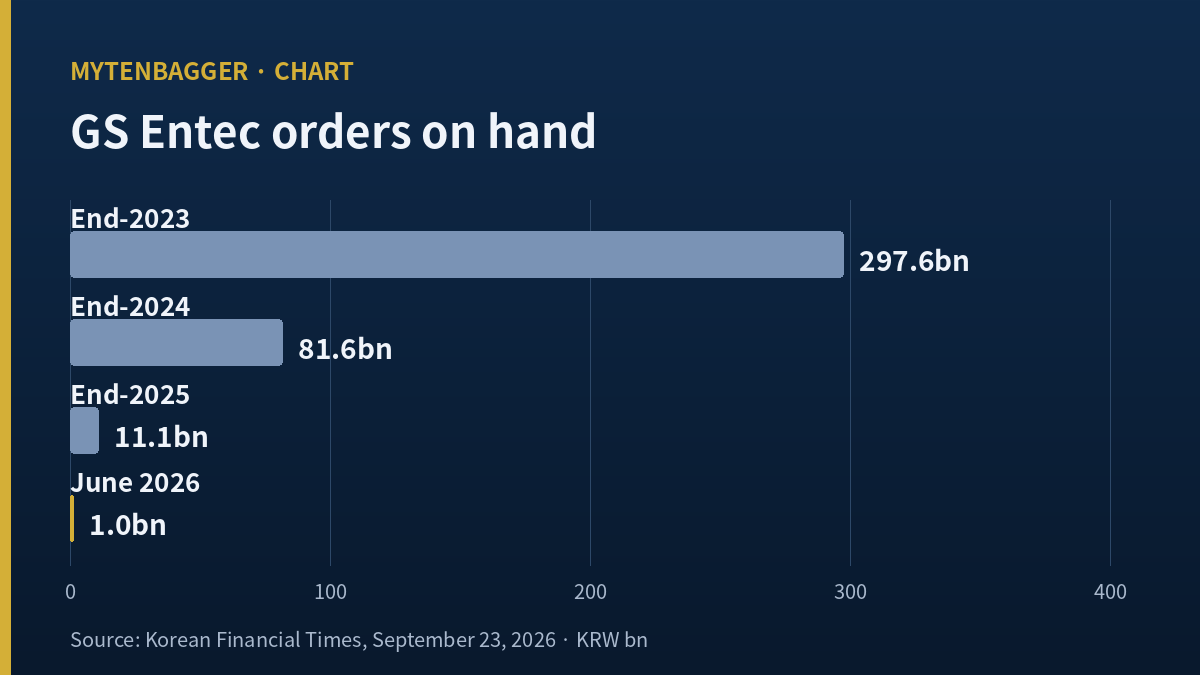
KRW 297.6bn to KRW 1.0bn
Orders on hand at GS Entec, the offshore wind foundation maker inside GS Global, from the end of 2023 to the end of June 2026. I do not own GS Global stock and I am keeping it on my watch list until that second number starts to grow again.
GS Global stock closed at KRW 2,535 on September 23, 2026, roughly USD 1.87 a share, and the company is worth about USD 154 million on the Korea Exchange. The number that made me write this entry is not the share price. It is KRW 1.0bn, the order backlog that GS Entec, a roughly three-quarters owned subsidiary that builds steel monopile foundations for offshore wind farms, reported at the end of June. At the end of 2023 the same line read KRW 297.6bn. The unit’s revenue for January to June 2026 came to KRW 10.6bn, and its operating loss over those six months was KRW 8.5bn, which is about 35% of the operating profit the entire GS Global group reported for the same period.
GS Global is listed on KOSPI, the main board of the Korea Exchange, the market where Samsung Electronics and Hyundai Motor trade. It is the trading arm of the GS conglomerate: it buys and sells steel, petrochemicals, coal and other commodities, distributes vehicles, and sits on top of a handful of manufacturing units. With a market value near USD 154 million it ranks far outside the top 100 names on the exchange, so by my own rule I do not take a buy or sell position. I record what I see and set the conditions under which I would look again.
Contents
GS Global Stock and a Wind Unit Whose Orders Ran Out
I came to this through the trading business, which is what most people buy GS Global stock for. The group reported revenue of KRW 4,109.26bn for 2025 and operating profit of KRW 52.30bn (DART annual report, group-level, via the luxrix data server). That is an operating return of about 1.27% on sales, which is normal for a commodity trader and not what caught me. What caught me was how much of the recent change in that small profit came from one small unit.
How small that profit is explains why a small unit matters. Over four years the group’s operating return on sales moved in a tight band: 1.39% in 2022, 1.95% in 2023, 1.92% in 2024 and 1.27% in 2025, by my arithmetic from the DART figures. Revenue in 2022 was KRW 5,070.92bn, then fell to KRW 3,916.49bn in 2023 as commodity prices came off, and has crept up since. The 2025 drop is the one that stands out: revenue grew 1.05% while operating profit fell 32.8%, from KRW 77.88bn to KRW 52.30bn. On sales of KRW 4,109.26bn, every tenth of a percentage point of operating return is worth about KRW 4.1bn. A single factory losing a few billion won a year can move the group’s return by that much on its own. At a steel mill or a chip maker, that would be a rounding item. At a commodity trader, it is the difference between a good year and a bad one.
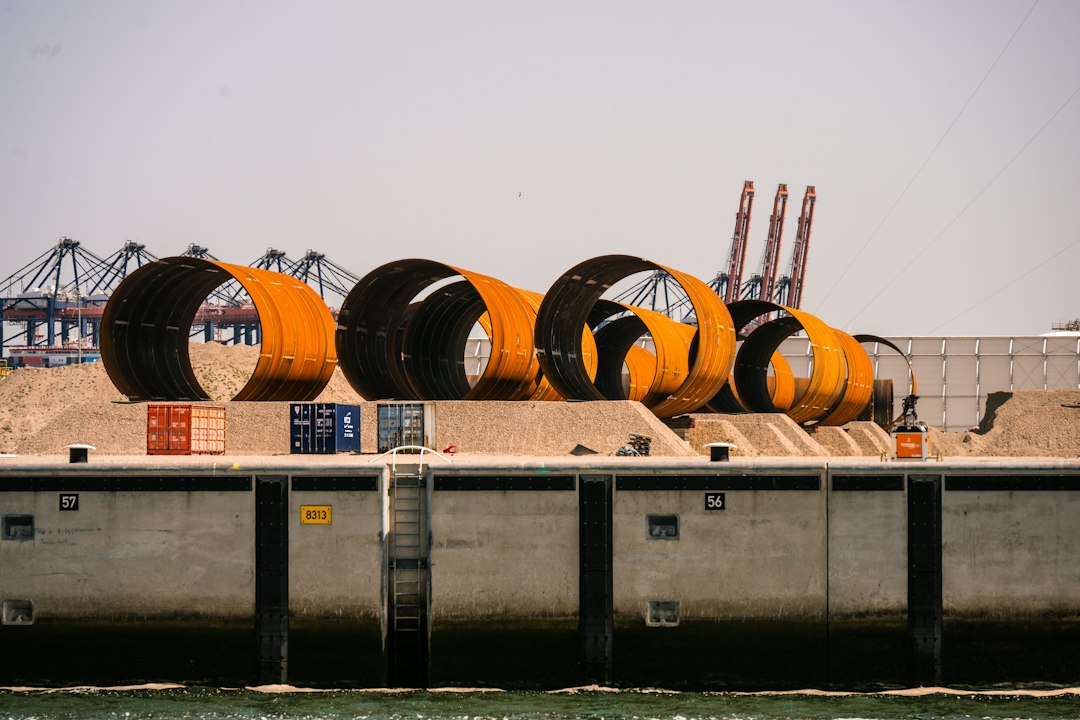
GS Entec is the unit. Korean trade press describes it as the holder of an exclusive Asian production license for monopiles from Sif, the Dutch foundation maker, and as the supplier of monopiles to the Yeonggwang Nakwol offshore wind project off the southwest coast (Newspim, September 22, 2026, in Korean). A monopile is the single giant steel tube that is driven into the seabed and carries the turbine tower. One wind farm can need dozens of them, and they are made to order. When a factory like this has no order, it has almost no revenue.
The Revenue Path at GS Entec, 2024 to June 2026
Orders on hand, year by year
The figures come from the Korean Financial Times (fntimes), in a September 23, 2026 credit column by Doo Kyung-woo, which I am paraphrasing from Korean (Korean Financial Times, September 23, 2026). By that column, GS Entec’s order backlog stood at KRW 297.6bn at the end of 2023, KRW 81.6bn at the end of 2024, KRW 11.1bn at the end of 2025 and KRW 1.0bn at the end of June 2026.
| GS Entec, KRW bn | 2024 | 2025 | Jan to Jun 2026 |
|---|---|---|---|
| Revenue | 214.2 | 86.0 | 10.6 |
| Operating result | 26.8 | 3.5 | -8.5 |
| Net result | 9.6 | -23.0 | -13.0 |
| Orders on hand at period end | 81.6 | 11.1 | 1.0 |
Source: Korean Financial Times, September 23, 2026. USD equivalents are not shown because the column itself uses won only.
Each year-end figure is a fraction of the year before. The 2024 year-end backlog was about 27% of the 2023 figure, the 2025 figure about 14% of 2024, and June 2026 about 9% of the December 2025 level, by my arithmetic. The unit worked through what it had, and nothing big replaced it.
Revenue and the operating result
Revenue followed the backlog down with a lag. In 2024 the yard still had Nakwol work to deliver, and GS Entec reported KRW 214.2bn of revenue and a KRW 26.8bn operating profit that year. In 2025 revenue fell 59.9% to KRW 86.0bn and operating profit to KRW 3.5bn, while the net result swung to a KRW 23.0bn loss. For January to June 2026, revenue was KRW 10.6bn and the operating result a KRW 8.5bn loss.
What this tells me is that the cost of the plant did not shrink with the orders. A foundation yard has cranes, rolling lines and welders whose cost runs whether a pile is on the line or not. At KRW 10.6bn of revenue in six months, the unit is carrying the fixed cost of a factory that produced KRW 214.2bn of sales two years earlier. Every month without a contract adds to the loss column.
A rough break-even line
I wanted a crude sense of how much revenue the yard needs just to stop losing money, so I drew a straight line through the two full years I have. In 2024, KRW 214.2bn of revenue produced KRW 26.8bn of operating profit; in 2025, KRW 86.0bn produced KRW 3.5bn. Each extra won of revenue between those two points carried about 18 won of operating profit, and the line crosses zero at roughly KRW 66.7bn of annual revenue. This is my own two-point estimate, not a company figure, and it assumes the cost structure stayed the same.
The first six months of 2026 say it did not stay the same. On my line, KRW 10.6bn of revenue in six months should have produced a loss of about KRW 4.1bn for the period. The reported loss was KRW 8.5bn, about twice as deep. The simplest explanation is that fixed costs went up while revenue went down, which fits what the DS Investment note says about the burden of expanded capacity. The yard was built out for a larger order flow that has not arrived. That makes the break-even point higher than my line suggests, and it means a small order will not be enough to stop the losses. It needs to be a large one.
What the Wind Unit’s Loss Did to GS Global Stock’s Group Profit
Now put that loss next to the group. In January to June 2026, GS Global reported group revenue of KRW 2,233.96bn, up 6.6% from KRW 2,095.74bn a year earlier, and operating profit of KRW 24.57bn, down 31.3% from KRW 35.75bn (DART report for the six months to June, via luxrix). In April to June alone, revenue rose 5.7% to KRW 1,134.89bn while operating profit fell 40.8% to KRW 11.72bn from KRW 19.79bn. Korean press reported the same 40.8% drop when the numbers came out in August.
| GS Global group, KRW bn | Revenue | Operating profit | Operating return |
|---|---|---|---|
| Jan to Mar 2025 | 1,021.74 | 15.96 | 1.56% |
| Apr to Jun 2025 | 1,074.00 | 19.79 | 1.84% |
| Jul to Sep 2025 | 945.78 | 6.45 | 0.68% |
| Oct to Dec 2025 | 1,067.75 | 10.10 | 0.95% |
| Jan to Mar 2026 | 1,099.07 | 12.85 | 1.17% |
| Apr to Jun 2026 | 1,134.89 | 11.72 | 1.03% |
Source: DART reports via luxrix, group-level. Three-month figures for October to December are the annual total minus the nine-month total. Operating return is my division.
The two 2026 periods each brought in more revenue than any three-month stretch of 2025, yet operating profit in both stayed below the April to June 2025 level. Revenue rose 7.6% in January to March and 5.7% in April to June against the same months a year before. More goods moved through the trading desk and less profit came out the other end. Part of that gap is the wind unit; the rest I cannot split without segment figures for each three-month period, which I have not seen.
GS Entec’s six-month operating loss of KRW 8.5bn equals 34.6% of the group’s KRW 24.57bn operating profit. If I simply add the loss back, the rest of the group earned about KRW 33.1bn. I do not treat that as a clean figure. Sales between group companies are removed when the group totals are built, and I could not check how much of GS Entec’s small revenue or cost was inside the group. So the KRW 33.1bn is a rough indication and nothing more. It does say the rest of the group, taken together, did not collapse; the sharp drop in the headline profit sits largely in one small factory.
Korean trading houses are easy to misjudge from the top line. When I wrote about Hyundai Corporation, the lesson was that a trader’s sales can grow quickly while the profit left over barely moves. GS Global is the mirror case: sales inched up, and a unit outside the trading desk decided the direction of profit.
For a Korean example of the same foundation business seen from another angle, I kept notes on CS Wind, the tower maker. The two companies sit next to each other in a wind farm, one under the water line and one above it, but they depend on different buyers and different policy triggers. CS Wind sells into a market that is already running. GS Entec is waiting for Korean offshore projects that have been approved on paper for years.
The trading business underneath
The one named sell-side view I found treats the trading side as the story. Ahn Ju-won of DS Investment & Securities, in a May 28, 2026 note, rated the shares a buy and put a value on them about 70% above the September 23 close (DS Investment & Securities note, in Korean). The note’s 2026 segment estimates, which I am translating from Korean:
- Trading and distribution: revenue KRW 4,172.7bn, operating profit KRW 64.7bn
- Manufacturing: revenue KRW 12.2bn, operating loss KRW 12.8bn
- Logistics: revenue KRW 48.3bn, operating profit KRW 3.2bn
- Other: revenue KRW 139.8bn, operating loss KRW 6.4bn
Two things stand out to me. First, the manufacturing loss in that estimate is about a fifth of the trading profit, so the group’s full-year number depends heavily on how deep that one hole gets. Second, the manufacturing revenue estimate of KRW 12.2bn for the full year sits very close to what GS Entec had already reported for January to June (KRW 10.6bn). If manufacturing in the note means mostly GS Entec, which I have not confirmed, the analyst assumed almost nothing for July to December, about KRW 1.6bn. That lines up with the KRW 1.0bn of orders on hand in June. On this point the bullish note and my worry agree. Where we differ is in how much weight the trading side can carry.
What I skipped the first time
A sales press release was where I started with this company months ago, and I stopped there too. The group revenue kept edging up year after year, from KRW 3,916.49bn in 2023 to KRW 4,066.49bn in 2024 and KRW 4,109.26bn in 2025, and I took a rising top line at a trader as a sign that the machine was fine. I never looked at the subsidiaries. If I had, I would have seen a manufacturing unit whose orders had already fallen by nearly three quarters in 2024. The group revenue was so large that a unit the size of GS Entec could lose almost all of its sales without the group total showing it. That is exactly the kind of change a top line hides. It still bothers me that I missed it, because nothing was concealed; I simply looked at the biggest number and stopped.
A Dutch Peer With Orders on Hand
The natural global comparison is the company whose process GS Entec licenses. Sif Holding N.V., listed on Euronext Amsterdam under the ticker SIFG, makes monopiles at its Maasvlakte yard near Rotterdam. I chose it for one reason: it is the licensor of the same product, so the only thing that differs is the order flow. I compare it on one point only, the state of orders on hand around the middle of 2026, each in its own unit. I do not convert units or build a ratio between the two, because a tonnage figure and a won figure do not divide into anything meaningful.
Sif reported for January to June 2026 that it delivered 101 monopiles, 59 of them in April to June, and that its order backlog stood at 422 kilotonnes, with revenue close to double the year-earlier level (Investing.com recap of Sif’s July 31, 2026 results call). For 2025 as a whole, the company reported a contribution of EUR 187.1 million and adjusted EBITDA of EUR 48 million, with a loss after tax of EUR 36.7 million (Sif financial highlights).
So the licensor has a full order list and the licensee in Korea has almost none. The technology is the same and the steel is the same. The difference is the market each one sells into: Sif’s European customers are placing orders now, while the Korean projects GS Entec needs have moved slowly. That tells me GS Entec’s problem is less about whether it can make the product and more about whether Korean buyers will order it soon.
The Case Against My Read of GS Global Stock
- The trading side may carry it. DS Investment expects trading and distribution to earn KRW 64.7bn in 2026, well above the manufacturing loss. If commodity prices stay high, the group can absorb GS Entec’s losses for a while without much damage.
- One large order changes everything. A single wind farm contract can refill a backlog of this size many times over. On September 22, 2026 GS Entec signed a memorandum with Munmu Baram, a floating wind project off Ulsan, to supply mooring piles. It carries no contract value, but it shows the unit is chasing work.
- Policy may finally move. South Korea passed an offshore wind special act in March 2025, which DS Investment expects to speed up project approvals in the second part of 2026.
- The group can sell a truck line and keep going. In March 2026 GS Global handed its BYD electric truck sales business to BYD Korea and kept only electric bus sales (Electronic Times, March 2026, in Korean). Management is willing to cut units that do not work, which argues for discipline.
- My figures for GS Entec come from the press. The backlog and revenue numbers come from a Korean trade column; I did not read a GS Entec report myself. If the column’s figures differ from GS Entec’s own report, my central fact shifts.
Where GS Global Stock Sits on My Watch List
These are the paths I see, with my own rough weights. They are personal estimates and should be read as such.
- Most likely, about 50%: GS Entec wins a contract of some size by mid-2027, the losses narrow but do not end in 2026, and group operating profit stays below the 2025 level this year.
- Where I could be wrong on the bright side, about 30%: a large Korean wind farm award arrives before the end of 2026, the backlog rebuilds past its end-2024 level, and the trading side holds, so the group’s profit recovers quickly.
- Worse, about 20%: no meaningful order in 2026 or 2027, the plant keeps running at a loss, and the group has to decide whether to keep funding it.
The conditions that would make me look at GS Global stock again:
- A contract announcement from GS Entec large enough to lift orders on hand back above KRW 50bn.
- July to September 2026 group operating profit above the KRW 19.79bn of April to June 2025, in the Q3 report due on November 16, 2026 (Mon).
- Manufacturing revenue for July to September above KRW 5bn, which would mean the yard is busy again.
- A second named brokerage estimate, so that I am not leaning on one note.
- GS Entec’s own report confirming the press figures I used above.
The first answer will come on November 16. After that, I will pull GS Entec’s own figures before I pull the group’s, because this time the small unit told me more than the big total did.
Prices and figures reflect the September 23, 2026 close. USD amounts are approximate, converted at roughly KRW 1,358 per dollar on that date. Company financials are DART group-level figures through the luxrix data server; GS Entec figures follow the Korean press cited in the body.