SK Telecom vs KT: Why One Trades at 48x and the Other at 8x
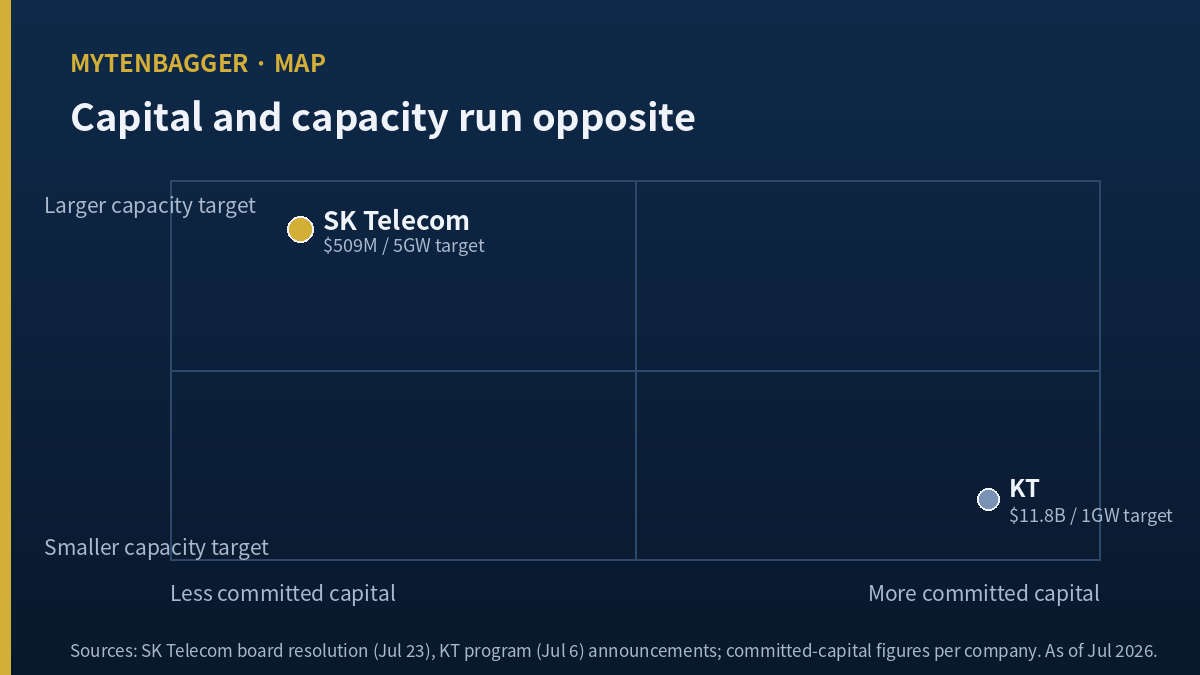
I do not hold SK Telecom vs KT as two versions of the same trade. One sells the size of an AI data center estate; the other sells the cash that estate is supposed to throw off, and pays it now. My weight currently sits with the second, not because it is the better company but because the commitments are weighted so differently. SK Telecom put $509 million behind a 5GW target. KT put $11.8 billion behind a 1GW target. What changes my mind is the first hard evidence that SK Hyper has pulled in outside capital.
Everyone is counting gigawatts. I started there too, lining up SK Telecom vs KT by announced capacity. Then I put the market values next to the income statements and stopped.
At the July 31, 2026 close on the KOSPI — South Korea’s main stock exchange, roughly the local equivalent of the NYSE — SK Telecom (017670) traded at ₩81,400 a share, or about $57. KT (030200) traded at ₩51,900, about $36. Multiply by shares outstanding and SK Telecom is worth roughly ₩17.5 trillion (about $12.3 billion) against KT’s ₩13.1 trillion (about $9.2 billion), both derived from close times share count.
A note on the pricing date. I drafted this off the July 27 close, when SK Telecom was ₩98,200 and KT was ₩54,600. On the very next session — July 28, the crash day described further down — SK Telecom fell more than 16% in a single day, drifted into the ₩78,000s, and closed the week at ₩81,400 on July 31. That is a 17% drawdown in four sessions. KT went from ₩54,600 to ₩51,900 over the same stretch, down about 5%. Every figure below is recalculated on the July 31 close. The market-value gap between the two narrowed from roughly ₩7.3 trillion to ₩4.4 trillion in those four sessions, and I read that narrowing as the first piece of the 55% scenario I lay out further down.
Now the awkward part. KT’s revenue is ₩28.2 trillion (about $19.8 billion) against SK Telecom’s ₩17.1 trillion (about $12.0 billion). KT’s operating profit is ₩2.469 trillion (about $1.73 billion) against SK Telecom’s ₩1.073 trillion (about $754 million). The company earning less than half as much is worth almost $3 billion more. On trailing earnings that is 47.7 times against 8.5 times — a 5.6-fold spread inside the same industry, in the same country, on the same theme.
The easy read is that one is the AI story and the other is not. That read is wrong. KT announced an ₩18 trillion program on July 6. Both companies are building. So I threw out the capacity question and asked a different one: whose balance sheet does the concrete get poured on? That question explains the spread almost entirely.
Contents
SK Telecom vs KT: three ways I split them apart
One: the capacity targets and the committed capital run in opposite directions
This is the number I kept going back to. On July 23, SK Telecom’s board approved SK Hyper, a wholly owned subsidiary built specifically for AI data centers. Fierce Network reported the commitment as $509.3 million (₩750 billion) in phased capital contributions through 2030, with Chung Suk-geun as CEO. The stated targets: an initial 5GW online in 2029, building to 15GW in Korea by 2035, with sites in Ulsan, Chungcheong and the Honam region.
Read the mandate carefully, because it is the whole story. Korean coverage of the board resolution describes the entity’s scope as securing land, building and operating substations, and landing customers. That is a development and origination mandate. It is not a mandate to carry 5GW of concrete on the parent’s books.
KT went the other way. Light Reading put KT’s July 6 program at ₩18 trillion ($11.8 billion) across five years under CEO Park Yoon-young, who took the job in March 2026. The split: ₩8 trillion for network, ₩5 trillion ($3.3 billion) for AI data centers targeting 1GW, ₩4 trillion ($2.6 billion) for cybersecurity, and ₩1 trillion ($653 million) for subsea cable carrying 90 Tbit/s. Korean reporting adds that the 1GW comes from building 20 new centers on top of the existing five.
Put the two side by side and the arithmetic is strange. SK Telecom’s target is five times KT’s. SK Telecom’s committed capital is about one sixth of KT’s data center line alone, and roughly one twenty-third of KT’s full program. Holding the comparison to the data center lines on both sides, that is about $102 million of committed equity per gigawatt of ambition at SK Telecom against about $3.3 billion at KT — a gap of more than thirty times (derived from the committed figures above).
I do not read that as a contradiction. I read it as two different financing models wearing the same press release. SK Hyper is a vehicle for attracting third-party capital into Korean AI infrastructure. The $509 million is seed money for a platform, not a construction budget. KT is putting 25 data centers on its own balance sheet.
Two: one shareholder return is a forecast, the other is a floor
I got this one wrong at first and it is worth admitting. When I pulled the dividend history I assumed SK Telecom had cut its payout to fund AI. Korean regulatory filings show SK Telecom’s dividend per share at ₩3,320 for 2022, ₩3,540 for both 2023 and 2024, then ₩1,660 for 2025 — well under half. KT over the same stretch went ₩1,960, ₩1,960, ₩2,000, ₩2,400.
The AI-funding explanation does not survive contact with the record. SK Telecom’s 2025 reduction traces to interim and year-end dividends being suspended during its data-breach response, not to a capital reallocation. And Meritz Securities analyst Jung Ji-soo, in a Korean-language note dated July 16, projects SK Telecom’s 2026 dividend per share back at ₩3,320 — a recovery view, not a permanent reset. My first framing was lazy.
Correcting it did not close the gap, though. It changed what the gap is made of. The ₩3,320 on the SK Telecom side is a sell-side projection. KT’s side is a company commitment: on May 12 KT lifted its annual minimum dividend per share from ₩1,960 to ₩2,400, a 22.4% increase, and committed to a 50% payout of adjusted net income for three years through 2028. The buyback program runs about ₩1 trillion from 2025 to 2028, with ₩250 billion executed in 2025 and another ₩250 billion under a trust arrangement that started in March 2026. CFO Min Hye-byeong framed the change as being about predictability, as Korean trade press reported it at the time.
A projection and a floor are not the same instrument. That difference is most of why I sit where I sit.
Three: what each one actually earns today
SK Telecom’s operating margin runs 6.28% with return on equity of 3.3%. KT’s are 8.74% and 10.2%. On 2025 dividends against the July 31 closes, the yields work out to roughly 2.0% and 4.6% (derived).
SK Telecom’s figures need a caveat, though, or you will undercount the company. Last year’s second quarter absorbed the breach: Korean business daily Hankyung reported in mid-July that operating profit fell into the ₩300 billion range in that quarter. Meritz models this year’s second quarter at ₩535.5 billion, up 58.3% year over year, and the 2026 full year at ₩1.917 trillion in operating profit on ₩17.711 trillion of revenue. A large slice of that growth is the base effect washing out, not a re-rating of the business.
KT is not clean either. SK Securities analyst Choi Gwan-soon, in a July 8 note, models KT’s second quarter operating profit at ₩562.2 billion, down 43.7% year over year, with customer compensation tied to its own information-disclosure incident trimming wireless revenue by 1.9%. NH Investment & Securities analyst Ahn Jae-min, writing a day later, models ₩609.4 billion for the same quarter, in line with a ₩613.6 billion consensus. Two named analysts, one day apart, more than ₩47 billion apart on the same quarter.
Putting SK Telecom vs KT numbers side by side
| Metric | SK Telecom (017670) | KT (030200) |
|---|---|---|
| Close, July 31 | ₩81,400 (~$57) | ₩51,900 (~$36) |
| Market value (derived) | ~$12.3B | ~$9.2B |
| Revenue | ~$12.0B | ~$19.8B |
| Operating profit / margin | ~$754M / 6.28% | ~$1.73B / 8.74% |
| P/E / P/B (trailing) | 47.7x / 1.31x | 8.5x / 0.69x |
| Return on equity | 3.3% | 10.2% |
| 2025 dividend per share | ₩1,660 (~$1.17) | ₩2,400 (~$1.69) |
| Stated capacity target | 5GW by 2029; 15GW by 2035 | 1GW (25 centers) |
| Committed capital | $509M (SK Hyper) | $11.8B (total program) |
Sources: Korea Exchange daily prices (July 31, 2026 close) · P/E and P/B are the published market figures for the same date (SK Telecom EPS ₩1,706, BPS ₩62,371; KT EPS ₩6,124, BPS ₩75,437) · Korean regulatory dividend filings · company announcements (SK Telecom board, July 23; KT program, July 6) · Fierce Network and Light Reading as linked. Revenue, operating profit and ROE are most recent annual. Dollar conversions at ₩1,424.0 per dollar — the onshore Seoul session close on July 31, 2026, cross-checked against Newspim and Money Today — except where a source published its own dollar figure.
KT wins revenue, operating profit, margin, return on equity and dividend. SK Telecom wins exactly one row — the capacity target — and the market has staked the entire spread on that row.
One more thing I did not put in the table: the trading range. Over the past year SK Telecom moved between ₩139,500 and ₩51,400, a 2.7-fold spread top to bottom. KT moved between ₩69,400 and ₩48,100, about 1.4-fold. Same sector, same theme, nearly double the amplitude.
That number changed my vocabulary. I had been about to call them a growth name and an income name, which describes the outcome as if it were the cause. The amplitude is set by how much unconfirmed future sits inside the price. SK Telecom’s price carries 5GW that has not touched an income statement yet. KT’s price carries dividends and buybacks that get confirmed every quarter. Obvious in hindsight; I only got it into a sentence after building the table.
What the forward estimates say about SK Telecom vs KT
Trailing multiples are doing a lot of distorting here, on both sides, so it is worth laying out what the named sell-side analysts actually model going forward. I want to be precise that these are their estimates and not mine.
On KT, Choi Gwan-soon at SK Securities models 2026 revenue of ₩27.56 trillion (about $19.4 billion) with operating profit of ₩1.99 trillion (about $1.40 billion), then 2027 revenue of ₩28.16 trillion (about $19.8 billion) with operating profit of ₩2.16 trillion (about $1.52 billion). He also models second-half 2026 operating profit at ₩931.4 billion, up 21.7% year over year as the financial drag from the disclosure incident fades, and puts the full-year shareholder return yield at 6.1%. His published price is ₩72,000. Ahn Jae-min at NH carries ₩89,000 and adds a separate angle I had not weighted: a potential KT Cloud listing, which Korean government guidance on duplicate listings may now permit.
On SK Telecom, Jung Ji-soo at Meritz models second-quarter revenue of ₩4.3703 trillion, up only 0.7% year over year, against that 58.3% jump in operating profit. That pairing is the base effect in one line: revenue essentially flat, profit up by more than half. It is a recovery, not an acceleration, and I think the distinction matters when a stock is carrying 47.7 times.
Stack those against each other and something interesting falls out. On SK Securities’ own 2027 estimate, KT would earn roughly ₩2.16 trillion in operating profit. Meritz’s 2026 estimate has SK Telecom at ₩1.917 trillion. Even after a full recovery year, SK Telecom is modeled to earn less than KT does — while carrying about $3 billion more market value. The gap is not a temporary artifact of the breach year. It survives the recovery.
Sizing SK Telecom’s 5GW against the region
Here is where a US-based reader should slow down, because the number is easy to wave through. IDC, cited in the same Fierce Network piece, forecasts Asia-Pacific data center capacity growing from 51.9GW in 2024 to 142.6GW by 2029.
Set SK Telecom’s target against that. Five gigawatts in 2029 would be roughly 3.5% of all forecast Asia-Pacific capacity, from one carrier in a country of 52 million people (derived from the two figures). The 15GW figure for 2035 is larger than one tenth of what the entire region is projected to hold six years earlier. These are not incremental numbers. They are numbers that require capital SK Telecom has not raised and power Korea has not yet allocated.
The 48x versus 8x spread is not a bet on whether they do AI. It is a bet on whose balance sheet it gets built on.
The company financing construction itself trades cheaper, because capital gets tied up, depreciation lands first and returns arrive last. The company originating deals and bringing in third-party money trades richer, because its capital stays free. The market is pricing that distinction correctly, in my view. But the richer multiple carries an untested assumption underneath it: that the outside capital actually shows up. Goldman Sachs, also cited in the Fierce piece, called Asia’s data center outlook exceptionally robust while flagging power availability as the constraint — which is the same caution from the other direction.
There is a related wrinkle on KT’s side. Two named Korean analysts put KT’s 1GW milestone three years apart. Ahn Jae-min at NH wrote on July 9 that KT will expand to 1GW by 2028. Choi Gwan-soon at SK Securities wrote on July 8 that the 1GW plus 90 Tbit/s of subsea capacity runs through 2031 at about ₩6 trillion. The company framed the spend as a five-year program, which lands closer to the 2031 reading. Two notes filed a day apart, three years apart on the same milestone. I take that as a measure of how wide the error bars are on all AI data center timelines right now, at both companies.
The paths I think are live for SK Telecom vs KT
What I think happens most often (55%)
Both succeed on their own terms and the spread narrows from both ends. KT’s multiple drifts up as self-funded centers start showing in revenue. SK Telecom gives back some premium as 5GW enters a verification window without proof. KB Securities analyst Kim Jun-seop wrote on June 1 that the Ulsan and Guro centers operated by SK Broadband begin operating in the second half of 2027 and, at full utilization in 2031, could contribute over ₩1.1 trillion to consolidated operating profit. Read that the other way: SK Telecom’s AI data center contribution is largely absent from the income statement for the next year or more. Holding 47.7 times across that gap is a lot to ask, and the four sessions after July 28 already took one bite out of the multiple.
Where I am wrong (30%)
SK Hyper lands a major anchor tenant or a large outside capital partner. Then the $509 million I have been calling seed money turns out to have been leverage, and 47.7 times starts looking cheap rather than stretched. I do not treat this as a stretch scenario — origination is literally the entity’s stated mandate. The Korean sell side leans this way: Hana Securities analyst Kim Hong-sik published ₩140,000 on June 23, KB’s Kim Jun-seop ₩130,000 on June 1, and Meritz’s Jung Ji-soo raised his from ₩98,000 to ₩110,000 on July 16 while upgrading to buy from hold. Those are their published numbers, not mine.
Everything else (15%)
Both get marked down together. Something close to that ran while I was drafting this. On July 28 the KOSPI fell 8.04% intraday to around 6,212, triggering the eighth circuit breaker of the year, with the KOSDAQ down 6.53% near 714. Retail investors bought a net ₩1.868 trillion while foreign investors sold a net ₩1.715 trillion. Korean daily Hankook Ilbo attributed the move to the Shanghai listing of Chinese memory maker CXMT and the competitive pressure that implies for Korean memory. All of those are intraday figures, not closes. Korean telecoms usually cushion days like that, and they did relative to the index — but the higher-multiple one gave up more, which is the thesis of this post getting stress-tested in real time rather than in a spreadsheet.
That detail deserves a footnote for anyone whose reference point is the S&P 500. A KOSPI circuit breaker halts trading when the index moves far enough intraday, similar in spirit to the US market-wide breakers but triggered more readily in practice. July 28 was the eighth this year. Eight index-level halts in seven months is not a normal tape, and it is context worth carrying into any Korean position: the currency and the index are both capable of moving more than a US-listed comparable would in the same window. Owning either of these carriers through an ADR or a Korea ETF does not remove that; it repackages it. I have been sizing accordingly, which is part of why the steadier cash profile appeals to me right now rather than the steeper one.
SK Telecom vs KT: the same test applied to both
A comparison post with a one-sided breakpoint is half a post, so I am writing the test out for each.
On SK Telecom. My view that the commitment is thin dies the moment SK Hyper discloses a first outside capital partner or anchor tenant. That would make $509 million a sufficient seed rather than an insufficient budget. Running the other way: if the 2029 roadmap produces no further land or substation announcements beyond the initial Ulsan work, I reclassify 5GW from target to rhetoric.
On KT. My view that the commitment is heavy dies if the 50% adjusted-payout policy or the ₩2,400 dividend floor slips. Spending ₩18 trillion while holding returns intact is the entire premise; abandoning either half breaks it. A halt in the buyback trust execution reads the same way.
The two tests resolve on different clocks, and that matters more than it sounds. KT’s commitments get marked every quarter. SK Hyper’s capital raise has no schedule at all. So I check KT quarterly and SK Telecom only when something is filed. Weighting toward the shorter verification cycle is a preference of mine as much as a conclusion.
The power and grid bottleneck both of these companies are standing on is something I worked through separately in Korea’s data center power problem, and the wider map of the AI infrastructure trade is in Korea’s AI infrastructure buildout.
The bet I am actually making
I do not sort SK Telecom vs KT into a good company and a bad one. I sort them into a bet on scale and a bet on cash. SK Telecom sells the size of the estate. KT sells what the estate should produce and hands some of it over every quarter. Both are coherent, and which one is right turns substantially on when SK Hyper’s first outside money is announced.
My weight is on the heavier commitment for now. Writing that down does not make me comfortable, though. When a market prices two companies more than five times apart, it has usually noticed something before I have. Next checkpoint is second-quarter results in early August — how much of SK Telecom’s base effect has washed through, and how far KT’s compensation costs land. I will open this journal again then.
Related reading