Yuhan Q2 Record Quarter: How Much of the Lazertinib Money Recurs
I ran two divisions before I wrote anything about Yuhan Corporation stock. The first: 58.9 billion won of license revenue against 61.4 billion won of quarterly operating profit, which is 95.9%. The second: 7.0 billion won of Lazertinib royalty against that same 58.9 billion won license line, which is 11.9%. One line carried the quarter, and roughly an eighth of that line is the kind of money that arrives again next quarter without a new event behind it. That gap is the whole reason this page exists.
Where I stand: watching
| What arrived | Figure | Who published it |
| Q2 operating profit (separate) | $43.4M (61.4 bn won) | Company preliminary release, July 30 |
| License revenue inside it | $41.6M (58.9 bn won) | Company segment breakdown, July 30 |
| Lazertinib royalty inside that | $4.9M (7.0 bn won) | Korean press, citing the earnings call, August 4 |
| Combination therapy H1 global sales | $546M | J&J second-quarter release, July 15 US time |
| Treasury share cancellation | 6,064,420 shares ($300.3M) | Company board resolution, July 23 |
I am only watching this one. What follows is the arithmetic behind that.
Contents
What Yuhan Corporation stock earned in the second quarter
Yuhan Corporation trades on the KOSPI, the senior board of the Korea Exchange, under code 000100. The KOSPI is the larger of Korea’s two main boards; the KOSDAQ next to it carries younger technology and biotech names. Yuhan is neither a startup nor a global major. It is a domestic pharmaceutical company founded in 1926 whose share price closed at 80,600 won ($56.92) on Friday, August 7, 2026.
On July 30 the company published preliminary second-quarter numbers on a separate basis: revenue of 614.0 billion won ($433.6M), up 10.4% from the same quarter a year earlier; operating profit of 61.4 billion won ($43.4M), up 34.7%; and net profit of 47.6 billion won ($33.6M), up 22.1%. Korean coverage called it the largest quarterly operating profit in the company’s history, and on the reported figures that description holds.
Only one segment moved in double digits
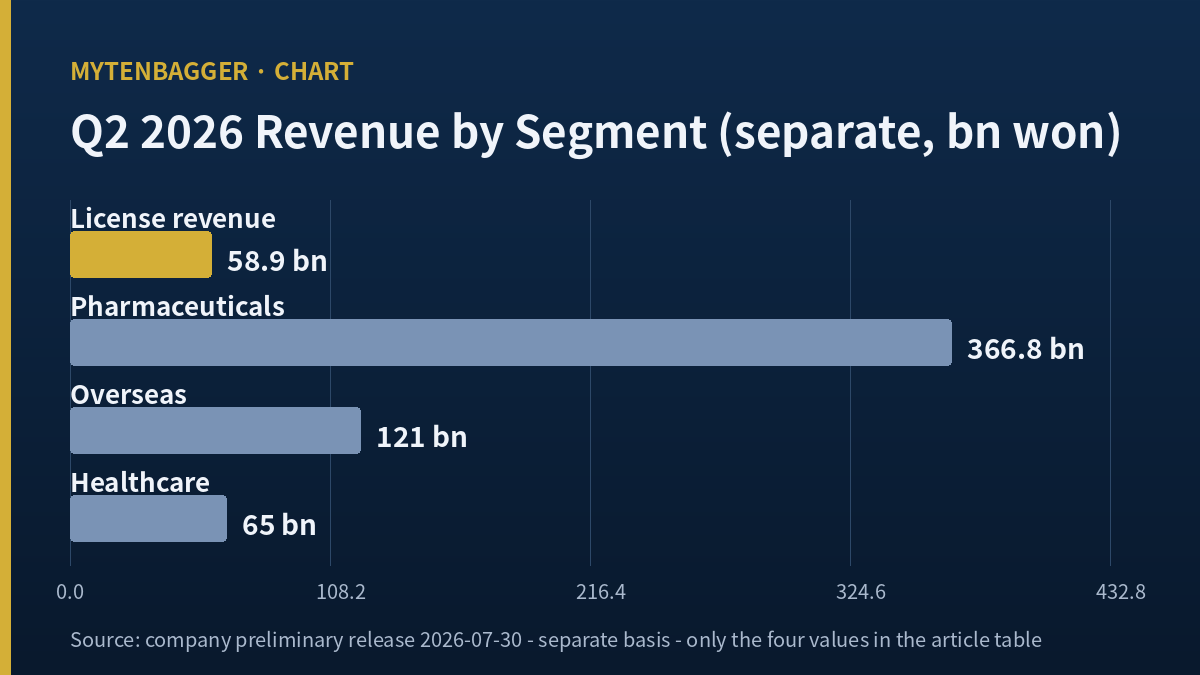
| Segment | Q2 revenue | Year on year |
| Pharmaceuticals | $259.0M (366.8 bn won) | up 6.3% |
| Overseas business | $85.4M (121.0 bn won) | up 5.4% |
| Healthcare | $45.9M (65.0 bn won) | down 5.5% |
| License revenue | $41.6M (58.9 bn won) | up 130.6% |
The three operating segments moved in single digits or went backwards. License revenue, which is 9.6% of quarterly sales, grew 130.6% and came to 95.9% of the operating profit line (58.9 divided by 61.4 equals 0.9593, derived). A segment worth less than a tenth of revenue accounted for a sum equal to almost all of the profit.
One housekeeping note, because I would want to know it if I were reading someone else’s page. The four segments add to 611.7 billion won against reported revenue of 614.0 billion won, a shortfall of 2.3 billion won. The report I worked from, published by Newsway in Korean, may have carried only the principal segments. I could not place that 2.3 billion won, so it appears in none of my arithmetic.
The license line holds two different kinds of money
License revenue is a single line in the company’s segment table, and two things sit inside it. Upfront payments and development milestones arrive when an event occurs, once each. Royalty arrives while the partner keeps selling the drug. The first kind is a payment; the second kind is a stream. A quarter built on the first does not tell me much about the next quarter.
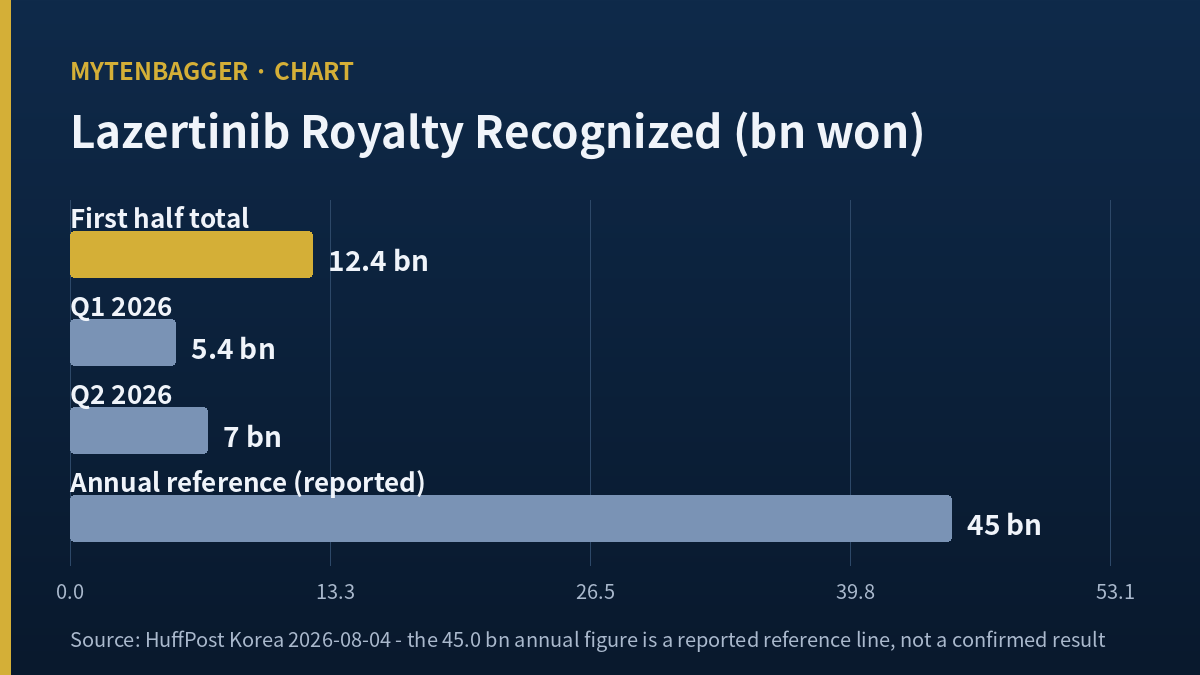
The company does not break that line apart in its release. The number surfaces instead in Korean coverage of the earnings briefing. Reporting by HuffPost Korea on August 4, which I am summarizing from the Korean instead of quoting it, put Lazertinib royalty at 5.4 billion won in the first quarter and 7.0 billion won in the second, with 12.4 billion won for the half. Those three figures close: 5.4 plus 7.0 equals 12.4.
Splitting the line gives 11.9%
Royalty of 7.0 billion won against license revenue of 58.9 billion won is 11.9% (7.0 divided by 58.9 equals 0.1188, derived). The remaining 51.9 billion won is event-driven. Both of these are true at once: the quarter was the largest on record, and roughly seven eighths of what made it large has no confirmed repeat schedule.
There is a second thread worth pulling. On May 7, analyst Jung Hee-ryung at Kyobo Securities cut the firm’s valuation on the shares to 130,000 won from the 150,000 won set on March 4, and the reason given, as reported by Newspim in Korean, was a delay in recognizing a European Lazertinib milestone. A milestone did not land in the first quarter. License revenue then rose 130.6% in the second. Whether those are the same item is something the company has not disclosed, so I cannot confirm it, and I am leaving the uncertainty on the page instead of resolving it in my own favor. If they are the same item, the size of the second quarter is a shift in arrival timing.
Dividing my royalty by my partner’s sales
Royalty is not a number this company controls. It attaches to someone else’s sales, and those sales are disclosed in New Jersey, not Seoul. Johnson & Johnson reported its second quarter on July 15 US time. As relayed by TheBio at Money Today, combined Lazertinib and Rybrevant sales reached $546 million in the first half, up about 70% year on year. The second quarter alone was $289 million, up 60.8% from roughly $180 million a year earlier (289 divided by 1.608, derived) and up 12.5% from the $257 million implied for the first quarter (546 minus 289, derived). Reading someone else’s income statement as if it were this company’s is a trap that sits one drugmaker over as well — HK inno.N’s prescription figures are not that company’s revenue either. By region, the second quarter split into $190 million in the United States, up 36.8%, and $99 million outside it, up 141%.
Now the division that matters. Half-year royalty of 12.4 billion won against $546 million of partner sales gives an effective ratio, and the ratio depends on where I convert.
| Path | Calculation | Effective ratio |
| Won on won | 12.4 bn / 812.7 bn won | 1.53% |
| Dollar on dollar | $8.8M / $546M | 1.60% |
| Conversion inside the report | 812.7 bn won / $546M | 5.1% above the rate below (derived) |
| Rate used throughout this page | Seoul close, August 7, 2026 | 1,416.10 won per dollar |
The two paths separate because the Korean report converted $546 million into 812.7 billion won at its own rate, and that conversion works out about 5.1% above the August 7 close I price everything else at (derived). I did not restate their won figure at my rate; leaving their conversion visible as theirs is the more accurate handling. I am not picking one quietly. I hold the effective ratio as a band of 1.53% to 1.60%, and either way it is not a contract rate. Recognition timing, regional terms, the conversion point, and however the company separates royalty from other license items are all folded inside it.
The multiple survives the currency problem
The same HuffPost Korea report describes an annual figure of 45.0 billion won for Lazertinib royalty. Whether that is company guidance or a market expectation is not stated there, so I treat it as a reported reference line and not as a company number. Against it, the half-year 12.4 billion won is 27.6% (12.4 divided by 45.0 equals 0.2756, derived). Six months in, a bit over a quarter of the way.
Filling the remaining 32.6 billion won in the second half at a constant effective ratio would require combination sales of roughly 2,136.6 billion won on the won path, which is 2.63 times the first half. Run it in dollars and the requirement is about $1.44 billion against $546 million, which is also 2.63 times. The exchange rate appears in the numerator and in the base, so it cancels. The two paths that disagreed on the ratio agree exactly on the multiple, and that is the number I keep.
Combination sales already grew about 70% year on year. Growing another 2.6 times in six months is not a picture I can draw. So I read 45.0 billion won as a line the company walks toward over several years and not a destination for this one. That reading is mine; neither the company nor any broker has framed it that way. I looked at royalty structure from a different angle in my Alteogen piece, where the question was the rate itself instead of the run rate.
A 7.5% cancellation Yuhan Corporation stock screens have not absorbed
Counting profit and counting the shares it divides into are separate jobs, and this company moved the second one last month.
On July 23 the board resolved to cancel its entire treasury holding. Per Seoul STV News, that is 6,031,820 common shares plus 32,600 preferred, 6,064,420 in total, worth about 425.3 billion won ($300.3M), with a cancellation date of July 31. Total shares issued fall from 80,828,541 to 74,764,121, a reduction of 7.50% (derived). I could not locate a separate filing confirming execution, so everything below assumes the resolution was carried out on schedule.
Two paths closing on the same share count
My indicator feed, sourced from Kiwoom and dated August 7, 2026, shows 79,647,643 shares and a market capitalization of 6,419.6 billion won. Multiply the August 7 close of 80,600 won by 79,647,643 and the market cap reproduces to the won. The screen is still using the pre-cancellation count.
I closed it from the other side as a check. Subtract those 79,647,643 common shares from the 80,828,541 total and preferred shares come to 1,180,898. Remove the cancelled amounts from each and the result is 73,615,823 common and 1,148,298 preferred, which sum to 74,764,121, matching the post-cancellation total in the filing coverage share for share. Two independent routes landing on the same integer is enough for me to treat the conclusion as settled.
Recomputed on the post-cancellation common count, market capitalization is 5,933.4 billion won, or $4.19 billion against the $4.53 billion on the screen. The difference is 486.2 billion won, 7.57%. I do not read that as the company getting cheaper. Fewer shares at the same price is a smaller market cap by construction, and per share it is an improvement. What it means practically is narrower: for as long as vendor share counts lag, any multiple built on the displayed market cap is built on the wrong base. This section expires the day a vendor updates the field. The broker valuations quoted below were also set before the cancellation, and I have not placed them beside the new share count. I wrote about what remains after a Korean company burns treasury stock in my KT&G piece.
Yuhan Corporation stock next to Johnson & Johnson
The natural comparison here is not another Korean pharmaceutical company. It is the partner, because the partner’s sales set the royalty. Figures below are as displayed on stockanalysis.com on August 9, 2026, with the share price dated August 8.
| Measure | Johnson & Johnson | Yuhan Corporation |
| Market capitalization | $624.74B | $4.19B post-cancellation (derived) |
| PE ratio | 30.05 (forward 23.08) | 33.74 trailing, Kiwoom basis |
| Profit margin | 21.48% | 8.47% |
| Dividend yield | 2.07% | 0.74% |
| Revenue, trailing twelve months | $97.93B | $433.6M in Q2 alone |
Johnson & Johnson is about 149 times the size (derived), pays nearly three times the yield, and earns two and a half times the margin, while carrying a lower trailing multiple. That comparison is not the interesting part. This is: half-year combination sales of $546 million are about 1.1% of half of J&J’s trailing twelve-month revenue (derived, and the periods are approximate, not matched). For the company whose shares I am examining, this drug is the story of the quarter. For the company selling it, this drug is roughly one percent of the top line. Those two facts sit on either end of the same royalty agreement, and only one of the two parties has a reason to talk about it every quarter.
The case against, and the case against that
A page with only one side is a research gap wearing a stance. Here is the other side, and then the other side of that.
Against
- A shrinking third quarter. The HuffPost Korea report cites an NH Investment & Securities estimate of 13.7 billion won ($9.7M) in third-quarter operating profit, down 37.9% year on year. Set against 61.4 billion won in the second quarter, that is a different order of magnitude.
- Drug pricing reform effective August 1. Flagged as pressure on the prescription business, which at 366.8 billion won is the largest segment.
- Patent expiries. Generic competition on Trajenta and Jardiance is described in the same coverage as an unavoidable drag.
- Six years without a new licensing deal. No new out-licensing since 2020, per that report. Milestone income comes from agreements already signed, and without new ones that portion eventually runs out.
- Consolidated cost. Rising research spending at the subsidiary ImmuneOncia is cited as a drag on consolidated operating profit.
Against that
First, the drug is genuinely selling. Second-quarter sales outside the United States rose 141% to $99 million while the US rose 36.8% to $190 million, which moves the center of gravity abroad and lengthens the runway.
Second, the cancellation was execution, not intention. Roughly 425.3 billion won of stock was destroyed. In a market where shareholder return plans are often documents, that distinguishes itself.
Third, named brokers had the shares above the current price. NH Investment & Securities set 140,000 won on May 4, Heungkuk Securities 130,000 won on May 6, and Kyobo Securities 130,000 won on May 7. Every one of those judgments predates the second-quarter results and the cancellation by about three months, so I record them as what was thought in May and I do not carry them forward as current opinion.
One more scale check on the same theme. Half-year consolidated operating profit of 75.7 billion won is 72.5% of the 104.4 billion won that same feed carries for full-year 2025 (derived). Six months has covered close to three quarters of last year’s entire operating profit, and the license line is the reason. That is the size of the thing I am trying to date.
On the balance sheet side, the same Kiwoom feed puts return on equity at 8.8%, price to book at 2.58, and the trailing multiple at 33.74. The dividend is 600 won per share, raised three years running, which is a 0.74% yield and a 25.1% payout when the per-share dividend is divided by per-share earnings (600 divided by 2,388.86, derived). This is not a company I would hold for the dividend. Cash-flow and EBITDA fields in that feed do not reconcile with the reported operating profit by an order of magnitude, so I excluded them entirely; a blank beats a plausible wrong number. I applied the same test to vendor fields in my Samsung Biologics piece.
What would bring me back to Yuhan Corporation stock
I am only watching, and the reason is not that the company is weak. It is that I have not been able to separate the kind of profit I would be buying. While the company keeps license revenue as one line, I have to assemble the royalty figure each quarter from press coverage of a briefing. I would rather not pay a multiple in that condition.
Two conditions that would change my mind
The first is a quarter with royalty recognition above 11.25 billion won, which is the reported 45.0 billion won annual line divided into four (derived). The second quarter was 7.0 billion won, so that requires better than 60% more. A quarter like that would be evidence the recurring portion is actually compounding.
The second is a new out-licensing agreement. Six years without one is the spine of the bear case, and breaking that spine would mean rebuilding the whole argument.
What would tell me I read this wrong
If third-quarter license revenue falls sharply and operating profit still grows year on year, I was wrong. That outcome would mean the three operating segments generated the profit themselves, which collapses the premise of this page. The NH estimate of 13.7 billion won points the other way, but an estimate is not an outcome. The check comes with the third-quarter filing.
The three boxes I fill next quarter
This page exists to prepare boxes, not to close an argument. There are three. Third-quarter license revenue. The royalty inside it. And whether the vendor share count has moved to 74,764,121. Once those are filled, the premises here either survive or they do not, without any further interpretation from me.
Three things the record quarter does not settle
Why a record quarter still leaves room for hesitation
The record is real. What made it is 58.9 billion won of license revenue, of which the confirmed recurring portion, royalty, is 7.0 billion won or 11.9% (derived). The rest requires an event. I am not arguing the quarter was bad. I am saying I cannot yet measure how long the good part lasts.
What the 7.5% cancellation changes, and what it does not
Share count falls by 6,064,420, so every remaining holder’s proportional claim rises accordingly. Treasury stock was already excluded from dividends and voting, so cancellation does not lift per-share earnings by the same percentage. What is certain as of the August 7 close is narrower and more useful: the market capitalization on the screen is still computed on the pre-cancellation count, and any multiple you build from it carries that 7.57% gap.
Where the royalty is tracked, quarter by quarter
Two places, every quarter. Partner sales come from the J&J quarterly release. The amount Yuhan recognizes appears in Korean coverage of the company’s earnings briefing. The company’s own segment table combines royalty and milestones on one line, so that line alone will not separate them. I keep the two numbers in a table and divide.
What I can record from the August 7 close is this. That close was 80,600 won, market capitalization 6,419.6 billion won on the screen and 5,933.4 billion won on the post-cancellation count (derived). The drug is selling well, and I have not yet seen the speed at which that selling turns into revenue on this company’s own income statement. I reopen this page in the quarter where that speed becomes visible.
Basis: share price, market capitalization, multiples, and share count from a Kiwoom-sourced indicator feed dated Friday, August 7, 2026. Exchange rate 1,416.10 won per dollar, the August 7, 2026 Seoul close, per Money Today and Steel and Metal News, which carried the same close. Second-quarter results and segment revenue from the company preliminary release of July 30, 2026 on a separate basis. Half-year consolidated preliminary figures are revenue of 1,166.2 billion won, operating profit of 75.7 billion won, and net profit of 91.4 billion won; those are never mixed with the separate-basis figures used above. Korean-language sources are summarized in my own words, not quoted. Figures marked derived are my own division from those sources.