Emart Interest Coverage: Two Ratios for One Year, Both Below One
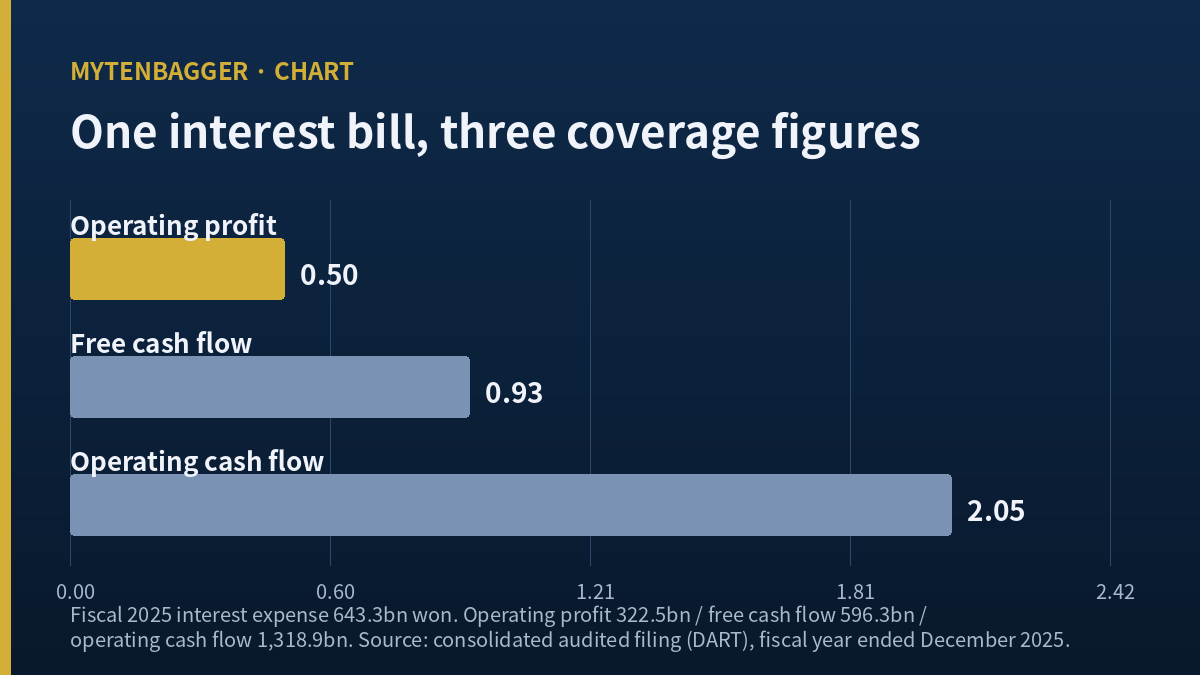
Emart stock closed at 78,900 won (about $55.62) on Friday, August 14, 2026. In the fiscal year that ended December 2025, the company earned 322.5 billion won ($227.4 million) of operating profit and paid 643.3 billion won ($453.5 million) of interest. Divide the first by the second and coverage is 0.50 times. Take operating cash flow instead, 1,318.9 billion won ($929.7 million), and coverage is 2.05 times.
Both figures come out of the same audited consolidated filing. They sit 4.09 times apart. I spent most of my reading time on which one describes the company, and I finished without picking. What I did instead is written below, along with the one line in an unfiled document that would let me choose.
Fiscal 2025 interest bill: 643.3 billion won. Two ways to cover it.
| 0.50x on operating profit 322.5bn won |
4.09x gap between them |
2.05x on operating cash flow 1,318.9bn won |
A third measure sits between them. Free cash flow of 596.3 billion won ($420.3 million) covers 0.93 times the same bill. That one is below 1.0, and the 66.97 billion won dividend is paid after it.
Contents
What Emart stock is a claim on
Emart Inc. (KRX: 139480) runs South Korea’s largest discount store chain. It trades on the KOSPI, the main board of the Korea Exchange, which lists roughly 800 companies and is the index most foreign allocators use as their Korea proxy. Emart’s own market value is 2,177.3 billion won, about $1.53 billion, which makes it a mid-cap on that board despite annual revenue of 28,970.4 billion won ($20.42 billion).
The consolidated entity is wider than the stores. It holds SCK Company, the licensee that operates Starbucks in Korea; SSG.com, the group’s online grocery arm; the Traders warehouse-club format; the E-Mart24 convenience chain; Shinsegae Engineering and Construction; and Chosun Hotel and Resort. That spread is why the operating profit line and the cash flow line diverge as much as they do, and it is also why the second quarter of 2026 went the way it did.
Five periods, five coverage figures, all below one
Before deciding between 0.50 and 2.05, I lined up the operating-profit version across every period I could pull from Korean regulatory filings. Figures are consolidated, from the Financial Supervisory Service filing system, in billions of won.
| Period | Revenue | Operating profit | Interest expense | Coverage |
|---|---|---|---|---|
| FY2022 | 29,332.4 | 135.7 | 529.7 | 0.26x |
| FY2023 | 29,472.2 | -46.9 | 594.6 | loss |
| FY2024 | 29,020.9 | 47.1 | 742.2 | 0.06x |
| FY2025 | 28,970.4 | 322.5 | 643.3 | 0.50x |
| Q1 2026 | 7,123.4 | 178.3 | 228.1 | 0.78x |
Revenue barely moved across four fiscal years. It sat near 29 trillion won the whole time. Interest expense climbed from 529.7 billion won to 742.2 billion won and then eased to 643.3 billion won. The variable in this company is the price of borrowed money, and my source for every line is the filing archive at the Korean regulator (DART).
One caution on the quarterly row. Korean quarterly filings report flow items cumulatively. First-quarter figures happen to be both cumulative and discrete, so the 228.1 billion won of Q1 2026 interest is a clean single quarter. When I tried to derive discrete interest for the second and third quarters by subtraction, the swings looked implausible, which suggests reclassification inside the year. So I use annual figures and first-quarter figures only, and the other quarters stay out of this piece.
Emart stock earned its largest quarter and still came up short
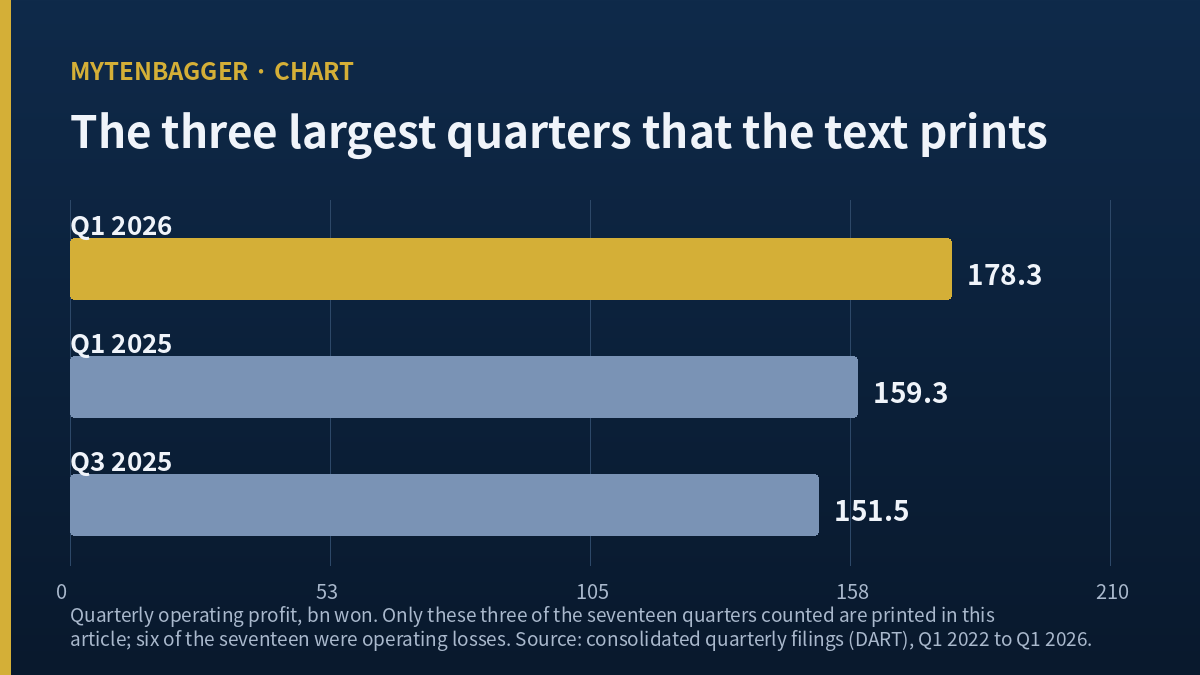
I sorted seventeen quarters of discrete operating profit, from Q1 2022 through Q1 2026. The largest is Q1 2026 at 178.3 billion won ($125.7 million). Second is Q1 2025 at 159.3 billion won, third is Q3 2025 at 151.5 billion won. Six of those seventeen quarters posted an operating loss.
The best quarter in my window covered 0.78 times its interest. Setting the two first quarters side by side shows why.
- Operating profit 159.3 billion won to 178.3 billion won, up 11.93 percent
- Interest expense 140.6 billion won to 228.1 billion won, up 62.21 percent
- Coverage 1.13x falling to 0.78x
A year ago the company cleared the bar. It cleared it by 13 percent, with no room to spare, but it cleared it. Then earnings grew at one rate and the interest bill grew at more than five times that rate, and the better quarter became the uncovered one. Korean press reported the same quarter as the strongest first quarter since 2012 (Money Today, May 13, 2026). I have not opened the 2012 statements, so I claim only what I counted myself.
Why Emart stock carries an interest bill this size
Part of the answer is an accounting rule. Under IFRS 16 a retailer that leases its floor space carries the leases as debt and splits the rent into depreciation and interest. A Korean labor paper reviewing Emart’s balance sheet put the fiscal 2024 lease liability at 4,325.7 billion won ($3.05 billion), right-of-use assets at 3,107.3 billion won, and lease interest alone at 151.9 billion won ($107.1 million), up 168.8 percent from 2019 (Labor Today, March 26, 2025).
Taking the lease portion back out
Total fiscal 2024 interest from the regulatory filing was 742.2 billion won. Lease interest of 151.9 billion won is 20.47 percent of that, by my calculation, and the two figures cover the same fiscal year, so the ratio holds. Strip the lease portion out entirely and the arithmetic goes like this.
- 742.2 billion won total interest minus 151.9 billion won of lease interest leaves 590.3 billion won of cash interest (by my calculation)
- Operating profit of 47.1 billion won divided by 590.3 billion won gives 0.08x
Remove the accounting effect completely and coverage does not approach 1.0. That result is what kept me on this line of reasoning. The lease standard makes the ratio look worse; it does not manufacture the shortfall. On the borrowing itself, Korean financial press reported total debt of 12 trillion won ($8.46 billion) and a debt-dependency ratio of 34.2 percent as of September 2025 (FN Times, March 16, 2026).
I have seen debt fall while the interest bill refused to follow at Lotte Chilsung, where interest took half of operating profit. Emart sits four times further along the same axis: interest here takes twice the operating profit.
The second quarter that split the two coverage figures further
On Thursday, August 13, 2026 the company published preliminary second-quarter results. Consolidated net revenue of 6,915.0 billion won ($4.87 billion) fell 1.8 percent year on year, and the consolidated operating line swung to a loss of 43.0 billion won from a 21.6 billion won profit (Shinsegae Group Newsroom).
My first move was to check the company’s number against my own. Korean coverage said the operating line fell 64.6 billion won year on year. My filing data puts discrete Q2 2025 operating profit at 21.6 billion won, and negative 43.0 minus 21.6 is negative 64.6. The company and my table are measuring the same thing.
| Q2 2026 | Revenue (bn won) | Operating result |
|---|---|---|
| Consolidated | 6,915.0 | -43.0 |
| Parent only | 4,442.8 | +25.6 |
| Traders warehouse clubs | 992.7 | +34.6 |
| SCK Company (Starbucks Korea) | 747.3 | -18.4 |
| SSG.com | 310.5 | -29.5 |
Add the confirmed Q1 consolidated operating profit of 178.3 billion won to the preliminary Q2 loss of 43.0 billion won and the consolidated first half comes to 135.3 billion won (by my calculation). The company’s reported first-half parent-only operating profit was 171.9 billion won, up 15.4 percent. Both cover the same six months; one is consolidated and one is parent-only. The 36.6 billion won between them went to subsidiaries and consolidation adjustments, and I cannot split those two causes apart without the notes.
SCK Company moved from a 40.3 billion won profit a year earlier to an 18.4 billion won loss, a 58.7 billion won swing, which Korean press described as the unit’s first quarterly operating loss since Starbucks entered Korea in 1999 (Herald Business, August 15, 2026). Reporting links the drop to a consumer boycott that spread from May 2026 and to a summer promotion the company withdrew. I have no way to size that link, so I record only the reported result.
When a consumer business posts a bad quarter I usually look for an input-cost lag first, the way I did with Lotte Wellfood and its cocoa timing. That frame does not fit here. Nothing in the raw-material chain explains a 58.7 billion won swing at a coffee licensee.
A cash payment worth 38 percent of Emart stock
On Thursday, June 11, 2026 Emart and affiliate Shinsegae agreed to buy out the 30 percent of SSG.com held by financial investors for 1,271.1 billion won in total. Emart’s share is 827.5 billion won ($583.3 million), lifting its stake from 45.6 percent to 65.11 percent. The purchase exercises a call option written into a November 2024 shareholders’ agreement, and payment plus closing is set for the end of August 2026 (Newspim).
827.5 billion won against a market value of 2,177.3 billion won is 38.01 percent (by my calculation). Cash worth better than a third of the equity leaves within the month, and what comes back is a larger claim on a subsidiary that lost 29.5 billion won last quarter. Neither the reporting nor my own search established whether the money comes from borrowing or from cash on hand. If it is borrowed, the interest line in the table above gets thicker from the third quarter forward.
What Emart stock is worth against the assets behind it
At the end of Q1 2026 consolidated total assets were 34,883.2 billion won ($24.59 billion) and consolidated equity was 14,135.2 billion won ($9.96 billion). Against a market value of 2,177.3 billion won:
- Market value divided by total assets is 6.24 percent (by my calculation)
- Market value divided by consolidated equity is 15.40 percent (by my calculation)
I do not treat either as evidence of cheapness on its own. Total liabilities of 20,748.0 billion won and a debt-to-equity ratio of 146.78 percent mean assets will always dwarf equity value at this leverage. What the two lines do explain is where 643.3 billion won of annual interest comes from. Assets of that size come with financing attached.
Price-to-book stays out of my reasoning here. Vendor book value per share of 402,471 won multiplied by 27,595,691 shares gives 11,106.5 billion won, which sits more than 3,000 billion won under the filed consolidated equity of 14,135.2 billion won. The gap looks like controlling versus non-controlling interests, but I did not open the notes to confirm it, and I will not build a multiple on an unconfirmed input.
The drawdown depends on which price series you measure
My indicator screen reports a 250-session high of 136,400 won and a low of 70,300 won, and labels the method as adjusted closing prices. I pulled 260 sessions of raw daily bars and separated the two series myself.
- Highest close: 127,600 won on Wednesday, February 11, 2026
- Highest intraday print: 136,400 won, same session
- Drawdown on closes -38.17 percent, on intraday -42.16 percent, a gap of 3.99 percentage points
The screen is serving the intraday series under a closing-price label. My tables quote the 78,900 won close, so I use the closing-series drawdown of -38.17 percent. The post-peak trough was 75,500 won on Monday, July 20, 2026, and the shares have recovered 4.50 percent from there.
A dividend raise, a 2027 target, and one number underneath both
The board declared a fiscal 2025 dividend of 2,500 won a share ($1.76) on Wednesday, February 11, 2026, up 25 percent from 2,000 won, for a total payout of 66.97 billion won ($47.2 million). Record date was April 1 and payment was April 23, 2026. A corporate value-up plan refiled on Friday, March 27, 2026 committed to a floor dividend of 2,500 won through 2027 and set a 2027 consolidated operating profit target of 1,000 billion won ($704.9 million) on revenue of 34 trillion won (Digital Today).
So I put the company’s own target and the sell-side estimates in front of the same interest bill. The assumption is that interest stays at the fiscal 2025 level of 643.3 billion won, which is an assumption, no more than that; the SSG.com payment could push it up.
| Whose operating profit | Amount (bn won) | Against 643.3 |
|---|---|---|
| FY2025 filed result | 322.5 | 0.50x |
| IBK Securities 2026 estimate | 521.0 | 0.81x |
| IBK Securities 2027 estimate | 568.0 | 0.88x |
| Company 2027 target | 1,000.0 | 1.55x |
On the sell-side path, coverage still does not reach 1.0 in 2027. The company has to hit its own 1,000 billion won target, which is 3.10 times the fiscal 2025 result, to get to 1.55x. Every figure in the right column is my own division.
Those estimates come from an IBK Securities note by analyst Nam Sung-hyun dated Thursday, July 9, 2026, which I read in full. Before converting anything I fixed the units. The table header reads billions of won, and the historical rows check out against the regulatory filings: FY2024 revenue of 29,021 matches 29,020.9, FY2025 operating profit of 323 matches 322.5, both inside 0.2 percent. Only after that did I convert the forecast rows. Reading forecast rows without anchoring the units on filed history is how a 90 percent collapse appears in a spreadsheet that has no collapse in it.
The dividend increase itself does not bother me. Payout is 2,500 won against reported earnings per share of 4,921 won, or 50.80 percent, which is unremarkable. What the coverage table implies is that the source of that dividend is cash flow and borrowing, since operating profit is spoken for before it gets there.
What the ownership register says, and what Emart is thin against
The one ownership figure I could verify against the register itself is foreign holding of the shares, reported at 25.29 percent. Foreign capital is already here in size, and that number is the outcome rather than an inference.
For a US comparison I used Kroger (NYSE: KR), priced at the same moment, $56.69 at 4:00 PM EDT on Friday, August 14, 2026, with a market value of $34.73 billion (Stock Analysis). I picked it for one reason: it is the low-margin grocery operator I could check to see whether the shortfall I found at Emart is simply what this industry looks like.
| Item | Emart | Kroger |
|---|---|---|
| Operating margin, latest full year | 1.11% | 3.20% |
| Dividend against earnings per share | 50.80% | 101.30% |
| Dividend yield | 3.17% | 2.75% |
The margin answer is no: Emart runs at 34.69 percent of Kroger’s operating margin, so 1.11 percent is thin even for this industry. The second row went the other way from what I expected. Kroger paid $1.56 against fiscal 2026 earnings per share of $1.54, which is 101.30 percent, while Emart paid half its earnings. The company I chose to show me discipline was the one stretching on that line.
The comparison stops at three items. Fiscal years end in different months, December against January; Emart consolidates a coffee licensee, a construction firm and an online grocer while Kroger is a food retailer; and I read neither company’s notes.
Where I stand on Emart stock, and what would break this
Position
A market value of 2,177.3 billion won puts this outside the largest hundred Korean listings, and outside that hundred I watch and take no view on owning. On top of that default I add one line from this piece: when a company has gone five reported periods without earning its interest, I stop counting record quarters and start counting coverage. Changing the unit I count is the only thing I did here.
For context on relative performance: over the 244 sessions from August 14, 2025 to August 14, 2026, Emart returned 0.51 percent while the KOSPI returned 116.33 percent and the equal-weighted department-store-and-general-retail sector, excluding Emart itself, returned 44.02 percent. Eighth of twelve in the sector, against a median of 27.34 percent. Beta 0.322, correlation 0.357. Recent pieces of mine have leaned on this decomposition repeatedly, so it stays as background here and does no work in the argument.
Two checkpoints
- The 2026 half-year report. The statutory deadline fell on Friday, August 14, 2026, and Saturday, August 15 is a Korean public holiday, so filing on or about Monday, August 17, 2026 is what I expect. Two lines matter: total first-half interest, and how much of it is lease interest. That is the split I could not close anywhere in this piece.
- The funding of the 827.5 billion won SSG.com payment, due at the end of August 2026. Borrowed money raises the interest line from the third quarter; cash on hand leaves net debt flat and drains liquidity instead. Which one it is changes the interest figure that sits under the 1.55x calculation above.
The condition that would retire this reasoning
My causal claim is narrow: coverage fell below 1.0 because the interest bill grew while earnings held up. Here is the single result that would kill it. If first-half 2026 interest expense comes in under 450 billion won while first-half operating profit stays near 135 billion won, my direction is wrong. In that case interest has already peaked, the problem is subsidiary earnings, and everything I have hung on the interest line in this piece is retired. Twice the Q1 figure of 228.1 billion won is 456.1 billion won, so 450 billion is a genuinely lower bar and not a restatement of what I already know.
Figures I left out
- Price-to-earnings of 16.03x. The vendor derives earnings per share by dividing price by the P/E, so quoting the two together would be circular. I used it for the payout calculation only.
- Price-to-book of 0.20x and 0.19x from two vendors, excluded for the equity gap described above.
- Share count of 27,595,691 against 27,595,819 from a second vendor, a 128-share difference I could not resolve. Market value rounds identically either way, so I used the count that reconciles to the won.
- Three-year revenue CAGR of -0.41 percent, excluded because the G-market deconsolidation sits inside the window.
- A seven-metric screen score of 57 out of 100. It is built to find cheap profitable companies, which is not the question in front of me.
- Inventory of 2,168.5 billion won and 27.7 inventory days, short and stable, and unrelated to this argument.
- Five-session co-movement, which flagged the stock as moving on its own. The earnings release of August 13 sits inside that window. Recent pieces used the same tool, so I note it and move on.
Twenty-three things on the other side
Already on the record, items 1 to 8
- Q1 2026 operating profit of 178.3 billion won is the largest of the seventeen quarters I counted. The direction is improving.
- First-half parent-only operating profit of 171.9 billion won rose 15.4 percent. The core business is recovering.
- Traders grew Q2 revenue 10.3 percent and operating profit 12.7 percent; the Everyday grocery format grew operating profit 51.7 percent.
- Homeplus, the number-three discount chain, had its rehabilitation proceedings terminated on Friday, July 3, 2026 (NewDaily). Emart stores near 37 closed Homeplus locations grew revenue 11.4 percent between May 10 and May 31.
- Kiwoom Securities projects 8.5 percent same-store growth for discount stores in the third quarter.
- Debt to equity improved from 157.36 percent in FY2024 to 144.61 percent in FY2025.
- Operating cash flow exceeded 1,000 billion won in each of FY2023, FY2024 and FY2025, at 1,135.1, 1,459.8 and 1,318.9 billion won.
- The dividend has been paid seven years running and was raised 25 percent for fiscal 2025.
Reached only by my own arithmetic, items 9 to 16
- Four of the five coverage figures are annual and one is quarterly. The period lengths are mixed.
- The 2.05x cash-flow coverage assumes I know where interest paid sits in the cash flow statement. I do not; I could not open the notes.
- The 20.47 percent lease share belongs to fiscal 2024 alone. Fiscal 2025 lease interest is unverified.
- The 1.55x for 2027 holds only if interest stays at the fiscal 2025 level.
- First-half consolidated operating profit of 135.3 billion won mixes a preliminary release with a filed quarter and may move in the half-year report.
- Treasury shares of 807,339, or 2.93 percent, are derived from the dividend total and not read off a filing.
- Calling the 36.6 billion won parent-to-consolidated gap “subsidiaries” overstates my knowledge, since consolidation adjustments are inside it too.
- Every dollar figure here is a conversion at one rate on one date, so none of them is a market price in dollars.
Not established, items 17 to 23
- I did not query individual regulatory filings for the last 90 days and worked through earnings coverage and analyst notes instead.
- Whether the half-year report has been filed is unconfirmed.
- Whether the 280,000-share buyback cancellation planned for 2026 has been executed is unconfirmed (Etoday).
- The 2026 credit rating review is unconfirmed. The most recent state I could establish is a 2024 downgrade to AA- with a stable outlook.
- Q2 consolidated net loss is reported as either 136.8 billion won or 156.3 billion won depending on the outlet, likely a controlling-interest distinction, unresolved.
- Q2 discount-store segment profit appeared in one outlet only, so it is not in my tables.
- One aggregator shows Hana Securities moving to neutral at 82,000 won on August 14; I could not corroborate it and have not used it.
What the sell-side published
I read the IBK note in full and reached the others through Korean secondary coverage. Multiples against the 78,900 won close are mine.
- Kiwoom Securities, analyst Park Sang-jun, Friday, August 14, 2026, valued the shares at 103,000 won, cut from 120,000, which is 1.31 times the close (Hankyung)
- Kyobo Securities, analyst Jang Min-ji, Friday, August 14, 2026, 110,000 won, cut from 130,000, 1.39 times
- Korea Investment and Securities, analyst Kim Myung-joo, Friday, July 10, 2026, 115,000 won, 1.46 times
- IBK Securities, analyst Nam Sung-hyun, Thursday, July 9, 2026, 120,000 won, 1.52 times
- Heungkuk Securities, analyst Park Jong-ryul, Wednesday, May 27, 2026, 120,000 won, cut from 167,000, 1.52 times
- Hanwha Investment and Securities, analyst Lee Jin-hyub, Monday, April 6, 2026, 150,000 won, 1.90 times
For the consensus screen I took only the one that prints both a contributor count and an as-of date. The FnGuide screen shows an average valuation of 110,091 won, an opinion score of 3.91, and eleven contributing houses as of August 14, 2026. A second aggregator shows 121,167 won on a rolling three-month window with no as-of date, which is why it runs more than 10,000 won higher: May and June estimates are still inside it. I used the dated screen and left the undated one out, and I am saying so out loud instead of quietly dropping it.
The bear case is on the record from named analysts. Kiwoom’s Park Sang-jun wrote that the issue is not the level of earnings but their visibility, citing SCK Company and Shinsegae E and C as units whose results are hard to project. Heungkuk’s Park Jong-ryul, cutting in May, pointed to owner-related reputational risk resurfacing through the boycott.
An ordering mistake I made while writing this
My draft put the lease-accounting objection in the other-side list. I assumed a counterargument that weakens the headline belongs at the back. Then I actually subtracted the 151.9 billion won of lease interest and got 0.08x, and the objection turned into the strongest paragraph in the piece. Moving a counterargument to the front made my reasoning harder to dismiss. I push objections to the back too often, and this one paid for being handled in the open.
Ottogi note from a stretch when three months passed with no analyst updating the numbers
Prices and multiples reflect the Friday, August 14, 2026 close as checked at the time of writing. Korean won is the reference currency throughout, and dollar figures are approximate conversions at 1,418.6 won per dollar, the Seoul market close of Thursday, August 13, 2026. That rate date, the August 14 price date and the August 14 publication date of the source that carried the rate do not fully overlap. Financial figures are consolidated as filed with the Korean regulator, in billions of won unless stated.
- BGF Retail ROE and the Asset Turnover Behind Its Peer Ranking
- GS Retail Convenience Store Margin Compared With Seven & i