Lotte Fine Chemical Earnings and the Segment That Lost Money
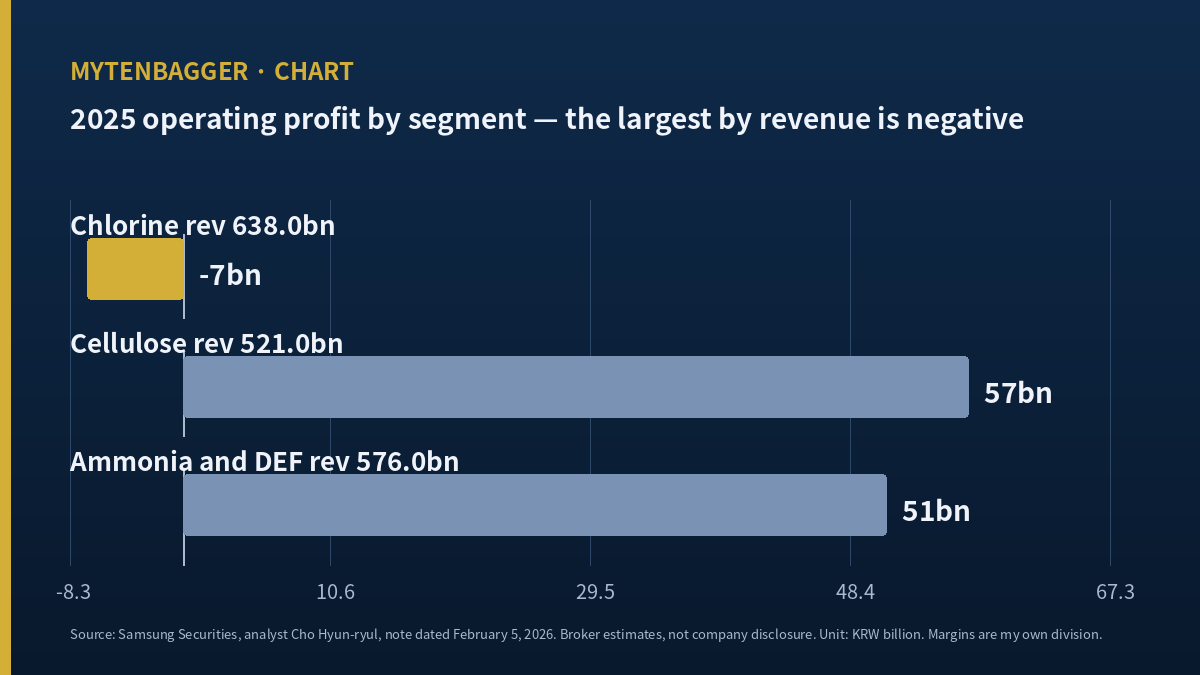
Lotte Fine Chemical stock is one listing wrapped around three businesses. The company trades on the KOSPI, the main board of the Korea Exchange. One of the three sells caustic soda and epichlorohydrin. One sells cellulose ethers into construction sites and pharmaceutical capsules. One trades ammonia and diesel exhaust fluid. Measured by revenue they are close to equal thirds. Measured by operating profit in 2025, the biggest of the three is estimated to have earned less than nothing, and I spent the morning trying to work out what that means for the whole. I priced another company in the same group twice and got two answers in Lotte Chemical stock.
The three businesses, as one broker estimated them for fiscal 2025
| Business | Revenue | Operating profit | Margin |
|---|---|---|---|
| Chlorine (caustic soda, ECH) | KRW 638.0bn | KRW -7.0bn | -1.10% |
| Cellulose derivatives | KRW 521.0bn | KRW 57.0bn | 10.94% |
| Ammonia and DEF | KRW 576.0bn | KRW 51.0bn | 8.85% |
Samsung Securities, analyst Cho Hyun-ryul, note dated Thursday, February 5, 2026. Margins are my own division. These are broker estimates. Company disclosure they are not, and that distinction matters more than usual here.
Contents
What Lotte Fine Chemical stock costs against what the company owns
The share closed at KRW 44,150 on Friday, August 21, 2026, which works out to roughly USD 31.84 at about KRW 1,386.5 to the dollar on the same day. With 25,800,680 shares outstanding that is a market value near KRW 1.1391 trillion, or about USD 821.6 million. Consolidated equity at the end of June 2026 stood at KRW 2,536.8 billion, so the market is paying about 44.9 percent of stated book value for the whole enterprise, by my calculation.
The balance sheet is unusually clean for a chemical producer. Total liabilities at the end of June were KRW 281.2 billion against that equity base, a ratio of 11.08 percent. For scale, the same company carried 18.12 percent at the end of 2022 and has walked it down every year since. There is essentially no leverage story to argue about here, and that absence turns out to be part of why the returns look the way they do.
At roughly USD 822 million of market value it sits well outside the largest Korean listings, so I keep it as an observation and write down what I checked.
Lotte Fine Chemical stock rests on a half year that passed all of 2025
The company filed its half-year report on Friday, August 14, 2026 with Korea’s Financial Supervisory Service. Consolidated revenue for the six months came to KRW 1,096.9 billion, operating profit KRW 94.6 billion and net profit KRW 138.9 billion.
| Fiscal year | Revenue | Operating profit | Net profit | Operating margin |
|---|---|---|---|---|
| 2022 | 2,463.8 | 404.3 | 146.2 | 16.41% |
| 2023 | 1,768.6 | 154.8 | 182.0 | 8.75% |
| 2024 | 1,670.5 | 50.4 | 36.4 | 3.02% |
| 2025 | 1,752.7 | 74.4 | 106.1 | 4.24% |
| First half 2026 | 1,096.9 | 94.6 | 138.9 | 8.62% |
Billions of Korean won, consolidated, from filings with Korea’s Financial Supervisory Service (receipt numbers 20230314001159, 20240329003375, 20250327000664, 20260311004005 and 20260814002262). Operating margins are my own division.
Six months of operating profit came to 1.27 times the full twelve months of 2025, and six months of net profit came to 1.31 times, both by my calculation. Split into quarters, operating profit ran KRW 32.7 billion in the first quarter and KRW 61.9 billion in the second, which lifts the quarterly operating margin from 6.40 percent to 10.56 percent. The company reported on Thursday, July 30, 2026 that second-quarter revenue rose 38.1 percent and operating profit 611.5 percent against the same quarter a year earlier, and credited the improvement to recovering international prices for its main products, the ramp of an expanded food and pharmaceutical grade cellulose line, and higher volumes of TMAC, a raw material for semiconductor photoresist developer. I declined to double a half-year for the same reason in Kumho Petrochemical stock.
One global producer splits the two businesses Lotte Fine Chemical stock bundles
The question I could not answer from Korean filings was simple: what margin does each of these two businesses earn when it is run at global scale by someone who reports it on its own line? So I went looking for a company that carries both a chlor-alkali business and a cellulose derivatives business and discloses them as separate segments. Exactly one turned up.
| Company and segment | Fiscal year ended | Revenue | Operating profit | Margin |
|---|---|---|---|---|
| Shin-Etsu, Infrastructure Materials (PVC, caustic soda) | March 31, 2026 | JPY 981,370m | JPY 164,890m | 16.80% |
| Shin-Etsu, Functional Materials (includes cellulose derivatives) | March 31, 2026 | JPY 440,847m | JPY 100,955m | 22.90% |
| Olin, Chlor Alkali Products and Vinyls | December 31, 2025 | USD 3,684.4m | USD 256.1m | 6.95% |
| Olin, Epoxy (the downstream that consumes ECH) | December 31, 2025 | USD 1,371.8m | USD -103.5m | -7.54% |
| Westlake, whole company | December 31, 2025 | USD 11,170m | USD -1,578m | -14.13% |
Each figure comes from the company’s own results release for the fiscal year shown. Margins are my own division. The fiscal years end in different months, which I take up further down. Ashland, the closest pure comparison on the cellulose side, is missing from this table on purpose, for a reason I give below.
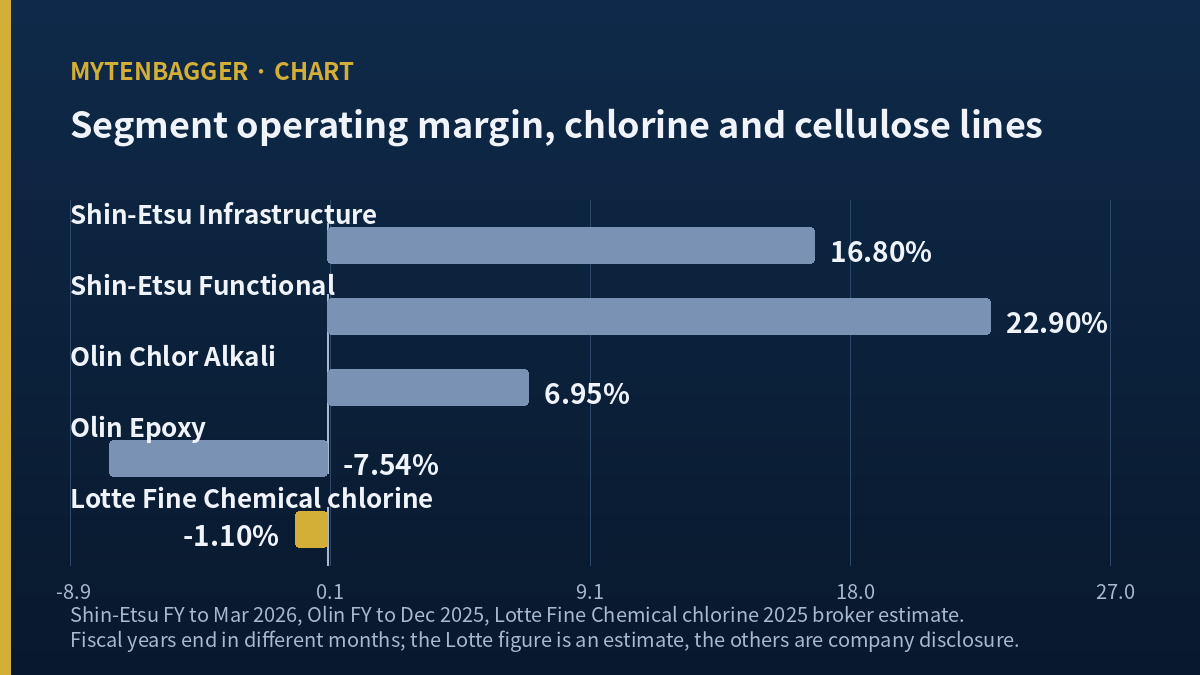
The spread inside Shin-Etsu is the number I came for. The same corporate group, the same reporting period, the same accounting: chlor-alkali and PVC returned 16.80 percent while functional materials including cellulose derivatives returned 22.90 percent, both by my calculation from the company’s segment table. Cellulose earns more than chlorine even in the hands of an operator who is excellent at both. Olin, which runs chlor-alkali at large scale in the United States without a cellulose business, earned 6.95 percent in that segment and lost money in epoxy, the downstream that consumes ECH.
So the Korean company’s profile is not an accident of one bad year. The business with the biggest revenue line is structurally the lower-margin one, everywhere I could check. What varies between operators is how thin. Shin-Etsu made 16.80 percent of it; Olin made 6.95 percent; the Samsung Securities estimate has Lotte Fine Chemical at negative 1.10 percent in 2025. That is a wide field, and it tells me the Korean loss sits somewhere on a spectrum, which is a different thing from a category error. Another Korean name carries the same shape one industry over: at KCC Corporation stock, silicones are 49 percent of revenue and the two producers ranked above it both post net losses.
Why Ashland is not in that table
Ashland is the obvious American comparison for the cellulose side, and I pulled its fiscal 2025 results, which cover the twelve months ended September 30, 2025. Revenue was USD 1.824 billion and adjusted EBITDA was USD 401 million, a margin the company states as 22 percent. What I could not get was an operating profit figure clean enough to put in the same column as the others, because the consolidated result for that year carried a large non-cash impairment. Adjusted EBITDA and operating profit are different measures, and dropping one into a column headed by the other would have made the table look more complete than my information actually was. So Ashland stays in this paragraph and out of the table.
What the demand side looks like for each of the three
Cellulose ethers face a construction market that is contracting
Methylcellulose goes into tile adhesive, mortar and render, so the building cycle is the demand. China’s National Bureau of Statistics reported property development investment down 18.0 percent year on year in the first half of 2026, with new construction floor area down 23.4 percent. Pricing follows: ChemAnalyst has Chinese cellulose ether at USD 3,966.33 per tonne in the first quarter of 2026, down 5.7 percent from the prior quarter, recovering to USD 4,174 in the second quarter, and puts the weakness down to high port and producer inventories against continuous production. The pharmaceutical grade is a separate and better story, but it is the smaller half of that business.
Epichlorohydrin pricing is reported two different ways
Two price assessors disagree about the same quarter. Procurement Resource puts Chinese ECH at USD 1,550.87 per tonne FOB in June 2026, down 19.6 percent from April, and describes improved supply availability with cautious downstream buying. ChemAnalyst has Japanese ECH averaging USD 2,730 per tonne in the second quarter of 2026, up 13.278 percent from the prior quarter, with Korea up 5.35 percent. The levels differ by more than the direction does. I am recording both and building nothing on either, which is why the demand section here is shorter than it would be if I trusted one of them.
The ammonia story lost its policy support in Korea
Part of the bull case for the ammonia business has been Korea’s clean hydrogen power auction, where imported ammonia would be co-fired in coal plants. That case narrowed in 2026. Korean trade press reported the 2026 clean hydrogen auction volume at 500 GWh against 3,000 GWh the year before, with coal and ammonia co-firing excluded from eligibility, and separately reported a government intention to restrict bidding to domestically produced hydrogen. An importer and distributor of ammonia is on the wrong side of all three of those changes. The company continues to supply green ammonia as marine fuel, with about 3,000 tonnes planned for 2026 by its own account, which is real but small against a KRW 576 billion revenue line.
A prosecutors’ raid landed in August on the products in the loss-making segment
On Wednesday, August 5, 2026, the Seoul Central District Prosecutors’ Office raided seven Korean petrochemical companies over alleged price fixing across eight products including PVC, plasticizers, caustic soda and hydrochloric acid. Two Korean outlets, the Korea Economic Daily and Newspim, both named this company among the seven on the day, and both described the case as a referral from the Korea Fair Trade Commission following a May inspection.
I do not know the outcome and I am not putting a number on it. What I will say is that caustic soda and hydrochloric acid are products of the chlorine segment, which is the same segment carrying the estimated 2025 loss and the largest revenue line. Anyone asking why the shares fell 37.99 percent from a closing high of KRW 71,200 on Wednesday, April 29, 2026 to KRW 44,150 on Friday, August 21 while the reported numbers improved has to put that date on the page.
The other thing the company did in the same window was announce capital spending. On Thursday, July 30, 2026 it said it would invest KRW 13 billion to lift TMAC capacity from 55,000 to 64,000 tonnes a year, a 16.36 percent increase by my calculation, due for completion in the second quarter of 2028. Three Korean outlets carried identical figures. No separate facility investment filing accompanied it, and in the whole ninety days to August 22 there was no single supply contract filing, no treasury share action, no dividend resolution and no large holding report.
Five brokers on Lotte Fine Chemical stock, and a 1.67 times spread
Five named Korean brokers published on this company in 2026. iM Securities kept KRW 62,000 on Wednesday, January 7 with a 2026 operating profit estimate of KRW 128.0 billion. Samsung Securities stayed at KRW 60,000 on Thursday, February 5 with KRW 116.0 billion. Shinhan Investment’s Lee Jin-myung put KRW 100,000 on Wednesday, April 29 looking for KRW 147.5 billion. IBK Investment’s Lee Dong-wook lifted to KRW 86,000 from KRW 63,000 the same day. KB Securities’ Jeon Woo-je lifted to KRW 67,000 from KRW 56,000 on Thursday, May 21.
Lowest to highest is 1.6667 times, by my calculation, and every one of the five sits above the August 21 close of KRW 44,150. The two highest were written when the shares were at KRW 64,500 on Tuesday, April 28, and I found no updated note from August. Meanwhile the January and February full-year operating profit estimates have already been overtaken by reported results: first-half operating profit of KRW 94.6 billion is 73.88 percent of the iM figure and 81.53 percent of the Samsung figure, both by my calculation, delivered in six months.
Consensus differs by vendor too. WiseReport showed an average of KRW 64,167 across six contributing houses as of Thursday, August 20, 2026; Korea Economic Daily’s market page showed KRW 62,200 as of Friday, August 21. Their 2026 earnings per share estimates differ as well, at KRW 8,050 and KRW 6,106. I have not picked between them.
How Lotte Fine Chemical stock did against its market and its industry
Over the 244 trading days from Thursday, August 21, 2025 to Friday, August 21, 2026, the shares returned 6.64 percent. The KOSPI returned 120.04 percent over the same window. The Korean chemicals group, equal-weighted across 113 names with this one excluded, returned 0.20 percent. So the shares trailed the market by 113.39 percentage points and beat their own industry by 6.44 points, and those two decompose cleanly: negative 119.83 plus 6.44 gives negative 113.39, with 94.9 percent of the shortfall coming from the industry.
Inside that industry the median name returned negative 9.28 percent and this one ranked 31st of 113, in the top 27.4 percent, ahead of 82 peers. Its beta to the market was 0.289 with a correlation of 0.341, so it was never going to travel with a market that more than doubled. Over the last 20 trading days it separated from its own industry as well, at negative 5.66 percent against the group’s positive 0.10 percent.
Where Lotte Fine Chemical stock sits, and what I could not confirm
The shares trade on the KOSPI under 004000. That is the only line for this company: I searched for an over-the-counter quote elsewhere and found none, which is not the same as proving none exists, and I want that distinction written down.
The corporate structure is worth naming for the same reason. The parent, Lotte Chemical, is itself listed on the KOSPI and consolidates this company, so anyone reading the parent’s numbers is already reading these three businesses inside a much larger and more cyclical set.
Those published lists are partial and the full holdings sit behind vendor access I do not have, so I can confirm it is absent from the largest positions, which is the whole of what I know.
Ten things that would make the reading above wrong
- The Korean segment line is an estimate and the peer lines are audited disclosure. Shin-Etsu, Olin and Westlake published their segment numbers themselves. The three Korean segment rows come from one broker’s model, and the sum of that model’s segment operating profit, KRW 101.0 billion, misses the audited consolidated figure of KRW 74.4 billion by KRW 26.6 billion. I put estimates and audited figures near each other on the same page, and the reader should hold them at different weights.
- A second Korean broker splits the segments differently. IBK Investment’s Lee Dong-wook estimated 2025 chlorine revenue at KRW 577.0 billion in a note dated Friday, July 31, 2025; Samsung Securities has KRW 638.0 billion. That is a KRW 61.0 billion gap in what counts as the same segment, and I could not establish which definition matches company reporting.
- The fiscal years in the peer table end in three different months. Shin-Etsu closes at the end of March, Olin and Westlake at the end of December, and the Korean estimate covers January to December. Chemical margins move fast enough that a three-month offset is not nothing.
- The August 5 case has no outcome yet. Its subject products are the ones inside the segment carrying the estimated loss.
- Two price assessors disagree on epichlorohydrin by direction and by level. If the higher set is right, the chlorine segment recovered faster in 2026 than the estimate table would suggest.
- Ashland’s absence weakens the cellulose comparison. Shin-Etsu’s functional materials segment holds more than cellulose derivatives, so 22.90 percent works as a proxy without being a clean read on the product itself.
- Market capitalizations across the peers were captured on different dates. I have not used them in any comparison for exactly that reason, and I mention it because leaving them out was a choice.
- The industry comparison flatters this company. Beating an equal-weighted group that returned 0.20 percent while the national index returned 120.04 percent is a fact, and it is also the kind of fact that reads better than it lives.
- Share count differs between my sources. The market data feed carries 25,800,680 shares; three broker and corporate information sources carry 25,800,000. The per-share effect is around 0.003 percent, but the dividend arithmetic supports the second number and the market-value arithmetic supports the first.
- I have been reading one number backwards. A debt-to-equity ratio of 11.08 percent registers to me as pure safety, and when I opened this name it registered that way again. Working through the returns this morning, it landed that the same thin borrowing is part of what holds return on equity down: a company that does not use debt accumulates equity, and the same profit divided by a larger base gives a smaller percentage. I knew both halves separately and had never put them on one company at once.
Where I stand on Lotte Fine Chemical stock and what would move me
The reason I am only watching is not that the multiple looks expensive, because it does not. It is that the largest of the three businesses inside this company is the one I understand least well and trust least, and the only segment-level numbers I have for it are a broker’s model that misses the audited total by KRW 26.6 billion.
Here is the number that would settle it for me. When the third quarter figures arrive after Monday, November 16, 2026, I am looking at one line: quarterly operating profit. If it comes in below KRW 32.7 billion, which is what the first quarter of 2026 delivered, then the cycle produced the first half, the company did not, and everything I wrote about the second half above is void. If it comes in above KRW 61.9 billion, the second quarter figure, then the chlorine segment has stopped being a drag and the three-way split I built this piece on needs rebuilding from a different starting point. Between those two, I wait for the fourth quarter.
Prices and multiples here reflect the Friday, August 21, 2026 close as I checked them while writing, so live quotes will have moved. Korean won is the reference currency throughout and the two dollar figures use roughly KRW 1,386.5 to the dollar on that same date, which is an approximation carried for the reader’s convenience. Financial statements come from filings with Korea’s Financial Supervisory Service; anything I describe as my own calculation was derived by dividing or multiplying those source figures myself.
Sources I used: Olin fiscal 2025 results · Shin-Etsu Chemical results for the year ended March 31, 2026 · Westlake fiscal 2025 results · Ashland fiscal 2025 results · Korea Economic Daily on the August raid · Newspim on the same case · Ajunews on second-quarter results · ChemAnalyst cellulose ether pricing · Procurement Resource epichlorohydrin pricing · China property investment data for the first half of 2026 · WiseReport consensus page. A companion piece in Korean covers the same company from the multiples side.
- Hyosung TNC Valuation Against Eight Spandex and Fiber Peers
- Kyobo Securities Earnings: Brokerage Gains, Derivative Losses