Korean Component Maker KMW: Sales Halved, Interest Bill Did Not
KMW stock closed at KRW 15,010 on Friday, August 21, 2026, on the KOSDAQ, the smaller of South Korea’s two main boards and the one where most Korean component makers list. I did not start with the price. I started with a line most people read last, and I read it across four annual reports instead of one.
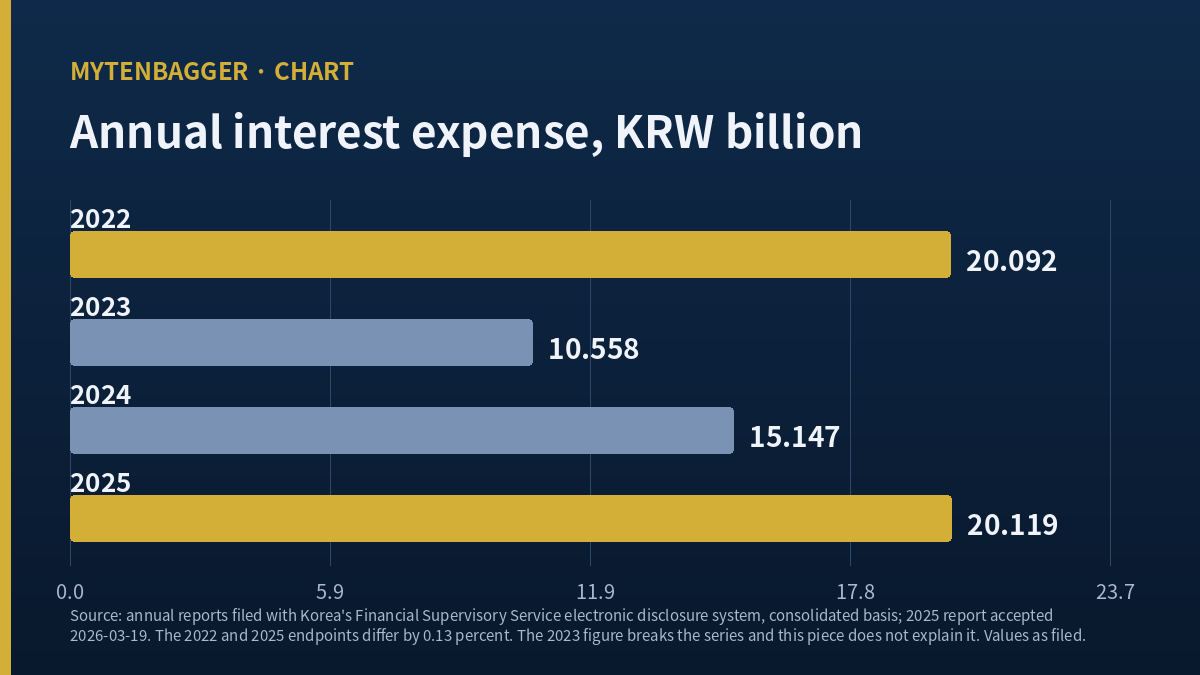
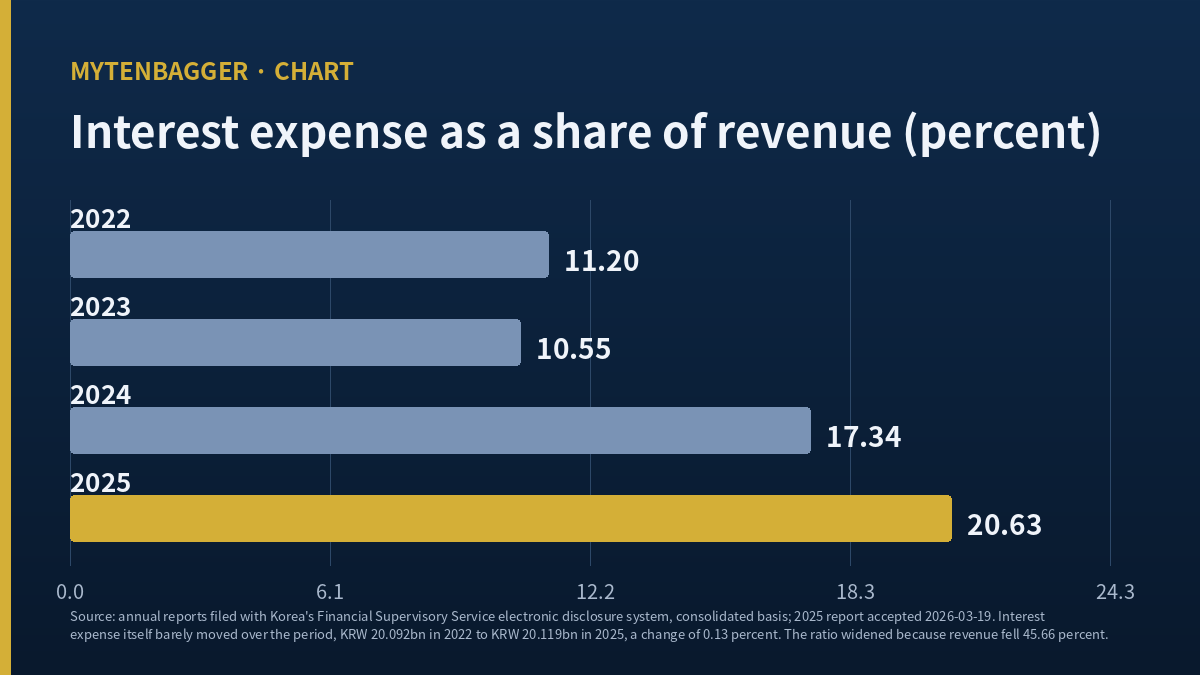
In 2022 this company paid KRW 20.092 billion in interest. In 2025 it paid KRW 20.119 billion. Over three years the number moved by 0.13 percent. In the same three years its revenue fell 45.66 percent. Everything else on the income statement moved, some of it a great deal. The interest line stood still.
What moved and what did not, 2022 to 2025
Moved: revenue, down 45.66 percent. Operating margin, which went far deeper into loss and then narrowed again, ending the period close to where it started. The share count, upward.
Did not move: annual interest expense, KRW 20.092 billion to KRW 20.119 billion, a change of 0.13 percent.
Consequence: interest as a share of revenue went from 11.20 percent to 20.63 percent, all of it arithmetic on the denominator.
Source: annual reports filed with Korea’s Financial Supervisory Service electronic disclosure system, consolidated basis. The 2025 report was accepted on Thursday, March 19, 2026 under receipt number 20260319000852. Percentage changes are mine, calculated from the filed figures.
Contents
Why KMW stock made me open four filings instead of one
I look at a lot of loss-making Korean small caps and I read them in a fixed order. Revenue first, then operating profit, then cash flow, and the interest line last, as a footnote to the balance sheet. That order works when a company’s debt and its business move together. It fails badly when the two come apart, and the only way to notice that it has failed is to read the same line across several years instead of one.
Here is what the four years look like when I put the two lines side by side.
| Fiscal year | Interest expense (KRW bn) | Interest as share of revenue |
|---|---|---|
| 2022 | 20.092 | 11.20% |
| 2023 | 10.558 | 10.55% |
| 2024 | 15.147 | 17.34% |
| 2025 | 20.119 | 20.63% |
| Four-year total | 65.916 | — |
Consolidated, from the annual filings named above. The share-of-revenue column is my own division of the filed interest figure by the filed revenue figure for the same year.
The 2023 dip is the part I cannot explain
The series is not a flat line. It halves in 2023 and then climbs back over two years. I have no explanation for the 2023 figure that I can source, and I am not going to invent one. What I can say is that the endpoints are three years apart and almost identical, and that the revenue underneath them is not.
One field I refused to use
The quarterly interest figures in my data source do not read consistently as either cumulative or discrete. The third-quarter 2025 cumulative value is smaller than the second-quarter cumulative value and larger than the full-year value, which cannot all be true at once. So this entire piece uses annual figures only. A ratio built on a field whose definition I cannot pin down is not evidence, and I would rather have four data points I trust than sixteen I do not.
What KMW stock is attached to
KMW makes the inside of a wireless base station: massive MIMO radio units, miniature filters, antennas, RF components and repeaters. It sits one step below the companies whose names appear on the tower, supplying parts into finished systems built by Samsung Electronics and China’s ZTE. Ericsson is discussed in Korean press as a possible future customer, which is not the same as a current one, and I have written it here as the former. The largest shareholder group, chairman Kim Duk-yong and one related party, holds 30.43 percent; foreign ownership is 6.33 percent (WiseReport, as of Friday, August 21, 2026).
KOSDAQ, where it trades, is South Korea’s secondary board. It is not a foreign-listed venue: there is no American depositary receipt for this company, and a US-based investor reaches it through a broker with direct Korean market access or not at all. There is a second barrier here that I do not usually have to mention. The only two research houses publishing on this name write in Korean, and one of them I could reach only through an aggregator. An English-reading investor cannot read the disagreement between them, let alone weigh it.
Which margins in this chain could carry a 20.63 percent interest bill
Here is the question I built the peer table around. Interest at 20.63 percent of revenue is a fixed charge sitting on top of everything else. If a company in this industry earned a normal operating margin, could that margin cover a charge of that size and still leave the company at break-even? I split the radio-access chain into the two tiers it actually has and checked.
Tier one, companies that sell the finished radio system.
| Company | Year end | FY2025 operating margin | Covers 20.63%? |
|---|---|---|---|
| Ericsson | December | 16.3% | No |
| Nokia | December | 4.4% reported | No |
| ZTE | December | 4.48% | No |
Tier two, companies that sell parts and subsystems into that system.
| Company | Year end | FY2025 operating margin | Covers 20.63%? |
|---|---|---|---|
| Amphenol | December | 25.4% | Yes |
| RFHIC (KOSDAQ) | December | 16.62% | No |
| Corning | December | 14.6% GAAP | No |
| Qorvo | March | 11.2% | No |
| Vistance Networks | December | 2.5% | No |
| Ace Technologies (KOSDAQ) | December | minus 12.42% | No |
| Airgain | December | minus 16.4% | No |
Sources: Ericsson full-year 2025 release; Nokia Q4 and full-year 2025 report; ZTE 2025 results release; Amphenol full-year 2025 release; Qorvo fiscal 2026 fourth-quarter results; Vistance Networks full-year 2025 release; Airgain full-year 2025 release. Korean peer figures are from annual reports filed with Korea’s Financial Supervisory Service, receipt numbers 20260323001723 and 20260331004907. Margins marked as calculations are operating profit divided by revenue for the same period, done by me.
One of ten clears it
Amphenol, at 25.4 percent, is the only company in either tier whose FY2025 operating margin is wider than the interest bill this Korean company carries as a share of its own sales. The second-widest, RFHIC at 16.62 percent, is four percentage points short. And RFHIC matters more than the rest, because it is a Korean KOSDAQ maker of RF components for the same base stations, filing under the same accounting regime in the same currency. It is the closest thing this company has to a like-for-like comparison, and it earned a positive margin in 2025.
Four things wrong with this table
Qorvo’s fiscal year ends in March, so its FY2026 figure covers April 2025 through March 2026 and is not the same twelve months as everyone else. Ericsson’s 16.3 percent includes a SEK 7.6 billion capital gain from the iconectiv divestment; excluding it the margin is closer to 13.1 percent by my calculation, which does not change the answer in the last column. Vistance Networks is the former CommScope, and its FY2025 continuing operations no longer contain the base-station antenna business, which Amphenol bought in February 2025 and which is therefore inside Amphenol’s number. And Corning is optical fiber and glass, adjacent to this chain but not a filter or antenna maker. I kept it because it sets a reference point for what a large, capital-heavy component supplier earns.
What this exercise showed me about my own reading order
The interest line. I have always treated it as something the balance sheet explains, so I look at it after everything else and usually only to confirm what I already decided. Building this table forced me to put it first, and putting it first changed which peer mattered. Read revenue-first, the peer that stands out is Amphenol, because it is enormous and profitable. Read interest-first, the peer that stands out is RFHIC, because it is the one company in the table that does exactly this and does it at a positive margin. I had the RFHIC figure in front of me for an hour before I understood why it belonged at the center.
Where the debt behind KMW stock has been going
An interest bill that stays flat while revenue halves usually means the borrowings behind it are not shrinking. In April 2026 four disclosures came out in a two-week span that show what the company has been doing with one part of that stack.
Borrowings that stay put have a mirror image: borrowings that were raised to build something. Shinsung Delta Tech financed its plants that way, and the interest line reads differently when the money went into capacity rather than into holding a shrinking business up — I worked through it in my entry on Shinsung Delta Tech building its plants on borrowed cash.
- On Wednesday, April 8, 2026 the company bought back KRW 9 billion of its tenth overseas convertible bond before maturity, in an off-market purchase funded from its own cash. The conversion price on that bond was KRW 13,577, and the outstanding balance fell from KRW 10.2 billion to KRW 1.2 billion (Lead Economy, Korean-language report).
- On Thursday, April 9, 2026, one day later, it sold that same KRW 9 billion of paper on to IBK Investment Securities for KRW 15.8 billion, booking a KRW 6.8 billion gain. Korean press put the potential share supply back into the market at 662,885 shares (Money Today).
- On Friday, April 10, 2026 the company disclosed conversion requests on KRW 8 billion of convertible paper (Jaekyung Ilbo).
- On Wednesday, April 22, 2026 it filed for the additional listing of privately placed convertible bonds. By Friday, April 24, 2026 the shares closed at KRW 29,550 and Korean coverage was writing about overhang (Jaekyung Ilbo).
I want to be precise about what those four items do and do not tell me. They tell me convertible paper is actively moving. They do not tell me the total outstanding convertible balance, which I could not establish, and they do not tell me whether a KRW 30 billion put option said to fall due in July 2026 was exercised. That second gap sits directly under the worst two months this stock has had, and I could not close it.
What the inventory did while this was going on
One more balance-sheet number moved in a direction I did not expect. Inventory stood at KRW 25.905 billion on Tuesday, June 30, 2026, which is 26.56 percent of the whole of 2025 revenue by my calculation. Measured against the single quarter’s own sales it works out to 96.9 days, up from 78.5 days a year earlier. For a components business that is a lot of finished and unfinished product sitting still, and it moves in the opposite direction from a company whose orders are about to arrive. I note it here because it is the one operating figure that argues against the recovery timetable the bull case rests on, and it comes from the same semi-annual filing as everything else on this page.
A company funding itself this way is not unusual in this part of the Korean market. What is worth noticing is where the money comes from. In the Taihan Cable piece I wrote about shareholders funding the backlog, the cash arrived through rights issues and the amount was visible and enormous. Here nothing arrives at all: paper that was already outstanding changes its legal form. And in the SKC piece measuring a raise against three years of cash burn, the comparison worked because both halves were disclosed. Neither of those methods works on this company, because I cannot see the total.
What the two Korean brokers say about KMW stock
Two houses publish on this name. Hana Securities analyst Kim Hong-sik raised his valuation by 40 percent on Tuesday, May 19, 2026 and held it in a telecom weekly dated Friday, August 14, 2026, on a buy rating (Newspim report briefing). Leading Investment Securities carries a neutral rating at a much lower level, according to the WiseReport consensus screen as of Friday, August 21, 2026. The two figures are 4.12 times apart. I could not open the Leading Investment note itself, and I do not have its analyst name or publication date, which is a real weakness in that half of the comparison.
The bull case has specific content. Hana’s Tuesday, May 19, 2026 upgrade rested on the US Federal Communications Commission’s AWS-3 spectrum auction that opened on Tuesday, June 2, 2026, on tightening restrictions against Chinese network equipment in the US and Europe, and on Samsung Electronics winning Verizon 5G supply in 2027. The same house then wrote on Friday, August 14, 2026 that the auction that would actually move this company’s revenue, the upper C-band 160 MHz sale, now looks likely to happen in April 2027. On the day the AWS-3 auction opened, Shinhan Investment described its effect as a possibility and stopped short of calling it certain and BNP Paribas said it was not an event large enough to change the industry (Money Today, Tuesday, June 2, 2026).
The part that matters most to me is the timing. Hana’s published 2026 estimate, KRW 176 billion of revenue and KRW 13 billion of operating profit, is dated Tuesday, April 14, 2026. First-half 2026 revenue came in at KRW 45.807 billion. Reaching the full-year estimate would require KRW 130.193 billion in the second half, which is 2.84 times the first half by my calculation. I could not find a single updated annual estimate published after the second-quarter figures landed.
Six reasons my reading of KMW stock could be wrong
- The one that bothers me most. A flat interest line does not by itself prove the debt stack is unchanged. Interest expense is a product of principal and rate, and I have not separated them. If average borrowing costs fell while principal rose, or the reverse, the number can hold steady for reasons that mean very different things. I could not obtain the maturity and rate detail that would settle it.
- The 2023 figure breaks the series. A number that halves and then doubles back over two years may be a reclassification, a capitalization of interest into an asset, or a one-off reversal. Any of those would make my endpoint-to-endpoint comparison less clean than it looks.
- Debt is genuinely coming down. The reported debt-to-equity ratio improved substantially through the first half of 2026, and a company converting bonds to shares removes both the principal and the coupon behind it. The interest line I am pointing at may already be falling as I write.
- The operating margin improved for three straight years, narrowing by 38.45 percentage points between the worst year and 2025 by my calculation. Whatever the interest line did, the operating business got substantially less bad over that stretch.
- The peer table compares companies whose business mixes are not alike. Amphenol earns most of its revenue outside radio access entirely, in data-center and automotive connectors, and its 2025 figure includes eleven months of a base-station antenna business it did not own the year before. A share of the margin gap in that table comes from portfolio construction and acquisition accounting, with industry conditions doing less of the work than the table implies.
- The regulatory tailwind is real and it is aimed in this company’s favor. The US is refusing equipment authorisation to products containing Chinese components, and this company has a history of supplying radio units on an original-equipment basis (Newspim, Tuesday, June 2, 2026). A delayed auction still arrives.
My position on KMW stock, and the line that ends this piece
At roughly KRW 633 billion of market value this sits well outside the Korean names I take a stance on, so it is a watch item, and this look did not move it toward the other column. What I found was not a company in distress. It is a company whose operating losses have been narrowing for three years while one fixed charge has quietly doubled in weight against its own shrinking revenue.
What ends this piece is not a revenue number and not an auction date. It is whether the interest line itself moves. The third-quarter 2026 report has a statutory deadline of November 15, 2026, which falls on a Sunday, so the filing lands on Monday, November 16, 2026 or later. If the annual interest run-rate implied in that filing has finally broken below the KRW 20 billion it has sat at for three years, the sentence this whole piece is built on stops being true and I will say so. And if it has not moved again, then the question shifts to a harder one that I have not been able to answer here: what exactly is the principal underneath it, and who holds it.
Prices and multiples reflect the Friday, August 21, 2026 close of KRW 15,010 as checked at the time of writing. Financial figures come from consolidated annual and semi-annual reports filed with Korea’s Financial Supervisory Service. Korean won is the reference currency throughout; the market value cited above converts at roughly KRW 1,386.5 per US dollar, the Friday, August 21, 2026 Seoul close, giving approximately USD 457 million. That conversion is approximate and carries the same date basis as everything else here.
- Korea’s BHI Price to Book: Why 10.45x Rests on a Stale Book Value
- Korea’s PNT Inventory Turnover: One Balance, Four Answers