Korea Gas Earnings and a Receivable Four Times Its Market Value
When I look at Korea Gas stock, I find the receivable line before I read the income statement. When I opened Korea Gas Corporation’s first-half 2026 report that way, operating profit was up 28 percent, and the receivable was 462 billion won thicker than it had been three months earlier.
This is my trading journal on how those two numbers moved in opposite directions. Korea Gas Corporation (KOGAS, 036460) trades on the KOSPI, Korea’s main board, and its market value of roughly 3.29 trillion won (about 2.37 billion US dollars) sits near the edge of the exchange’s top 100, so in a personal journal I default to watching. The KOSPI is the senior of Korea’s two boards; the KOSDAQ is the smaller-cap venture board, and this name is a KOSPI large-cap by listing though a mid-cap by value. That distinction matters for a foreign reader because index-tracking access to Korea skews toward the KOSPI heavyweights, and a 3.29 trillion won utility sits below most of them.
Contents
What Korea Gas stock rests on: the first-half numbers
Start with what actually improved. First-half 2026 consolidated revenue was 19.31 trillion won (about 13.93 billion dollars), down 5.2 percent from 20.36 trillion a year earlier. Revenue fell, yet operating profit rose 28.0 percent, from 1.24 trillion won to 1.59 trillion won (about 1.14 billion dollars). In the second quarter alone, operating profit of 675 billion won was up 66.9 percent year on year. Net profit attributable to owners for the half was 888 billion won, roughly double the 452 billion of a year earlier. The debt-to-equity ratio fell to 345.3 percent at the end of June, well below the 423.2 percent of a year before.
All of that is genuinely better. But when revenue drops and profit climbs, I always stop and ask where the profit came from before I read it as a recovery.
| Consolidated | 1H 2026 | 1H 2025 | Change |
|---|---|---|---|
| Revenue (trillion won) | 19.31 | 20.36 | -5.2% |
| Operating profit (trillion won) | 1.59 | 1.24 | +28.0% |
| Net profit to owners (billion won) | 888 | 452 | ~2x |
| Debt-to-equity (period end) | 345.3% | 423.2% | -77.9pt |
Where the 28 percent in Korea Gas stock actually came from
Read the half-year results together with the company’s own commentary and the profit increase splits three ways. First, the LNG import price fell, cutting cost of sales by 1.41 trillion won (about 1.02 billion dollars) versus a year earlier. Second, overseas subsidiaries earned more. The Canada LNG business in particular swung from a 3.3 billion won loss in the year-earlier half to a 143 billion won operating profit this half. Third, resource-development blocks including Mozambique added to that on the back of oil prices. The overseas contribution is the part I trust least as a run-rate, because it swings with crude and with project-specific timing; the Canada block alone accounts for the entire year-on-year swing from a small loss to a 143 billion won profit, and a single block turning a corner is not the same as a durable earnings base.
None of those three is a domestic city-gas tariff increase. In fact, a residential supply-cost increase was rejected in May 2026. That is the heart of reading this stock: the profit recovery is the part that lower input costs handed back plus the part earned abroad, and there is no part that came from charging Korean households more. Profit built on falling input costs can reverse in the next quarter if fuel prices climb again. So I do not treat this profit as structurally locked in. I treat it as profit this half’s fuel prices and environment produced.
I split it into two scenarios. In one, LNG import prices stay low through the second half, cost savings continue, and combined with the overseas blocks the annual figure lands high. In the other, oil and the won-dollar rate climb again, import prices rebound, and much of this half’s gain flows back. KB Securities argued that “higher LNG prices are positive for the overseas blocks.” Set that beside the fact that the same price rise returns as domestic input cost, and the company does not move in one direction with oil.
Because a regulated tariff sets the direction of profit here, I keep this stock next to a piece where I split Korea Electric Power’s thesis into a tariff axis and a volume axis. One is power, one is gas, but the frame is the same: the government holds the price down.
In the same half, the receivable grew by 462 billion won
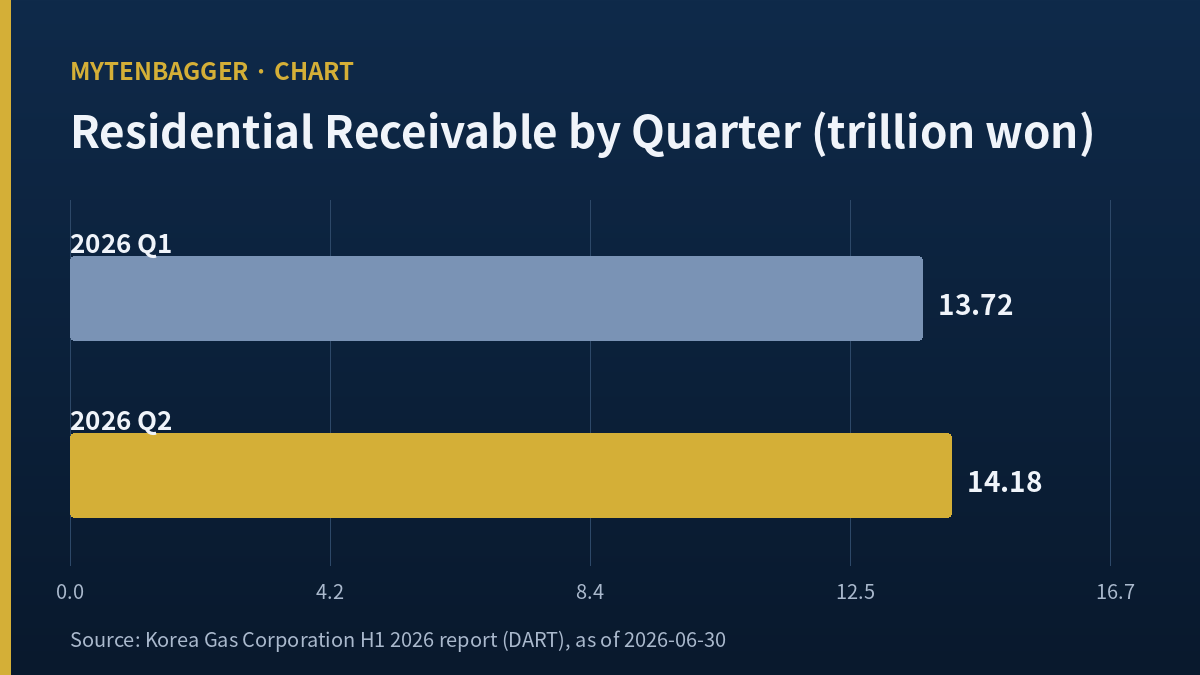
Now the other side. The residential receivable rose from 13.72 trillion won at the end of the first quarter to 14.18 trillion (about 10.23 billion dollars) at the end of the second, an increase of 462 billion won. This receivable is the pile of import costs the company has paid but has not yet recovered through tariffs. When the government does not let it raise the city-gas price to match cost, that gap stays on the balance sheet under the name “receivable.”
Here is the point I want to nail down. A receivable is money owed to the company, not cash in the account. Even when operating profit rises, the money the domestic segment did not recover through tariffs sits in the asset column and never becomes cash. So profit and cash diverge often at this company. First-half operating cash flow was a positive 4.24 trillion won, which is not weak, but that reflects inventory movements and fuel-cost settlement, while the receivable itself was not collected and instead grew.
One more figure ties it together. The 1.41 trillion won drop in cost of sales was the single largest push behind the profit gain, and even in that quarter of falling input prices the receivable still thickened by 462 billion won. Input costs fell while the amount owed rose, which means the tariff did not track costs down; the uncollected past sat where it was. Profit rose on the income statement and the receivable rose on the balance sheet, two ledgers inside one company moving the opposite way. I have written about profit and cash pulling apart before, in KEPCO KPS, which made money every quarter its cash did not. That case ran on customer concentration; this one runs on a suppressed tariff.
Why I anchor Korea Gas stock on book value
At the 21 August 2026 close of 35,650 won (about 25.71 dollars), the screen shows a trailing P/E of 24.74. I do not use it, for two reasons.
First, the screen EPS of 1,440.99 won behind that multiple is derived as “current price divided by P/E.” Put an EPS pulled backward out of the price back underneath that same price and divide, and the price sits above and below the same division. It is circular. Second, that 24.74 is effectively built on full-year 2025 net profit of 132 billion won, and 2025 contained a single loss quarter of 407 billion won in the fourth quarter. When I add the owners’ net profit of the last four quarters myself (Q3 2025 through Q2 2026), I get 568 billion won, and the trailing P/E on that is 5.8. I cannot fix the real multiple at one point between 24.74 and 5.8. So I set the earnings multiple aside.
I look at the asset side instead. Owners’ equity of 11.76 trillion won at the end of the second quarter, divided by 92,314,165 shares, gives book value per share around 127,000 won, and against the market value of 3.29 trillion won that is a price-to-book of 0.28. The screen figure of 0.30 is close. The stock trades at roughly a quarter of book. But that book value contains 14 trillion won of receivable whose collection timing is unclear, so I do not read book as recoverable value one-for-one. A low P/B is also the market saying it has already discounted that receivable and the regulatory risk.
| Metric (2026-08-21 close) | Value | How I read it |
|---|---|---|
| Price / market cap | $25.71 / $2.37B | reconciles to won cap |
| P/E (screen) | 24.74x | circular, excluded |
| P/B (owners’ equity) | 0.28x | my anchor |
| ROE (2025 consolidated) | 1.2% | low |
The recent price path of Korea Gas stock
The price track is worth setting down. The 21 August 2026 close of 35,650 won is 22 percent below the 250-day high of 45,700 won and 14.4 percent above the 250-day low of 31,150 won. From a 20 July low of 31,700 won the stock climbed gently for about a month, and the close sits above both its 20-day moving average of 35,295 won and its 60-day average of 34,235 won. The one-month return is a positive 4.65 percent, but the six-month is a negative 14.29 percent and the twelve-month a negative 12.83 percent. A short bounce and a longer slide sit side by side.
What the price says is that the market gave this half’s rebound only partial credit. Operating profit up 28 percent and a debt ratio down nearly 78 points, and yet the stock still trades 22 percent under its own 250-day high, reads as a market weighing the receivable and the tariff risk more heavily than the profit. I lean the same way. A utility that cannot set its own price is, from the market’s seat, an earnings stream with a policy switch in the middle of it, and switches like that get a discount until the direction is clear. For a US reader it helps to name the analog directly: the receivable is Korea Gas’s version of a regulated utility’s deferred-fuel-cost regulatory asset, except that here the deferral has been allowed to grow to a scale most US utilities never reach, because the tariff catch-up keeps being postponed.
A global peer where the fuel cost gets recovered
For a global reader, the sharpest comparison is a regulated gas utility whose structure does the opposite of KOGAS on this one point. Atmos Energy (NYSE: ATO), a US regulated natural-gas distributor, recovers its gas costs through a purchased-gas-adjustment mechanism, so it does not accumulate a large uncollected receivable the way KOGAS does. At the 21 August 2026 close of 166.85 dollars, Atmos carried a market cap of 28.20 billion dollars, a trailing P/E of 19.79 and a forward P/E of 18.67 on EPS of 8.43 dollars, with revenue of 4.92 billion dollars over the trailing twelve months and a 2.40 percent dividend yield. Its EPS reconciles exactly against price and multiple (166.85 divided by 19.79 is 8.43).
I do not build a full multiple table across the two, because the businesses differ in scale and structure. I hold the comparison to one axis: Atmos recovers fuel cost on a defined mechanism and trades near 20 times earnings with a healthy return on equity, while KOGAS sits at 0.28 times book with a 14.2 trillion won receivable stuck on the balance sheet because the tariff was held down. The recovery mechanism is the difference, and it is the whole reason the two carry such different valuations. It also explains the dividend gap: Atmos has raised its payout for years on cash it actually collects, while KOGAS cut its 2025 dividend even as reported profit recovered, because the profit that recovered was partly a receivable that has not turned into distributable cash.
The other side of the Korea Gas case
Writing only the bullish case turns a journal into an advertisement, so I set out the reasons I am still watching. The receivable of 14 trillion won is more than four times the market value of 3.29 trillion won, and when and along what tariff path it gets recovered rests with the government, not the company; the May 2026 rejection of a residential supply-cost increase shows that risk plainly. The dividend is the second reason: the 2025 payout of 1,154 won per share was down 20.7 percent from 1,455 a year earlier, a year in which the payout ratio fell even with a tax incentive in place. Rising profit did not translate into more cash returned to shareholders. Third is the won-dollar rate: a higher rate pressures separate-basis net profit through import costs and foreign-currency debt. Fourth, return on equity is 1.2 percent.
There is a specific trap I am guarding against here. A price at 0.28 times book looks like deep value, and for a company that recovered its costs on schedule it would be. But a low multiple on a book that is nearly half receivable is only cheap if that receivable converts to cash, and conversion depends on a tariff decision the company does not control. A discount to a distorted book is not automatically a margin of safety. That is why I treat the 0.28 as a description of what the market fears, not as a signal to buy.
Sell-side looks up while I keep watching Korea Gas stock
The forward view belongs here too. On 10 August 2026, KB Securities analyst Jung Hye-jung kept a BUY rating but cut the objective to 44,000 won (about 31.73 dollars) from 48,000, an 8.3 percent reduction. The note credited the 675 billion won second-quarter operating profit to strong overseas blocks while adding that “receivable collection will inevitably be delayed.” The average of Korean brokerage objectives is 48,727 won, above KB’s. Reports from May, including Eugene Investment at 59,000 won and a Hana Securities note, all predate the second-quarter results, so on freshness I weight the August KB figure first.
In short, named brokerages see 20 to 30 percent of upside above the 35,650 won close, and their case rests on overseas blocks and oil. That is not far from my own direction. What I have not yet confirmed is whether that upside clears the weight of a 14.2 trillion won receivable. The fact that even the sell-side flagged delayed collection supports my watching stance.
My stance and what would prove this piece wrong
I keep the stock as watch-only. Four things would tell me this read is wrong.
- From the third quarter of 2026 on, the residential receivable actually starts to fall on a quarterly basis, meaning tariff increases are on track.
- The third-quarter profit increase is shown in the notes to come from domestic tariff recovery, not from cost and overseas.
- The payout ratio rises again, so profit growth reaches shareholders as cash.
- Named brokerage coverage lays out a concrete schedule for receivable collection.
The first two of the four are settled by the third-quarter 2026 report. Its legal filing deadline is 15 November 2026, which falls on a Sunday, so it arrives after the 16th. Until then there is one more event I follow: the government’s fourth-quarter residential tariff decision. Whether the price rises to match cost or gets held down again sets the receivable’s next direction. On the day that decision lands, I reopen the receivable line of this journal, because that single number tells me whether the recovery is real cash or another year of deferral.
Sources and notes
Figures were checked against Korea Gas Corporation’s 2026 half-year report (DART) and: Ajunews, first-half results, 7 Aug 2026 (Korean press); Newspim, KB Securities report brief, 10 Aug 2026 (Korean sell-side); Newsquest, receivable and tariff analysis (Korean press); Korea Gas Corporation IR, first-half results; peer data from stockanalysis.com, Atmos Energy, 21 Aug 2026 close. Prices and market cap are as of the 21 August 2026 (Friday) close; the won-dollar rate of 1,386.5 used for dollar conversions is the 21 August close. P/B and the last-four-quarter profit are my own back-calculations. Korean-press figures are my paraphrase, not direct quotations.
- Soosan Industries Earnings: Higher Sales, Much Lower Margins
- Kumho Tire Stock Costs the Same as Goodyear: Valuation Compared
- KT Corp Q2 Earnings: Five Ways to Score One Korean Telco Quarter
- Kakao Pay Balance Sheet: Liabilities Tripled, Equity Barely Moved