Amorepacific ROE vs Global Beauty Peers: A 23-Point Gap
4.40. 4.71. 4.75. Those three numbers are returns on equity, and they belong to three companies on three continents: Amorepacific in Korea, Kose in Japan, and Estee Lauder in the United States. Amorepacific stock is the one I was researching. The other two showed up because a Korean brokerage told me, in a single clause, to go look at them.
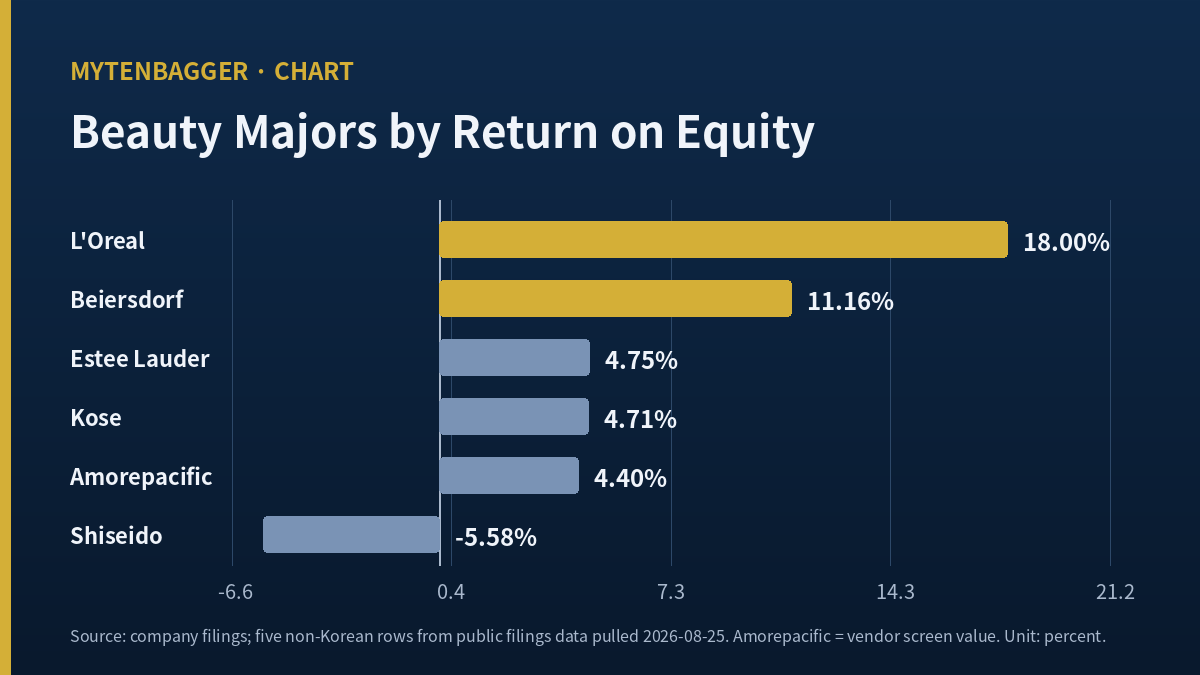
Return on equity, six beauty companies, most recent completed fiscal year
Upper tier · L’Oreal 18.00% · Beiersdorf 11.16%
Lower tier · Estee Lauder 4.75% · Kose 4.71% · Amorepacific 4.40%
Below the floor · Shiseido −5.58%
Top to bottom, the spread is 23.58 percentage points. That is the group a June 2026 note used to reset the multiple on this stock, and no one said which end of it they meant.

Contents
Three returns on equity that sit inside a third of a point
I make a point of writing down where a company sits before I write down what I think of it. The trouble with this one was that its position kept moving depending on which company I put beside it. Against L’Oreal it looked like a broken business. Against Shiseido it looked like a survivor. Against Kose it looked like a twin.
So I stopped choosing and put all of them in one table. What came out was not a ranking. It was a split. Two companies live in double digits, three companies live near four and a half percent, and one company is under water. The middle of that distribution is empty. There is no beauty major sitting at eight percent to hold the two halves together.
Why I care about the split and not the average
An average across those six comes to 6.24 percent, and it would describe none of them. When a research note says it is applying a multiple derived from global peers, the number it produces depends entirely on whether the writer was picturing the top half or the bottom half. I cannot audit that choice from the outside. What I can do is show that the choice exists and that it is worth 23.58 percentage points of return on equity.
What Amorepacific stock is, for a reader outside Korea
Amorepacific Corporation trades under the code 090430 on the KOSPI, which is the senior board of the Korea Exchange and the index most foreign allocations to Korea are benchmarked against. It is the operating company behind Sulwhasoo, Laneige, Innisfree, Hera, Etude and Espoir, and since 2024 it has consolidated COSRX, the skincare brand whose snail mucin essence became an Amazon staple in the United States.
At the Tuesday, August 25, 2026 close of KRW 143,300, the market value of the common shares works out to KRW 8.382 trillion, or roughly USD 6.06 billion. The trailing price-to-earnings ratio on the vendor screen I use is 41.98 and price-to-book is 1.81. Korean won is the base currency in this piece; the dollar figure is a convenience conversion at approximately KRW 1,382.4 per dollar, the Seoul interbank close for Monday, August 24, 2026.
One structural detail that surprises people
There is a separate class of preferred shares, 10,557,830 of them against 58,492,759 common shares as of the company’s own most recent published shareholder table. The market capitalization figure quoted above counts only the common line. I flag this because it matters for anyone reconstructing per-share figures from Korean screens, and I am deliberately not building this article on top of it.
The June note that reset the multiple to “global peers”
On Tuesday, June 23, 2026, Korean financial press reported that NH Investment & Securities had lowered its stated valuation on this name from KRW 180,000 to KRW 160,000, and that the stated reason was an adjustment of the applied multiple to 25 times to reflect valuations at global companies in the same business. The following day, Wednesday, June 24, 2026, Korea Investment & Securities was reported to have cut from KRW 180,000 to KRW 155,000, citing a very unfavorable flow-of-funds backdrop across the Korean cosmetics group.
Both of those figures belong to the brokerages that published them and neither is mine. I am reading them here as market information. What caught me was the wording of the first one. The company had not missed anything. The ruler had moved.
I am working from Korean secondary coverage
I did not obtain either original report. Everything I quote about their stated reasoning comes from Korean-language market coverage summarizing them, which means a journalist stood between the analyst and me. Where I paraphrase, I am paraphrasing that coverage and not the underlying document.
So I built the peer group myself
Five names, most recent completed fiscal year, no currency conversion. Converting them into one currency would suggest a comparability that does not exist, since three different fiscal calendars are involved.
| Company | FY end | Revenue | Net income | Net margin | ROE |
|---|---|---|---|---|---|
| L’Oreal (OR.PA) | 2025-12-31 (Wed) | EUR 44,052m | EUR 6,127m | 13.91% | 18.00% |
| Beiersdorf (BEI.DE) | 2025-12-31 (Wed) | EUR 9,852m | EUR 939m | 9.53% | 11.16% |
| Estee Lauder (EL) | 2026-06-30 (Tue) | USD 15,049m | USD 182m | 1.21% | 4.75% |
| Kose (4922.T) | 2025-12-31 (Wed) | JPY 330,193m | JPY 15,114m | 4.58% | 4.71% |
| Amorepacific (090430) | 2025-12-31 (Wed) | KRW 4,252,820m | KRW 247,316m | 5.82% | 4.40% |
| Shiseido (4911.T) | 2025-12-31 (Wed) | JPY 969,992m | JPY −40,680m | −4.19% | −5.58% |
The five non-Korean rows come from public filings data pulled on Tuesday, August 25, 2026. The Amorepacific revenue and net income lines are the consolidated 2025 figures from the Korean regulatory filing, receipt number 20260318000785. Every net margin cell is my own division of that row's net income by that row's revenue, so the column is internally consistent even where a provider publishes a slightly different figure. The 4.40 percent shown for Amorepacific is the vendor screen value; computing it from the filing against year-end total equity gives 4.49 percent instead. Both sit in the same cluster, and I use the more conservative screen number in the table.
The comparison I did not force
I did not put operating margin in this table. Shiseido’s 2025 operating result is positive while its bottom line is deeply negative because of an impairment charge, and lining that up against a Korean operating profit line without reading both sets of notes would produce a number that looks like a comparison and is not one. I also did not attempt a return-on-equity decomposition; I looked at another Korean cosmetics name where two measurement windows gave opposite answers recently enough that I know how quickly that kind of exercise turns into its own article.
Global peers
Global peers is a phrase I have used in my own notes. I have never once written down which companies I meant by it. When I finally made the list for this stock and put the numbers beside the names, the list did not hold together as a group. I do not think I have been lying to myself exactly, but I have been using a word that carried no contents, and I only found that out because someone else used it in a sentence that moved a price by 11 percent.
Amorepacific stock sits in the lower tier, and two non-Korean names sit there with it
This is the part I find genuinely interesting. The gap between Amorepacific at 4.40 percent and Estee Lauder at 4.75 percent is 35 basis points. The gap between Amorepacific and L’Oreal is 1,360 basis points. If the lower cluster were made up of Korean and Japanese companies while the upper one were European and American, the tidy story would be a geographic discount and I would have to argue about whether Korea deserves one.
It is not laid out that way. The lower cluster holds a Korean company, a Japanese company and an American one. The upper cluster holds a French company and a German one. Whatever is sorting these six, a passport is not doing it. What the three low names share is a form of business: large owned-brand portfolios built over decades, heavy department-store and duty-free legacies, and a slow, expensive pivot toward channels that did not exist when the brands were built.
That reframing matters for how I read the June cut. A discount applied to Amorepacific because Korean beauty is out of favor is a discount that can unwind when sentiment turns. A discount applied because legacy brand houses everywhere are earning four and a half percent on their equity is a different animal, and it does not care what Korean flows do.
The industry around it is growing much faster than the company is earning
Korea’s cosmetics exports reached USD 7.0 billion in the first half of 2026, up 27.3 percent on the prior year, with the United States taking USD 1.45 billion and crossing 20 percent of the total for the first time. July alone brought USD 1.35 billion, a ninth consecutive monthly increase. Those figures come from Korean regulatory and trade ministry collections. They cover the whole Korean industry and say nothing about this company on its own. Hold them beside a 4.40 percent return on equity at the country’s largest brand house and the picture gets uncomfortable. An export boom of that size is showing up somewhere in Korea, and at the moment more of it appears to be reaching contract manufacturers and small independent labels than the incumbent that spent thirty years building the department-store business. That is the sharpest argument I know against paying up for the incumbent today, and it is also the argument that would reverse fastest if the incumbent’s overseas margin keeps climbing. One of the exporters carrying those independent labels abroad is Silicon2, which I looked at separately.
Amorepacific stock’s margin does not travel with its return on equity
Look across the table one more time and the ordering breaks. On net margin, Amorepacific’s 5.82 percent is third of six, ahead of Kose at 4.58 percent and far ahead of Estee Lauder at 1.21 percent. On return on equity the same company is fifth of six. The two rankings disagree, which means something in the equity base is doing the work.
The filing gives a plain reading. Consolidated total equity at the end of 2025 was KRW 5,503,457 million against total liabilities of KRW 1,457,755 million, a debt-to-equity ratio of 26.49 percent. This is a company carrying an unusually light balance sheet for its size. That is a comfort in a downturn and a drag on the ratio investors quote most often, and I am content to leave the observation there instead of building it out.
Where the ownership line sits
Of the KRW 247,316 million in consolidated 2025 net income, KRW 235,682 million was attributable to owners of the parent, leaving 4.7 percent with minority holders. That is a small enough share that I am not adjusting anything for it. It is worth naming because I looked at a Korean contract manufacturer earlier this month where the same line took a quarter of the profit, and the checking has stayed with me since.
What Amorepacific stock’s own quarter looked like
The company published second-quarter results on Thursday, July 30, 2026: revenue of KRW 1,175.9 billion, operating profit of KRW 117.3 billion, net profit of KRW 93.4 billion. The company stated year-on-year changes of plus 17.0 percent, plus 59.3 percent and plus 148.1 percent.
Domestic revenue was KRW 610.8 billion producing KRW 59.6 billion of operating profit; overseas revenue was KRW 551.6 billion producing KRW 71.8 billion. By my arithmetic that is a 9.76 percent domestic margin against 13.02 percent overseas. The Americas grew 56.5 percent and the Europe, Middle East and Africa region grew 63.3 percent, while China declined. One Korean outlet put the China decline at 6.2 percent and another put greater China at 13 percent, and since those are different collection scopes I carry both and lean on neither.
The quarter before the quarter
Stripping the cumulative presentation out of the Korean quarterly filings gives single-quarter operating profit of KRW 126.7 billion for the first quarter of 2026 and KRW 117.3 billion for the second. The second quarter was 7.39 percent smaller than the first, and the single-quarter operating margin fell from 11.16 percent to 9.98 percent. Both of those are my own divisions from the filed figures. The 59.3 percent everyone quoted is measured against a thin second quarter of 2025, when single-quarter operating profit was only KRW 73.7 billion. The half-year improvement is real: KRW 244.0 billion against KRW 191.4 billion, up 27.51 percent. It is simply smaller than the headline.
The upgrades arrived after the print, and here is what they cited
On Friday, July 31, 2026, the same NH analyst who had cut in June was reported to have moved back up, from KRW 160,000 to KRW 170,000. Korean coverage that day counted around ten houses raising their stated figures into a KRW 170,000 to KRW 195,000 band, with Kyobo Securities at KRW 210,000. Eugene Investment was reported to have moved from KRW 150,000 to KRW 170,000 on Monday, August 3, 2026.
The asymmetry I keep returning to
June’s two cuts cited a peer multiple and a flow backdrop. July’s raises cited the quarter. The reasons travelled in opposite directions across the boundary of the company itself, and in between the earnings line never changed direction at all. My Korean-language entry on this stock takes that asymmetry as its whole subject. Here I only note that the peer multiple half of it turns out to rest on a group whose members are 23.58 percentage points apart.
What the pre-print estimates implied, and why I park them
Three named Korean houses published full-year 2026 operating profit estimates for this company before the second-quarter print. Eugene Investment put the year at KRW 442.0 billion in a Friday, May 29, 2026 note; LS Securities at KRW 481.0 billion on Thursday, April 30, 2026; Yuanta Securities at KRW 417.0 billion on Monday, May 4, 2026. Half-year actual operating profit of KRW 244.0 billion covers 55.2 percent, 50.7 percent and 58.5 percent of those three respectively, which is my own division. On the face of it every one of them is beatable if the second half merely matches the first. I park these anyway, because all three predate July 30 and none of the houses that raised their stated valuations afterwards has published a revised operating estimate I could obtain. Quoting a pre-print estimate as though it were the current consensus is the kind of small dishonesty that compounds, and I would rather carry the gap openly.
Three ownership claims I could not verify from a primary document
I checked three secondary claims about who holds this company and could not confirm any of them from a primary document, which is an unusual outcome and worth stating plainly.
What each check returned
A third-party holdings tracker listed Amorepacific at roughly half a percent of the fund at a mid-June 2026 date, but that is a secondary source and I will not put weight on it. The Franklin FTSE South Korea ETF publishes a full list of more than 160 holdings that I also could not open; the top-25 view does not include this name, which settles nothing. The honest summary is that the absence sits in my verification and may not sit in the holdings at all.
Five things I hold against my own read of Amorepacific stock
- The one that hurts most. A tier is a claim about persistence, and I am asserting it from a single fiscal year of data for each company. Three different fiscal calendars are stacked in that table, and Estee Lauder’s year ended six months after everyone else’s. Return on equity is also computed differently by different data providers, so the 35-basis-point gap I called a cluster could partly be methodology.
- Naming the sorting mechanism as legacy brand structure is my interpretation. It is no kind of measured finding. I did not test it against, say, channel mix disclosures at all six companies, because four of them do not disclose in comparable form.
- Shiseido’s negative reading comes from a large impairment. A one-off charge distorts a return figure badly, and treating it as a tier boundary flatters my framing.
- The stock is at 41.98 times trailing earnings. On the seven-metric checklist I run, it passes five and fails two, and the two failures are the price-to-earnings ratio and return on equity. Nothing in this article makes that combination cheap.
- China is still shrinking, both for this company and for the Korean industry: first-half 2026 Korean cosmetics exports to China fell 6.6 percent to USD 1.01 billion even as total exports rose 27.3 percent to USD 7.0 billion. If the American strength that offsets it is partly a tariff-timing effect, I have not shown otherwise.
Where I stand on Amorepacific stock and what would break it
I am watching.
Building the peer table did not make me more positive on the stock; it made me distrust the sentence that sent me to build it. A multiple set against global peers is only as meaningful as the peer list behind it, and the honest version of that list here splits into two halves 23.58 points apart. When I place this company by the evidence I can check, it settles beside a Japanese house and an American one that are working through the same problem, and none of the three has solved it yet.
The condition that would retire this piece
My thesis here is that a business model is doing the sorting and a country is not. If Estee Lauder or Kose posts a double-digit return on equity in its next completed fiscal year while Amorepacific stays near four and a half percent, then what I called a tier was one fiscal year of coincidence and the grouping was never a grouping. That is a cleaner test than anything I could run on the price, and I will get the answer without having to own a single share.
Prices and multiples in this piece reflect the Tuesday, August 25, 2026 close as I checked them while writing. Publication comes later, so live quotes will have moved. Korean won is the reference currency; the dollar figure is approximate, converted at about KRW 1,382.4 per dollar as of the Monday, August 24, 2026 Seoul close, and peer figures are left in their own reporting currencies on purpose.